Atlas9 min read
Lofoten: Kelp Forests Under the Northern Lights
Inside the Arctic Circle, warm Atlantic water meets polar light cycles and grows some of Europe's richest kelp forests. A guide to Lofoten's underwater jungle.
Tom Okafor ·
Norway turned wild kelp into an industry with trawls and a five-year rotation. The history, the ecosystem debate and what taretrawling taught the world.
Along the west coast of Norway, between the skerries of Møre og Romsdal and the islands of Trøndelag, a handful of unusual vessels spend the short northern summer dragging one of the strangest machines ever built for harvesting a plant. It is called a taretrål — a kelp trawl — and it does one thing: cut the stem of the great tangle kelp, stortare (Laminaria hyperborea), a hand's breadth above the sea floor, so the plant is taken but its anchor stays alive. Norway has run this harvest for over half a century, at a scale of well over a hundred thousand tonnes of wet kelp in a good year, under a management system built on a single forest-like idea: rotation. Understanding how Norway got here — from kelp-burning and iodine to trawling and, now, farming — is one of the most instructive stories in the whole economics of kelp.
The Norwegian relationship with seaweed started, as it did around the northeast Atlantic, ashore. Coastal farmers spread storm-cast wrack on fields and fed it to overwintering livestock — sheep and cattle that graze seaweed are an old coastal tradition. More dramatically, from the seventeenth century onward, communities burned dried kelp in coastal furnaces to make potash for glassworks, and later joined the nineteenth-century iodine trade that briefly made kelp ash a strategic commodity on coasts from Norway to Scotland's Hebrides.
The industrial turn came in the twentieth century with alginates — the gelling, thickening and film-forming compounds in brown kelp tissue that end up in everything from food and pharmaceuticals to textile printing and wound dressings. Norwegian alginate production began during the Second World War, built first on gathered weed and imported raw material. The resource problem was obvious: the world's largest standing crop of tangle kelp lay in shallow water off the coast, unworkable by hand at industrial volumes.
The answer, developed through the 1960s and operating from around 1971, was the kelp trawl: a wide, low dredge head with a serrated cutting edge, towed slowly across the forest canopy so that it parts the long stipes from their holdfasts without digging up the reef. A single company has operated most of the fleet, supplying its alginate plant on the southwest coast, and the harvest has concentrated on the wave-sheltered skerry belts between roughly 62°N and 65°N — where the tangle kelp grows thickest.
What makes taretrawling globally significant is not the machine but the regime wrapped around it. Norwegian kelp management rests on the rotation principle:
The principle is familiar to anyone who knows forestry — and that is exactly how Norwegians talk about it. The kelp beds are managed less like a fishery and more like an even-aged forest estate, with the important difference that a kelp "rotation" is measured in years, not decades.
Rotation is not a magic word, and Norway's own scientists have been among the most careful critics of the system. A mature tangle kelp forest is not just kelp. The stipes of Laminaria hyperborea carry a rich garden of epiphytes — red and green algae, bryozoans, hydroids — and the three-dimensional habitat between canopy and floor shelters fish, crabs and a dense understory fauna. A trawl removes the canopy architecture of a worked field in a single season.
The questions that keep the debate alive:
Norway's answer has been to keep the science close to the wheelhouse: national research institutes survey beds, the rotation length itself has been examined and adjusted in light of regrowth findings, and the harvest has stayed in its historical core zone rather than chasing expansion northward into ecologically different waters. It is the kind of honest, unglamorous compromise that makes wild-harvest economics actually run long-term: a monitored resource, harvested by a single accountable industry, under public rules.
There is a harder story above the Arctic Circle. Along parts of northern Norway, kelp forests have been grazed down by huge populations of green sea urchins into urchin barrens — pavement-like reefs where only the urchins remain, too nutritionally poor to be worth fishing. The phenomenon echoes the classic barrens of the North Pacific, where otters were the missing control; in Norway the drivers are complex and debated, with changes in coastal fish communities, climate and the legacy of heavy fishing all implicated.
The good news from Norwegian trials is that barrens are reversible. Where researchers have culled urchins at scale, kelp has regrown from spore bank and survivors within a few seasons — the same recovery principle the whole trophic cascade literature predicts, demonstrated methodically at latitude 70. It is one of the clearest natural experiments in temperate marine ecology, and it underpins a growing interest in kelp restoration as practical work, not just theory.
The latest chapter is one of the most interesting pivots in the global kelp story: Norway, with the world's most experienced wild kelp industry, is now also building a farmed one. Sugar kelp (sukkertare) longlines in fjords, new hatcheries, and a licensing system opened in the 2010s have drawn a wave of operators, from start-ups to salmon-industry giants placing kelp and mussel rafts in integrated multi-trophic systems that strip nutrient plumes from fish farms. The engineering conversation — rope geometries, storm loading, seed-stock quality — is the same one Tidewright has with every new operator, and our guides to offshore seaweed systems and growing sugar kelp reflect much of what the Norwegian learning curve has already paid for.
Watch where the Norwegian model goes from here: a society that industrialised its wild kelp while keeping the forest standing, and which is now deliberately learning to plant it. The combination of trawl rotation, monitoring science, farming and, lately, restoration is about the most complete national kelp portfolio anywhere — and the wider mission of restoration at scale echoes it directly.
Taretrawling (Norwegian taretråling, sometimes written tare trawling) is the mechanical harvest of tangle kelp (Laminaria hyperborea) using a towed dredge head with a cutting edge. The trawl skims over the sea floor and severs the long stipes a short distance above it, leaving holdfasts and understory in place so the forest can regrow — the same "cut above the root" logic as coppicing woodland.
Norwegian research tracking trawled beds found that tangle kelp regrows toward pre-harvest stipe length and canopy biomass over roughly four to six years. The five-year rotation is set on that recovery curve: each sector is harvested once, then legally rested, so no hectare of the core zone is cropped twice in quick succession.
It removes the canopy of a worked field for its rest years — the tall stipe structure, its epiphyte gardens and its value as fish shelter all go down with the harvest, and regrowth recovers in stages. Whether the rotation is precautionary enough is a live debate in Norway itself. What thirty-plus years of monitoring show is that the beds do grow back and keep producing; the harder question is about the fine structure of the communities in between.
The commercial trawling zone concentrates on the western coast between Møre og Romsdal and Trøndelag — skerry-sheltered waters where tangle kelp grows densest. Seaweed farming is farther flung, with licensed sites along much of the Norwegian coast, including fjords in the north.
It is one of the most deliberately managed wild seaweed harvests in the world: zoned, rotated, monitored and operated by a small, accountable fleet. Its critics are justified in pressing on cumulative habitat effects, and the precautionary value of rotation depends on honouring the rest periods strictly. Managed as designed, it is a working model of how a nation can live from a kelp forest without liquidating it.
Inside the Arctic Circle, warm Atlantic water meets polar light cycles and grows some of Europe's richest kelp forests. A guide to Lofoten's underwater jungle.
Tom Okafor ·
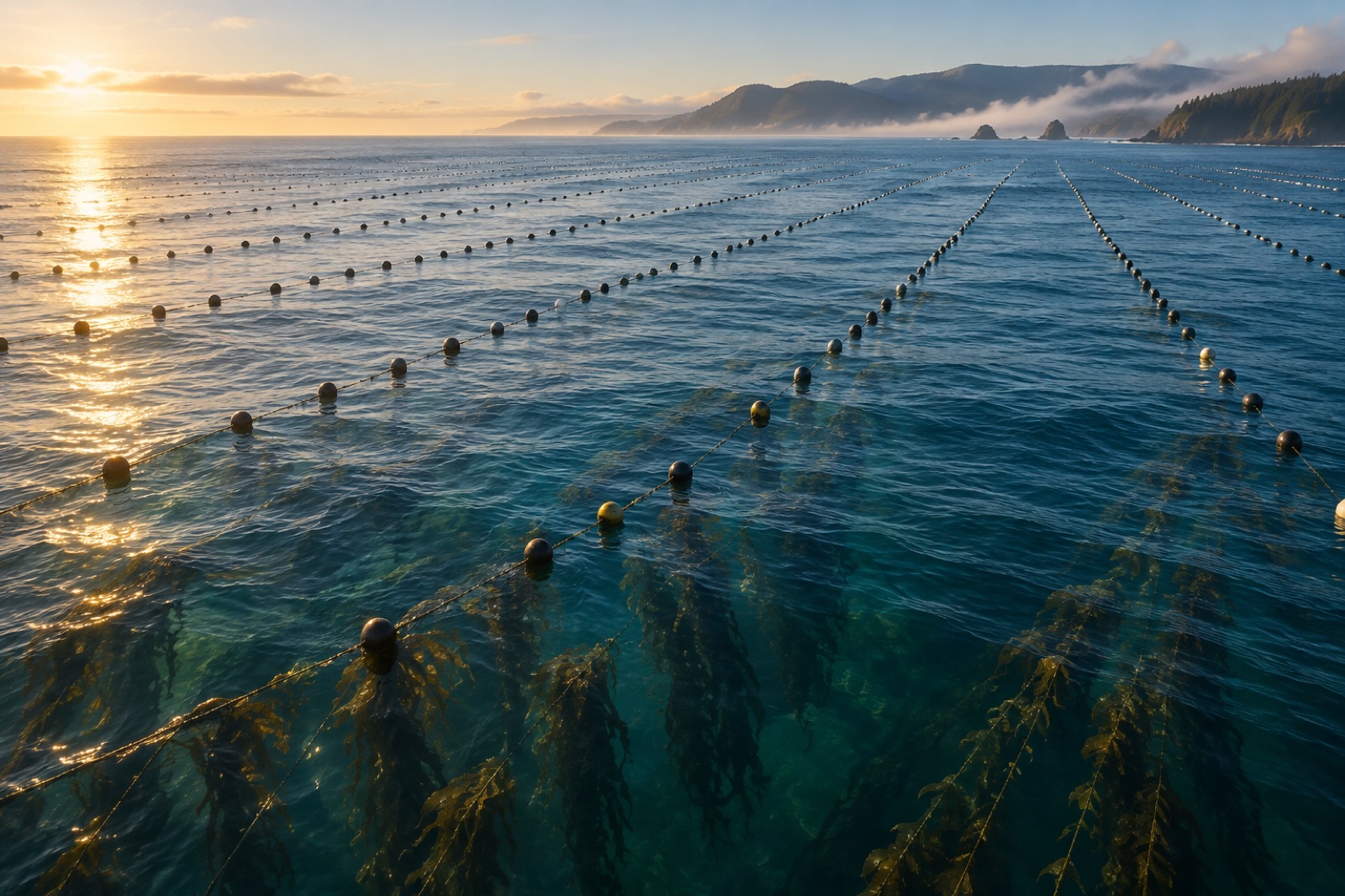
Why seaweed farming is moving offshore, how submerged longline systems survive open-ocean swell, and what automation changes for farms at industrial scale.
Naomi Reyes ·
The science of alternate stable states on rocky reefs: how kelp forests collapse into urchin barrens, why barrens resist recovery, and how reefs flip back.
Dr. Mara Ellison ·