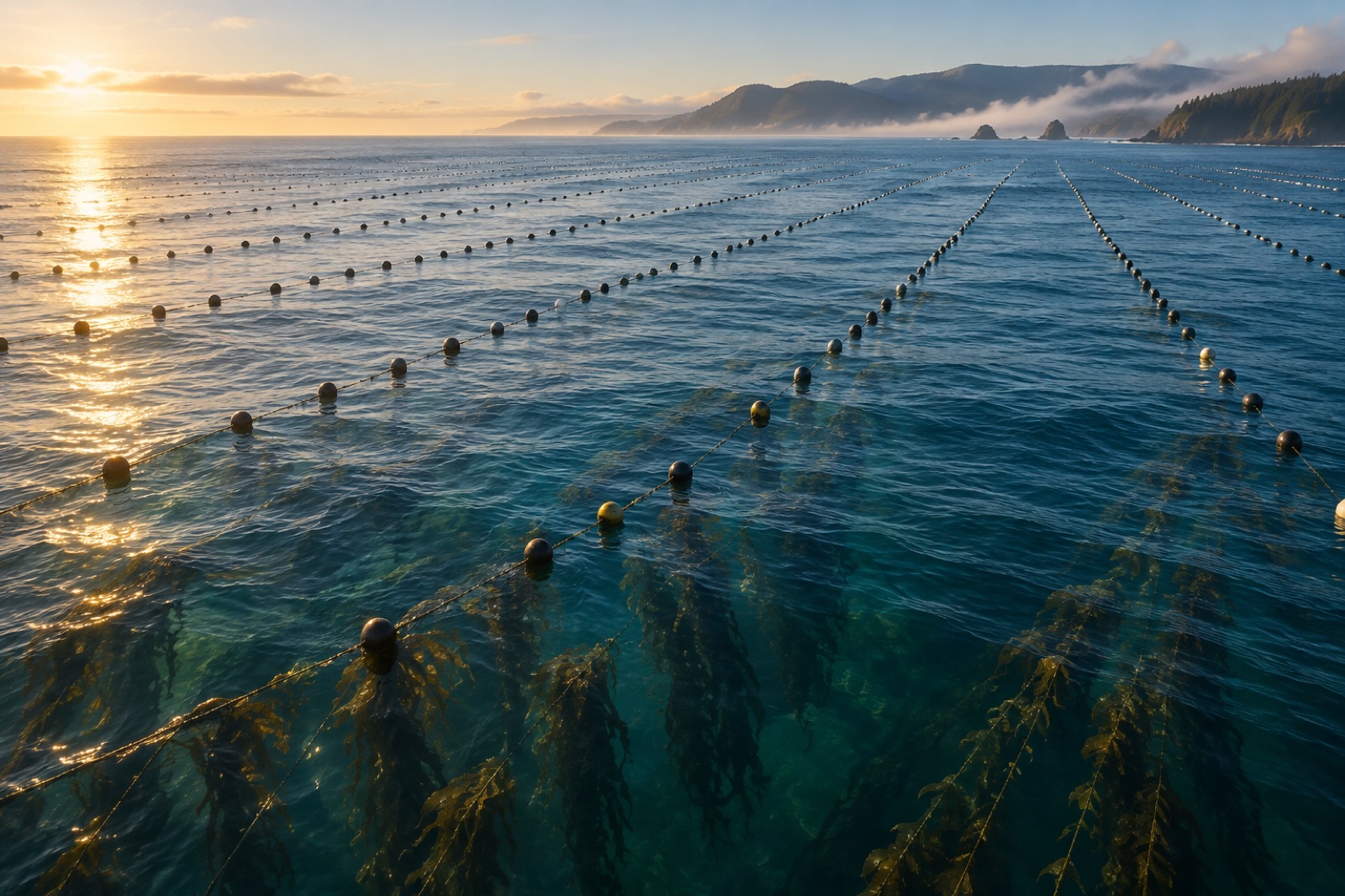
The sheltered coves where seaweed farming began are running out. Nearshore leases compete with fishing grounds, shipping lanes, recreation and conservation zones — and the biggest untapped resource for kelp aquaculture lies further out, in deeper, cleaner, colder water with more consistent nutrients. The catch is that offshore means energy: wave energy, current energy, storm energy, all focused on your moorings. Offshore seaweed farming is fundamentally an engineering project, and it is where the industry's most interesting hardware is now being built.
This article explains why farms are moving into exposed water, how submerged longline systems duck the worst of the surface, what automation must deliver at scale, and where the economics start to make sense. It builds on the baseline grid design in our longline design guide and the load-case logic of storm-proofing a kelp farm.
Why go offshore at all?
Four pressures push farms seaward:
- Space. Nearshore sites are finite and contested. Larger, contiguous offshore areas allow farms of tens to hundreds of hectares — the scale at which cultivation can supply biostimulants, bioplastics feedstocks and animal feed.
- Water quality. Offshore water tends to be colder, more nutrient-consistent and cleaner. Nearshore nutrient spikes (runoff events) or heatwaves stress crops; offshore sites sit closer to the ocean's mean state. Our explainer on upwelling covers why cool, nutrient-rich deep water is kelp's favourite meal.
- Fewer conflicts. Moving beyond small-boat anchorages and swim zones reduces social licence friction — though it trades it for shipping, defence and offshore-energy negotiations.
- Restore at scale. Restoration projects like Tidewright's own reseeding work need nursery hardware too; our Holdfast program grows climate-resilient seedstock on coastal hatchery lines, and offshore deployment experience from the farming industry directly informs how we place restoration lines in exposed locations.
The obstacle, in one sentence: everything offshore is harder to reach, harder to fix, and loaded by seas that make the rare bad week the design case, not the average day.
Designing for swell: what offshore energy does to a farm
Wave forces on a longline grid drop steeply with depth — roughly exponentially relative to wavelength. A farm at the surface feels the full orbital velocity of every wave; the same grid submerged ten metres below the trough feels a fraction of it. That simple physics drives the two great branches of offshore farm design:
Surface-following systems
Traditional surface longlines ride out storms by moving with the water. Offshore versions are heavily engineered: high-tension headers, large compliant flotation, synthetic anchor lines with substantial scope, and elastomeric snubbers absorbing shock loads. They work, but everything attached at the surface is in the firing line of the biggest storms — and surface gear creates navigational exclusion across the whole farm footprint.
Submerged systems
The dominant offshore trend is growing the crop just below the wave-active layer: seeded lines suspended at 5–15 metres depth, held by subsurface flotation, with only small marker buoys (or none) at the surface. Benefits stack quickly — dramatically lower storm loads, near-total freedom for surface navigation, no seabird perching on floats, and less solar UV on the gear. The engineering bill arrives in two places:
- Harvest. You must raise the crop (or the diver/robot must reach it). Systems accomplish this with winches flooding or venting buoyancy modules to bring lines to the surface, tensioned risers that can be hauled up, or in some designs the whole grid scuttles down after seeding and is winched up at harvest. Every lifting system is a moving part that must work after six months of salt, slime and storms.
- Light and depth control. Kelp wants light. Too deep and growth stalls; too shallow and the crop re-enters the wave field. Site surveys establish the attenuation of light with depth, and systems are tuned to hold lines in the sweet band as the crop (and its weight) grows. Some designs actively adjust depth seasonally.
Structural and mooring design offshore
Offshore mooring philosophy borrows heavily from fish farming and offshore energy:
- Spread moorings with elastic catenaries. Rather than a taut grid pinned hard to the bottom, offshore grids hang in deliberately stretchy networks: submerged flotation at line intersections, synthetic rope with engineered elongation, and compliant corner mooring legs. The whole field is designed to give with a storm rather than fight it, dissipating energy as heat in the rope and risers.
- Fewer, bigger anchors, well-set. Drag anchors (embedment fluke anchors) set by pulling into the seabed are common in softer sediments; driven piles or rock bolts where the bottom cooperates. Individual anchor capacities are calculated against computed storm loads from wave and current modelling of the site, not heuristics.
- Corrosion-engineered hardware. Offshore service intervals are long. Fasteners, shackles and swivels are oversized, galvanised or stainless in splash zones, and designed for diver- or ROV-replaceability.
- Fatigue, not just ultimate strength. Offshore lines see millions of load cycles per season. Rope and hardware are selected for fatigue life; small-diameter high-modulus lines that are "strong enough" on the nameplate can die quietly under micro-motions at connections.
Automation: the piece that makes offshore workable
Labour is 40–60% of nearshore farm operating cost (see seaweed farm economics). Offshore, sending a crewed vessel out for daily checks stops being plausible. The industry is answering with layered automation:
- Remote condition monitoring. Every offshore system now designs in load cells on critical mooring legs, GPS on flotation, pressure depth sensors, and current meters — with satellite or cellular telemetry ashore. An operator watches tension and position traces and only sails when a threshold crosses.
- Cameras and machine vision. Subsurface cameras on corner posts watch crop density and biofouling; the same data feed that would drive a skiff visit becomes a weekly review of imagery.
- Mechanised and robotic harvest. Industrial-scale projects are testing harvest heads that slide down a line and strip crop mechanically, autonomous surface vessels that lift and cut growth lines, and conveyor-barge harvest concepts borrowed from the mussel industry. The goal across all of them: tonnes per person-hour up by an order of magnitude from hand-cutting.
- Seeding mechanisation. Twine spools fed from drums across long runs, and in some concepts seeded tape deployed from autonomous vehicles, cut seeding labour the same way.
Automation's promise isn't just cost — it's safety. Removing people from boats in marginal weather windows is the strongest argument for robotics offshore.
The economics of offshore scale
Does it pencil? The honest summary today: offshore seaweed farming is at the stage fish farming was in the 1980s — technically demonstrated, economically unproven at the commodity prices it must beat, and improving fast. The logic:
- Scale advantages are real. Grid hardware, installation vessels and monitoring systems spread over 100+ hectares drive capital cost per tonne down steeply.
- Opex hinges on harvest. Mechanised harvest reliability is the make-or-break number; a failed lift system in a storm week can erase a season.
- Revenue must come from volume markets. Offshore farms can't live on restaurant kombu; they're aimed at biostimulants, feed ingredients, biopolymer feedstocks and (eventually) food ingredients — where competitors are terrestrial crops with deep cost bases.
The most credible near-term pathway is co-location: offshore wind farms licensing kelp cultivation inside their arrays, sharing survey data, exclusion-zone infrastructure and — one day — service vessels. Multiple European pilot projects are already testing that model.
Where Tidewright fits
Tidewright is a restoration company, not a commodity farm, but we borrow everything offshore farming learns. Our Drifter reseeding vessels are autonomous by design — a direct descendant of the "crewless vessel, shore-side monitoring" doctrine — and our Holdfast nurseries use farm-grade submerged line engineering to grow seedstock that survives the exposed sites where forests were lost. And when a restored forest becomes harvestable at its margins decades later, it's these same systems — submerged, monitored, mechanically harvested — that our Harvest program assumes will exist to fund the next forest.
Key takeaways
- Farms are moving offshore for space, cleaner and colder water, and fewer nearshore conflicts — trading those for far heavier engineering loads.
- Submerging the crop 5–15 metres below waves is the dominant offshore design move, cutting storm loads dramatically at the price of harvest complexity.
- Offshore mooring design is fatigue engineering and compliance: elastic catenaries absorb storm energy rather than fight it.
- Automation — remote load monitoring, machine vision, mechanised seeding and harvest — is what removes crewed boat days from the equation.
- Scale economics are promising but unproven at commodity prices; co-location with offshore wind is the most credible near-term model.
FAQ
Why not just build bigger nearshore farms?
Nearshore space is contested and finite, and nearshore waters run warmer and more variable. Offshore disease-free, thermally stable water and large contiguous lease areas are the prize — worth the engineering once nearshore options run out.
How deep should offshore kelp lines hang?
Typically 5–15 metres — deep enough to duck the wave-active layer, shallow enough for the light kelp needs. The exact band comes from site-specific light attenuation surveys and storm statistics, adjusted as the crop gains mass.
Isn't offshore farming too expensive to be viable?
At today's bulk commodity prices, mostly yes — as it was for salmon forty years ago. Costs per tonne are falling with scale and automation. Viability today is clearest in co-location schemes (e.g., inside wind farms), premium contracts, and dual-use systems sharing costs across crops.
What happens to an offshore farm in a major storm?
Submerged grids are designed to absorb the storm through compliant moorings and depth; surface markers may heel or submerge temporarily. Post-storm, remote load and position data tell operators exactly which legs took overload and where to inspect. Nothing beats a swathe of historical design, conservative factors and slow first seasons.
Can restored kelp forests use offshore farming techniques?
Directly. The same submerged line engineering, remote monitoring and mechanised deployment that offshore farming develops is what large-scale restoration seeding needs, and it's the lineage our Drifter vessels and Holdfast nursery lines draw from.