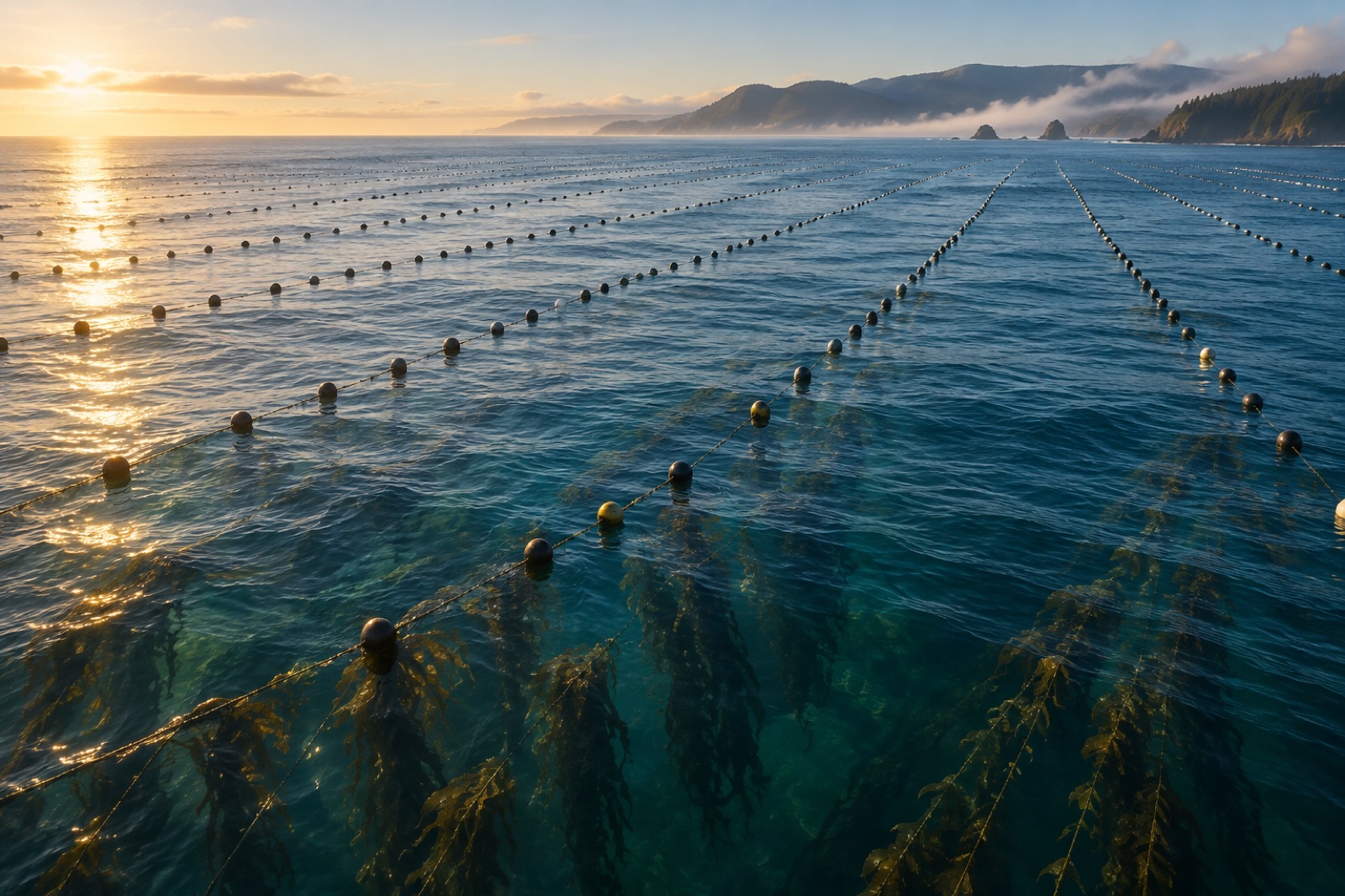
Every seaweed farm has two seasons: the growing season you planned, and the fortnight of bad weather that decides whether your plan mattered. A single winter storm can part undersized headers, drag anchors across a grid, spin flotation tangled into the growth lines, and convert a tonne of healthy crop into drift kelp on a beach. Farmers who've been through it all say the same thing: you don't survive storms with heroics the night before. You survive them with design decisions made on a computer six months earlier, and maintenance habits kept all season.
This article lays out how storms load a farm, the design factors that absorb those loads, the pre-storm checklist worth laminating, and the discipline of learning from every blow. It picks up where the component choices in our longline design guide leave off, and shares its load philosophy with offshore seaweed systems, where storm design is the entire brief.
How a storm actually loads a farm
Design begins by respecting what the ocean does. In a bad storm, your farm experiences four loading mechanisms, usually together:
- Wave orbital motion. Water particles under waves move in circles that reach the surface gear directly. Anything at the surface — buoys, marker floats, high-flotation risers — gets accelerated hard, cyclically, for hours or days. Wave forces fall steeply with depth, which is why deep grids live and surface-heavy grids die.
- Current and storm-driven flow. Storms push water; a laden growth line presents huge drag area. Even a moderate increase of current across a kelp-heavy grid generates tonnes of sustained load that anchors and risers must carry the whole storm through.
- Shock and snatch loads. When a buoy gets dragged under and pops back, or a slack line takes up suddenly in a wave trough, loads spike far above the mean. Rigid systems snap under snatch; elastic and heavy systems absorb it. This is why nylon risers — stretchy, forgiving — persist in storm-prone farms.
- Added mass at the worst time. Winter storms arrive when the crop is near peak biomass and biofouling has spent a quiet season quietly adding kilograms to every metre. Design loads must assume grown-out, fouled, full-displacement gear — not the clean gear you installed.
The uncomfortable rule: the average day is irrelevant. A farm is designed for the design storm — a statistically rare event appropriate to your exposure and risk appetite — just like a bridge.
Design factors that decide survival
Safety factors, honestly applied
Working convention: rope and hardware minimum breaking load (MBL) at five to ten times the expected static working load, with everything sized at once — the header is only as strong as its shackle; the anchor only as good as the soil it sits in. Common failure chain: well-specified rope terminated by an undersized, corroded shackle; strong dock lines on uninspected galvanised hardware from the chandlery sale bin. Audit the whole load path, not the famous parts of it.
Elasticity where you need it, rigidity where you don't
Nylon's 20–40% elongation at working load is the cheapest shock absorber in the industry and belongs in risers and snubbers. Conversely, elasticity between header lines lets them travel and collide in storms — headers themselves want controlled, predictable tension. High-modulus lines (Dyneema-type) save weight but transfer snatch loads straight to anchors; if you use them, you must buy back compliance elsewhere.
Anchor margins and seabed truth
More long-run farm losses trace to anchors than to rope. Match the anchor to the actual seabed (survey it — even a pole probe and a camera sled tell you a lot), use embedment anchors where sediment allows, rock bolts or drilled piles on hard bottom, and assume lateral softening after repeated storms. Scope — the ratio of anchor line length to depth — matters as much as anchor type: too-short scope converts horizontal drag into uplift that plucks anchors out.
The grid's geometry as a load-management system
Configuring header angles, spacing and corner angles for your site spread storm loads across anchors rather than racking one corner leg. Steeper corner angles concentrate load; gentler geometries share it. Square grids with strong corners and compliant middles tend to outlive over-tensioned tight grids — internals can deform in a storm without any component reaching its limit.
The pre-season and pre-storm checklists
Design gets you to September; habit gets you through February.
Early season (when gear goes in):
- Full splice-and-shackle inspection on assembly; dye-mark or log every critical connection.
- Baseline tension on every mooring leg with a load cell or spring scale; log it.
- Photograph every anchor set and riser; tomorrow's failure starts today.
Mid-season (monthly, and after every stiff blow):
- Dive or camera-check corner moorings and riser chafe points — the seabed contact zone is where abrasion lives.
- Re-measure leg tensions; retension what's crept.
- Look up: chafe where lines pass through flotation is the classic silent killer.
72 hours before a forecast storm:
- Remove everything non-essential at the surface: work floats, spare line, marker clutter.
- Add or check storm snubbers on exposed corner legs.
- Sink what can be sunk — subsurface flotation layouts earned their keep in exactly this week.
- Confirm navigation marks lit and reporting obligations (notice to mariners lines of communication) are ready in case something does break loose.
- Photograph the grid from your reference points. Post-storm comparison tells you what moved.
After every storm:
- Re-inspect before trusting anything: tension trace, anchor position (GPS the corners), chafe audit, diver or camera swim of risers.
- Log what happened. Storm data is design data for next winter.
Insurance, records and the manager's mindset
Storm resilience is also administrative. Insurers in aquaculture increasingly require documented maintenance logs, design calculations and named responsibility for pre-storm actions — a laminated checklist with initials beats memory when a claim is assessed. Keep:
- Design documentation (load calculations, component specs, seabed survey).
- A gear register: every critical rope, shackle and anchor, its install date and inspection history.
- A weather log relating farm actions to forecasts and observations.
And a habit borrowed from aviation and shipping: write your failure reviews before you need them. Walk the farm each off-season asking "if this corner gave way in a twelve-metre sea, what happens next?" Every honest answer improves the design; every defensive answer names the component that will surprise you.
Restoration raised the stakes
At Tidewright, storm design carries extra weight: our reseeding lines are placed deliberately on exposed reef where forests were lost, and must hold climate-resilient seedstock through winters until the kelp's holdfasts take over. The engineering is the same discipline described here — computed design storms, elastic risers, honest safety factors — applied by our Holdfast nursery program and deployed by autonomous Drifter vessels that can return after every blow to verify tension and anchor position without waiting for a weather window. When you're restoring forests for decades, "design for the worst week" becomes "design for the worst decade."
Key takeaways
- Farms fail in rare storms, not average days: design to a defined storm event and load the model with grown-out, fouled gear.
- Apply safety factors to the whole load chain; the cheapest rusting shackle defines your real strength.
- Elasticity absorbs shock — nylon risers, snubbers, compliant catenaries; rigidity belongs in header tension only.
- Anchors are the historical weak point: real seabed survey, correct anchor type, generous scope.
- Survival is a habit: logged tensions laughed at small problems are what pre-storm checklists and post-storm audits are for.
FAQ
What wind speed or wave height should a farm be designed for?
Design to a return-period event matched to your risk, not a round number — commonly the storm statistically expected once in 10–50 years at your site, using real hindcast data for your location. A sheltered bay and an exposed point need radically different design events; let local data drive the choice.
Should I sink my lines before a big storm?
If your system was designed with submersible or subsurface flotation, yes — depth is the best storm shelter, as offshore farms demonstrate. Retrofit-sinking a surface grid at the last minute usually damages more than it saves. Design submergence in from the start or ride it out prepared.
What breaks first in most storm failures?
Statistically and anecdotally: anchors and riser chafe near the seabed, followed by hardware at connections (shackles, splices, thimbles). Rope mid-span failure is rare in well-maintained grids — the ends and edges get you.
Can insurance cover storm losses?
Specialist aquaculture insurance can cover stock and gear against storm events, generally contingent on documented design standards and maintenance. Treat the logbook as part of the premium — insurers pay out against evidence.
How do restored forests survive storms without any gear?
Wild kelp anchors with a holdfast that grips rock through millions of load cycles — an evolved structure we describe in holdfast biology. Restoration design aims to hand the site over to that biology as fast as grown holdfasts can grip; the gear's only job is to bridge the gap.