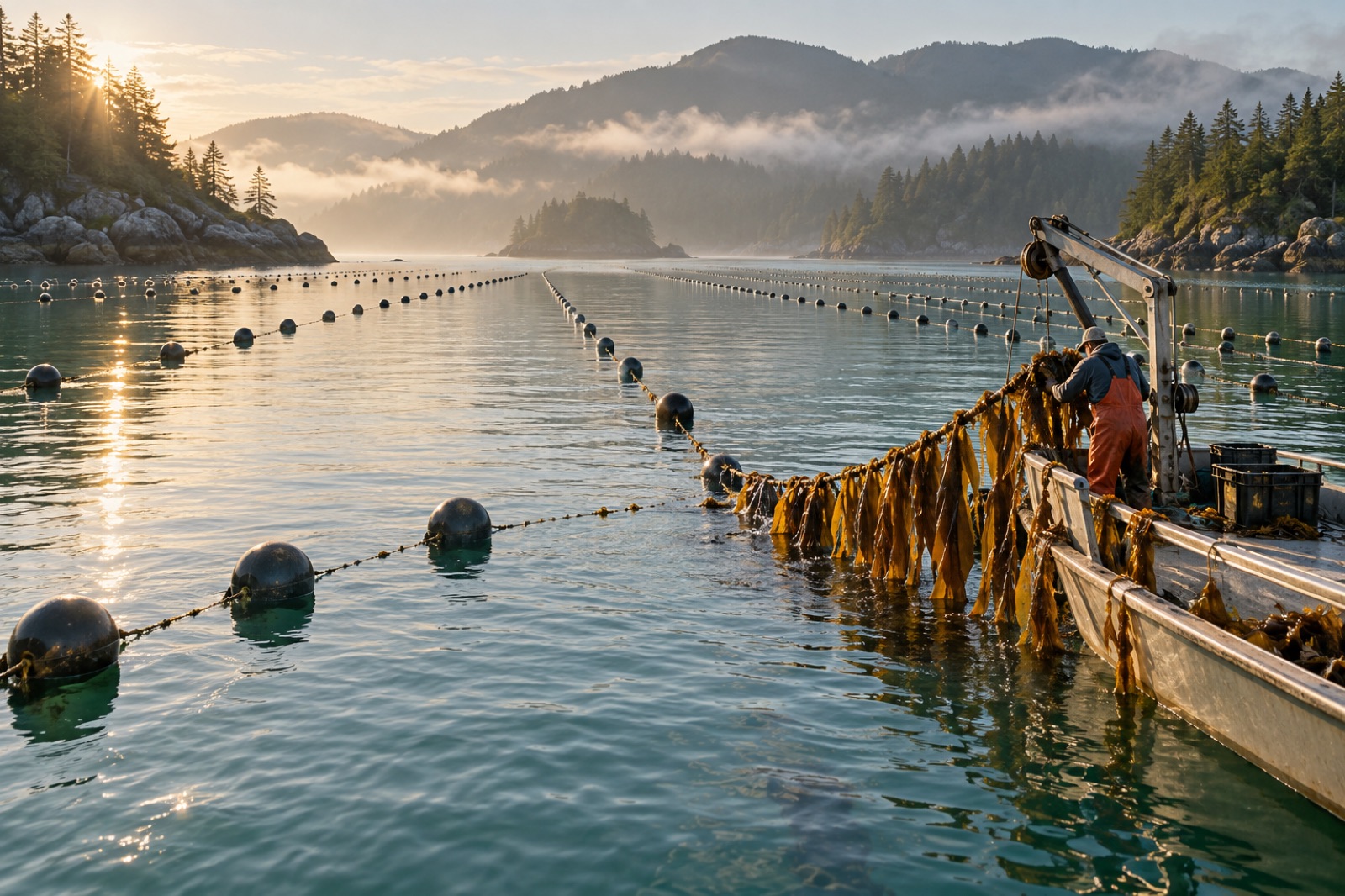
A seaweed longline looks simple from the surface: a few marker buoys, a rope grid beneath, a season of quiet growing. Beneath that simplicity sits genuine engineering. A harvest-laden line carries several tonnes of wet kelp, floats and biofouling; a winter storm translates wave energy into shock loads that snap underspecified gear in minutes; and a single failed anchor can drag a hundred metres of line through the rest of your grid and into your neighbour's. This article walks through the anatomy of a well-designed longline farm and the decisions — rope, anchors, depth, spacing — that determine whether your grid survives to harvest.
It pairs with our practical overview, how to start a small seaweed farm, which covers the permitting, markets and season planning that this hardware is in service of.
Anatomy of a longline system
Almost every commercial seaweed farm is a variation of the same motif: horizontal longlines, each holding a tensioned backbone from which the crop grows. A standard one-hectare grid might carry five to ten longlines. Each line, from seabed up, consists of:
- Anchors at both ends (and sometimes mid-point for long lines), each connected to-
- Anchor legs or risers — chain and/or rope rising from the anchor to-
- The header line (backbone) — a heavy line (commonly 20–36 mm) tensioned horizontally at depth, from which hang or attach-
- The growth lines (seeded lines) — typically 5–20 mm line carrying the seeded kelp (produced in a hatchery as described in seaweed seed stock: from spores to seeded line), either run as the header itself (single-line systems) or suspended between backbones (two-line or catenary systems), and
- Flotation — surface and subsurface buoys holding the grid at constant depth and counteracting the weight of crop and gear.
Variants matter mostly at the margins: raft systems, IMTA (integrated multi-trophic aquaculture) co-location with shellfish or fish, and single-point-moored and hanging-dropper designs. The load cases below apply to all of them.
Rope: material, size and stretch
Farm rope will spend its life saturated, abraded, UV-exposed at the buoy lines, and loaded cyclically. The familiar workhorse is three-strand or braided polypropylene (PP): it floats (useful for surface runs and growth lines you want off the seabed), is cheap, and is easy to splice. Nylon (polyamide, PA) sinks, is more expensive, and brings two properties worth the cost in critical positions: roughly 20–40% elongation at working loads — a built-in shock absorber in storm conditions — and better abrasion resistance. Polyester (PE) is a middle path: sinks, moderate stretch, excellent strength retention when wet. UHMWPE (Dyneema-type) is extraordinarily strong for its diameter and nearly inextensible; it allows smaller, lighter lines but loses the shock absorption that protects anchors, and costs several times more per metre.
A sensible conventional build:
- Header lines: 24–32 mm PP or a polyester braid
- Anchor risers: chain on the first metres off the seabed (abrasion where the leg sweeps the bottom), then nylon or polyester
- Growth lines: 12–20 mm, sized for the weight of mature kelp you'll actually be hauling
- Buoy tethers: PP for surface buoys, polyester where abrasion against any hardware is a concern
Oversizing modestly is cheap insurance. Rope cost is a small fraction of gear + labour; a parted line can cost you the season on it. A working design rule is a minimum breaking load (MBL) at least five to ten times the expected static load, with energy absorption (stretch, snubbers or chain catenaries) taking care of the dynamic peaks.
Anchors: the foundation that fails first
More farms end more permanently through anchor failure than through any other component. Anchor choice depends on the seabed:
- Helical screw anchors screw into firm sand or mud and offer excellent holding in a small, clean installation footprint — the modern standard where the bottom allows them. They must be set to depth with a torque indicator; a shallow-screwed anchor in soft mud is an anchor in name only.
- Concrete blocks (deadweight) are simple, heavy and forgiving in rocky bottoms, but their holding capacity depends on weight and friction; storm loads on soft bottoms can drag them a long way.
- Rock bolts and specialized anchors are used on hard bottoms where screws can't bite.
Size anchors for the uplift and lateral load of the worst design storm on a harvest-weight line, not for calm-day geometry. A widely-used rule of thumb puts the design storm's peak line load in the 1–3 tonne range per line end on a 100 m, harvest-laden longline — always verify against your own site's waves and depths. Lay anchor legs at a scope (rise-to-seabed ratio) that keeps the load angle favourable; steep legs convert lateral load into pure uplift and pull anchors out.
Depth and flotation
Growing depth is a photosynthesis, not an engineering, question — but it has engineering consequences. Kelp fronds want light without surface wave violence:
- 1–3 m below the surface is the common band in temperate farms, deep enough to escape worst storm tearing, shallow enough for strong photosynthesis.
- Tension control matters. A slack line dips deep at midpoint; an over-tensioned line pulls floats down under load. Aim for the modest catenary that the line achieves under its empty weight plus half the harvest weight, and re-check tension mid-season as the crop gains mass.
- Subsurface floats (often at intervals of 15–25 m along the header) hold depth under crop load and keep lines clear of propellers. Keep at least one reliably-sighted surface marker per line at the ends — your own emergency grab point and a navigation safety requirement in most jurisdictions.
Depth and flotation evolve as the season runs: expect to add floats as harvest approaches. Kelp gets heavy fast in the final weeks.
Spacing and grid layout
Spacing resolves three competing needs — water flow (nutrient delivery) per line, navigability for your own workboat, and seed efficiency per hectare. Common arrangements:
- Between longlines: 8–20 m. Tighter spacing packs more crop per lease unit; wider spacing keeps flow strong, lets a boat work each line on both sides, and reduces the chance a failed line sweeps into its neighbour.
- Line length: 80–150 m per anchored header. Longer lines save anchors but concentrate risk: a failure makes a longer mess, and harvest logistics get slower.
- Orientation: lay lines into the prevailing current and storm-wind direction, so flow sweeps clean water along — not across — the grid and storm loads arrive end-on to the strongest axis.
Grid corner anchors should be marked on charts and GPS-precision navigational buoys; the exact corners matter for your lease compliance, your own storm-season inspections, and everyone else's safety.
Designing for the worst day
Good longline design is pessimistic. For each component, ask what it will face on the worst day of the permit period:
- Storm waves. Peak dynamic loads arrive as snaps as the buoy-carrying line heaves. Include shock absorption — stretchy rope, chain catenary segments, or inline snubbers — somewhere in every load path.
- Biofouling weight. By harvest, mussels, bryozoans and hydroids add tens of percent to line weight and drag, invisible until a storm turns it into breaking loads. Antifouling decisions (dive cleaning schedules, timing-harvest earlier) are part of gear design.
- Harvest weight. A wet, mature kelp canopy on 120 m of line is multiple tonnes. Your floats, your header and your anchors must carry it — and your harvest boat must handle it without parting the gear.
- A parted line. Design so a single failure does not cascade: independent anchors at each line end, gentle slack between adjacent lines, and enough separation that a dragging line loses energy before entangling.
Build, inspect, learn
Install in the calmest season window your permit allows, with a surplus of splices done and re-done and every shackle seized. Reliable, pre-tested farm hardware of exactly this kind also underpins restoration seeding — Tidewright's Drifter reseeding vessels lay survey-grade line on the same engineering logic, just with kelp spores aboard. Then inspect: after the first storm of the season, after any significant blow, and on a fixed schedule. Chafe at hardware interfaces — thimbles, shackles, buoy eyes — is the usual killer in year one and the cheapest to fix (hose sleeves, bigger thimbles, chafe-rated line). Keep a mooring map; small farms that skip it find themselves, in year three, divers in the dark looking for an anchor they're sure is "somewhere near the old orange buoy."
Key takeaways
- A longline grid is a load path: anchors, risers, header, growth lines and flotation, each sized for storm + harvest + biofouling, not calm-day geometry.
- Use floating PP for header and growth lines, sinking rope and chain off the seabed, and keep some stretch in the system as built-in shock absorption.
- Helical screw anchors set to torque are the modern standard where bottom type allows; size every anchor for the design storm on a harvest-laden line.
- Grow at 1–3 m, keep consistent (not excessive) tension, and add subsurface floats as crop mass builds.
- Space lines 8–20 m apart, oriented into prevailing current and storm direction, so a single failure does not take out the grid.
FAQ
What rope is best for seaweed longlines?
For header and growth lines, three-strand or braided polypropylene is the standard workhorse because it floats and is cheap and spliceable. Use polyester or nylon with chain for anchor risers — they sink, resist abrasion, and provide stretch that absorbs storm shock. UHMWPE is a specialist material: strong and thin but nearly inextensible and costly.
How deep should a seaweed longline sit?
Most temperate farms hold growth lines one to three metres below the surface. Shallower risks storm-wave damage and propeller exposure; deeper reduces photosynthesis and growth. Use subsurface floats to hold depth as crop weight increases through the season, and re-check tension mid-season.
How many anchors does a longline farm need?
A typical single longline of 100–120 m is anchored at both ends — two anchors per line — with some designs adding a mid-point anchor on longer lines. So a one-hectare, five-to-ten-line grid commonly carries ten to twenty-plus anchors, with spares. Always size the anchor to the worst-storm, harvest-weight load, not the calm-day line weight.
How much space should there be between longlines?
Eight to twenty metres between longlines is the practical band. Closer spacing fits more crop in a lease but reduces water flow per line and lets a failed line drag into its neighbour; wider spacing improves flow and navigability at the cost of crop per hectare.
Can longline gear entangle whales and marine life?
Surface-tensioned, submerged longline grids with tight rope — unlike slack vertical lines — rarely interact with large marine life, and farm monitoring in many jurisdictions shows low interaction rates. Good practice still applies: maintain line tension, avoid known migratory corridors in siting, remove derelict gear promptly, and follow local wildlife-interaction reporting rules. Good gear discipline is good wildlife practice.