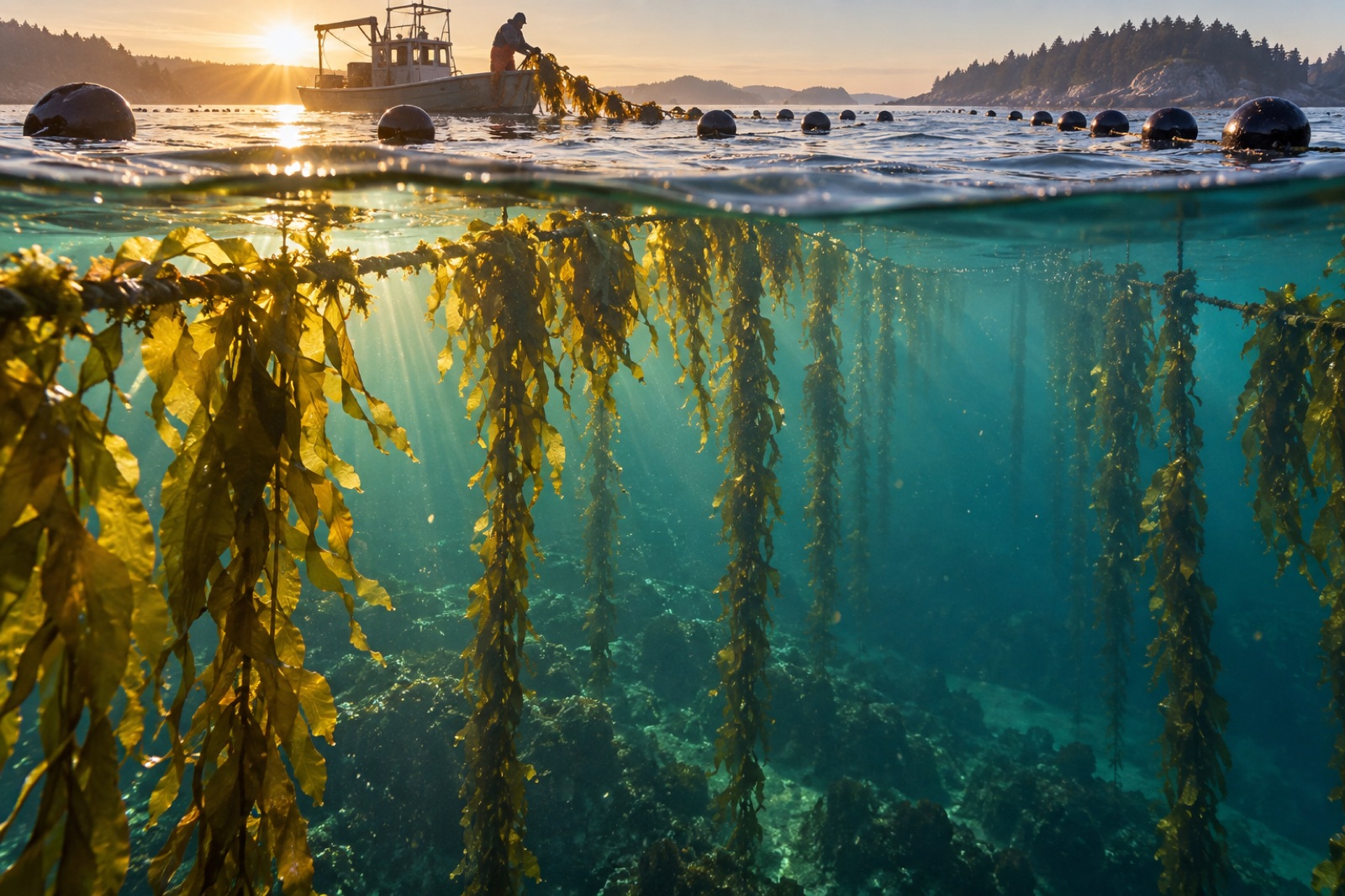
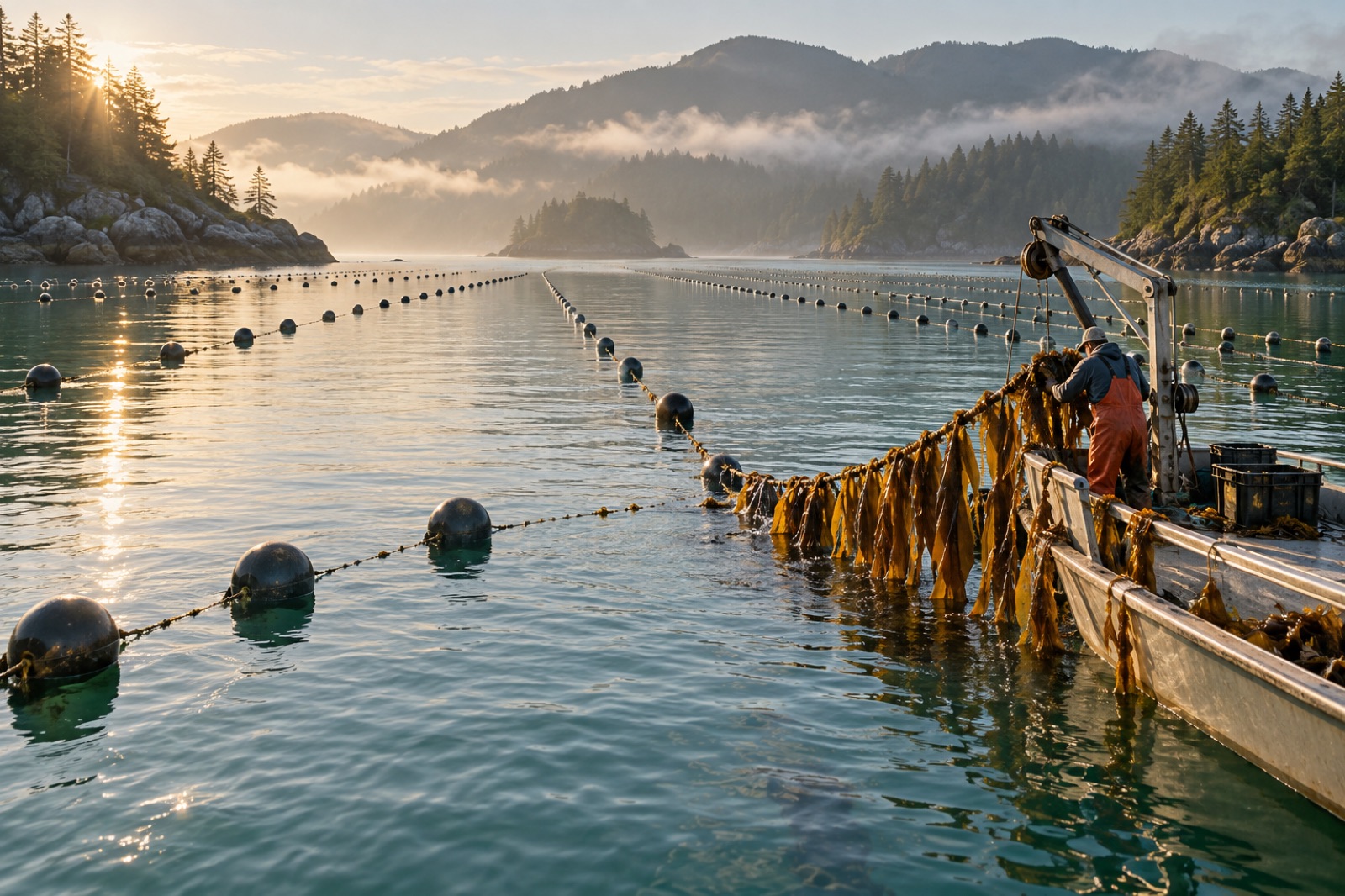
Ask three kelp farmers what their first farm cost and you'll get numbers that differ by an order of magnitude — because one bought a new boat and built for ten hectares, while another rented deck space on a mussel barge and grew a single longline off the side. Equipment is where a seaweed farm's budget is won or lost, and the range is wide precisely because a farm can start as a few hundred metres of rope or as a marine construction project.
This article is the realistic shopping list. It works through the gear in the order you'll need it — vessel, moorings and lines, seeding equipment, harvest and handling, monitoring, safety — with indicative cost ranges for a one-hectare pilot and the shape of a ten-hectare commercial build-out. All figures are indicative, generalised across markets and wildly variant with local supply; treat them as planning ranges, not quotes. For the business context, pair this with our beginner's guide to starting a seaweed farm and the seaweed farm permits guide that this iron and rope has to wait behind.
The vessel: your biggest single decision
You need working deck space, low freeboard for hauling lines, and enough power to tow loaded line and live with the weather at your site. In rough order of cost:
- A used skiff or workboat (5–8 m) with an outboard — the classic pilot-farm vessel, typically $15,000–$60,000 ready to work. Does everything a hectare needs except impress anyone.
- A purpose-built or converted workboat (8–12 m) with a small crane or hydraulic hauler — $80,000–$250,000+. This is the comfortable commercial crew boat.
- Not owning a boat at all. Many of the smartest first operations contract a local mussel boat or fishing vessel for seeding and harvest weeks — a few thousand dollars per campaign — and buy their own hull only when the season's workload justifies it. Chartering puts your capital into lines, not into a depreciating asset that sits at a mooring eleven months a year.
Add a hauler. A hydraulic or powered line hauler ($3,000–$15,000) transforms harvest from a strength test into a process, and it is worth one earlier than new farmers expect.
The water grid: moorings, lines and flotation
The engineering of this layer — anchor sizing, rope specification, depth and spacing — is covered in depth in our longline design guide. Here is what the bill looks like for hardware alone:
| Item |
Unit cost (indicative) |
One-hectare grid needs |
| Anchors (deadweight or helical) |
$150–$600 each |
12–24 |
| Header/backbone rope, 24–32 mm |
$1–$3 per metre |
~700–1,000 m |
| Growth line, 10–16 mm |
$0.50–$1.50 per metre |
1,500–3,000 m |
| Surface and subsurface buoys |
$20–$120 each |
20–60 |
| Chain, shackles, thimbles, swivels |
$2,000–$5,000 per grid |
1 set |
A workmanlike one-hectare hardware grid lands at roughly $8,000–$25,000 in materials, depending on how exposed the site is — exposed sites buy heavier everything — and how much you can splice, fabricate and scavenge in-house. Anchor installation either rides on your own vessel (slow, free-ish) or a contractor's barge (fast, $3,000–$10,000 per deployment day).
A rule worth tattooing on the budget: don't economise on moorings. Rope and buoys are consumables; anchor failure is existential. Overspec the ground tackle and buy the cheapest respectable rope upstream of it.
Seeding equipment
Seeded line comes from a hatchery — yours or a supplier's, and for nearly all beginners, a supplier's (see seaweed seed stock: from spores to seeded line). Your seeding kit is therefore mostly handling gear:
- Insulated tanks or tubs for transport — seeded line stays wet and cold from hatchery to grid (a few hundred to a few thousand dollars).
- Deployment reels and line-handling rigs so seeded line pays out cleanly alongside the backbone ($500–$3,000).
- The seed itself — budget this as an operating cost per metre of seeded line; hatchery pricing varies by species and region, but plan on seed and transport as one of your top three annual costs.
Building your own hatchery — controlled-environment tanks, filtered seawater, cooled culture rooms, microscopy — is a $100,000+ commitment plus specialist labour. Do it when your acreage or your genetics program justifies it, not before.
Harvest, landing and handling
The harvest is a sprint and every bottleneck costs crop (see harvest timing for why the window is unforgiving). Beyond boat and hauler:
- Knives, stripping combs and deck gear — cheap, buy spares.
- Harvest baskets, bins or bulk bags with drainage — $30–$150 each, and you need volume; a hectare of sugar kelp is many wet tonnes.
- Landing-side handling: access to a dock or beach with vehicle access, a means to weigh (crane scale), and a plan for the same-day destination — processor's truck, cold room, or dryer.
Processing is where budgets genuinely diverge. Fresh delivery needs only a refrigerated truck or an agreement with someone else's. Drying — the gateway to shelf-stable food and ingredient products — spans raised racks and poly-tunnels (hundreds of dollars, weather-dependent) to containerised electric dryers ($20,000–$150,000+). Many pilot farms dry nothing in year one; they sell fresh or transfer drying to a partner, missing margin but dodging the most failure-prone machine on the farm.
Monitoring and instrumentation
Small money, enormous value:
- Temperature logger for the grid — $50–$300; the harvest-timing instrument you will check obsessively.
- Water-quality sonde (dissolved oxygen, salinity, turbidity) if you can stretch to it — $2,000–$8,000, and increasingly the evidence base regulators and buyers appreciate.
- Handheld refractometer, sampling jars, a decent scale — a few hundred dollars of the gear that turns anecdote into records.
- A drone for site inspection is a genuine luxury-turned-tool ($1,000–$3,000); canopy and line condition from the air saves boat hours. Our restoration teams run the same loop at a larger scale with satellite and drone canopy mapping through Canopy Ledger.
Safety and compliance gear
Non-negotiable, and cheap relative to everything above: lifejackets for every person on every day, VHF radio, first-aid kit, knife-at-the-hip on any working deck, and whatever navigation marks, lights and registration your permit conditions demand. Budget $1,500–$4,000 to do this properly, and never negotiate with it.
Two budget sketches
The one-hectare pilot, asset-light
- Charter vessel time for deployment and harvest: $4,000–$8,000
- Water-grid hardware: $10,000–$20,000
- Seed and transport: $3,000–$8,000
- Handling, monitoring, safety gear: $3,000–$8,000
Total: roughly $20,000–$45,000, plus lease rent, permits and your own labour — deliberately structured so a failed season teaches hard lessons at tuition prices.
The ten-hectare commercial start
- Owned workboat with hauler: $120,000–$280,000
- Ten grid systems, heavier spec: $150,000–$350,000
- Seed at scale: $40,000–$100,000
- Landing infrastructure and a serious dryer: $80,000–$250,000
- Monitoring, safety, spares, contingencies: $40,000–$100,000
Total: on the order of $450,000–$1,100,000 before working capital — which is why most commercial farms grow into this from a pilot rather than arriving at it on day one, and why offtake agreements and permissioned sites precede the steel.
Buying strategy: spend where failure is fatal
- Overspec: anchors and ground tackle, safety gear, the hauler.
- Buy mid: rope, buoys, bins, boats — the used market in aquaculture gear is deep.
- Rent or contract first: hatchery capacity, drying, big vessels, and deployment barges.
- Never cheap out on records: scales, loggers and a notebook that survives salt water are the equipment that compounds in value every season.
Key takeaways
- A working one-hectare pilot needs roughly $20,000–$45,000 of equipment if you charter vessel time; a ten-hectare commercial start runs into the mid-hundreds of thousands.
- The vessel decision dominates the budget — delay owning a boat until the workload demands it.
- Spend on the things whose failure is fatal: anchors, safety gear, the hauler; economise on rope, buoys and boats, which the used market supplies well.
- Hatcheries and dryers are the two largest temptations to overbuild; rent both until acreage and markets justify ownership.
- Monitoring gear is the cheapest equipment on the farm and the only category whose value grows every season you run it.
FAQ
What is the minimum equipment to start a kelp farm?
A small boat you can haul line from, anchors and one longline grid's worth of rope and buoys, seeded line from a hatchery, harvest bins, and safety gear. With chartered vessel time, farmers get a pilot line or hectare growing for the price of a decent car — the skills, the permit and the market are the real barriers, not the iron.
How much does a kelp farm cost per hectare?
As a planning range, water-grid hardware alone runs roughly $10,000–$25,000 per hectare depending on site exposure, before vessel, seed, handling and labour. Fully capitalised commercial cost per hectare — boat, processing, everything — is dramatically higher, which is why offtake agreements belong at the front of the budget, not the back.
Should a new farm buy or rent seagoing equipment?
Rent or contract the expensive, seasonally-used assets first: the boat, the deployment barge, drying capacity and hatchery services. Buy the grid, the safety gear and the monitoring instruments — the things you need constantly and learn from daily. Ownership follows demonstrated workload.
What equipment do farmers most often forget?
Spares and handling volume: spare shackles and rope, a second set of knives, and enough baskets to absorb a full harvest day without a stoppage. The forgotten items that end seasons are boring — a lost shackle pin with none spare aboard — which is exactly why they're forgotten.
Your permit conditions will specify navigation marking and often equipment specifications for moorings and buoyancy; maritime authorities similarly govern lights and shapes. Beyond compliance, insurers and buyers increasingly care about traceable, well-maintained gear — keep receipts, inspection logs and photographs; they cost nothing and defend everything.