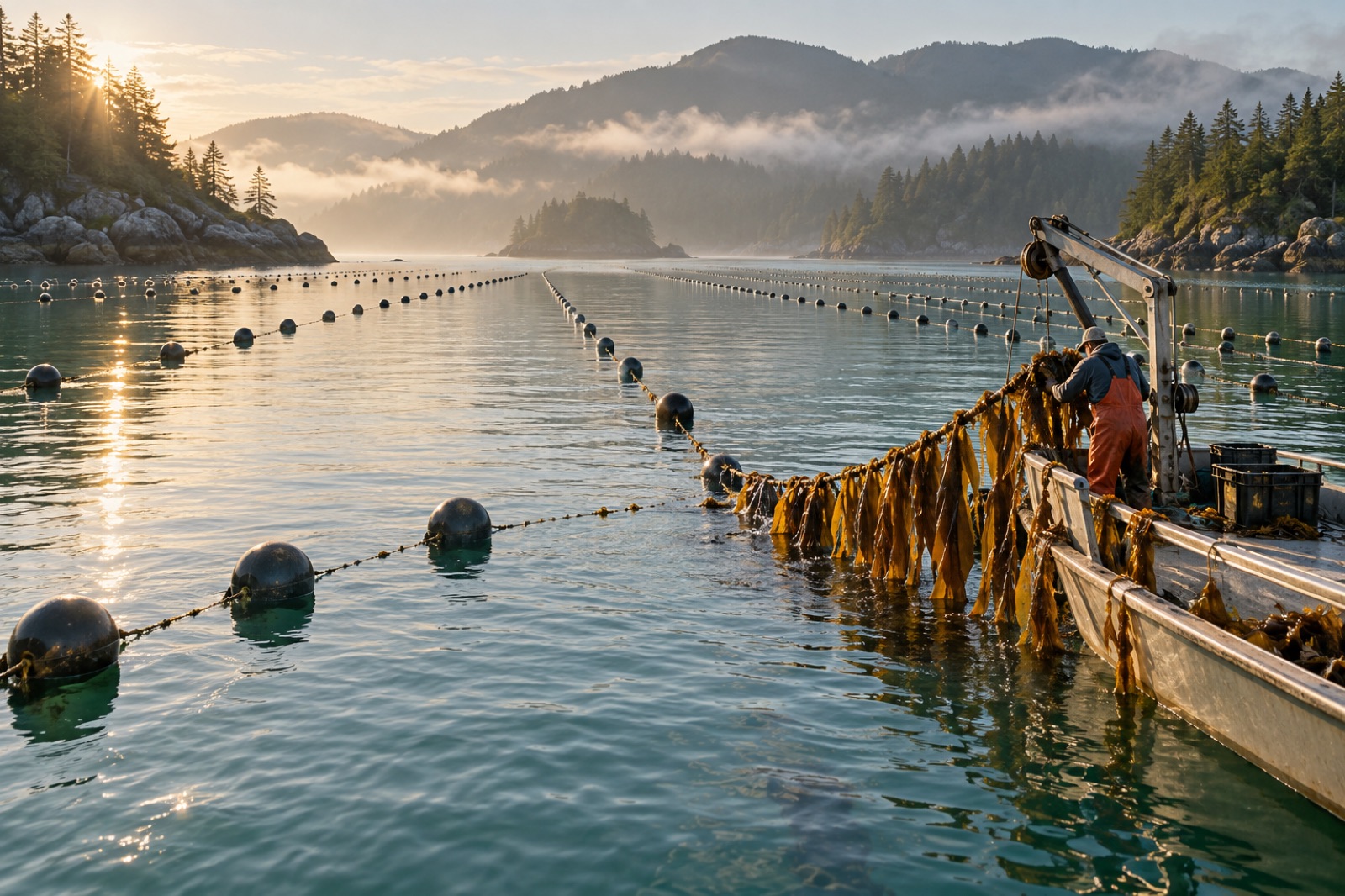
Harvest kelp too early and you leave biomass on the line; harvest too late and the crop you do haul is degraded, fouled or gone. The right moment is a moving target set by three curves that rarely peak together: growth, quality and fouling. For most farmed kelps, the practical answer is to harvest in the last weeks of rapid growth — before the summer bloom of epiphytes and biofouling arrives, and before warm water starts eroding the blade faster than the plant can grow it back.
This guide covers the trade-offs, the species-by-species seasons, and the sampling routine that lets you call the peak on your own farm rather than from a calendar.
The three curves that decide your harvest date
Biomass
Farm-grown kelp grows roughly exponentially through its season, then plateaus. In the classic cold-temperate pattern, seeded line goes out in autumn, plants stay small through the dark winter months, then growth explodes in late winter and spring as daylength and nutrient availability overlap. The steepest weeks of that curve are when standing biomass doubles — and they're also exactly when quality is highest, because the plant is young, tender and unfouled.
The plateau matters more than the peak. Once growth stalls, every additional week on the line is pure downside: weight gained is roughly zero while fouling and erosion accumulate.
Quality
What counts as "quality" depends on your buyer, and this is the part new farmers most often skip: agree the quality specification before the season starts, not at the dock. For food-grade kelp, buyers care about dry matter content, texture, colour and, critically, iodine concentration — see our seaweed nutrition guide for why iodine limits matter in human food. For biostimulant and bioplastic feedstock, consistent moisture and low ash (low contamination with sand and shell) matter more than tenderness.
Young, fast-growing blades tend to have higher protein and lower dry matter; older blades accumulate carbohydrates such as mannitol and laminarin, get tougher, and can concentrate iodine and heavy metals. Two farms harvesting the same species four weeks apart can deliver materially different products — which is why serious buyers ask when you harvested, not just what.
Fouling and erosion
Late spring brings the enemy: bryozoans, hydroids, spirorbid worms and fast-growing epiphytic algae colonize the blade surface, making the crop unsaleable for premium markets and miserable to process. At roughly the same time, warming water past the species' comfort zone triggers blade erosion from the tip backward. Fouling and erosion often arrive within two or three weeks of the biomass plateau — that window, not the calendar, defines your harvest deadline.
Species-by-species seasons
These are the broad northern-hemisphere patterns; your site will shift them by weeks, which is why local sampling beats any guide.
Sugar kelp (Saccharina latissima)
Sugar kelp is the workhorse of North Atlantic and North Pacific farming. Seeded in autumn, it grows hard from February onward and typically peaks between April and June. The trigger to pull is usually water temperature: once surface water pushes past roughly 12–15°C, quality falls fast — blades erode, fouling explodes, and tissue nitrogen (your protein proxy) drops. Most farmers target a three-to-six-week harvest window and treat the end of it as fixed.
Kombu (Saccharina japonica)
Kombu is farmed at vast scale in China, Japan and Korea, mostly on similar autumn-to-late-spring scheduling, with harvest concentrated from late spring into early summer depending on latitude. Warm-edge regions harvest earlier; cool, nutrient-rich water extends the season. Japanese kombu destined for dashi is often aged after drying — quality there is defined as much by post-harvest handling as by the harvest date, as we cover in our kombu dashi recipe.
Bull kelp and giant kelp
The big canopy kelps behave differently. Bull kelp is an annual that can run from spore to full canopy in a single growing season; giant kelp is a perennial in which farmers (where it's farmed) often harvest fronds, not whole plants — cropping the upper canopy and leaving the holdfast and lower fronds to regrow. Partial harvesting extends a perennual asset across years and changes the timing logic: you harvest when canopy biomass and condition justify the boat time, sometimes more than once per season, and you watch for storm-season damage rather than a clean annual endpoint.
Warm-water species
In the tropics, species like Kappaphycus and Eucheuma grow year-round on 30-to-60-day cycles. Harvest timing becomes a rotation problem — continuous planting and cropping across a grid — rather than a single seasonal decision, and "quality" management focuses on disease (ice-ice) and grazing pressure more than on a fouling window.
A sampling routine that catches the peak
Don't guess from the boat. A simple, repeatable routine will pay for its labour many times over:
- Fixed sample points. Mark the same positions on the same lines all season (line ends behave differently from line middles — sample both).
- Weekly from the rapid-growth phase. Pull a measured metre of seeded line. Record wet weight per metre — that's your biomass trajectory, and the moment it flattens is the moment your harvest conversation starts.
- Condition scoring. Note epiphyte cover, blade erosion, and grazing damage on the same visit. A 0–3 scale per category is enough; consistency matters more than sophistication.
- Tissue tests monthly, then weekly near the peak. Dry matter (a microwave oven and a scale will do crudely; a dehydrator and lab balance properly), and a send-away panel for iodine and — if your buyer requires it — heavy metals and microbiology for food-grade product.
- Log water temperature. A cheap continuous temperature logger hanging on the grid is the single best predictive instrument you can buy.
When the wet-weight-per-metre curve flattens and condition scores begin slipping, you are in the window. Harvest hard.
Logistics: the harvest is a race
A season of patient growing compresses into a fortnight of frantic work, and the farms that cope are the ones that treat harvest as a logistics problem planned months ahead:
- Boat and crew hours are the binding constraint, not line capacity. Size the grid to what you can actually pull in the window, or stagger seeding dates across the grid so subsections peak a week apart.
- Weather windows govern everything. Have go/no-go criteria agreed in advance and a plan for which lines get priority if the window truncates — take the most fouling-prone, food-grade lines first; feedstock lines can wait.
- Landing and processing must keep pace. Kelp landed hot and stacked begins degrading within hours. Chilling, rapid drying or a same-day delivery agreement with a processor should be booked before the season, not during it. If you haven't built out this side yet, our kelp farm equipment guide covers the handling and drying end of the operation.
- Partial harvesting can buy time: stripping the fouled distal third of blades early, or taking the best lines in a first pass, keeps premium product premium.
What restoration teaches farmers about timing
On wild reefs, canopy biomass follows the same annual rhythm, and our restoration crews time reseeding to land spores just as wild kelp would naturally release them — the Holdfast nursery program plans its entire seedstock calendar around local growth phenology for this reason. Farmers can steal the same trick: your harvest window is best predicted by watching what nearby wild kelp beds are doing. When wild blades start eroding at the tips and the first epiphyte fuzz appears in the shallows, your clock is running.
Key takeaways
- Harvest timing is a three-way trade-off between biomass, quality and fouling — and in most kelp species all three resole just before summer.
- Agree your buyer's quality specification (dry matter, iodine, ash, tenderness) before the season; it defines what "the peak" even means.
- Sugar kelp and kombu typically peak April–June in the northern hemisphere; canopy kelps can be partially harvested more than once per season.
- A weekly wet-weight-per-metre measurement plus condition scoring catches the peak far better than any calendar.
- Plan harvest as a race: boats, weather windows and landing capacity decide what fraction of the peak you actually capture.
FAQ
When is the best month to harvest kelp?
In the northern hemisphere, most farmed sugar kelp and kombu is harvested between April and June, earlier in warmer waters and later in cool, nutrient-rich ones. But the honest answer is site-specific: track wet weight per metre of line weekly and harvest when growth flattens and fouling starts — that signal beats the calendar by weeks.
What happens if you harvest kelp too late?
Three things compound: blades begin eroding faster than they grow, so standing biomass actually falls; epiphytes and biofouling colonize the surface, downgrading or destroying food-grade value; and tissue nutrient composition shifts. A few weeks late can turn a premium food crop into compost-grade feedstock.
Can you harvest the same kelp plant twice?
With perennial canopy species like giant kelp, yes — farmers crop the upper fronds and leave the holdfast to regrow, sometimes harvesting a canopy more than once in a season. With annual species like sugar kelp, the whole plant is typically harvested once at season's end, then re-seeded the following autumn.
How do you test kelp quality before harvest?
Start with field measurement: wet weight per metre of line, dry matter from a weighed fresh-and-dried subsample, and a visual fouling score. For food-grade crops, send tissue samples to a lab for iodine, heavy metals and microbiology, and confirm the results meet your buyer's specification before committing the harvest.
Does water temperature really control the harvest window?
Largely, yes. Temperature drives both the erosion of cold-water kelp blades and the timing of fouling communities. Farmed sugar kelp quality typically deteriorates quickly once local surface water warms into the low-to-mid teens Celsius. A continuous temperature logger on your grid is the cheapest harvest-timing instrument available.