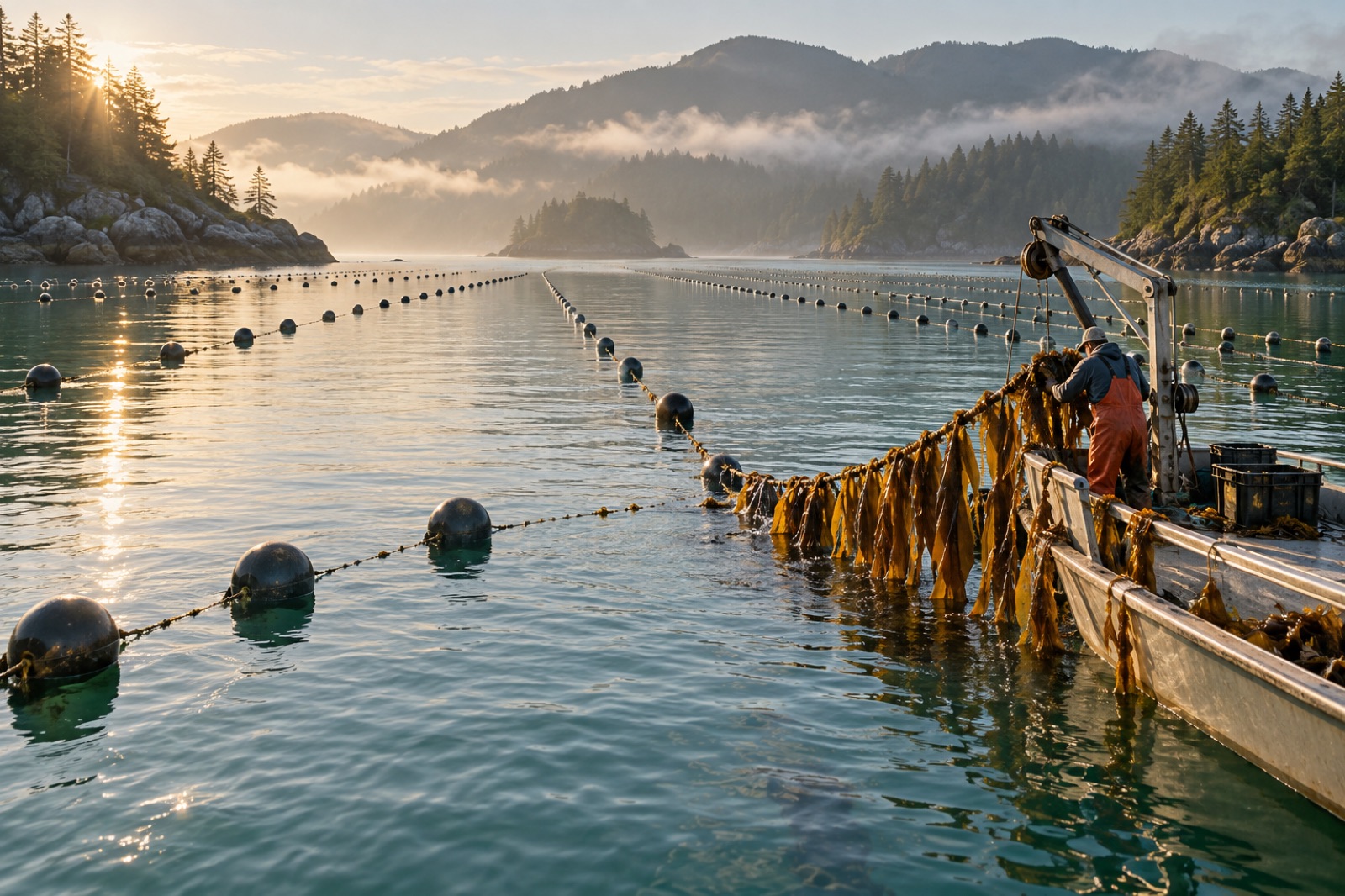
Every hectare of farmed or restored kelp begins its life on a spool of string in a tank. Before a single frond unfurls in the ocean, a hatchery has already spent weeks coaxing microscopic life stages through one of the strangest reproductive cycles in the plant-like world — and made decisions about parentage, temperature and timing that will shape the crop's whole season. Understanding seed stock is understanding where farming actually happens: not at sea, but in the quiet, sterile-lit rooms of the hatchery.
This article explains how kelp seed works — the biology that makes it possible, the seeding techniques used to set spores onto grow-line, and why genetic matching has become central to both responsible farming and ecological restoration. Tidewright's Holdfast hatchery system exists precisely because seed is the highest-leverage link in the restoration chain, and much of what follows is how our partner hatcheries work in practice.
The biology that makes seeding possible
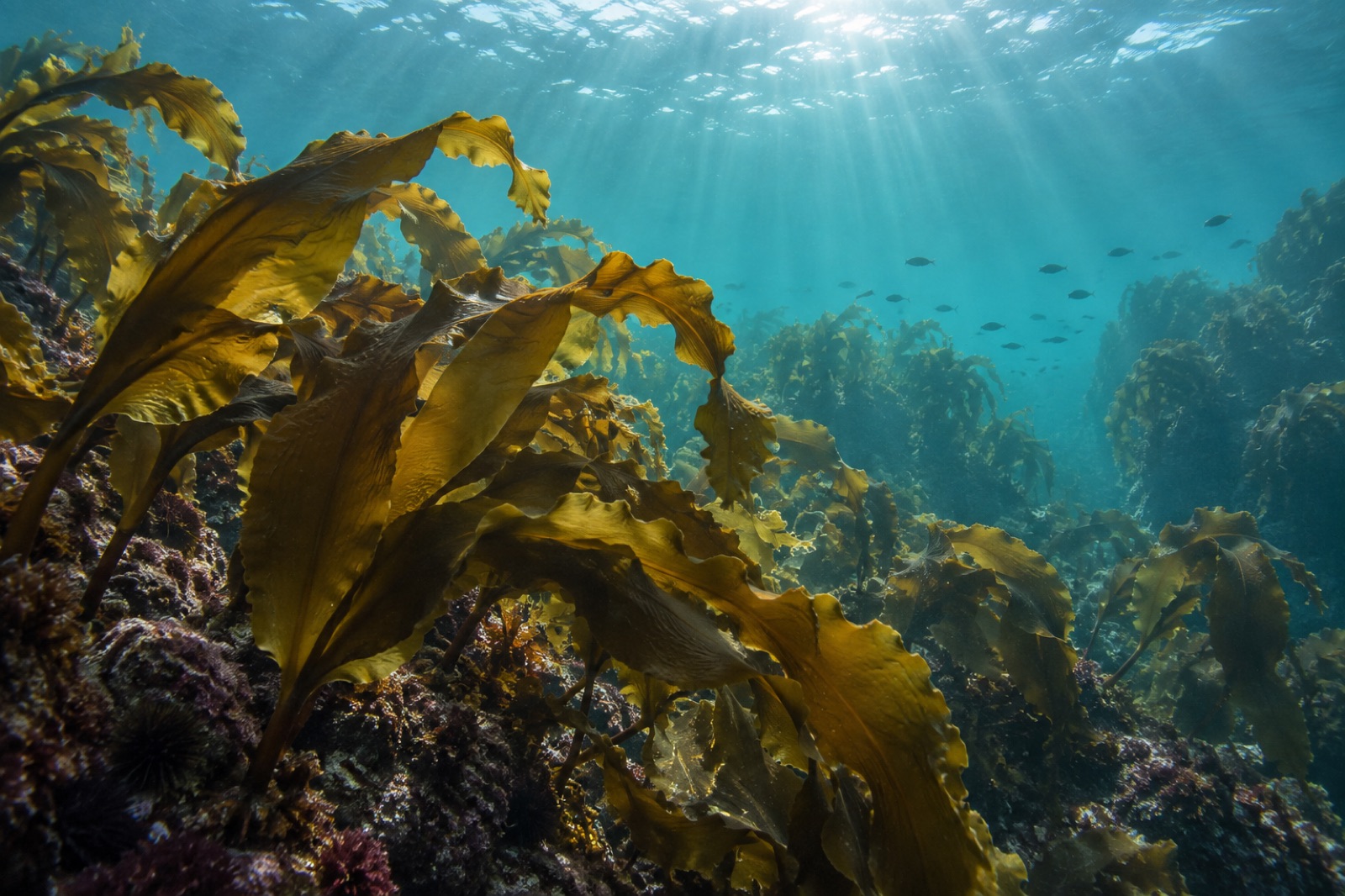
Kelp is not a plant; it is a brown alga, and its life cycle has a twist most crops don't. Farmed kelps like sugar kelp (Saccharina latissima) and kombu (Saccharina japonica) alternate between two entirely different generations:
- The sporophyte — the big, familiar blade-and-stipe kelp, metres long, that you see in the water.
- The gametophyte — a microscopic, filamentous stage a few cells wide, invisible to the naked eye, living in the water column or on surfaces.
The big kelp produces patches of reproductive tissue called sori (singular: sorus), darkened zones on the blade packed with sporangia. Each sporangium releases zoospores — swimming, single-celled spores that settle on a surface, germinate, and grow into the male and female gametophytes. Given the right light and temperature, male gametophytes release sperm; females produce eggs that, once fertilised, develop directly into new juvenile sporophytes. Those juvenile sporophytes, grown thickly along a seeded line, are what a farmer out-plants to sea.
The hatchery exists to control every step of that chain: choosing the parents, collecting the sorus tissue, triggering spore release on schedule, catching the spores on line, and nursing the gametophyte-to-sporophyte transition until the seedlings are robust enough for ocean conditions.
Step by step: how seeded line is made
1. Selecting parent plants
Seed quality begins with parent selection. Hatcheries collect sorus-bearing blades from healthy, vigorous wild or cultivated kelp in the region where the seed will be grown. Selection criteria include blade condition (no disease, minimal grazing damage), reproductive maturity (sorus abundant and well-formed), and provenance — the parents' genetic origin matters, as we discuss below. Multiple parents are collected to preserve genetic diversity in the seed batch; a seed line derived from one or two parents is a genetic bottleneck planted across a farm.
2. Preparing and releasing the spores
In the hatchery, sorus tissue is cleaned (to strip off nuisance diatoms, bacteria and grazing invertebrates), briefly desiccated in cool conditions (which concentrates and synchronises the release trigger), then immersed in sterile, temperature-controlled seawater. Within hours, millions of zoospores swim free. The hatchery filters and counts the spore suspension to work toward a target seeding density — spores per millimetre of line — tuned to the species and the farm's out-planting plans.
3. Seeding the line: spores onto string
The seeded "line" is usually thin (often 2–6 mm) twine of a biodegradable or natural fibre — coir, hemp, or similar — wound on spools. Spools are submerged in the spore suspension, either in static tanks with gentle circulation or in continuous-flow systems. Over 24–48 hours the spores settle, glue themselves to the fibre, and germinate into gametophytes. Some hatcheries skip the line step at first, settling spores directly onto artificial substrates or keeping free-living gametophyte cultures in flasks — a valuable intermediate for breeding and research, and a seed-bank function in its own right.
4. Nursery culture: gametophytes to sporophytes
Seeded spools now pass through a nursery phase lasting typically four to eight weeks. Gametophytes develop on the line under carefully controlled light and temperature; then conditions are shifted to trigger reproduction and the appearance of juvenile sporophytes — visible at last as a faint brown fuzz on the twine, then as millimetre-to-centimetre seedlings. Water quality discipline is severe in this phase: the young sporophytes are vulnerable to diatom films, bacterial blooms and rapid fouling, and UV-sterilised, filtered water is standard.
5. Hardening and out-planting
Before shipment, seedlings are hardened — exposed to gentle water motion and fluctuating conditions that prepare them for the ocean. Spools are shipped chilled and moist to the farm, where the seeded line is unwrapped and wound around or braided into the farm's growing lines. Out-planting dates are scheduled tightly around sea temperature: in most temperate regions kelp goes to sea in autumn as temperatures fall, growing through winter and spring to harvest.
Why genetic provenance matters
A hatchery's most consequential decisions are invisible on the finished spool: which parents, from where, and how many. This matters in two directions.
Adaptation to future conditions. Kelp populations differ in their tolerance to warm water, low nutrients and other stressors; those differences are genetic. Seed drawn from parents that survived recent marine heatwaves carries genes for heat resilience; a hatchery that tracks parent origins can select for climate-ready stock — increasingly as essential for farming season-to-season reliability as it is for restoration. Our science lead Dr. Theo Nakamura covers the underlying biology in our species profiles, and the genetic toolkit continues to improve rapidly.
Respecting local populations. The mirror image of adaptation is displacement. Moving seed between distant populations risks outbreeding depression: hybrids of locally adapted and imported kelp can be less fit than either parent stock in local conditions. Responsible hatcheries rely on locally collected parent stock, keep regions genetically separate, and document provenance. This is the central design principle of Tidewright's Holdfast seed system — regionally banked gametophyte cultures, locally sourced parents, and provenance records attached to every batch of seeded line.
Seeding for restoration versus farming
The same fundamentals apply, but restoration adds requirements. A food farm can standardise on one high-performing strain across many sites. A restoration site asks for more: genetic diversity to give the restored population the raw material for natural selection; trait coverage across heat, nutrient and grazer tolerance; and careful site-matching to local ancestry. Holdfast-style restoration seeding therefore builds batches from many parents (often dozens) per site, keeps the age and size of juvenile sporophytes at out-planting tighter than a farm would require, and accompanies the out-planting with genetic reference sampling so later monitoring can measure how the restored population is actually establishing.
Buying seed as a farmer: what to ask
If you are ordering seed stock from a hatchery for your first or fifth season, these questions separate professional from amateur suppliers:
- What is the provenance of the parents? Region of collection, number of parents, and documentation.
- What seeding density do you achieve? Spores per millimetre of line and juvenile counts at despatch, not promises.
- What health screening was done? Diatom load, bacterial issues, gametophyte contamination (in species where that's a risk).
- When were the spores seeded, and what is the recommended out-planting window? Seed has a freshness clock; old nursery stock underperforms.
- Can I see the batch records? Any hatchery that cannot produce a documented chain from parent to spool is a hatchery to avoid.
Good seed stock is the cheapest insurance in the entire farming operation. Cheap seed fails after the lease, gear and season are already committed.
Key takeaways
- Kelp seed production exploits a two-generation life cycle: big sporophyte parents release swimming spores that become microscopic gametophytes and then juvenile seedlings on twine.
- Hatcheries control the chain — parent selection, spore release timing, seeding density, nursery triggers, hardening and shipping — and quality at each step compounds.
- Genetic provenance is as important as count: locally matched seed performs better, and moving genotypes across regions risks outbreeding depression.
- Restoration seeding adds more parents per batch and tighter out-planting standards than commercial farming, to build diverse, site-matched populations.
- Seed stock is the highest-leverage purchase in kelp aquaculture; ask about provenance, density, health screening and batch records before you commit your season.
FAQ
What exactly is "seed" in seaweed farming?
Seaweed seed is not a seed in the plant sense. It is twine or line on which microscopic kelp gametophytes and juvenile sporophytes have been grown in a hatchery, ready to be out-planted to sea where they develop into full-size kelp.
Can I seed my own line without a hatchery?
Yes — the direct-seeding approach collects reproductive sorus tissue from wild kelp and releases spores over line in simple tanks at the farm. It can work well with practice and an abundant, healthy local parent population, but it gives lower, less consistent seeding densities and no health screening. Most commercial farms and restoration projects use licensed hatchery seed; our beginner's guide to starting a farm recommends hatchery seed for at least the first seasons.
How long does hatchery seed production take?
From sorus collection to out-plant-ready seeded spools typically takes six to twelve weeks: a few days of spore release and seeding, four to eight weeks of nursery culture, then hardening and shipping. The season is scheduled backwards from the farm's out-planting window in autumn.
Why is genetic matching such a big deal?
Local kelp populations are adapted to local temperatures, nutrients and day-length cues. Seed matched to local genetics performs better and avoids outbreeding depression when it interbreeds with wild kelp. Regional provenance records also matter for permits and increasingly for buyer requirements. This is why Holdfast — Tidewright's hatchery system — keeps regional gametophyte banks and traces every batch.
How long does seeded line keep after delivery?
Seeded line is perishable. Refrigerated, moist spools keep for days to a couple of weeks depending on species and nursery maturity, but performance declines with storage. Plan out-planting immediately after delivery and hold chilled until lines are in the water.