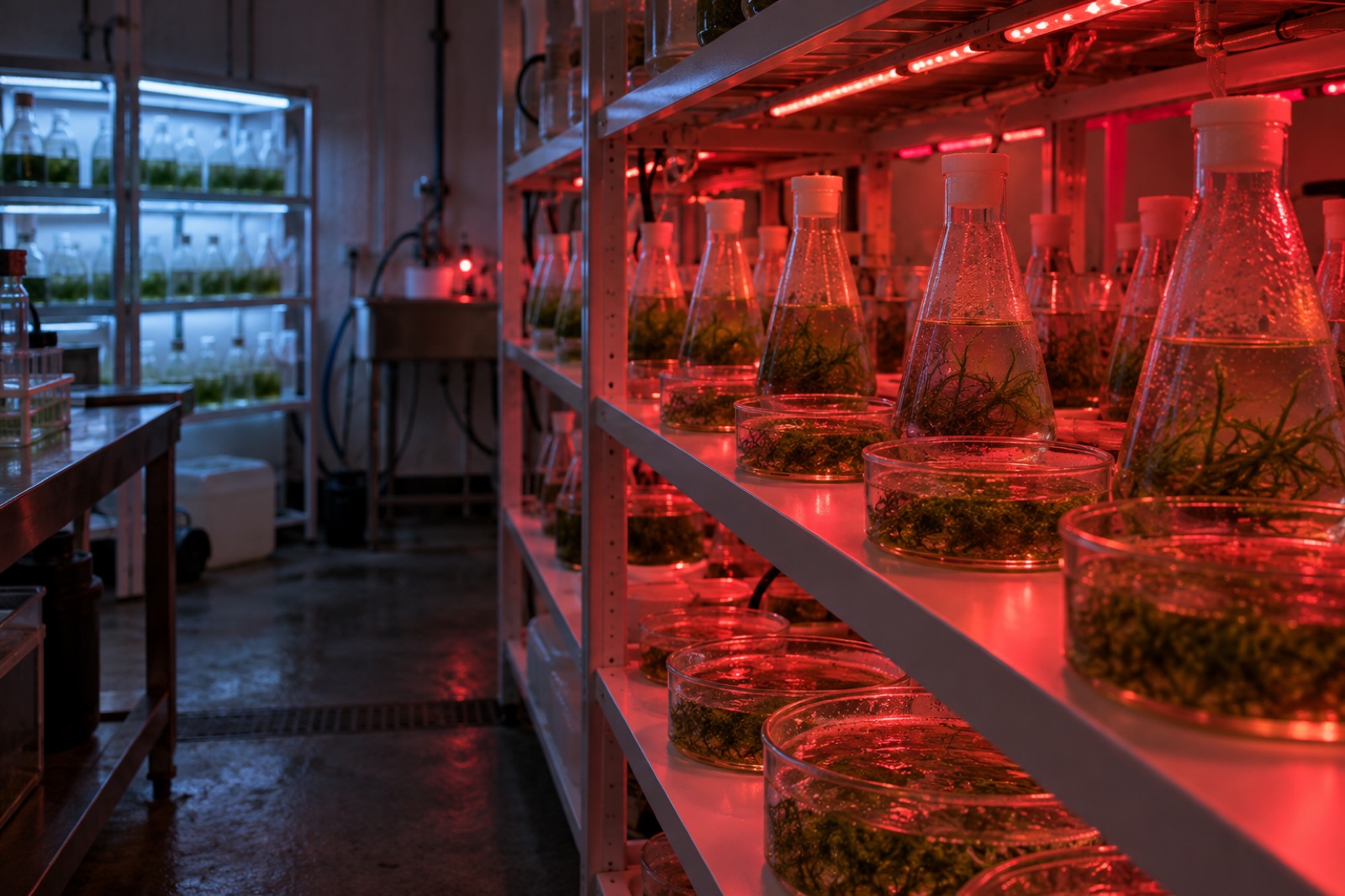
Walk into a serious kelp hatchery and the loudest room is the nursery — pumps, bubblers, the clatter of spools. Walk one door further and you find the room that actually decides your season: a dark, cool space that hums like a wine cellar, lined with shelves of glass flasks standing in dim red light. This is the gametophyte culture room, and everything the farm will harvest next spring is sitting in these flasks as a filaments you'd need a microscope to see.
This article explains what the room is for, how to specify one, and how to run the calendar that ends with thousands of metres of seeded line ready for the ocean. It's the operational companion to our deeper dives on photoperiod control and making seed string.
Why Gametophytes Get Their Own Room
Kelp runs a two-generation life cycle: the big blade you know is the sporophyte, but between it and the next sporophyte sits a microscopic, filamentous stage — the gametophyte. (If the alternation of generations is new to you, read the kelp life cycle first.) The gametophyte is the dollar of the kelp world: tiny, durable, and the only stage you can hold in a flask for years.
That durability is the commercial opportunity. If you can keep gametophytes alive and vegetative — growing as filaments but not switching into reproduction — you hold a living seed bank. When the season calls, you flip the environmental switches, the gametophytes produce eggs and sperm, and you seed twine on demand instead of chasing wild sorus tissue every autumn. This is essentially the system behind Holdfast's nursery lines: region-specific gametophyte families, held in reserve, seeded to schedule.
Specifying the Room
A gametophyte room is closer to a wine fridge than to a lab. You are buying three things: cold, darkness on demand, and clean air.
Temperature
For boreal kelps like sugar kelp (Saccharina latissima) and kombu (Saccharina japonica), vegetative gametophyte culture typically runs at 10–12 °C, never warmer than 15 °C. Warm-temperate species differ, but the pattern holds: gametophytes of most farmed kelps tolerate cold far better than heat, and a warm weekend in a failed room can cook a whole seed bank in 48 hours.
Practical implication: use a refrigeration unit with a backup, not a room air conditioner. Wire the compressor to a high-temperature alarm that reaches someone's phone. The single most common seed-stock disaster is a silent refrigeration failure on a long weekend.
Light
This is where the room earns its mystique. Kelp gametophytes read blue light as a signal to begin gametogenesis — to make eggs and sperm — and red light as a signal to stay vegetative. The classic culture-room trick, established by German phycologists in the 1970s and still standard practice, is to hold cultures under dim red light to keep them in the vegetative, filamentous state.
In practice that means:
- Vegetative hold: low-intensity red or red-enriched LED panels, typically 10–30 µmol photons m⁻² s⁻¹, long days or continuous light.
- Induction: when you want reproduction, cultures move to blue-leaning white light at higher intensity, and gametogenesis follows within days to two weeks.
The two regimes can live in the same room on different shelving runs with separate timers; many hatcheries simply give induction its own room to eliminate stray-light accidents. The spectrum and timing detail is its own discipline — see hatchery light cycles.
Air and access
Gametophyte cultures don't need a cleanroom, but they need a room treated like food prep: washable walls, a door that closes, a footbath or shoe policy, and a rule that nothing from the sea-side of the hatchery comes in without being cleaned. Seawater tanks are champagne for contaminants; the culture room is where you refuse them entry.
Clean Water, Clean Glass, Clean Hands
Culture water is filtered seawater — commonly 0.2 µm filtration, or 1 µm filtration followed by pasteurisation or UV — enriched with a defined nutrient medium. Most labs use a Provasoli-type enrichment (PES or PESI): a standardised recipe of nitrate, phosphate, vitamins, trace metals and chelated iron. The enrichment matters because consistent media produces consistent growth; the sterility matters because it doesn't matter how perfect your spectrum is if a pennate diatom blooms through your flask and smothers the filaments.
The working rules of the room:
- Change media on a calendar, not on a vibe. Every two to four weeks for slow vegetative cultures, weekly for fast-growing induction cultures. Miss a change and old flasks yellow as nutrients crash and pH swings.
- Autoclave or pasteurise everything that touches a culture — flasks, pipettes, forceps, the twine you'll eventually seed.
- One flask, one strain, one label. Waterproof marker plus a printed label; mystery flasks are disposed of, no exceptions. Traceability starts here, not at the dock — the genetics in each flask is exactly the kind of lineage record that informs choosing genetics that belong.
- Look at the cultures. A weekly pass with an inverted microscope catches diatom contamination, bacterial films and early gametogenesis while there's still time to act. Filaments should be even, olive-brown and branched; bleached, clumped or gel-slimed cultures get quarantined.
The Seeding Calendar
The room's value is realised through its calendar. Work backwards from outplanting day — the day seeded line should hit your farm's longlines — and a typical sugar kelp schedule for a Northern Hemisphere farm looks like this:
T-minus 8 to 10 weeks: pull the strains you intend to seed from the vegetative bank. Subculture fresh filaments into clean flasks so the induction starts from actively growing material, not tired stock.
T-minus 3 to 6 weeks: move to induction conditions — blue-white light, fresh enriched media, the species' trigger temperature. Gametophytes form eggs and spermose structures; under the microscope you'll see the swollen oogonia of the females first.
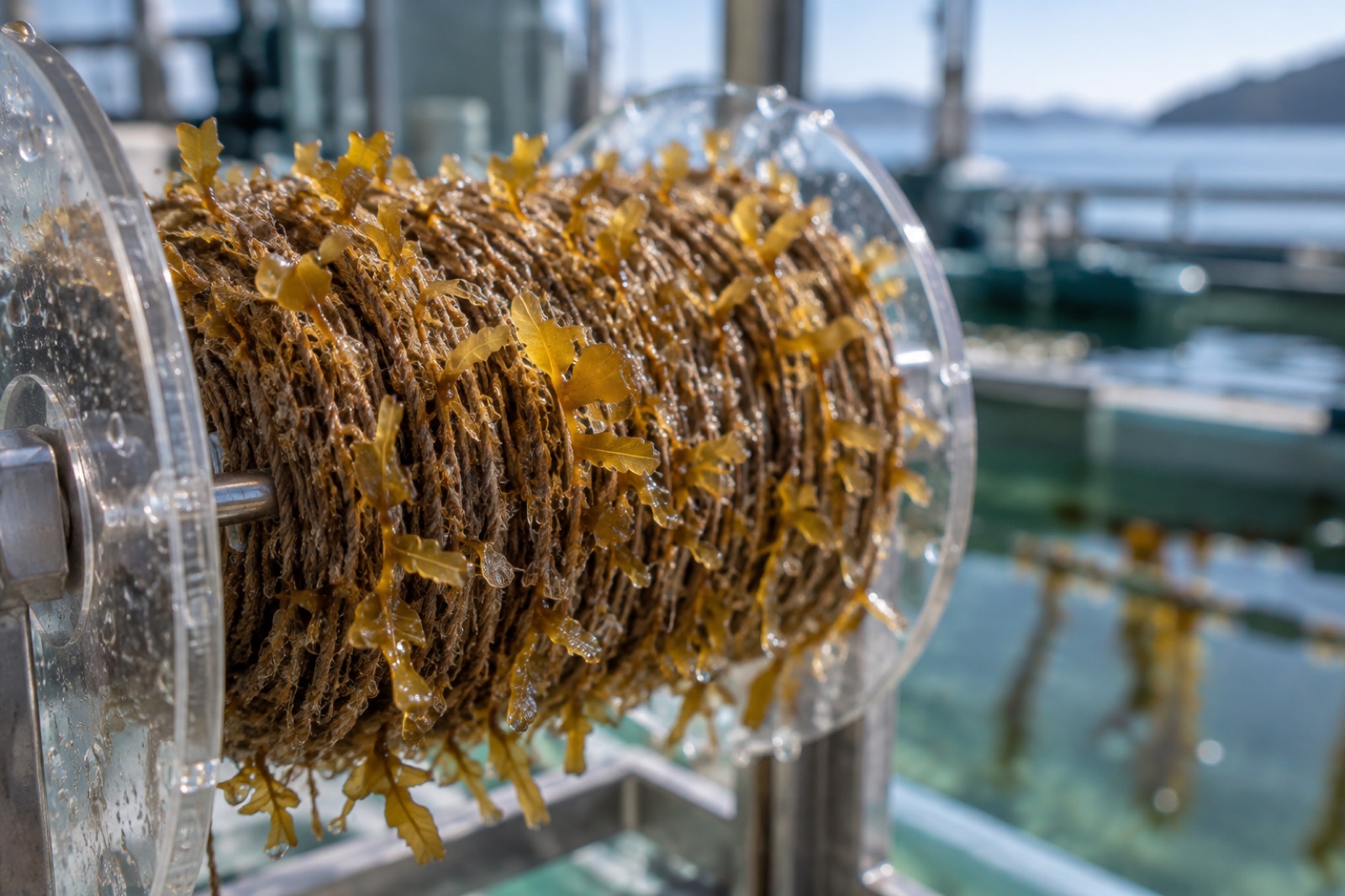
T-minus 2 to 3 weeks: seeding. Dense gametophyte slurry (or freshly released spores, if you run the classic spore-seeding route) is applied to your seed twine in shallow tanks — sprayed, dipped or tumbled depending on your setup, as covered in seed string production.
T-minus 0 to 2 weeks: nursery grow-out. Seeded spools sit in light, circulated, nutrient-dosed seawater until sporophytes are visible to the naked eye — the classic "fuzz stage" at roughly 1–2 mm. Check readiness with the same discipline you'd apply to any crop before transplant; our seed viability checks article lays out what "ready" looks like.
Outplant day: spools go to sea. The room, meanwhile, is already re-banking the strains that performed.
Two calendar disciplines matter most. First, stagger your induction batches — two waves, two weeks apart, so one bad transfer or one warm spell can't zero the season. Second, write the whole schedule on one wall with names against dates. Culture-room failures are rarely scientific failures; they're handoff failures, where everyone assumed someone else changed the media.
The Seed Bank Is an Asset
Treat the vegetative bank the way a brewery treats its yeast: it is the business. Diversify it (multiple strains from multiple local parents), duplicate it (two flasks of every strain, ideally two shelves), and review it each off-season. Strains that seeded weakly, grew slowly or produced thin blades at the farm get retired; strains from parent plants that survived a warm summer get promoted. Over five years the room quietly becomes a breeding programme, and your seed stock starts to reflect your site's particular water — which is precisely the logic of locally matched seedstock behind Tidewright's Holdfast system and the principle any small grower can copy at flask scale. If you're building from scratch, our guide to setting up a seaweed hatchery covers the room in the context of the whole facility, and hatchery water quality covers the chemistry in detail.
Key Takeaways
- The gametophyte stage is kelp's storable seed; a culture room exists to keep it alive, clean and vegetative until called.
- Hold vegetative cultures cold (roughly 10–12 °C for boreal kelps) under dim red light; induce reproduction with blue-white light and fresh media.
- Sterile-enough discipline beats high-tech: scheduled media changes, clean glassware, one-string-one-label traceability.
- Build the calendar backwards from outplanting day, and stagger induction batches so no single failure ends the season.
- The vegetative bank is a compounding asset: diversify it, duplicate it, and let farm performance retire and promote strains.
FAQ
How long can gametophytes be stored in culture?
Vegetatively held kelp gametophytes are famously durable — research collections have maintained strains for years to decades with periodic subculturing. Practically, plan to refresh your working stock from the bank every year or two and to re-collect some wild parent material periodically to keep local diversity in the system.
Do I need a dedicated room, or can a corner of the hatchery work?
A corner works if it solves the three non-negotiables: stable cold, light you fully control (no window daylight, no shared switches), and physical separation from unfiltered seawater systems. A converted commercial cool-room or insulated shipping container with shelving is a common budget answer.
What's the biggest cause of culture loss?
Contamination by diatoms and other microalgae is the chronic thief; refrigeration failure is the acute killer. Both are managed with process, not luck: filtered/pasteurised media on a schedule, and a high-temperature alarm that actually reaches a human.
Red light or dark for the vegetative hold?
Both appear in practice, but dim red light is the standard because gametophytes photosynthesise slowly under it, staying alive and slowly dividing without receiving the blue-light cue that triggers reproduction. Total darkness works for some species but risks slow decline and makes inspection harder.
Can I skip gametophyte culture and just seed with fresh spores each autumn?
Many farms do exactly that — collecting fertile sorus tissue seasonally is the classic route and avoids running a room at all. The trade-off is timing risk and genetics you can't carry forward. Most operations that grow past a few hectares eventually want the security of a banked supply, even if they keep spore-seeding as a parallel track.