Farming11 min read
Making Seed String: From Spore Release to Nursery Lines
Seed string is the kelp farm's starter crop. This step-by-step guide covers sorus collection, spore release, inoculation density, incubation and out-planting.
Naomi Reyes ·
Kelp gametophytes are demanding housemates. Learn the temperature, light, filtration and nutrient regimes that keep seed cultures healthy until out-planting.
A kelp hatchery is a place where a wild alga that normally spans sixty metres of ocean is persuaded to complete the most delicate stage of its life in a petri dish. Everything about that dish — the water in it, the light above it, the chemistry dissolved between them — decides whether your gametophyte cultures survive to become seeded twine or collapse under a film of diatoms and bacteria.
The good news: the requirements are well understood. Kelp hatcheries from Hokkaido to Maine converge on broadly the same recipe, refined across decades of Nori and kombu aquaculture in East Asia and adapted by Western breeders over the last fifteen years. This article lays out that recipe, parameter by parameter, and the monitoring habits that keep it stable.
If you are still building your facility, read this alongside our guide to setting up a seaweed hatchery and the companion piece on making seed string.
In the ocean, kelp's microscopic stages — spores, gametophytes, embryonic sporophytes — are vanishingly rare survivors in a sea of grazers, bacteria and competing algae. Recruitment works because enormous numbers of spores are released and a few land exactly right. A hatchery exists to compress that lottery into a controlled workflow, and to do that it must remove nearly every other living thing from the water.
That is the core mindset shift: hatchery water management is less about adding goodness and more about subtraction. Filter out competitors. Screen out grazers. Deny bacteria their footholds. Then, on the clean substrate you have created, hold temperature, light and nutrients inside tight, species-appropriate bands until the young sporophytes are large enough to move outdoors.
Most of what you are protecting is invisible. Kelp's life cycle alternates between the big blade-forming sporophyte and a microscopic gametophyte generation — filaments only a few cells wide. Gametophytes are hardy in one sense (they can persist for weeks without reproducing, which makes them a useful "seed bank") and fragile in another: a bloom of pennate diatoms in the culture flasks can smother them in a long weekend. Understanding gametophyte biology is genuinely useful at the bench, not just in exam halls.
For the temperate kelps most commonly farmed — sugar kelp (Saccharina latissima), kombu (Saccharina japonica), oarweed (Laminaria digitata), the Pacific species — cool water is the organising principle.
Cold rooms and refrigerated water baths are the reliable route for maintenance banks. For working cultures, small immersion or inline chillers (aquarium-style units are fine at bench scale) tied to a digital thermostat keep drift under about ±0.5 °C, which is comfortably tight enough. Two rules of thumb from working hatcheries:
Hatchery light regimes surprise most newcomers because they are deliberately dim. Gametophytes live at depths and seasons where light is scarce.
Whatever LEDs you choose, stick to one fixture type per room. Mixing spectra between shelves confounds everything when troubleshooting.
Raw seawater is soup. The goal is broth. A typical treatment train, in order:
Many hatcheries additionally autoclave or pasteurise their final culture water — especially for long-lived maintenance stocks — accepting the extra handling time as insurance. At production scale that becomes impractical, and robust 0.2 µm plus UV treatment is the accepted compromise. Whichever route you take, dedicate plumbing: the culture water system should share as little as possible with wet-lab seawater, and every joint is a place biofilm can seed from.
Filtered seawater contains almost nothing for a growing kelp, which is fine for maintenance but insufficient for induction and early sporophyte growth. The standard family of recipes descends from Provasoli's enriched seawater (PES): nitrate and phosphate in roughly Redfield-ish proportions plus micronutrients and vitamins.
Practical notes:
Also remember what those nutrients are for: a reminder that kelp's astonishing nitrate appetite in the sea is exactly what makes nutrient credit and bioremediation programmes viable later in the supply chain.
A hatchery lives or dies on boring regularity. The cadence that experienced seed-stock managers converge on:
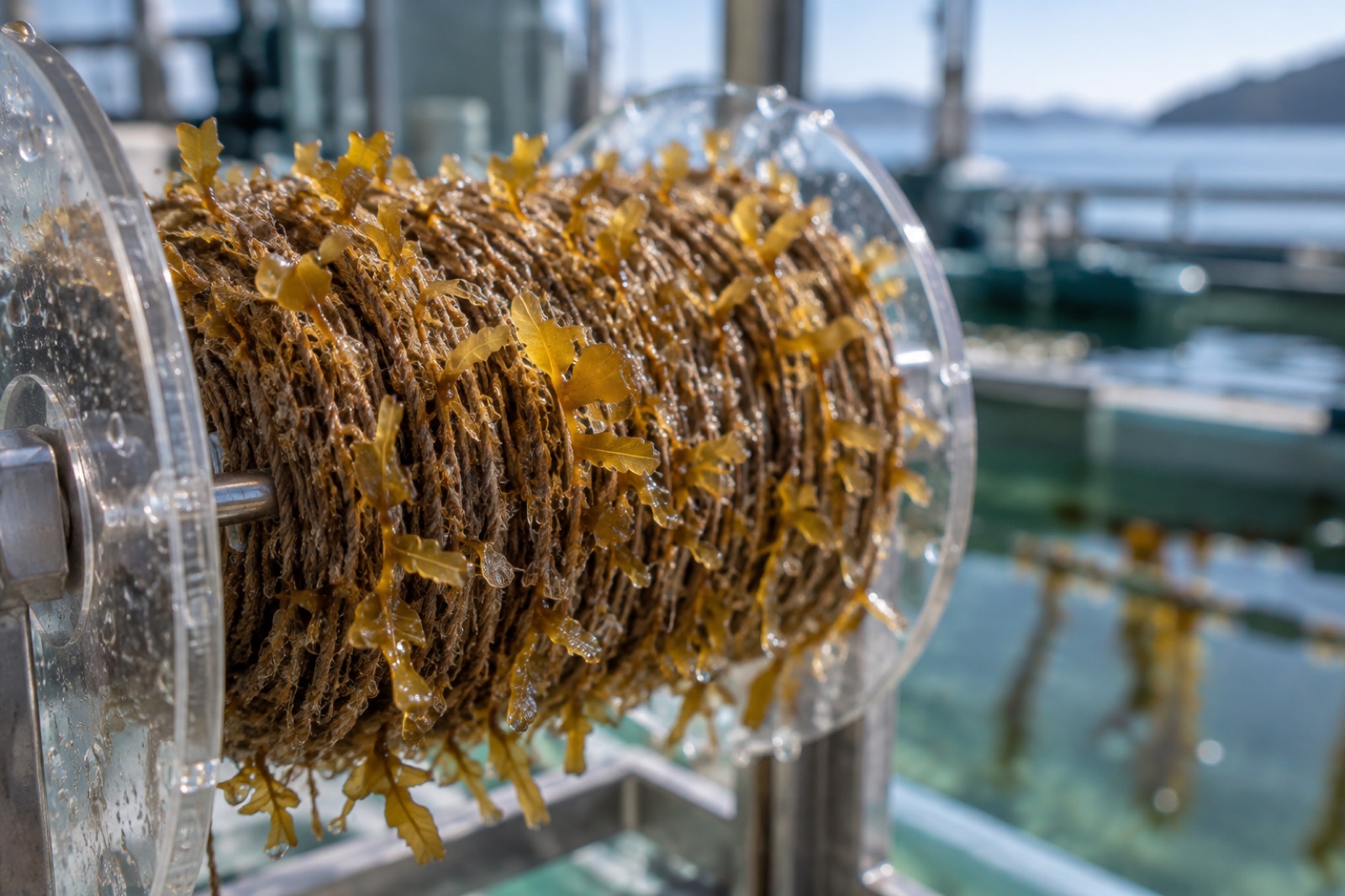
As soon as sporophytes are visible to the naked eye on the twine, the philosophy shifts from surgery to gardening. Seeded string moves to a nursery tank with higher flow, generous unenriched (but still filtered) seawater exchange, and gradually rising light. Water exchange rates of one to three tank volumes per day with 5–10 µm filtration are typical; the mission now is flushing waste and adding natural trace complexity, not sterile isolation.
This is also the handover point in Tidewright's own Holdfast programme: hatchery-quality cultures pass to coastal nursery sites where seeded lines toughen against real plankton and real weather before vessels lay them on a reef. Hardy string makes hardy forests.
For maintenance experiments it can work, but full-strength artificial mixes lack trace organics wild gametophytes rely on, and every manufacturer's formula is a little different. Most hatcheries start with real, clean seawater and filter it heavily. If you must use artificial mixes, run side-by-side tests before committing a seed bank.
For maintenance stocks, partial water changes every one to two weeks with fresh, treated, nutrient-low seawater are typical. Longer intervals build metabolic waste and shift pH; shorter ones distend labour and handling risk. During induction and seeding, follow the batch protocol — usually one to two exchanges per week.
Usually, yes — the stringiness is a sign of nutrient enrichment driving filament growth ahead of maturation, or of light above their comfort band. Drop light first, reduce nutrient enrichments, and give them a fortnight closer to their wild conditions.
Gently, yes. Still cultures stratify and develop local pH extremes under light. Soft aeration — just enough to keep the suspension slowly mixed — keeps chemistry uniform and filaments separated. Aggressive bubbling damages filaments and kicks contaminants into suspension.
Oversizing equipment and undersizing monitoring. A big chiller without an alarm is worse than a small one with a text message the day it fails. Spend asymmetrically on sensors, loggers and sentinel checks; buy the machines afterwards.
Seed string is the kelp farm's starter crop. This step-by-step guide covers sorus collection, spore release, inoculation density, incubation and out-planting.
Naomi Reyes ·
Kelp farming begins in a hatchery, not the ocean. How seaweed seed stock is made: life cycles, sorus selection, spore seeding, nursery growth and genetic matching.
Dr. Elias Brandt ·
A practical guide to building a small kelp hatchery: culture room design, seawater systems, equipment, budgets and the weekly workflow that produces seeded twine.
Naomi Reyes ·