Encyclopedia9 min read
Sugar Kelp (Saccharina latissima): Species Profile
Sugar kelp is the sweet-tasting cold-water kelp that farmers love. Explore its biology, range, life cycle and why it anchors a new wave of ocean farming.
Dr. Theo Nakamura ·
IMTA pairs kelp and shellfish with fed fish farms so waste nutrients become crops. How integrated multi-trophic aquaculture works, its benefits and its limits.
Integrated multi-trophic aquaculture — IMTA — is a farm design that grows species from different levels of the food web together so that one crop's waste becomes another crop's fertilizer. In the classic arrangement, fed fish provide dissolved nutrients, seaweeds absorb those nutrients from the water, and shellfish filter the fine particles, mimicking the nutrient recycling of a healthy reef. Done well, IMTA turns aquaculture's biggest liability — nutrient pollution — into a second and third harvest, while producing some of the lowest-impact protein on the planet.
This guide explains how IMTA works, why it matters for the future of seafood, what a real system looks like on the water, and where the honest limits of the approach lie.
Conventional fed aquaculture — salmon pens, sea-bass cages, shrimp ponds — releases a lot of what the animals don't eat or retain. Uneaten feed and fish waste dissolve and disperse into the surrounding water as nitrogen, phosphorus and fine organic particles. In enclosed or slow-flushing bays, that nutrient load can fuel algal blooms, deplete oxygen and smother the seabed beneath pens. It's the single most-cited environmental criticism of marine fish farming, and in poorly located monoculture operations, the criticism is fair.
Wild ecosystems don't have this problem because nothing there is "waste." The nutrients one organism releases are raw material for the next: kelp takes up dissolved nitrogen, filter feeders take particles, deposit feeders rework the sediments, grazers keep everything cropped. IMTA is the deliberate reassembly of that loop around a farm.
A working IMTA site typically combines three functional groups:
Some systems add a fourth, deposit-feeding layer beneath the cages, and land-based versions push tank outflow through seaweed raceways before discharge. The principles are the same everywhere: match species to the nutrient form they're best at capturing, and close as much of the loop as the site allows.
Fish retain only a fraction of the nitrogen and phosphorus in their feed; the rest leaves as dissolved ammonia and phosphate (which seaweeds want) and as fecal particles (which filter feeders want). Ammonia concentration is highest immediately downstream of the pens and dilutes with distance and current, which makes placement the central engineering challenge of IMTA.
Seaweed longlines are sited in the nutrient plume — close enough to benefit, far enough that fish-farm turbulence and anti-fouling operations don't batter the crop. In well-studied operations, kelp grown beside salmon cages shows measurably higher tissue nitrogen and faster growth than control sites outside the plume, which is nutrient capture you can literally weigh at harvest.
The shellfish lines sit farther out, where particles have dispersed but are still enriched. Their role is subtler but important: they convert fine organic seston into harvestable biomass and, by filtering the water, can improve clarity around the whole site.
The headline benefit is bioremediation. Seaweeds and shellfish genuinely remove nitrogen and phosphorus from coastal water, and the removal is verifiable: tissue sampled at harvest tells you exactly how much nutrient left the system in the crop. In load-sensitive bays, that can move a farm from net polluter toward nutrient-neutral. Seaweed production also draws down dissolved CO₂ locally during fast growth, creating small zones of elevated pH that can benefit nearby calcifiers — one reason shellfish and seaweed are increasingly co-cultivated even without fish.
IMTA spreads a farm's revenue across three markets that fail for different reasons. Seaweed sells into food, fertilizer ingredients and bioplastics; shellfish into reliable fresh and processed markets. If fish prices drop or a disease event hits one crop, the others still pay the crew. There's also a productivity argument: seaweed fertilized by nutrient-rich farm outflow can outperform wild-stand yields, meaning more kelp per meter of line.
Perhaps least tangible but most decisive: regulators and coastal communities view integrated farms far more favorably than monoculture pens. A visible kelp forest around a salmon site is a legible signal of stewardship. For operators seeking permits in contested waters — and for the coastal councils that must defend them — IMTA reframes the conversation from "how much damage is acceptable" to "what does the system produce."
IMTA is elegant in diagrams and demanding on the water. The obstacles that trip up new operations:
It's worth being precise about what IMTA is and isn't. It is a way to make food production cleaner and more productive. It is not, by itself, wild-reef restoration — cultured kelp on lines is a crop, not a recovered habitat, and a farmed system doesn't recreate the three-dimensional structure of a lost giant kelp forest.
But the two are natural allies. IMTA normalizes seaweed cultivation in working coastal economies, builds hatchery and seedstock expertise, and produces kelp biomass without touching wild beds. That's why we run both: our farms fund and de-risk the restoration work our Drifter reseeding vessels do on wild reefs. The skills, the nurseries and even the genetics pipelines overlap — a farm that knows how to grow kelp is a coast that knows how to restore it.
No, and honest practitioners don't claim it does. IMTA captures a meaningful share of dissolved and particulate nutrients, but capture rates depend on farm layout, currents, season and scale, and much of the nutrient mass still disperses. The right framing is substantial mitigation plus productive reuse — not erasure.
No. IMTA is a farm structure; "organic" is a certification standard about feed ingredients, chemical use and husbandry. An IMTA farm can be conventional or certified organic, and many organic principles (like minimizing synthetic inputs) are easier to meet in an integrated system, but the labels are independent.
Absolutely, and this is common. Seaweed-plus-shellfish systems (sometimes called extractive aquaculture or, in urbanized estuaries, nutrient bioextraction) need no fed input at all — the seaweeds draw on ambient nutrients from rivers and upwelling, and the shellfish filter natural plankton. These are arguably the lowest-impact farms of all, since nothing is fed and nothing is wasted.
The choice follows local temperature and salinity. Sugar kelp and kombu dominate cold-temperate sites in the North Atlantic, Pacific Northwest and East Asia; Gracilaria and other warm-temperate reds suit southern sites; dulse is emerging for high-value food markets. Match species to your site, not to a trend — and source seedstock from hatcheries that work with local genetics.
Close enough to sit within the nutrient plume, far enough to survive farm operations — typically tens to a few hundred meters, but the right answer comes only from current modeling and in-water nutrient tracing at your specific site. This is one case where a single season of cheap monitoring cheapens a decade of expensive guessing.
Sugar kelp is the sweet-tasting cold-water kelp that farmers love. Explore its biology, range, life cycle and why it anchors a new wave of ocean farming.
Dr. Theo Nakamura ·
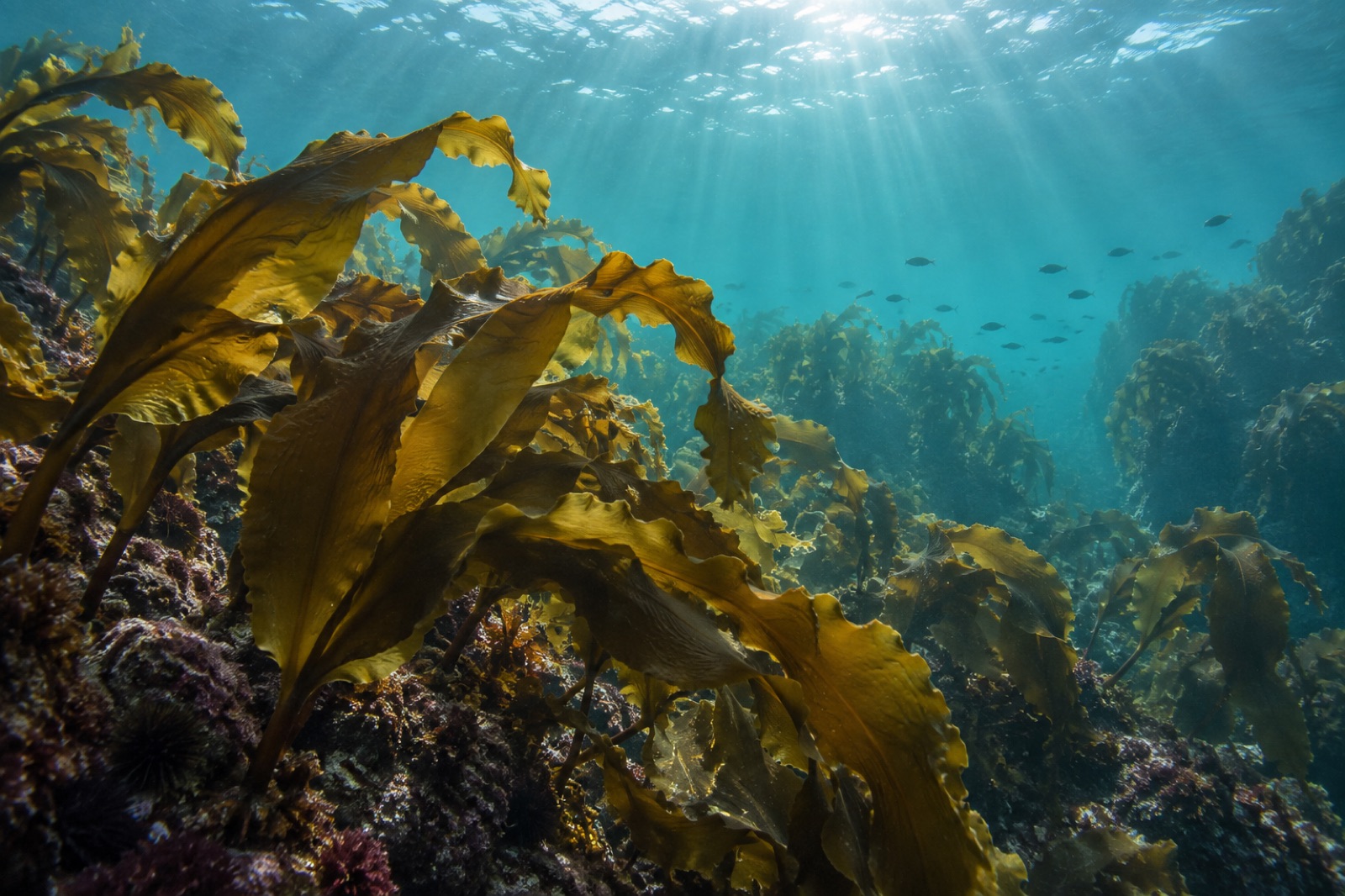
Kombu is the kelp behind dashi and the backbone of the world's seaweed farms. Learn its biology, life cycle, Hokkaido roots and future in a warming sea.
Dr. Theo Nakamura ·
Wakame is a beloved edible kelp in Japan and Korea — and one of the world's most widespread invasive seaweeds. Understand both sides of Undaria pinnatifida.
Dr. Mara Ellison ·