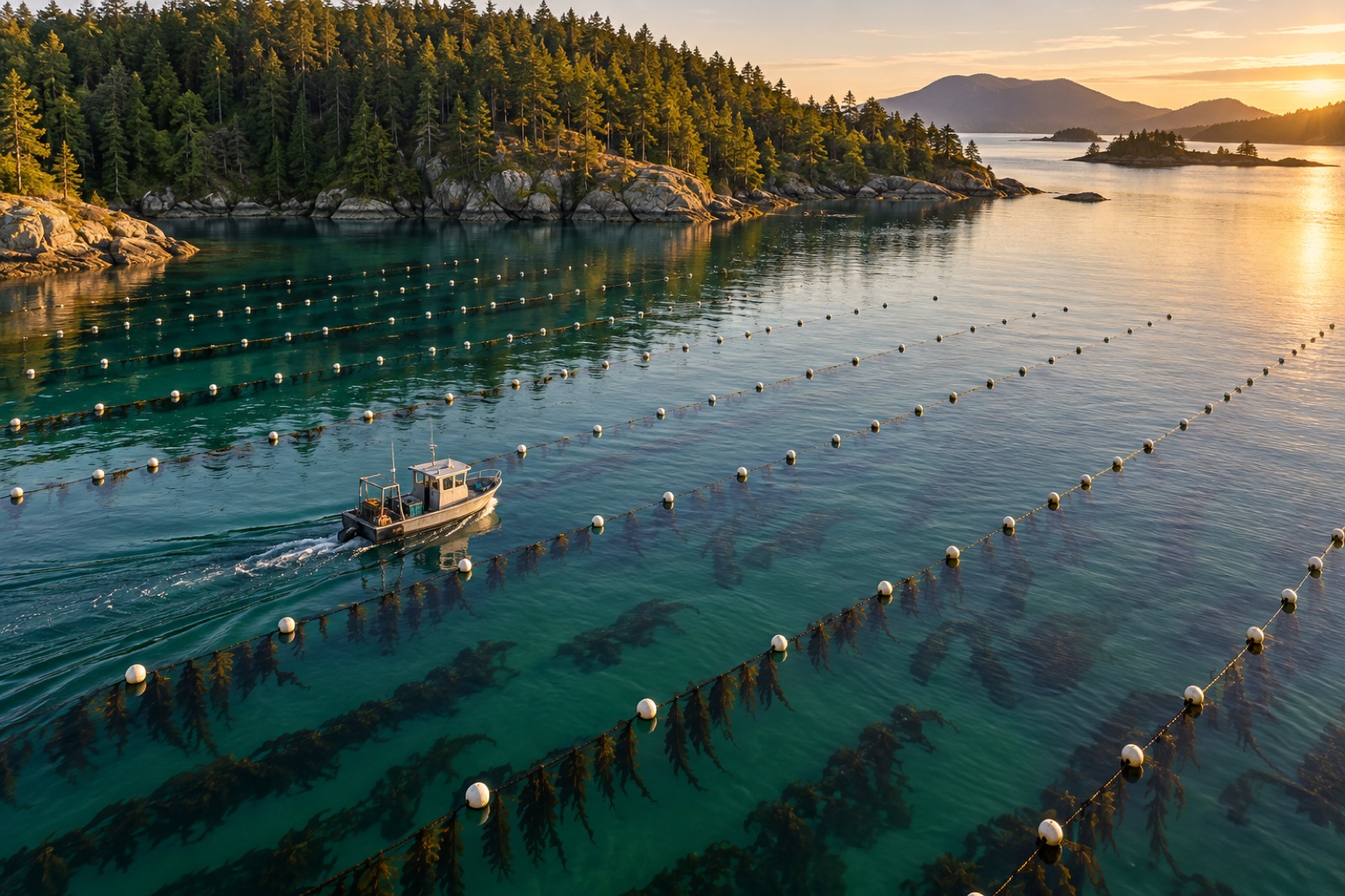
Shrimp farming's oldest problem is water. Feed goes in, shrimp grow, and dissolved nitrogen and phosphorus accumulate faster than a closed pond can shed them. Farmers respond with water exchange, chemicals and aeration — all costs, all with limits. One of the most elegant responses is also one of the oldest ideas in aquaculture: grow something that eats the waste. Pairing a fast-growing red seaweed, Gracilaria, with penaeid shrimp turns nutrient removal from a cost centre into a second harvestable crop.
This article is a practical guide to gracilaria–shrimp polyculture: why the pairing works, how ponds are laid out and stocked, what the nutrient budget really looks like, and the honest economics and risks. It sits inside the broader family of integrated multi-trophic aquaculture, but unlike many IMTA designs it can be retrofitted to conventional earthen shrimp ponds, which is why it's spreading in tropical and subtropical farm regions.
Why this pairing works
The complementarity is almost textbook:
- Shrimp excrete and waste feed releases dissolved inorganic nitrogen and phosphorus — nitrate, ammonium, phosphate — that would otherwise fuel algal blooms, oxygen swings and sludge.
- Gracilaria is a fast-growing, nutrient-hungry macroalga that strips exactly those compounds from the water column, converting them into harvestable biomass.
- The seaweed also oxygenates water by day and can damp the swings of phytoplankton blooms, reducing the diurnal stress that drives both shrimp mortality and forced water exchange.
The underlying nutrient cycle is covered in our explainer on the marine nitrogen cycle — and the same biology that causes trouble in coastal eutrophication is, in a controlled pond circuit, turned into crop. Gracilaria's established position in aquaculture helps too: it is the world's major agar-producing seaweed and the foundation of well-documented farming systems — see farming Gracilaria and the agar supply chain.
Two physical designs: co-culture and compartment culture
1. In-pond co-culture
Seaweed is grown inside the shrimp pond itself, usually as:
- Floating longlines or rafts anchored across part of the pond surface, or
- Bottom-fixed tube nets / stake-and-line arrays in shallower margins.
Co-culture is simple and cheap to retrofit, but it competes for light (seaweed shades the pond slightly) and space, and harvest can disturb shrimp. Shading is a double-edged tool: in hot climates modest shade can stabilise pond temperature; too much shading depresses the phytoplankton some extensive systems rely on.
2. Compartment / recirculating culture
The pond is split: the shrimp occupy one zone, the seaweed occupies an adjacent treatment zone (a polishing canal, settling-and-seaweed channel, or separate pond) through which shrimp water is pumped or gravitationally circulated. Effluent passes through or past the seaweed, stripped of dissolved nutrients, then returns or is discharged cleaner.
Compartment designs cost more to plumb but solve the interference issues: shrimp husbandry and seaweed harvest don't collide, seaweed density can run much higher without shading shrimp, and nutrient stripping can be tuned by flow rate and bed size. For new builds, most engineers I'd offer this layout prefer the compartment version; for retrofits, co-culture longlines are the faster start.
The nutrient budget: size the seaweed to the shrimp
The design question is a mass balance, not a guess. Work through four steps:
- Estimate nutrient loading. Feed input per cycle × typical nitrogen content of feed gives N input; only a fraction is harvested in shrimp; much of the rest enters the water. Use your own feed records — this is where record keeping earns its keep.
- Estimate seaweed uptake. Gracilaria's nitrogen content is typically a few percent of dry matter, varying with conditions. From uptake per kilogram of dried seaweed, back-calculate the biomass of standing crop you'd need to absorb a target share of the dissolved load.
- Set area and density. Standing crop per unit area on floating lines or nets then tells you the treatment area. As a rule of thumb many working designs allocate a significant minority of the water area — often a third or more of the pond surface or an equivalent compartment canal — to the seaweed zone at meaningful shrimp densities. Intensify shrimp density and the seaweed share must rise in step.
- Plan harvest removal. Nutrients are only removed when biomass is harvested, not when it merely grows. Weekly partial harvests keep the crop young, fast-growing and continuously taking up nutrients — a full-grown, uncropped seaweed bed stops being a filter.
Flow rate in compartment systems matters as much as area: too fast and contact time is too short; too slow and the bed starves and dies back. Start moderate, then tune against nitrate readings at the compartment inlet and outlet.
Husbandry: running both crops together
Seaweed side
- Vegetative stocking. Gracilaria is propagated vegetatively from healthy branch fragments — no hatchery phase needed, which is part of the species' charm. Use clean, local, disease-free stock and check your biosecurity rules (see biosecurity on a seaweed farm).
- Line and net hygiene. Fouling competes for nutrients and shade; turn or clean arrays on a short cycle.
- Harvest rhythm. Frequent partial harvest maintains uptake; dump or sell the crop — it has real value (more below).
Shrimp side
- Feed discipline. The pairing does not forgive overfeeding; the design just makes overfeeding less catastrophic. Feed to demand with trays.
- Aeration at night still matters. Seaweed is a net oxygen sink in the dark; do not count on the algae to replace aeration. Manage so the pond survives the pre-dawn low.
- Health partitioning. Keep netting, bed geometry and flow so shrimp health events can be treated without dragging the whole system down; the seaweed zone is not medicine for an already-sick pond.
Water quality tracking
Track the small set of numbers that actually drive decisions: total ammonia-nitrogen, nitrate, orthophosphate, pH and dissolved oxygen at dawn and dusk. A shared field water-testing protocol works fine; the point is the inlet/outlet comparison across the seaweed zone.
What the second crop is worth
Gracilaria is not a token byproduct. Established markets include:
- Agar extraction — the dominant industrial demand for the genus; quality and gel strength drive price.
- Abalone and sea-cucumber feed, where fresh or dried gracilaria is a standard ration.
- Food and functional-ingredient uses (and a familiar kitchen cousin — see our guide to agar-agar).
For many polyculture operations the honest value split is: shrimp remain the business, while gracilaria converts a disposal problem into a modest, reliable second revenue stream and reduces water exchange and treatment costs. The big win is usually the avoided cost: cleaner discharge, fewer emergency flushes, better FCR margins from stabler water — and, increasingly, the licensing and market-access upside of demonstrably cleaner effluent.
Risks and honest limitations
- Carry-over disease and biosecurity. Vegetative seaweed moved between farms can carry pathogens or pests. Quarantine incoming stock and keep shared-water arrangements under a written plan.
- Oxygen crashes. Dense seaweed biomass plus warm nights plus heavy feed days is a known kill combination. Don't extend bed size without extending aeration and monitoring.
- Market realism. Agar-grade prices fluctuate and specs matter; not every tonne of pond-grown gracilaria earns food-grade or gel-grade money. Line up a buyer before you size the zone, and pressure-test the value chain honestly.
- Not a substitute for overstocking discipline. The seaweed slows water-quality decline; it does not repeal it. Designs that assume the algae will absorb unlimited intensification eventually fail in the same way ponds always have.
Getting started: a pilot sequencing
- Read your cycle. One full shrimp cycle of water-quality data (inflow, in-pond, outflow) using your farm records.
- Small co-culture pilot. A few floating longlines in one pond, weekly partial harvest, nitrate readings before and after the array.
- Scale within one pond. Expand until the inlet/outlet nutrient gap plateaus at real flows.
- Decide on a compartment build. Only when your data shows the demand — and your buyer discussions show the revenue — invest in channels, pumps and dedicated treatment area.
- Review against whole-farm economics. Fold the pilot's avoided costs and seaweed revenue into the farm's numbers with the frameworks in seaweed farm economics.
Key takeaways
- Gracilaria eats what shrimp waste: dissolved nitrogen and phosphorus become a second harvestable crop, and daytime oxygenation steadies pond water.
- In-pond co-culture is the fast retrofit; compartment or canal designs give better control and are easier to scale without shrimp interference.
- Size the seaweed zone to the nutrient load as a mass balance — and remember that harvest, not growth, is what removes nutrients from the system.
- The honest economics: modest second revenue plus large avoided costs in water exchange, treatment and discharge compliance.
- The main failure mode is assuming the algae replaces feeding discipline and aeration. It doesn't. It rewards growers who keep both.
FAQ
How much pond area should I give to seaweed?
There's no single number; it scales with shrimp density, feed rate and flow. In practice, meaningful treatment zones occupy roughly a third or more of the effective water area at typical intensive shrimp densities — but set it from your own nutrient budget, not a universal ratio.
Can I do this in marine (pond) and brackish systems?
Yes. Gracilaria tolerates wide salinity ranges, which is why it pairs with penaeid shrimp across brackish and marine farms. The species/strain chosen should match your local salinity, temperature and light regime.
Will the seaweed shade my shrimp ponds too much?
At reasonable coverage, shading is usually modest and can even stabilise temperature in very hot climates. Problems arise when floating arrays cover so much of the surface that phytoplankton and gas exchange suffer — keep coverage and bed density within what your oxygen data supports.
What do I do with the harvested gracilaria?
Sell to agar processors or feed buyers where you have access (line up the buyer before scaling), or on smaller farms, compost or feed it locally. Its value as filtered, nutrient-recycling biomass is real even where market options are thin.
Does polyculture remove the need for water exchange?
It reduces — sometimes greatly — but rarely eliminates exchange, especially around harvest, after heavy weather or during health events. Think of the seaweed as shrinking your exchange volume and stabilising quality between flushes, not ending water management.