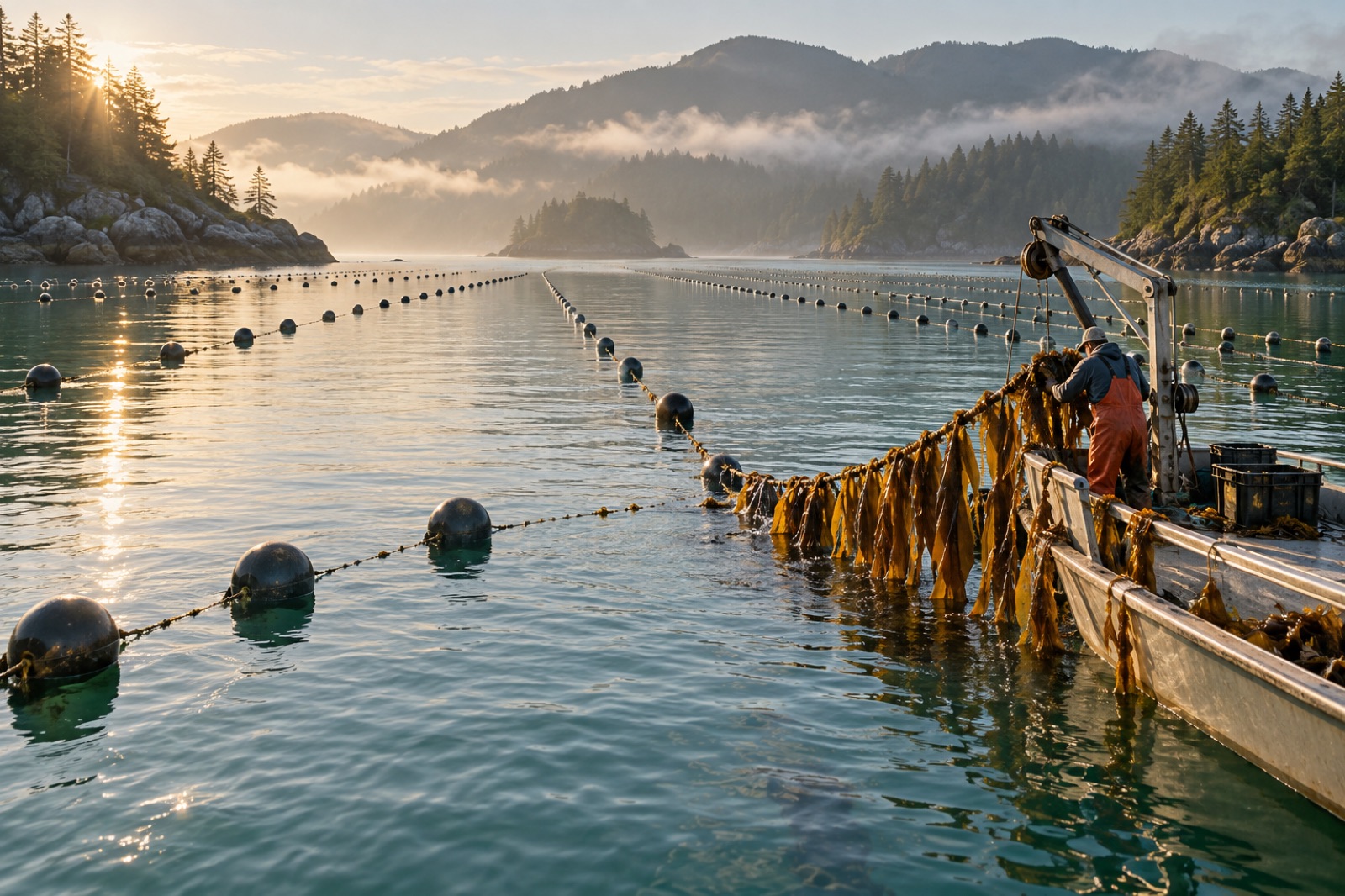
Seaweed farming carries a reputation for low-cost entry — no feed, no fresh water, no fertiliser, just rope in the sea and a growing season. That reputation is half true. The input costs are genuinely low; the labour, compliance and processing costs are genuinely not. Farms fail on the second column far more often than the first. This article lays out a realistic financial picture for a small commercial kelp farm: what you'll spend before the first harvest, what a line can yield, what the crop actually sells for, and the levers that separate a working business from an expensive hobby.
If you're earlier in the journey, our step-by-step guide to starting a small seaweed farm covers permits, sites and season planning; this piece assumes you've found a site and want to know whether the numbers can work.
Start-up capital: what the first season actually costs
For a first farm of around one hectare — five to ten longlines of roughly 100–150 metres, purpose-designed per our longline design guide — the honest budget ranges widely by region, but the categories are consistent:
- Gear and moorings: rope, chain, anchors, buoys, shackles and thimbles. Expect this to be the single largest hardware line item. Anchoring and rope quality are not places to economise — gear failure costs a season.
- Vessel access: buying a suitable workboat is beyond most start-up budgets; most small farmers own a modest skiff and contract a larger vessel with a crane or winch for seeding and harvest days. Budget the contract hours explicitly.
- Seed stock: hatchery-seeded line, either purchased per metre of seeded twine or produced in-house. Buying seed is usually cheaper than building hatchery capacity until you're farming several hectares; our seed stock explainer walks through the trade-offs.
- Leases and permits: site licence fees, environmental assessments and (in many jurisdictions) a navigation notice. Highly variable — in some places trivial, in others the dominant start-up cost and the longest timeline.
- Processing and cold chain: at minimum, drying space, clean salt or food-safe containers, and access to refrigeration or freezing. This is the line first-time budgets most often omit.
- Insurance and safety: vessel insurance, employer liability if you have crew, and site liability.
A lean, founder-labour one-hectare operation in a jurisdiction with cooperative permitting can start in the low tens of thousands of dollars. With assessments, contracted vessels and approved processing it can be several times that. Plan for the middle and be pleasantly surprised.
Operating costs: where the money actually goes each year
Season after season, the operating budget is dominated by three things:
1. Labour
Kelp's near-zero input costs mean labour becomes 40–60% of operating expense for small farms. Seeding, mid-season line checks, harvest (which arrives all at once, compressed into a few spring weeks) and post-harvest handling are all people-hours. Every design decision that reduces boat days — better line spacing for your vessel, larger single harvests over multiple pickups, gear you can service from a smaller boat — falls straight to the bottom line.
2. Vessel operating costs
Fuel, maintenance and contracted boat time. Harvest logistics often drive farm layout: if a crane-equipped vessel can lift entire growth lines, you can beat the narrow harvest window; if you hand-harvest from a skiff, you need more days and a bigger market tolerance for variable quality.
3. Processing
Kelp is roughly 80–90% water. You are, functionally, in the business of removing water quickly and safely. Air-drying is cheap and brilliant when weather cooperates, and ruinous in a wet spring. Mechanical dryers, blanching and freezing, and food-safety-compliant hanging space are where "cheap to grow" meets "expensive to handle". The farms that stay profitable almost always own or co-own reliable drying capacity.
Yields: what a line can realistically produce
Yield varies enormously by species, site, season length and stocking density. As working figures reported across temperate kelp industries:
- Sugar kelp (Saccharina latissima) and kombu (Saccharina japonica) commonly return 5–15 wet kilograms per metre of growth line at harvest in a good season, with well-run farms on ideal sites exceeding that.
- A one-hectare grid carrying 1,500–3,000 metres of growth line can therefore produce 10–40 wet tonnes per season — a wide band that tracks site quality more than anything else.
Two dampeners on optimistic spreadsheets: first, you will lose some percentage of seeded line to storms, poor set and fouling every season (good operators plan for 10–20% loss, not zero). Second, wet tonnes are not product tonnes. Dried at 10–15% moisture, that 20-wet-tonne harvest is two to three tonnes of dried product. Do all of your revenue arithmetic on dried tonnes, because that is what buyers price.
Revenue: what kelp actually sells for
Now the sobering part. Farm-gate prices for bulk kelp (the basis of global alginates, fertilisers and commodity biostimulants) are low — a few dollars per dried kilogram, sometimes barely a dollar. At bulk prices, the 10–40 tonne wet harvest above won't cover costs, which is why pure commodity plays only pencil at very large scale with mechanised harvest.
Small farms stay viable by selling up the value ladder:
- Wholefood and culinary grades: dried whole leaf, flakes and food-grade kombu can bring an order of magnitude more than bulk prices — but demand food-safe drying, testing, packaging and a story chefs believe in.
- Nursery seed and broodstock: selling seeded line to other farms is a real revenue stream for operators with hatchery skills.
- Biostimulant and feed customers: contracted sales to processors smooth price volatility even at modest rates.
- Co-located crops: integrated multi-trophic aquaculture lets shellfish or fish revenue share the same moorings, vessel days and lease — often the difference between marginal and robust economics.
A worked example, realistic rather than rosy: a one-hectare farm yielding 20 wet tonnes, dried to ~2.5 tonnes, sold as a mix of 60% food-grade (good but not luxury pricing) and 40% bulk, can gross in the range of a modest annual salary — before paying that labour. Scale, automation and contracted customers are how that becomes a business rather than a busy year.
The levers that decide profit or loss
Every profitable small farm we've worked alongside pulls the same five levers:
- Site quality first. Faster growth, cleaner produce, calmer logistics. A mediocre site makes every other lever twenty percent harder.
- Buyers before buoys. Secure an off-take agreement — even a soft letter of intent — before you put gear in the water. Harvest is perishable; buyers found afterwards pay accordingly.
- Own the drying bottleneck. Shared dryers with neighbouring farms or shellfish co-ops turn the biggest risk into fixed, predictable cost.
- Design labour out. Fatter lines harvested whole; mechanical lifting; fewer, bigger boat days. Cost per tonne is a design outcome, not luck.
- Stack revenue per hectare. IMTA, seed sales, agritourism days, nursery contracts. The mooring grid is the expensive part; everything that shares it is margin.
It's worth noting that these economics are precisely what Tidewright's restoration-adjacent farms are built against: our Tidewright Harvest model co-locates revenue farms with restoration sites so that lease, vessel and monitoring costs serve both the crop and the forest, and fisheries partners in our Reef Partners programs can adopt the same stacked-income structure.
Key takeaways
- Inputs are cheap; people, boats and processing are not. Labour is 40–60% of small-farm operating cost.
- Budget start-up honestly across gear, vessels, seed, permits and processing — with drying capacity as the most-omitted line.
- Realistic yields are 5–15 wet kg per metre, 10–40 wet tonnes per hectare, and roughly a tenth of that dried.
- Bulk commodity prices won't pay a small farm's bills; food-grade, seed, biostimulant contracts and IMTA stacking will.
- Sign a buyer before you seed, and design every farm choice around reducing boat days per harvested tonne.
FAQ
How much does it cost to start a one-hectare kelp farm?
Anywhere from the low tens of thousands of dollars for a lean, founder-run operation with simple permitting, to several times that where environmental assessment, contracted vessels and approved processing facilities are required. Get local quotes for moorings and farm an honest labour budget before committing.
What is a realistic seaweed yield per hectare?
For sugar kelp and kombu-type species, plan around 10–40 wet tonnes per hectare per season depending on site quality, then divide dried product by roughly eight to ten. Your first two seasons at a new site should be treated as calibration years.
Is small-scale seaweed farming profitable?
It can be, but rarely on bulk prices alone. Profitable small operations sell food-grade or value-added product, hold contracts for biostimulant or feed supply, stack income (shellfish, seed, tourism), and rigorously minimise labour per tonne. Treat the first plan that pencilled at commodity-only prices as a warning sign.
How do I find buyers for my kelp?
Start local: chefs, food co-ops, regional processors, fertiliser and biostimulant formulators. Test a dried sample batch against their specs before you scale. Letters of intent before seeding are the single most valuable document a new farm can hold.
Can seaweed farming work as a side income to fishing?
Yes — this is one of the strongest models. Fishing vessels, licences and crew skills transfer directly, and kelp's season often fits the fishery's off-season. Fisheries cooperatives and programs like our Reef Partners pathway for fisheries formalise exactly this complementarity.