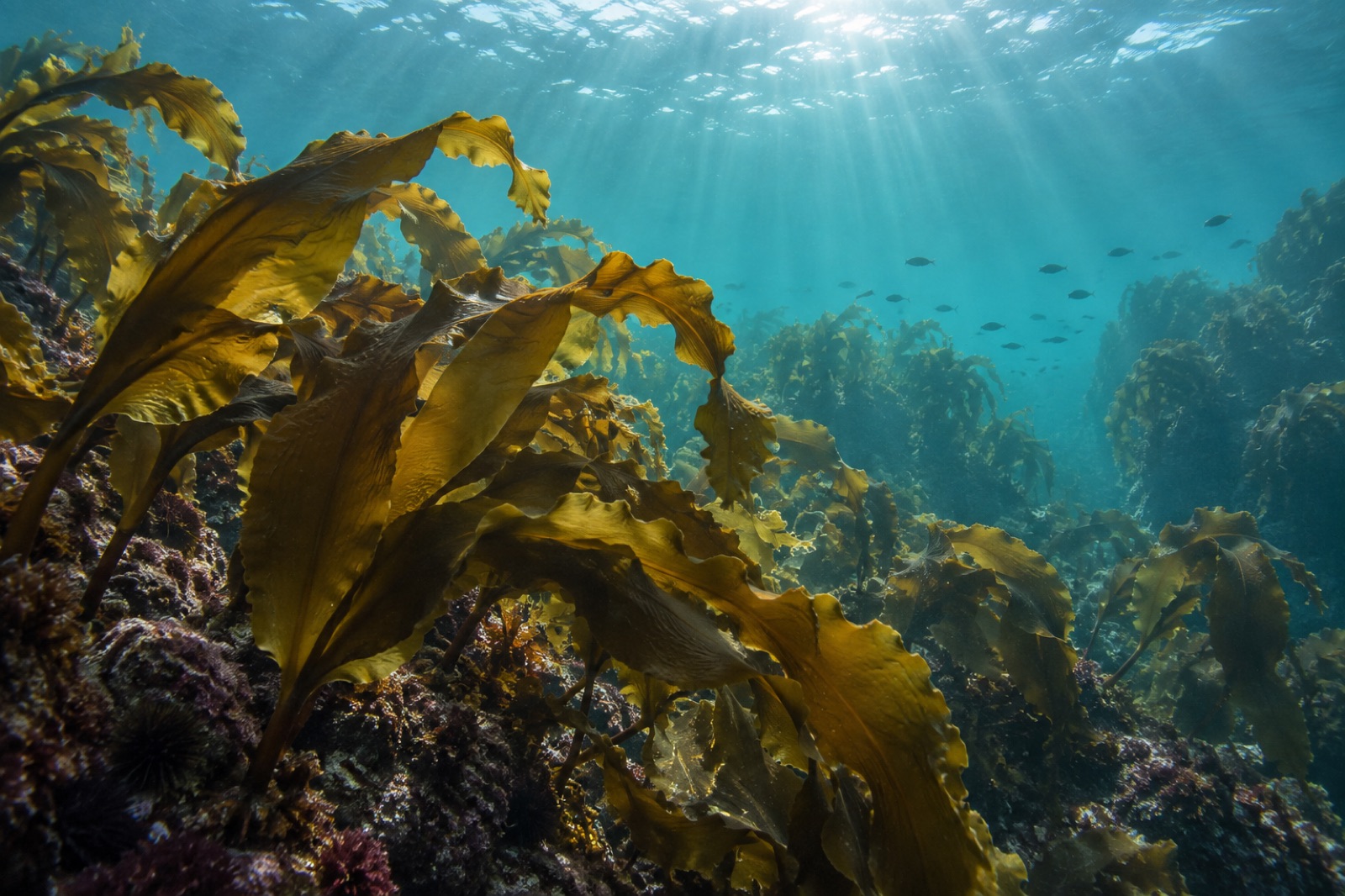
Kombu (Saccharina japonica) is the most quietly important seaweed on Earth. It seasons the stockpot of an entire cuisine, anchors the largest seaweed aquaculture industry in the world, and grows wild in cold Pacific forests that shelter everything from abalone to sea otters. If you have ever tasted dashi — the clear, savoury broth at the heart of Japanese cooking — you have tasted kombu. Here is the biology, geography and culture behind it.
Fast facts
|
|
| Scientific name |
Saccharina japonica (formerly Laminaria japonica) |
| Group |
Brown algae (Phaeophyceae), order Laminariales |
| Maximum length |
2–5 m typical; wild giants over 10 m |
| Lifespan |
Usually two years, sometimes longer in the wild |
| Depth range |
Subtidal, roughly 2–30 m, on rocky substrate |
| Temperature preference |
Cold water, roughly 5–15 °C; stressed in prolonged warmth |
| Distribution |
Native to the northwest Pacific: Hokkaido and northern Honshu (Japan), the Korean Peninsula, the Russian Far East; farmed widely, especially in China |
Anatomy of a dashi kelp
Kombu shares the classic kelp body plan — a holdfast gripping rock, a short stipe, and then, in place of giant kelp's many divided fronds, one immense, undivided blade. That single broad frond is the whole point. It grows from a meristem near the base and can stretch to the length of a small fishing boat, thick and leathery at the edges, ruched like dark silk toward the middle.
Unlike many large kelps, kombu has no gas floats. Its fronds surge with the swell rather than standing upright in cathedral columns, which is part of why wild kombu beds have a different underwater feel from a Macrocystis canopy — darker, closer to the reef, a low golden-brown ceiling rather than a forest of masts.
The blade's surface accumulates mannitol and sea salts as it grows, and a pale white powder — mostly mannitol — blooms on the surface of well-cured dried kombu. For generations this was mistaken for salt or mould; it is actually a mark of quality and one of the easy ways to tell a well-made product from a rushed one.
A two-year life in two bodies
Like all kelps, kombu alternates between generations, and the two could hardly look more different.
- The sporophyte is the familiar frond. In autumn and winter its maturing blade develops dark, velvety patches called sori, which release clouds of swimming zoospores.
- Spores settle on clean rock and grow into the gametophyte generation — microscopic filaments, just a few cells, that produce eggs and sperm.
- Fertilised eggs germinate into new sporophytes, which grow slowly through winter and explosively through the long days of spring.
A wild plant typically lives about two years. The invisible gametophyte stage can persist much longer in shade and sediment, forming a seedbank in the reef itself. This dormant stage is the biological basis of kelp restoration: Tidewright's Holdfast hatcheries culture exactly this generation, raising millions of gametophytes on seeded twine far more densely than a reef ever could.
Where kombu grows: the Oyashio's gift
Kombu is a creature of cold, nutrient-rich water, and its homelands trace the path of the Oyashio — the "Parent Current" that slides south from the Sea of Okhotsk along Hokkaido's eastern flank. Nowhere is this clearer than Hokkaido itself, which remains the heartland of wild kombu gathering, with dried kelp producing about nine-tenths of Japan's domestic supply.
Japanese connoisseurs divide kombu by coastline the way winemakers divide grapes:
- Ma-kombu from southern Hokkaido — thick, broad, elegant; the classic dashi kombu.
- Rishiri-kombu from the northern island waters — clear, sweet stock prized for light dashi.
- Rausu-kombu from the Shiretoko Peninsula — rich and rounded, the heavyweight.
- Hidaka-kombu (mitsuishi-kombu) — softer, everyday kelp that cooks down quickly for simmered dishes.
The curing culture is its own craft. In some towns, harvested kelp is aged a year or more in storehouses — kombu kura — where slow maturation deepens its savoury character, a practice that turns a perishable wild harvest into a cellar-aged commodity. Our Coastal Atlas explores these cold-water coastlines in depth, region by region.
Kombu and the science of umami
Kombu earned a place in scientific history in 1908, when the chemist Kikunae Ikeda boiled down kelp stock and isolated the substance behind its savouriness: glutamate. He named the taste umami. The dried blade's alchemy comes from a handful of actors:
- Glutamic acid — the savoury trigger, at concentrations few ingredients match.
- Alginates and soluble fibre — which give kombu its body and make it valuable as a texturiser.
- Iodine — kombu is one of the richest iodine sources in any cuisine; a blessing in the right amounts and a reason to treat it with respect rather than abandon.
One piece of practical kitchen science: glutamate leaches fastest in water held just below boiling. Steep at a bare simmer, and never boil hard — the stock turns bitter and clouded. Our seaweed food guides cover dashi technique in far more detail.
From wild beds to floating farms
China grows more Saccharina japonica than anywhere on Earth — which is remarkable, because the species is not native there. Introduced from Hokkaido to Dalian in the late 1920s, it became the foundation of an industry built on a brilliant piece of farming: hatcheries chill water and culture sporelings through summer in tanks, then outplant seeded ropes onto longlines in autumn, when coastal seas cool. Fronds grow downward on suspended lines through winter and are harvested by the boatload in early summer.
This "forced sporeling" method broke the farming calendar's dependence on natural reproduction, and it is a direct ancestor of the seeding technology we use in restoration. The engineering behind modern longlines and seeded cord is covered in our seaweed farming guides.
Threats in a warming sea
Kombu is a cold-water species in an ocean that is warming fast. The northwest Pacific has experienced some of the most intense marine heatwaves on record, and wild kombu beds feel them first: warm water suppresses the nitrate the kelp needs, shortens the growing season, and at the southern edge of its range can erase beds outright. Even in Hokkaido's heartlands, harvests swing hard on warm years.
The species is not endangered — farmed production dwarfs the wild take — but wild kombu forests, with their genetics tuned to specific bays and current systems, are a different question. They harbour the cold-adapted lineages that future farming and restoration will need. Protecting them, and the cold-water reefs of the northwest Pacific generally, is not nostalgia; it is seedbank management for a warming century.
Key takeaways
- Kombu (Saccharina japonica) is a single-bladed cold-water kelp native to the northwest Pacific, typically reaching 2–5 m over a two-year life.
- It alternates between a large sporophyte and a microscopic, long-lived gametophyte — the stage restoration hatcheries culture at industrial density.
- Wild kombu tracks the cold Oyashio current; Hokkaido produces around 90% of Japan's domestic dried kombu, graded by coastline like fine wine.
- Glutamate from kombu gave science the word "umami" in 1908; proper dashi is a just-below-boiling art.
- China now farms vast tonnage of this species on longlines using summer-cultured sporelings — technology ancestral to modern kelp restoration.
- Marine heatwaves are compressing the wild range; wild beds matter as genetic seedbanks even where farming booms.
FAQ
Is kombu a plant?
No. Like its giant-kelp cousin, kombu is a brown alga. Its holdfast anchors but absorbs nothing — growth and feeding happen across the whole blade surface, powered by photosynthesis and dissolved nutrients.
Is kombu the same as kelp?
Kombu is a kelp — one species among roughly a hundred in the order Laminariales. "Kelp" is the ecological category; kombu is the species (and, in the kitchen, the ingredient made from several closely related Saccharina species).
Why does dried kombu have white powder on it?
Mostly mannitol, a natural sugar alcohol that crystallises as the blade cures. It is a traditional sign of slow, careful drying — brush it off if you like, but it dissolves harmlessly into stock, and connoisseurs leave it on.
How much kombu is safe to eat, given the iodine?
Kombu is exceptionally iodine-rich. A small daily portion of dried kombu in dashi is fine for most people, but regularly eating large amounts — or drinking concentrated kombu water — can push iodine intake past safe limits, especially for people with thyroid conditions. Moderation and variety are the rules, as with any potent food.
Can you grow kombu outside Japan?
Yes, and people do — China farms it at enormous scale, and trial farms operate in Europe and North America with native Saccharina species like sugar kelp (S. latissima) or oarweed (S. japonica's relatives). Local genetics matter enormously, which is why our species coverage emphasises provenance: the right kelp for the right bay.