Farming11 min read
Farming Gracilaria: The Agar Seaweed Supply Chain
How Gracilaria red seaweed is farmed in ponds and on lines, how agar is extracted from it, and what growers should know about grades, buyers and realistic yields.
Naomi Reyes ·
A practical guide to pond and lagoon culture of Gracilaria — pond design, stocking, water exchange, harvest cycles and the agar and food markets it serves.
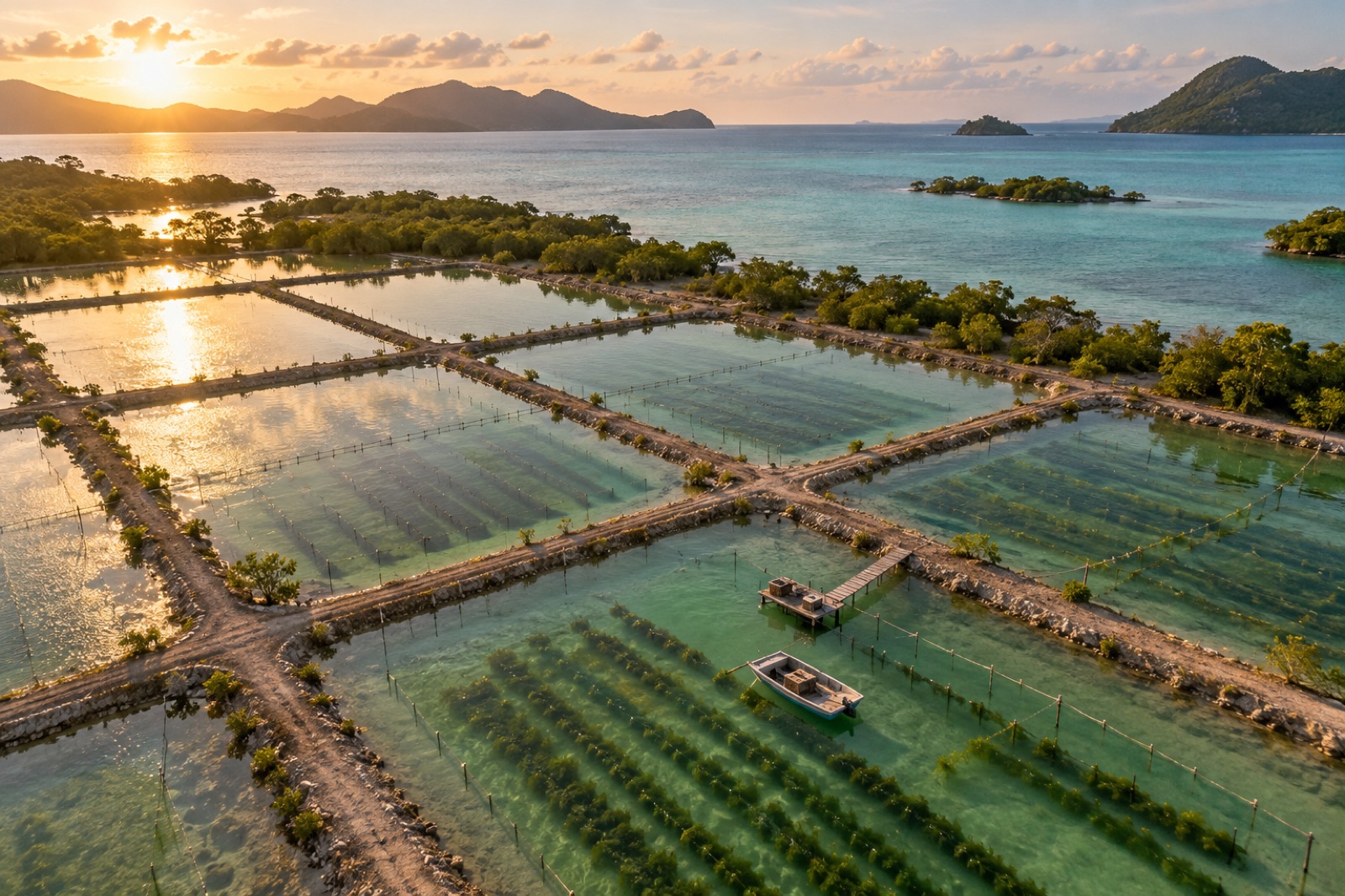
No hull, no longlines, no anchors — just warm, sunlit water in a shallow coastal pond, and a red alga that grows so obligingly it has fed and gelled a substantial share of the world's kitchens and laboratories for decades. Gracilaria, the genus behind much of commercial agar and the fresh ogonori of East and Southeast Asian food markets, is the most farmed seaweed hardly anyone in cold-water kelp circles talks about. Where Farming Gracilaria: The Agar Seaweed Supply Chain traces what happens after harvest, this guide stays at the water's edge: how pond culture actually works, from site and stocking to weekly harvest rhythm.
Open-water farming puts you at the mercy of weather, drag and boat logistics. Pond culture inverts those constraints: you trade exposure for control. In a pond you manage water depth, exchange, salinity and grazing pressure directly, and harvest with a rake and a basket rather than a winch. The trade-offs are real — land and pumping costs, disease concentration, and vulnerability to heat and rain events — but for warm-water species the arithmetic often favours basins.
Gracilaria is almost perfectly built for this:
Pond performance is set at siting, not at stocking. You are looking for:
If you come from open-water kelp background, note how different this checklist is from the depth-current-exposure logic of Choosing a Farm Site: Depth, Current, Exposure and Neighbours. A Gracilaria pond is agriculture with seawater; think field, not mooring.
Ponds in commercial Gracilaria areas are typically shallow — on the order of half a metre to a metre of standing water — because Gracilaria is farmed as a suspended crop that benefits from light reaching most of the water column and from frequent handling. Design principles:
Stocking is vegetative: healthy thalli — clean, well-pigmented, epiphyte-light — are broken into fronds and spread across the pond, either free-floating, tucked into the substrate, or suspended in short mesh tubes ("net pockets") hung from lines or frames. Suspension keeps the crop off the sediment, out of the worst of the benthic grazers, and dramatically easier to harvest; it costs infrastructure and labour to set.
Practical stocks run dense enough to shade the bottom (suppressing weeds) but open enough for water to move through the canopy. Exact densities vary with water exchange and temperature; the skill is in the weekly thinning that keeps the canopy in the fast-exponential part of its growth curve rather than letting it crowd itself into stagnation.
Growth is tracked by simple measures: standing biomass per pond, frond condition, epiphyte load on older tissue, and water transparency. A pond diary — what came in, what went out, what the water looked like — is worth more than any sensor; the record-keeping discipline of good kelp farms transfers wholesale.
Ponds concentrate biology, so water management is the whole craft:
Harvest is continuous or cyclic: a portion of each pond weekly, whole ponds on rotation, with trimmings returned as stocking. The crop is pulled by hand or with rakes into baskets, drained, rinsed in clean seawater and moved to shade — Gracilaria wilts and bleaches fast in direct sun.
Then the road splits by market:
Fast-growing red seaweeds like Gracilaria sit in the same continuous-harvest family as Ulva and the tropical carrageenophytes covered in Kappaphycus and Eucheuma: high moisture, fast turnover, and a processing decision that must be made before the crop is cut, not after.
Commercial pond culture is overwhelmingly a warm-water industry because growth rates and year-round cycles drive the economics, but Gracilaria species occur from temperate to tropical shores, and small-scale trials exist well outside the tropics. The constraint is usually winter growth slowing below commercial interest.
Yields vary enormously with temperature, exchange, stocking method and strain, so any single number would mislead. What matters operationally is the harvest interval your pond can sustain weekly without drifting backward in standing biomass — track that per pond, per season, and let your own ledger set the benchmark.
Yes — the same species is farmed on ropes and rafts in open water, and in land-based tanks for high-value food grades. Pond culture sits between the two: more control than the sea, lower cost per tonne than tanks.
Ice-ice is a stress syndrome — whitening and fragmentation — linked to heat, salinity shock, low exchange and crowding. There is no cure for affected fronds; remove them, correct the stressor, and protect your mother stock so you can re-stock from clean material.
Almost certainly: coastal earthworks, seawater abstraction and aquaculture each attract their own consents in most jurisdictions. Start the permitting conversation early — the framework in Seaweed Farm Permits: Navigating Leases, Licences and Consent applies to ponds as much as to marine sites.
How Gracilaria red seaweed is farmed in ponds and on lines, how agar is extracted from it, and what growers should know about grades, buyers and realistic yields.
Naomi Reyes ·
Ulva grows faster than almost any farmed seaweed and cleans up nutrient pollution — but it sporulates, frays and defies handling. A practical farming guide.
Naomi Reyes ·
How to evaluate a seaweed farm site: the physical criteria that decide your crop, the water quality checks, and the social map of neighbours and rules.
Naomi Reyes ·