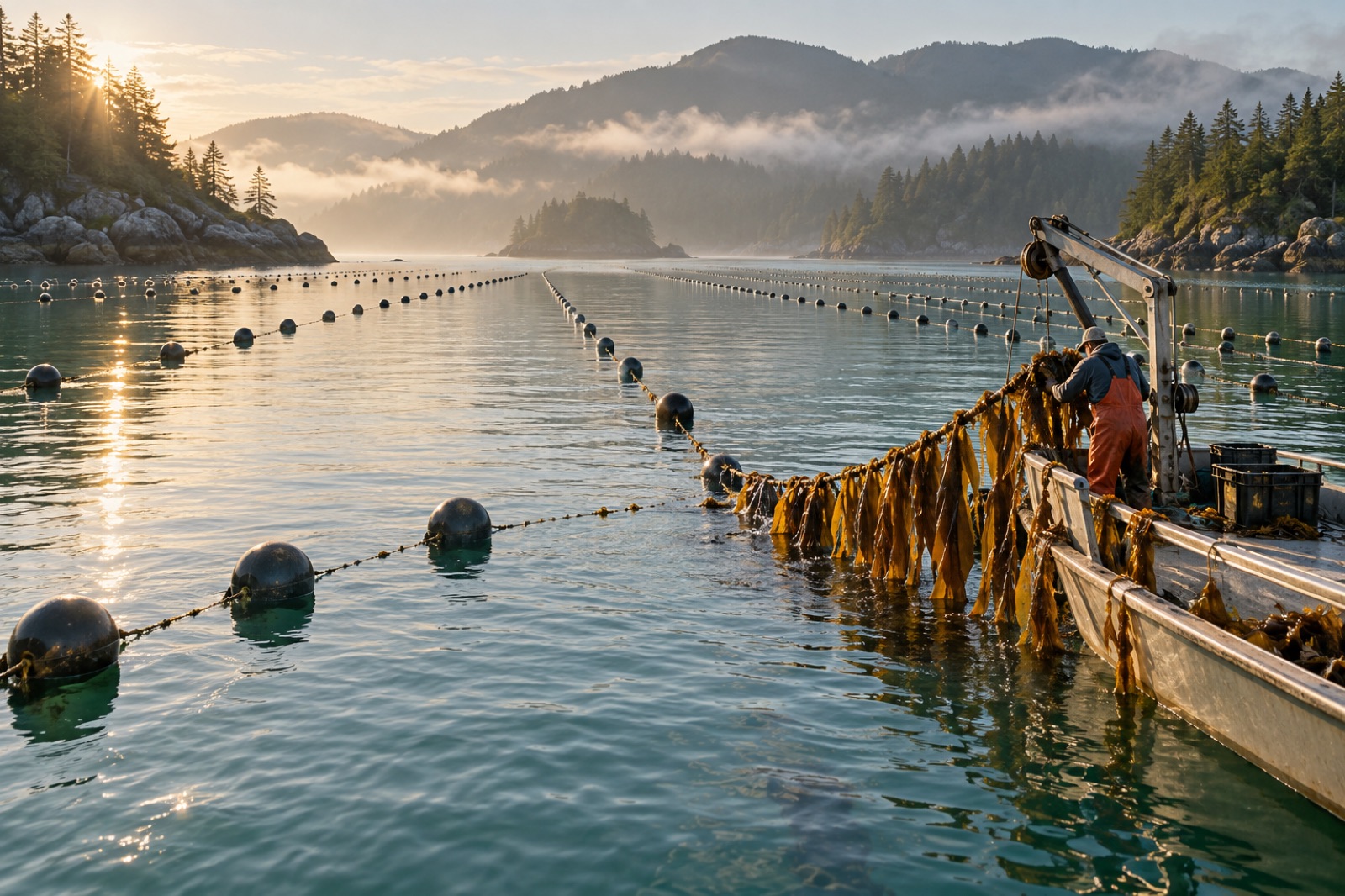
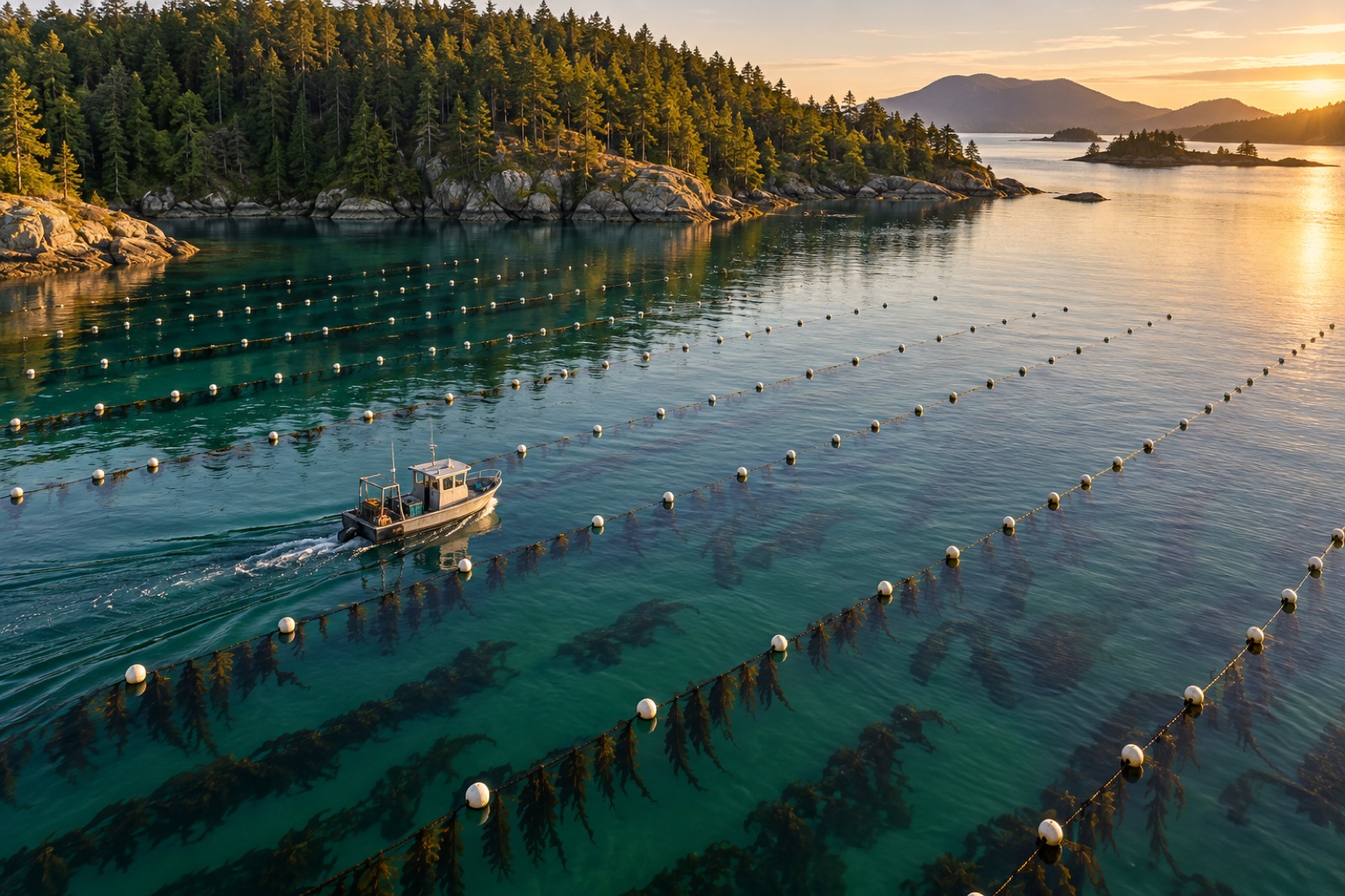
Every kelp farm has a supply chain, and its most fragile link is about three millimetres thick: the seeded twine your whole season grows from. Farmers obsess over anchors and rope, and then treat seed — the one input that determines species, genetics, growth rate and disease status — as a line item to be ordered in the autumn rush. By then it is usually too late to order well.
This article is the buyer's guide: where kelp seed stock actually comes from, what your two sourcing routes cost you in lead time and control, how provenance rules shape what you may plant, and what to check when a spool of seeded line arrives at the dock. For the biology inside the hatchery — life cycles, spore release, nursery culture — read our companion piece, seaweed seed stock: from spores to seeded line.
The two sourcing routes
There are only two places seeded line comes from, and most farms will use the first.
Route 1: A commercial or program hatchery
A hatchery does the entire microscopic half of kelp farming for you: collecting and cleaning sorus tissue from parent blades, triggering spore release, seeding spools of twine, culturing them through the gametophyte-to-sporophyte transition, and shipping line carrying centimetre-scale seedlings ready to out-plant. In return you get:
- Consistency. Seeding density, seedling vigour and delivery dates you can plan a season around.
- Disease and fouling screening. Nursery-phase problems — diatom films, bacterial blooms — are caught in the tank, not on your lease.
- Provenance documentation. Parent collection location, batch records, and in well-run programs a genetic profile of the seed lot. Increasingly, food buyers, restoration funders and insurers all ask for exactly this.
This is the model behind Tidewright's Holdfast hatchery network, which grows climate-matched seedstock for restoration and partner farms — and it is the right default for a farm's first several seasons, whatever country you farm in.
Route 2: Permitted wild sorus collection
In some jurisdictions, a licensed farmer may collect reproductive blades (sorus-bearing tissue) from wild kelp and seed their own lines in a shore-based setup of tanks, chilled seawater and patience. The appeal is real: low cash cost, tight local provenance by definition, and independence from hatchery queues. So are the costs:
- Regulation. Wild collection almost always requires a permit, often with species quotas, closed areas and seasonal windows. Collecting without paperwork is poaching, full stop — and in regions where wild kelp is itself under pressure, tight limits are the point of the rules.
- Skill and infrastructure. You become a hatchery. Temperature control, sterile discipline, and the judgment to read seedling health under a magnifier are learnable — but they are a second profession stacked onto farming.
- Risk concentration. One fouled tank loses your whole year's seed, with no supplier contract to fall back on.
The pragmatic middle path many experienced growers choose: buy hatchery seed as the backbone of the season, and run a small permitted collection as research, insurance and learning — never as the load-bearing supply.
The procurement calendar: order a season before you plant
Seed is the longest-lead-time item in the whole farm, and first-year farmers discover this the hard way. A realistic calendar, for a temperate farm planting in autumn:
- 12–9 months out: choose species and quantity; approach hatcheries. Parent stock for next season's seed is being selected now — in many hatcheries, broodstock collection for your autumn crop happens while the current crop is still at sea. Late orders get whatever genetics remain, if any.
- 6–4 months out: sign a supply agreement with volumes, delivery window, price and quality specification. Confirm your hatchery's provenance: parents sourced from your region, and if your sector demands it, a climate-matched strain.
- 3–1 months out: the hatchery seeds and cultures your spools. You should receive batch updates — seeding density achieved, nursery survival; a professional hatchery volunteers these.
- Delivery window (days, not weeks): seeded line is shipped chilled and is out-planted within a narrow window — often 48–96 hours of receipt. Your lines must already be in the water, tensioned and waiting. The classic first-year failure is beautiful seed arriving at an unprepared lease.
Put the whole chain in reverse in your planner: harvest window fixes planting week, planting week fixes delivery, delivery fixes the hatchery's seeding date, seeding fixes broodstock collection — which lands the previous spring. Our article on the first-year business timeline builds this calendar into the farm budget.
Provenance: why "local genetics" is a rule, not a slogan
Kelp populations are locally adapted to temperature, photoperiod and seasonality. Planting seed raised from distant parents does not just risk a weak crop — it risks introducing mismatched genetics into wild populations your farm abuts, and a bolting, off-season crop that sheds spores into the wrong season. Responsible jurisdictions increasingly codify this: seed for a lease must derive from parents collected within a defined radius or region, with a minimum number of parents to preserve diversity.
Ask every supplier three provenance questions and expect documentary answers:
- Where were the parents collected? Insist on a named region, and prefer one matching your lease's water.
- How many parents contributed to this batch? A batch from two blades is a genetic bottleneck you are about to plant across hectares. Well-run hatcheries use dozens of parents per batch.
- Is the strain climate-matched? For a farm on a warming coast, seed selected for thermal resilience is becoming a straightforward economic decision — the difference between a harvest and a heat-killed season. Why local adaptation matters so much is spelled out in marine heatwaves 101.
Quality control at the dock: what good seed looks like
Seeded line is perishable, and the delivery moment is your only chance to reject a bad batch before it costs you a season. Check, on receipt:
- Coverage. Unspool a sample metre: seedlings should be visible as an even brown fuzz along the twine — not dense clumps (overcrowded, will self-thin and knot) and not bare stretches with gaps (poor seeding or transit die-off).
- Size and vigour. Seedlings should be at the agreed size class — typically millimetre to low-centimetre scale at delivery — uniform, and a healthy olive-brown. Bleached, translucent or slimy sections are red flags.
- Cleanliness. The twine should carry kelp, not a garden: heavy green or golden-brown films suggest diatom or green-algal fouling cultured in the nursery, which will outcompete your seedlings at sea.
- Cold chain. Spools must arrive chilled, moist and odourless-clean. Warm, dry or sulphurous-smelling deliveries have been cooked in transit; document and reject per your contract.
Accept only with the batch sheet: seeding dates, parent region, seeding density and the delivery-window instructions. File it — your buyer, insurer or certifier may ask for it years later, exactly as carbon and restoration programs ask today (see how documentation chains work in MRV for blue carbon).
Contracts and contingencies
Treat your seed supplier as your most important business relationship after your buyer. A workable agreement specifies volume and size class, the delivery window with named fallback dates, a quality standard (with a rejection process), and what happens if the hatchery loses the batch — credit, re-seed, or a refill from a held reserve. Professional hatcheries hold nursery redundancy for exactly this; ask. Then build your own redundancy: a second supplier relationship warmed up, or your permitted small-scale collection running, so no single lost tank can cost your year.
Key takeaways
- Farm kelp comes from exactly two places — hatcheries or permitted wild sorus collection — and hatchery seed should be the backbone of any farm's first seasons.
- Order seed 6–12 months before out-planting; broodstock for your autumn crop is collected while the current crop is still growing.
- Provenance is regulatory reality, not marketing: local parentage, many parents per batch, and increasingly climate-matched strains for warming coasts.
- Inspect seed on receipt — even coverage, agreed size, clean twine, intact cold chain — and accept only with batch documentation.
- Write delivery windows, quality standards and failure remedies into the seed contract, and keep a second supply route warm.
FAQ
Can I collect my own kelp seed from the wild?
Sometimes — but only under permit in most jurisdictions, with limits on species, areas, seasons and quantities. Wild kelp forests are under pressure in many regions, so collection rules are deliberately tight. Even where legal, self-seeding demands hatchery-grade water control and skills; most farms do better buying professional seed and running collection only as a modest, licensed side operation.
How far ahead do I need to order seeded line?
Six to twelve months before your planting date. The binding constraint is broodstock: hatcheries collect parent tissue for your season months in advance, and late orders can only take what remains — if anything. Signing a supply agreement half a year out, with volumes and a delivery window, is standard practice.
What does "provenance-matched" seed mean?
Seed whose parent kelp was collected in the same region — the same water conditions — as your lease. Kelp populations are locally adapted to temperature and season length, so non-local seed tends to underperform or reproduce out of season, and can introduce mismatched genetics into neighbouring wild beds. Many regulators now require provenance documentation for exactly this reason.
How much seeded twine does a hectare need?
It depends on your line spacing and seeding method, but hectare-scale farms typically out-plant on the order of several thousand metres of seeded twine across their growth lines. Specify volume in your hatchery contract by metres of line and target seedling density, and reconcile it against your grid layout before signing.
What should seed cost?
Prices vary widely by species, region, seeding density and whether provenance or climate-matched selection is included — so treat any single figure with suspicion. What matters to the budget is that seed is a modest share of total season cost, typically well below labour and gear combined; the expensive seed mistake is not price but failure — a dead batch at planting time costs the entire season, not the spools.