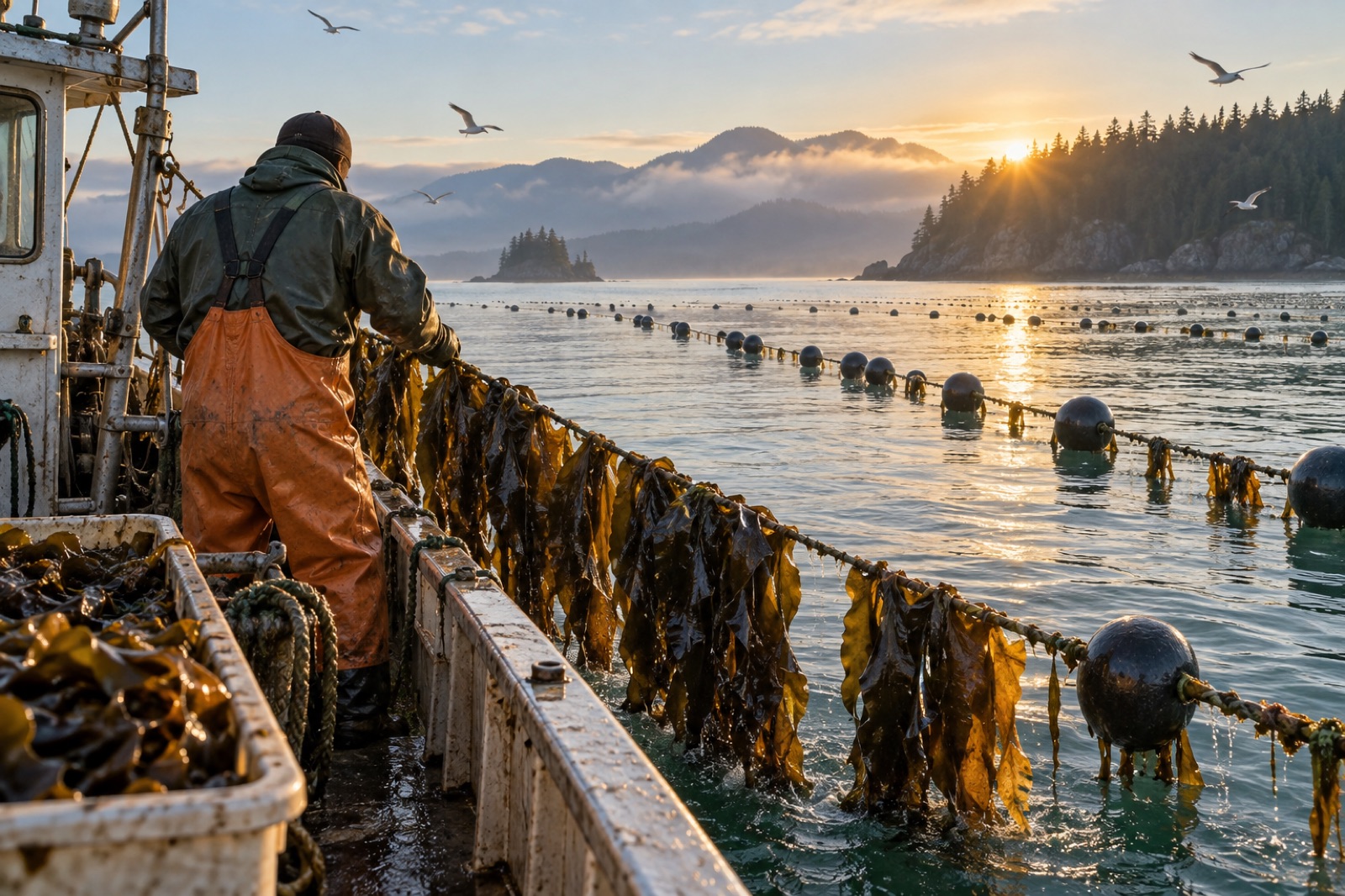
A seaweed farm is, by any measure, one of the most photogenic workplaces on the coast: black longlines beaded with kelp, gulls working the tide line, a workboat nosing between rows of what looks like a submerged orchard. Visitors pay to walk through orchards and vineyards on land; a growing number of farmers are discovering they will pay to visit one at sea. Tourism will never replace your product revenue — but done carefully, it can soften the brutal seasonality of seaweed income, build the local goodwill every farm needs, and turn your crop into a story people carry home.
This guide covers the realistic shapes a kelp farm visitor program can take, what regulators and insurers will ask of you, and where the economics actually land.
Why Diversify? The Cash-Flow Problem Tourism Solves
Most small kelp and seaweed farms earn the great majority of their income in a six-to-ten-week harvest window. That concentrates revenue, labour and risk into a sliver of the year, a dynamic we break down in Seaweed Farm Economics: Costs, Yields and Realistic Revenue. A visitor program spreads earnings across the calendar:
- Pre-season (autumn/winter): seeded-line tours — visitors see deployment, hatchery output, and the "baby forest" stage.
- Growing season: ecology-focused trips when the lines are lush and full of fishes and invertebrates.
- Harvest: the premium product — working-harvest trips where guests watch or help pull lines.
Tourism income is also product-independent. In a harvest year cut short by storms or a die-off, a farm with bookings still earns. And visitors who have stood on your deck become your most loyal direct-market customers — see Selling Farmed Kelp Direct: Farmers Markets, Restaurants and CSAs.
There is no single model. Match the offer to your site, boat and appetite.
Boat tours (the workhorse)
A sixty-to-ninety-minute loop around the lease on a stable vessel is the simplest product. Content: how kelp grows, why the farm is where it is, wildlife on the lines, a taste of the product. Group size is set by your boat's certified capacity, not ambition.
Harvest experiences
Guests gear up and help haul, weigh and grade a line, then take home what they cut. These sell at a premium because they are participatory. They also cut into your own harvest hours, so schedule them at the edges of commercial days, not in their heart.
Snorkel and kayak visits
The most spectacular option — a kelp farm in summer is a vertical garden full of life — and the most demanding. Cold water, boats under way and submerged lines are a serious risk envelope. Most operators partner with a licensed dive or paddle outfitter rather than running in-water trips themselves. If kayaking and snorkelling audiences matter to you locally, it is worth understanding what that community looks for; our dive-focused sister site content exists for exactly that readership among the dive operators solutions audience.
School and education programs
Often the highest-impact per visitor: curriculum-aligned two-hour visits combining a shore talk, microscopes with gametophyte cultures, and a dockside look at the gear. Modest revenue per head, but booked solid in term time, and they buy community legitimacy money can't get any other way.
Onshore tasting and hatchery visits
If you hold a shore base — even a shed with tanks — a land-based option catches weather days that would cancel boat trips. A nursery walk-through plus a tasting flight of your products converts well to retail sales.
Permissions, Licences and Liability: The Unglamorous Core
Before pricing anything, answer four regulatory questions with the relevant authorities:
- Does your aquaculture lease permit tourism? Many leases are granted for crop production only. Adding "visitor activity" may require a lease variation or an additional consent. Ask early; agencies move slowly.
- Is your vessel certified to carry passengers for hire? In most jurisdictions a workboat and a passenger vessel are different legal objects, with different survey, manning and safety-equipment requirements. This is usually the single biggest gate.
- Does your insurance cover it? Your farm liability policy almost certainly excludes paying guests. Marine tourism add-ons exist and are not exotic, but they are priced against your activity profile. Read our guide on insuring a seaweed farm alongside your broker conversation — and revisit cold-water safety protocols with real care, because guests double every exposure number in them.
- Food safety rules for tastings. Serving product to visitors usually triggers food-premises requirements. The hygiene discipline in Food-Grade Seaweed: Hygiene, Handling and HACCP at the Farm Gate is your baseline, plus whatever a tasting service adds locally.
None of this is a reason not to do it — but the farms that succeed treat the paper trail as product development, not an afterthought.
Designing the Experience
A strong farm tour is a story with a beginning (the problem: lost kelp, empty reefs), a middle (the work: hatchery, seeding, growing), and an end (the bench in your hand, the taste in your mouth). Practically:
- Script the first ten minutes. Who you are, what they will see, where the life jackets live. Safety briefings delivered warmly set the tone; delivered clinically, they set a different one.
- Show, don't lecture. Haul one line. Hand around a length of seeded twine. Pass a jar of gametophyte culture and a hand lens. People remember what they touched.
- Plan for the solo host. Early on, the skipper is also the guide, deckhand and snack server. Design the route and script so one competent person can run it.
- Weather policy in writing. What counts as a cancellation, how rebooking works, what the shore-based fallback is. Publish it at booking time.
- Leave time to sell. The last fifteen minutes dockside, with product laid out and cards accepted, is where tours pay for themselves twice over.
Pricing and Booking: Small Numbers, Real Money
Keep the maths honest. A realistic illustrative model for a six-passenger tour: three departures a week through a twenty-week season at a modest per-head price yields a useful but not transformative sum — typically on the order of a junior crew member's seasonal wages. The leverage comes from the attachments:
- Direct sales conversion. Farms commonly report that a large share of tour guests buy product on the day, and many become repeat direct customers.
- Weekday education bookings fill dead time between weekend public tours.
- Partnerships with local accommodation, restaurants and festivals sell your tours for you.
Simple online booking with card payment is non-negotiable; so is a waiver system integrated into checkout.
Neighbours, Gear and Good Behaviour
A visitor is a guest on a working site, and a working site sits inside a community that may already be wary of aquaculture. The same consent-first discipline described in Winning Social Licence: Community Consent for New Seaweed Farms applies doubly once you add a passenger boat: tell neighbouring fishers you are starting tours, respect their gear, keep wash down near working boats and seabird colonies, and brief guests on what not to touch.
Ecologically, a well-run visitor program barely registers — kelp farms themselves are restorative infrastructure, and Tidewright's own Harvest program treats farm-gate education as part of the restoration model rather than a distraction from it (our figures there are illustrative, but the principle is real).
Key takeaways
- Tourism diversifies dangerously seasonal seaweed income and builds direct-market customers, but it never replaces crop revenue.
- Start with boat tours; add participatory harvest trips and school programs before attempting in-water snorkel or kayak products.
- Lease variation, passenger-vessel certification, insurance and food-safety rules are the four regulatory gates — clear them before you take a booking.
- Script the experience around story and touch; end every tour dockside with product to buy.
- Model the money honestly: tours pay for themselves through attachments — retail, education bookings and partnerships — more than through tickets alone.
FAQ
Do I need a separate business to run farm tours?
Not necessarily, but many operators run tourism under a distinct trading name for clarity on insurance, bookkeeping and marketing. Your accountant and insurer should agree on the structure before launch.
What boat do I need?
Whatever your maritime regulator certifies for carrying passengers for hire — often a surveyed vessel with defined stability, safety equipment and crewing. Some farms partner with an existing tour-boat operator whose vessel already qualifies, trading expertise and access for a revenue split.
How do I handle weather cancellations?
Publish a clear weather threshold, decide the night before, and offer rebooking or refund automatically. A shore-based fallback (hatchery visit, tasting) converts many would-be cancellations into smaller but real sales.
Will tourists damage the farm or disturb wildlife?
With a briefing and a defined route, impact is minimal — boats already transit working farms daily. The bigger risks are behavioural (guests handling gear unsupervised), which scripting and crew attention control.
Is this worth it for a one-person farm?
Only if the format fits a solo host — short, small, simple. A solo farmer running long, complex trips will burn out by August. Start with school visits and weekend public tours, and grow only once the paperwork and the script run themselves.