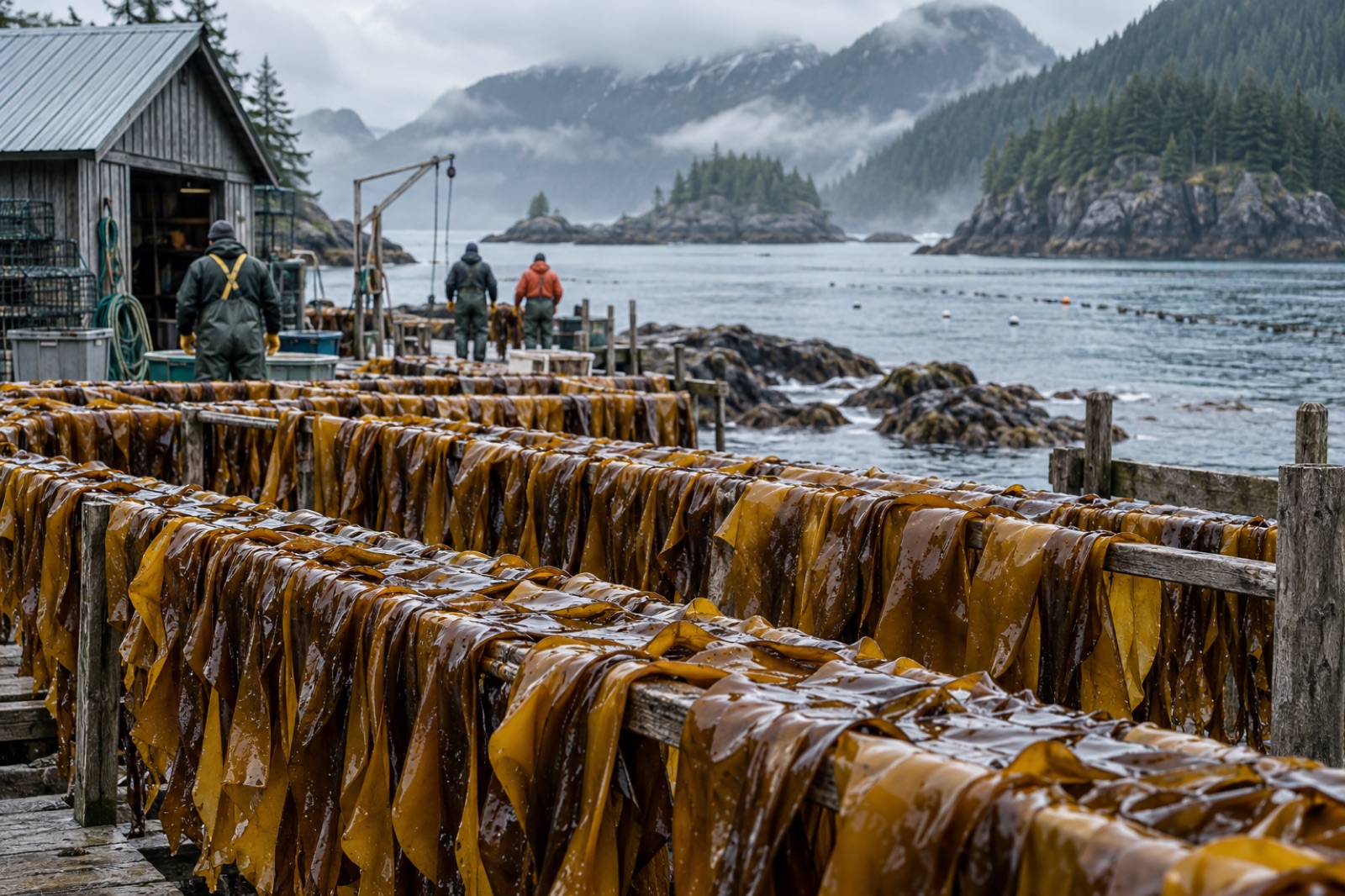
The kelp growing on your lines is already food, or it is not. The difference isn't decided in the drying shed or the processor's lab — it's decided on day one, when you chose your site, and every day after, in a chain of small hygiene decisions that either protect the product or quietly contaminate it. Food-grade handling is not a marketing aspiration; it is a set of systems. The good news, after setting up farm-gate handling for two dozen growers: the systems are simple, cheap and mostly common sense — once you know what you are actually protecting against.
This guide walks through the whole chain: site selection, vessel and personnel hygiene, harvest, transport, and the critical drying window. If you want the species-by-species processing choices afterwards, see Post-Harvest Processing: Drying, Blanching, Freezing, Milling.
Why seaweed is a special food-safety case
Seaweed is unusual among produce. It is raw, wet, ambient-temperature, continuously in contact with its growing environment, and often cold-processed (dried or blanched, never cooked). Unlike vegetables, it is commonly eaten with no peel or wash step between the shaker and the salad. Unlike shellfish, its food-safety risks aren't standardised into national monitoring schemes in most of the world — the burden of rigor falls on the grower.
The result: the farmer is responsible not just for a product that tastes good, but for the chemical and microbiological integrity of something that grows very large in a shared environment. Treat it accordingly, and the craft is entirely manageable.
Start with the site
Everything downstream is easier if the growing waters are clean. Before stocking a site for food production, run the checks you would expect any discerning buyer to ask for:
- Classified or monitored growing water. In many jurisdictions, shellfish waters are classified (A/B/C or approved/conditionally approved) and other seaweed farms ride those classifications by convention. Even where they don't strictly apply, choosing a classified site and citing it in your paperwork is the fastest credibility lever available.
- Distance from discharge. Sewage outfalls, combined-sewer overflows and river mouths after heavy rain are the main episodic contamination risks. A working buffer is 500 metres from continuous discharge and a routine of not harvesting within 24–48 hours after heavy freshwater flows.
- Marina and anchorage proximity. Fuel sheen, bilge water and anti-fouling paint residues are unglamorous, local and real. Lines too close to a berth tend to taste it.
- Historic shoreline use. Old canneries, timber treatment plants and mine outflows leave legacies in sediment. Where there is any history at all, a baseline heavy-metal screen on both water and a first test batch of dried product is cheap insurance and a one-off cost.
None of this guarantees a safe product, but all of it makes a safe product achievable. Overbuilt sites fail for boring reasons, like marketing; contaminated sites fail for unforgivable ones.
People, boats and bags
Once the site is chosen, the next hygiene layer is the one that actually touches the kelp. Harvest, transport and landing are short bursts of intense contact, and this is where most contaminants enter the chain. The main rules, which every crew member should be trained on before the first haul:
- Wash hands before touching kelp. A bucket of fresh water and soap on the boat is fine. No, really.
- Clean, gelcoated or food-grade surfaces. Fibreglass decks with chipped gelcoat, bare wood or bare aluminium in persistent contact with product are hard to sanitise and worse to keep honest. Marine-grade plastic bins with lids are the universal answer.
- Dedicated food-contact equipment. The knife that cuts rope does not par-boil dinner. Mixing tools is how metal filings and diesel end up "somewhere" in the product.
- No fuel or oil open near product. Refuel before harvest, never mid-haul. A single splash makes the bin a waste bin.
- Kelping gloves are food gloves. Nitrile or natural-rubber gloves, rinsed clean, changed when torn or dirty. They are part of the food system, not just PPE.
- Personnel illness rule. Nobody with gastro or exposed wounds touches product. This is twenty-first-century food law, not a courtesy.
The harvest window
From the moment a blade is cut, the clock starts. Kelp is roughly 85–90% water and begins cellular collapse and bacterial multiplication within hours at ambient temperature. The quality cliff is steep and largely irreversible:
- 0–2 hours: prime. The blade is glossy, firm, sea-fresh.
- 2–6 hours: workable, with declining texture and a rising bacterial load at warm temperatures.
- 6–24 hours at ambient: the product is decaying; drying arrests the process but the bacteriological and sensory damage is baked in.
The practical disciplines this drives: harvest into shade or shade-cloth covers; keep bins out of direct sun; if the day is warm, a ferry of ice or a chilled brine rinse in clean seawater on the boat buys you the time to land properly. Do not rinse in harbour water. Do not "hold" wet kelp overnight in sacks, which is essentially composting it.
Timing the season matters just as much. Iodine, which is both the point of eating kelp and its regulatory tightrope, varies through the year and between species; our guide to harvest timing explains the windows for the main food species, and our kitchen team's iodine safety explainer is essential context for setting serving sizes and product claims.
Landing, transport and the wet chain
Once you land, the goal is to shorten wet time and break the warm chain. Good practice is boringly repetitive:
- Land product in clean bins, not on the slipway. Tee up a trolley or vehicle with a rack so the bins travel, not the loose kelp.
- Transport in a clean vehicle, not shared with fuel, fish offal or bait; a boot liner paid for itself the day it was bought.
- Rinse in the drying shed if the site mandates it — but only in clean, potable or clean seawater, and immediately before drying.
- From cut to spread out in the dryer: the hard ceiling most food-safety plans use is 4–6 hours. Many trained growers aim for 2.
Traceability starts here too. A batch of kelp from one rope-set on one date is a lot; a combined pile "from the north line today, probably" is not. Write the lot numbers before you turn the engine on, and the paperwork writes itself. For anything sold commercially, most jurisdictions require a documented lot trace regardless of size.
Drying: where the chain either holds or fails
Drying is the safety fulcrum. Get it right and your product leaves the shed with low water activity, inhibiting bacterial growth and arriving at the customer in the same condition it left your hands. Get it wrong and you have warm wet kelp doing biology in a sealed bag.
A few non-negotiables most growers converge on:
- Target water activity below 0.6. A cheap water-activity meter is a good investment once you sell; cracker-dry texture is a decent proxy before then.
- Fast, warm, moving air is better than slow, hot, still air. Dehumidified rooms around 30–40°C will dry quality kelp in under 24 hours. Higher temperatures darken and scorch.
- Never dry on the ground. Racks, not tarps on asphalt; air from all sides, no dense stacking.
- Never re-wet dried product. Condensation in cooling product, and "just one rinse for dust" are how mould writes its name in your batch records.
For anything destined for powdering, which concentrates contaminants and iodine alike, the discipline is doubly important: a mill grinder turns a borderline batch into a legal problem.
HACCP without the frightening paperwork
Hazard Analysis and Critical Control Points sounds industrial, but at farm scale it is just a written version of the chain above. A simple farm HACCP plan names each hazard (pathogens from dirty hands, fuel from the boat, metals from the site, moisture from slow drying), names the control that addresses it (handwash, no-fuel-near-product rule, baseline test, drying specification), and names the check that proves the control worked (a hygiene log, a water-activity meter, a batch record).
You do not need a consultant to write it — you need an afternoon, a whiteboard and a coffee. Most food-safety authorities for small producers audit plans like this with a yes/no checklist, not a tribunal.
Selling food, not just seaweed
A last thought: hygiene is commercial. A buyer who can see your growing-water test, your batch records and your water-activity number is a buyer who does not ask twice. The bar for "cottage seaweed" is rising, and the farms that benefit will be the ones that treat it as a moving target they've already passed. Our kitchen colleagues write from the other side of the transaction for kelp buyers in Edible Seaweeds: A Cook's Field Guide — reading what they look for in a supplier is a cheat code for building your reputation.
Key takeaways
- Food-grade seaweed starts at site selection: clean classified water, buffer distance from outfalls, and a baseline heavy-metal screen where there is shoreline history.
- The hygiene chain is people, boats, bins, knives and the no-fuel-near-product rule — trained once, enforced always.
- Harvest is a clock: shade, chill or ice if needed, and get product into a dryer within 4–6 hours of cutting.
- Drying is the safety fulcrum: below 0.6 water activity, fast warm moving air, never on the ground, never re-wet.
- A small-farm HACCP plan is a one-page version of this article; write it before you need it, and your paperwork, insurance and sales all get easier.
FAQ
Do I need water tests before the very first harvest?
Ideally yes where there's any doubt — a basic panel covering faecal indicator bacteria and a one-off heavy-metal screen on the first dried batch is cheap, and once you have it, subsequent seasons mostly require updates only after site or discharge changes.
What if my site isn't in a classified shellfish area?
You can generally still grow food-grade product, but expect buyers or authorities to ask for your own water-quality data or a site-risk assessment. A one-off consultant visit or environmental consultant report is often a worthwhile investment for premium markets.
How long can I store dried seaweed safely?
Properly dried product (below 0.6 water activity) in sealed food-grade packaging away from light and heat commonly keeps quality for 12–24 months, and safety for longer. A "best before" of 12 months is a conservative, honest shelf-life most producers stand by.
Do frozen or fermented products change the safety picture?
Freezing preserves product but doesn't improve a contaminated one; fermenting is a legitimate processing method with its own microbiology and safety rules. Both are covered in more depth in post-harvest processing; neither is a fix for poor handling upstream.
Is this different for wild-harvested seaweed?
Mostly the same — wild harvest trades the controlled site variables for wilder ones (unknown water quality, more varied age and fouling). The cleanest wild-harvest operations choose known-clean beds, harvest fast, and treat the same post-harvest hygiene as gospel.