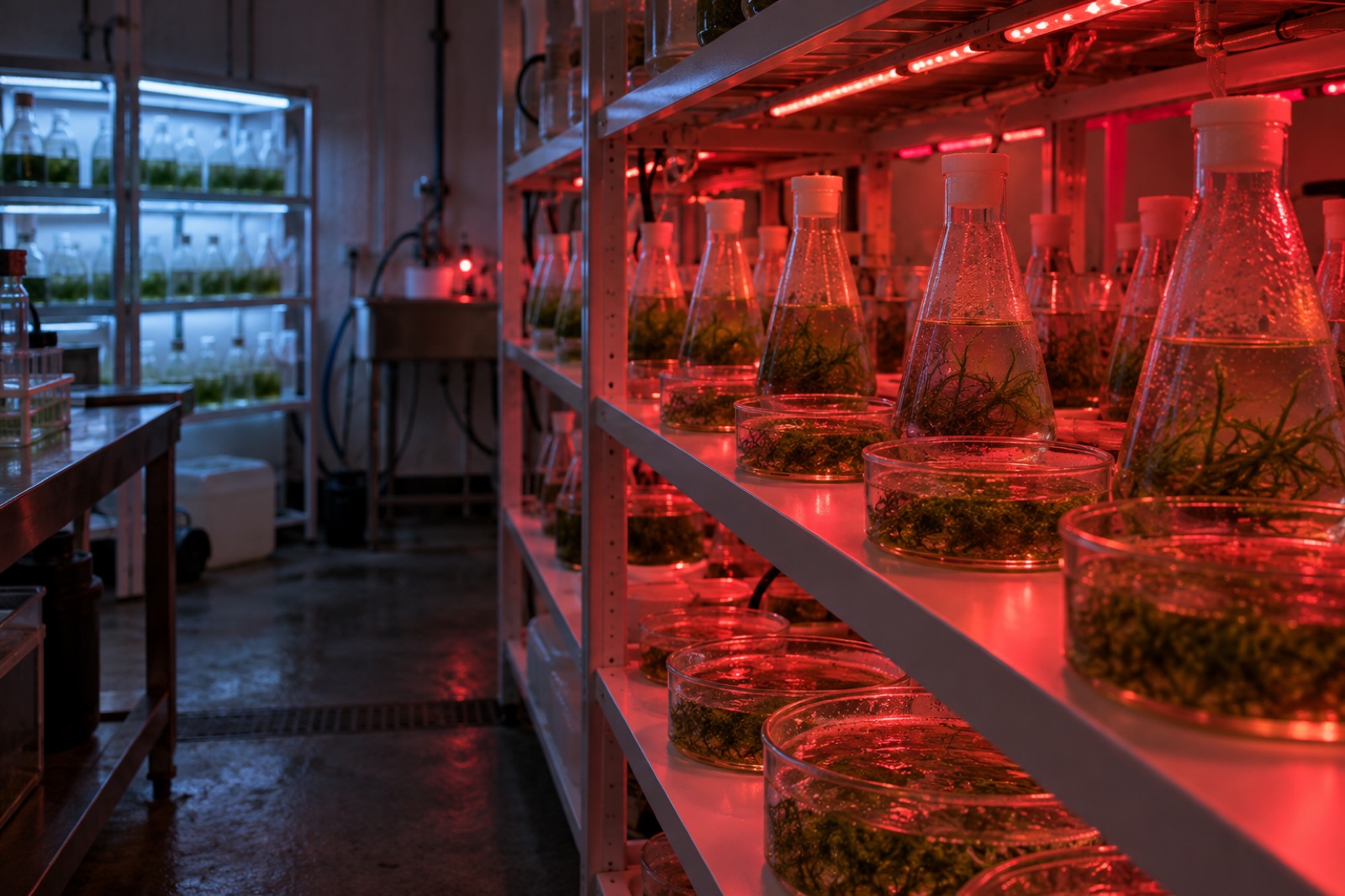
In a kelp hatchery, light is not just something cultures grow under — it is the steering wheel. Kelp runs its life through two alternating generations, and the microscopic one, the gametophyte, can be held quietly in storage for months or woken into reproduction within weeks, largely by changing the colour and length of the light it receives. Understanding that switch is the difference between a hatchery that seeds lines on schedule and one that discovers its cultures either starved or already gone to spore before the farm was ready.
This guide covers the biology in enough depth to trust the practice, then the practice: the lighting setup, the holding and release recipes, and the failure modes. It pairs with our guides on seed stock sourcing, hatchery water quality and the wider description of the gametophyte in kelp gametophyte biology.
The generation you can't see, and why it obeys light
Kelp's life alternates between the big sporophyte — the blade-and-stipe plant anyone can see — and a microscopic filamentous gametophyte. The sporophyte releases spores; spores settle and germinate into gametophytes; the gametophytes produce eggs and sperm; fertilisation starts a new sporophyte. The whole extraordinary loop is laid out in the kelp life cycle.
The hatchery's trick is that in many kelp species — most studied in the sugar kelp Saccharina latissima and Asian kelps like Saccharina japonica and Undaria pinnatifida — gametophyte maturation is gated by light quality. The broad, useful simplification:
- Red light tends to keep gametophytes in a vegetative state: they grow as filaments, dividing and spreading, but don't switch to sexual reproduction.
- Blue light tends to trigger gametogenesis: eggs and sperm form, fertilisation follows, seedlings appear.
This isn't magic; it's photoreception. Kelps have blue-light sensing systems (aureochromes and related receptors) that couple light conditions to development. The exact thresholds and the species-to-species fine print vary — which is why hatchery practice always confirms against the particular stock in the room — but the red-to-hold / blue-to-release framework is the workhorse of commercial kelp seed production around the world.
The holding recipe: keeping gametophytes asleep but healthy
A "held" culture is alive and slowly growing, not dormant like a dry seed. This matters: held cultures need care, and they do drift over time. Standard practice for holding gametophytes:
- Light: low intensity, red-dominant. Practically, this means red-filtered fluorescent tubes or, now usual, red LEDs with emission peaking around 660 nm, at low photon flux — on the order of 5–20 µmol photons m⁻² s⁻¹ for many laminarian gametophytes, far dimmer than any growth-room intuition suggests.
- Temperature: cool, commonly in the 10–15 °C band for temperate species — low enough to slow metabolism, high enough to avoid stress.
- Day length: a mild long-day or neutral schedule (12–16 h) is typical for holding; day length is a much weaker lever than colour for kelp gametophytes — wavelength dominates.
- Medium: a nutrient-replete, axenic (clean) seawater medium, changed on a regular calendar; holding is a maintenance job, not a feeding race.
Under those conditions, healthy stock cultures can persist for many months to over a year. The limits to watch: cultures gradually accumulate contamination unless handling is clean (a reason biosecurity belongs in the hatchery conversation), and very long-hold cultures can lose vigour. Commercial practice therefore also cryopreserves or refreshes held stock periodically — a topic for a dedicated seed-bank article, and a key feature of Tidewright's fictional Holdfast seedstock pipeline.
The release recipe: waking the cultures on a schedule
When the farm calendar says seeding is close, the hatchery flips the switch:
- Shift the light to blue-rich. Blue LEDs around 450 nm are the usual choice. Some protocols mix blue and white or use cool-white light; others step through progressive increasing light intensity.
- Raise intensity. Move up to roughly 20–40 µmol photons m⁻² s⁻¹, tuned to species and the colony's history.
- Keep day length neutral-to-long; keep temperature in the reproductive window — many temperate kelps only complete gametogenesis below species-specific thermal ceilings, so light release is always done in concert with chilled water systems.
Under a blue-rich release, laminarian gametophytes commonly form reproductive structures within roughly one to four weeks, sometimes faster, sometimes longer depending on the stock, its holding history, and water conditions. That window is the hatchery's lead time — the answer to "when do you need to know the seeding date?" is: however many weeks your species-and-stock takes to release, plus the nursery-time to grow visible sporophytes on the seeded twine.
A practical gametophyte-room lighting setup
You don't need a laboratory-grade chamber to get most of the benefit; you need predictability.
- Two isolated light environments. The held culture area bathed in red, the release area in blue/white — ideally separate shelves or rooms so light leakage can't erode the holding state. Foil or blackout curtains are cheap and effective.
- Dimmable, timed fixtures. Simple LED strips with timers and a dimmer are sufficient at small scale. Log actual intensity at shelf height with a cheap quantum meter once, and record the positions — repeatability beats precision.
- Heat discipline. LEDs are cool-running but racks stack heat in an enclosed room; monitor the actual culture temperature, not room thermostat readings.
- A dark-period respect. Avoid casual room-lighting intrusions into held shelves: red-lit rooms with door-open white light still shift biology over months. The trick that makes hatcheries trustworthy is boring consistency.
The facility context — bench layout, water preparation, temperature control — sits in setting up a seaweed hatchery; lighting layers on top of those foundations.
Common failure modes, diagnosed
The culture went sexual before we were ready. Almost always light leakage: white light from a door, a red fixture whose spectrum wasn't as red as the box claimed, or a shelf-level intensity that crept up over time as fixtures aged or positions drifted. Measure light at the culture vessel; audit the spectrum claim on red fixtures — some "red" consumer LEDs leak enough blue to matter.
The release is late or patchy. Common causes: held culture too old or nutritionally tired; temperature drifting up out of the reproductive window; intensity too low. Sometimes the honest answer is that the stock was variable — one reason hatcheries keep multiple genetic lines and stage releases.
Seedlings appear, then don't grow. That's usually a nursery question, not a light one — water quality and nutrient dynamics come back into play, and the transition to seeded-line nursery culture belongs with seed string production.
Everything looks fine but sporophytes are all one sex, or none. Rare, but a reminder that gametophyte cultures are living populations: keep records of which collection produced which culture — genetic bookkeeping that connects to kelp population genetics in the wild.
The day-length question newcomers always ask
Land-plant horticulture runs on photoperiod: day length controls flowering and growth phase in crop after crop. Kelp gametophytes, by contrast, respond to day length weakly and to colour strongly. Long days in the red still hold. Short days in blue still release. Get the spectrum right first, then treat day length as a tidy-corners variable: a stable, moderate schedule, no big swings mid-season. This also means hatcheries in different latitudes don't need different magic — a Norwegian and a Tasmanian laminarian gametophyte read the same blue light, even if their optimal temperatures differ.
Key takeaways
- Kelp gametophytes are the hatchery's seed stock, and they are steered mainly by light colour: red holds, blue releases.
- Held cultures are alive — low light, cool temperature, clean medium, and a maintenance schedule.
- Release to seeding takes weeks, not days: flip the blue switch on the farm calendar's lead time, and respect species temperature ceilings.
- Predictability beats precision: two isolated light environments, timed dimmable fixtures, and logged intensities deliver most of the benefit cheaply.
- Diagnose failures at the culture vessel, not the room: spectrum leaks, intensity drift and temperature creep are the usual suspects.
FAQ
Does the red/blue system work for every kelp species?
It's best validated in laminarian kelps — sugar kelp and its relatives. Many other kelps behave similarly in spirit, but the details differ and red/brown seaweeds are their own story. Treat red-to-hold / blue-to-release as a strong default to verify against your stock, not a law.
Can I use ordinary red and blue "grow light" LED strips?
Often yes, with an audit: confirm actual emission spectrum (some "red" strips leak blue), measure intensity at the culture shelf, and check uniformity across the shelf area. Horticultural strips are cheaper than scientific fixtures; record-keeping makes them reliable.
How long can a gametophyte culture be held?
Months to over a year in good conditions, declining gradually in vigour and cleanliness. Commercial hatcheries refresh stocks, maintain multiple lines, and use cryopreservation for long-term backup — held cultures are a working buffer, not an archive.
Does day length matter at all?
Far less than colour. Keep a stable, moderate schedule (12–16 h of light) and don't touch it mid-season. Big photoperiod swings are a source of unforced error, not of benefit.
What's the single biggest lighting mistake new hatcheries make?
White light intruding into the held-culture area — a door left open, a work light over a red shelf, "just for a minute" maintenance under fluorescents. Months of small exposures add up to early sexuality. Build light discipline into the room, and failures like this stop happening.