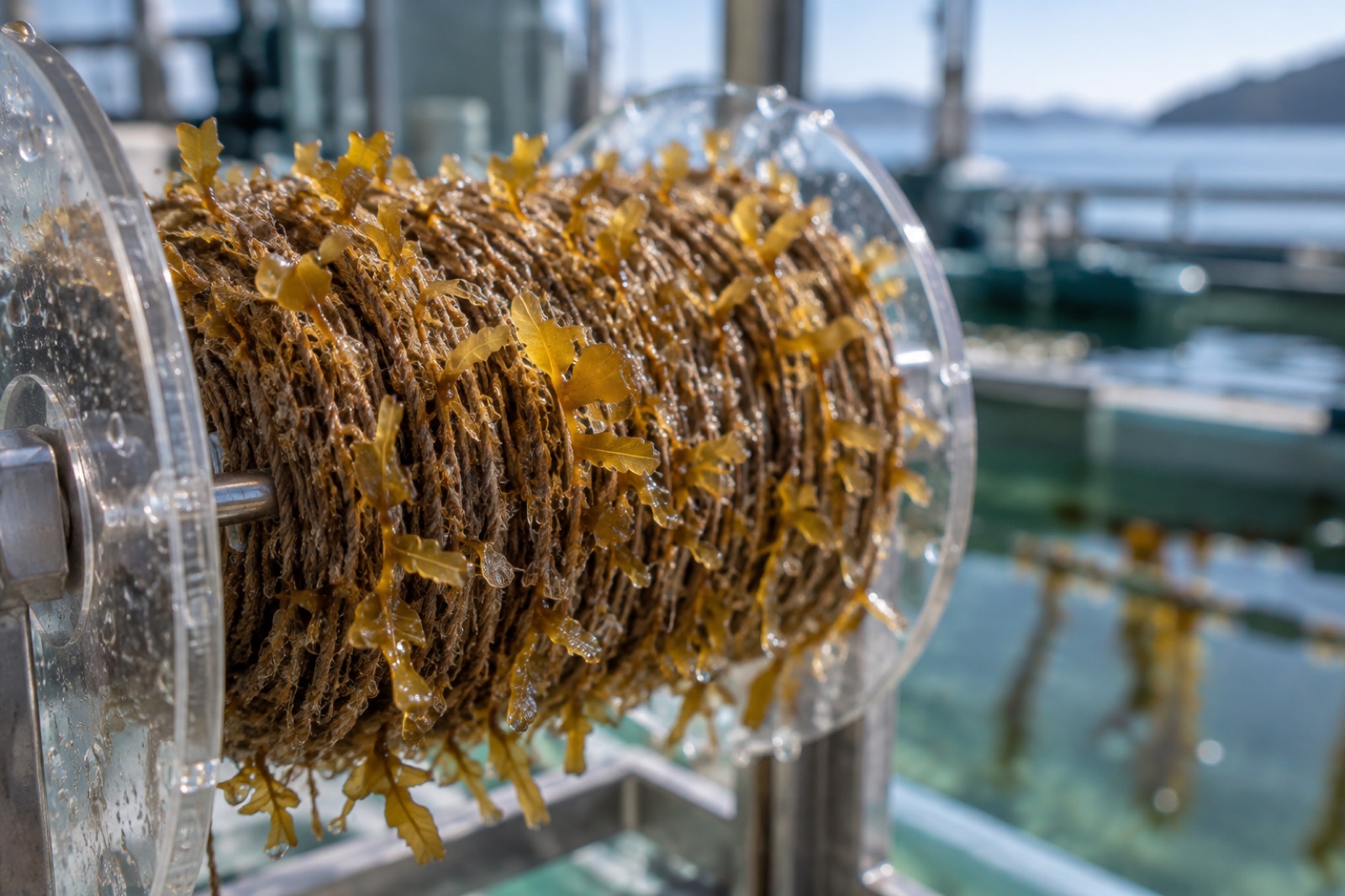
Every line of seeded twine that leaves a kelp hatchery began life in a tank of seawater. If that water was clean, cool and stable, the microscopic gametophytes in it divided quietly for weeks on end. If it carried a diatom bloom, a bacterial bloom or a film of competing algal spores, the culture looked fine right up until the day it didn't — and the hatchery lost a season it could not restart, because kelp reproduction runs on the ocean's calendar, not the manager's.
Our overview of hatchery water quality covers the fundamentals — temperature, light and nutrients as culture variables. This article is about the operational layer beneath that: how hatcheries actually produce and defend good water, day after day. It is less glamorous than breeding and more decisive. We've learned much of this the hard way building the Holdfast hatchery network; this is the craft we wish someone had written down for us.
What "good water" means to a gametophyte
Kelp gametophytes — the microscopic half of the kelp life cycle — are single filaments of cells with no protective structure at all. Whatever is dissolved or suspended in the water is, functionally, inside their world. Good hatchery water for temperate kelps generally means:
- Cold and stable. Most temperate kelp gametophytes are held somewhere in the single digits to low teens Celsius, species-dependent, and what they tolerate least is swing — a culture that rides 9–12 °C with the weather is under chronic stress even though neither extreme is lethal.
- Particle-free at culture scale. A 1-micrometre filtration endpoint is common practice; diatoms, ciliates and algal spores mostly fail to pass it.
- Chemically quiet. No metals leaching from plumbing, no chlorine carry-over from municipal water, no surfactants from cleaning, no ammonia accumulating from a dead corner of tank.
- Low biological load. Even filtered water is never sterile — the goal is keeping the background bacterial community sparse and boring, because an enriched, excited bacterial film on a culture vessel wall is where crashes begin.
Nutrient enrichment, interestingly, is the one place hatchery water is deliberately dirtier than the sea: culture media add nitrate, phosphate, vitamins and trace metals to feed growth. Which means your clean water is a deliberate soup, and everything else alive wants a seat at that table.
The filtration train
No single treatment step makes culture water. Hatcheries chain them, each stage protecting the next.
Intake and settling
Water enters from an ocean intake, a shore well or — increasingly — a recirculating source. Raw seawater first sits in a settling or buffer tank: sand, silt and the largest plankton drop out, and the hatchery gains a day or two of stored water as insurance against intake downtime. Opaque or darkened buffer tanks also knock back any phytoplankton already in the water by starving it of light.
Coarse and fine mechanical filtration
Sand filters, bag filters or drum screens remove the tens-of-micrometres fraction; cartridge filters then step down in stages — 10, 5, then 1 micrometre is a common train. Staging matters: running raw seawater straight into a 1-micrometre cartridge blindfolds it in hours, while a staged train lets each filter do one job well. Differential-pressure gauges across the cartridges are the cheapest sensors in the building and the first thing a good hatchery tech checks each morning.
Disinfection: UV, ozone, or both
Ultraviolet sterilisation inactivates what filtration catches and much of what it misses — bacteria, viruses, spores — provided water is clear enough to transmit UV, which is another reason fine filtration comes first. Ozone is a stronger oxidant, effective against dissolved organics and stubborn microorganisms, but it must be fully stripped before water touches culture: ozone and residual oxidants are acutely toxic to gametophytes. Many hatcheries use UV as the workhorse and reserve ozone for system sanitation between batches.
The final filter: the vessel itself
Autoclaved or pasteurised water, sterile glassware, and poured new medium each refresh — at the gametophyte stage, culture hygiene resembles a microbiology lab more than a farm. The filtration train delivers clean water to the door of the culture room; the culture room itself is a separate discipline of laminar practice and clean technique.
Choosing your source water
Three sources dominate, each with a character.
Open-ocean or deep intake water is chemically stable and biologically quiet — less plankton, fewer spores, steadier temperature — and is the gold standard where geography allows it. It costs money to pump but saves money in treatment.
Nearshore surface seawater is cheap and biologically loud: spring diatom blooms, terrigenous sediment after rain, salinity swings near river mouths, and seasonal pulses of every competitor spore in the neighbourhood. It is workable with a serious filtration train and a willingness to watch the forecast — our piece on reading the water covers the open-farm version of this literacy — but it will test you every April.
Artificial or reconstituted seawater removes biological risk almost entirely and gives perfect repeatability, at a price per litre that works for small gametophyte banks and research cultures but rarely for production volumes. Many hatcheries use it selectively: artificial water for the pedigree germplasm library, filtered natural water for the production lines.
The pragmatic answer for most coastal hatcheries is hybrid: nearshore intake, upgraded with wells or depth where possible, backed by storage large enough to ride out a bloom or a storm runoff event.
The daily craft: monitoring that catches trouble early
Water quality management is mostly a rhythm of small observations made without fail.
Every day: temperature logged per system; differential pressure across filters; a glance down the microscope at a sample of each culture line — not to admire it, but to ask "is anything here that wasn't here last week?" A single diatom frustule or an unusually active bacterial field in today's sample is a message; a week later it is a catastrophe.
Every week: bacterial load checks on culture water (even simple plate counts catch rising trends), nutrient reagent stock inspection, and a walk of the plumbing looking for biofilm at joints and dead legs — any section of pipe water can sit still in will grow its own ecosystem.
Every batch: refresh media on schedule rather than "when it looks like it needs it," and record the refresh. When contamination appears, the logs are how you find the week it entered.
Every season: full system sanitation — drained, scrubbed, ozonated or chlorinated and thoroughly rinsed — timed to the quiet weeks before seed string production ramps up.
Contamination: the three intruders
Almost everything that crashes a kelp hatchery culture is one of three things.
Diatoms. The classic invader: they arrive in a filtration failure, love the same nutrients your gametophytes do, and grow faster. A light diatom haze can sometimes be outrun by immediate media change through sterile technique and re-filtration of the system; a heavy one in a production culture is usually a write-off. The real fix is upstream — find which filter stage failed before you culture anything else.
Bacterial films and heterotrophic blooms. Often follow a nutrient or hygiene lapse: old media, a contaminated stock solution, a dirty transfer. Subtle at first — the culture clouds slightly, smells wrong, gametophytes sicken at the edges. Response is isolation of the affected vessels, sanitation of everything they touched, and forensic review of the last two media batches.
Competitor algal spores. Ulva is the perennial offender — a single spore becomes a visible green film that carpets vessel walls and smothers filamentous cultures. Green fuzz in a brown-seaweed hatchery means unfiltered seawater reached somewhere it shouldn't, full stop.
The discipline common to all three: when in doubt, quarantine first, investigate second. Kelp hatcheries are small, interconnected worlds; biosecurity thinking, normally aimed at farm sites, applies with even more force indoors. And because seed for a whole farm season may pass through one contaminated week, your viability checks before outplanting are the last firewall.
Shared systems, separated risks
One final architectural choice: how many independent water systems should a hatchery have? A single shared loop is cheap and efficient — and a single point of failure that can carry one contamination event into every culture line at once. Two or more isolated trains, ideally with separate pumps and filters, cost more and mean that a bad week takes out half the hatchery instead of all of it. Production-scale operations, ours included, also run their pedigree germplasm lines on a physically separate system from production water — the seed bank is the one asset no season can replace.
Key takeaways
- Gametophytes tolerate almost no water-quality error: cold, stable, particle-free and biologically quiet water is the foundation every seeded line stands on.
- Effective hatchery water comes from a train — settling, staged mechanical filtration down to ~1 micrometre, then UV or ozone — with each stage protecting the next.
- Source choice sets the difficulty level: deep or open-ocean water is quiet, nearshore surface water is cheap but biologically loud, artificial seawater is clean but costly at scale.
- Daily microscopy and logged filter pressures catch contamination at the "message" stage, a week before it becomes the catastrophe stage.
- Nearly all culture crashes trace to diatoms, bacterial blooms or competitor algal spores; quarantine first, investigate second.
- Redundant, isolated water systems and a physically separate germplasm line keep one bad week from ending a season.
FAQ
How fine does filtration need to be for kelp gametophyte culture?
A common production endpoint is 1-micrometre cartridge filtration followed by UV; research-scale work often adds pasteurisation or autoclaving of media and glassware. The finer you filter, the more important staged pre-filtration becomes, because fine cartridges blind quickly on raw seawater.
Can I use municipal tap water in a seaweed hatchery?
Not directly — residual chlorine and chloramine are toxic to gametophytes, and municipal water chemistry varies. Some hatcheries do use carbon-filtered and aged municipal water to reconstitute artificial seawater, but never as a straight diluent.
Schedules vary by species, density and temperature, typically on the order of every one to four weeks for gametophyte maintenance cultures. The key is that it happens on schedule and is recorded — "refresh when it looks tired" is how contamination gets a foothold.
What's the first thing to check when a culture crashes?
The filtration train's differential-pressure logs and the media-refresh records. Most crashes trace to a filter breach, a contaminated media batch or a hygiene lapse at transfer — and the logs tell you which, in minutes rather than days.
Is ozone or UV better for hatchery water?
They do different jobs. UV is the routine in-line disinfectant — safe downstream once water leaves the unit. Ozone is a stronger oxidant useful for sanitising systems and stripping organics, but it must be fully removed before water reaches culture. Most hatcheries treat them as complements, not competitors.