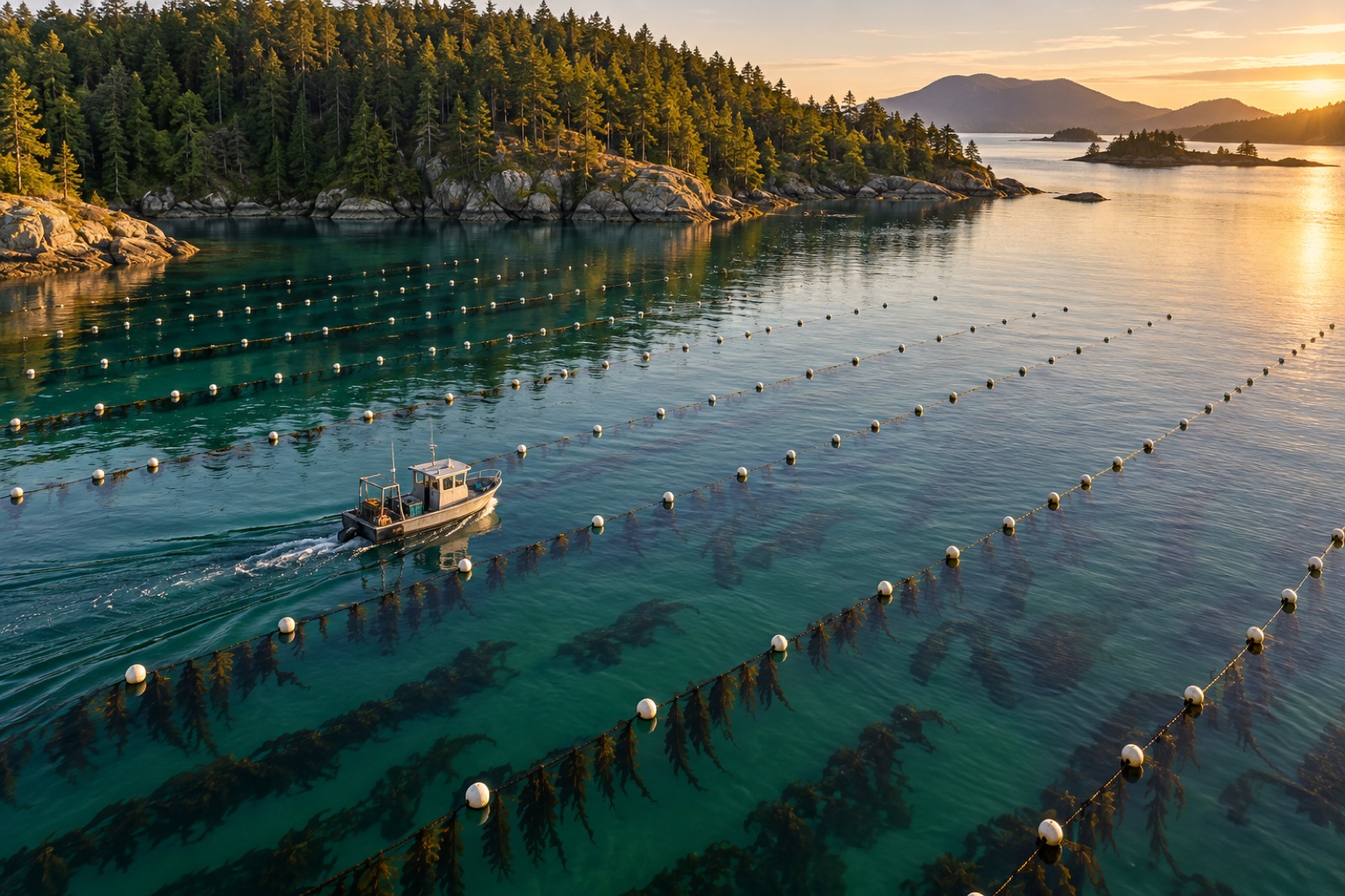
Kelp has no roots and no roots means no buffer. Everything the crop needs — dissolved nitrogen, carbon, the right temperature, enough light-carrying clarity — arrives only if the water delivers it, and the water changes its mind daily. Farmers who read that water well harvest heavy, clean blades; farmers who guess spend the season puzzled.
You do not need a research vessel to read water. You need three measurements taken honestly at the right frequency — temperature, salinity and nitrate (or a solid proxy for it) — plus a habit of writing them down. This article explains what each variable actually does to kelp, how the ocean layers and seasons complicate the picture, and a monitoring routine simple enough to survive a busy harvest week.
Temperature: the master variable
Temperature governs nearly everything kelp does. Enzyme rates, growth speed, gametophyte development, spore release, and the metabolic tipping point at which a crop stops growing and starts struggling all run on temperature.
For the commonly farmed sugar kelp and its relatives, growth is strongest in cold water — roughly the 5–15 °C band — and stress builds as surface water climbs past the high teens. Sustained warmth above a species' thermal ceiling doesn't just slow growth; it invites blade erosion and epiphyte blooms, and it shortens the harvest window brutally. Our science team covers the physiological edge in how hot is too hot for kelp, and the hidden half of the story — why gametophyte cultures hate warmth even more than blades — in hatchery water quality.
What matters for the farmer is not a single temperature but three patterns:
- The seasonal arc. When is your water coldest, when does it cross the crop's comfort ceiling, and how many growing weeks sit between those dates? This sets seeding and harvest dates more than any calendar.
- The rate of change. A degree a week for a month is acclimation. Three degrees in three days after a warm wind shift is a stress event.
- Depth structure — which brings us to the thermocline.
The thermocline: your lines live in two oceans
In calm stratified seasons the water column splits into a warm, often nutrient-poor surface layer and a cold, usually nutrient-rich bottom layer. A longline hung at two metres and another at eight metres can be farming in functionally different seas.
Stratification matters in both directions. In summer, surface layers heat up: if your lines ride shallow, warming can reach stress levels while cooler water sits two metres deeper — an argument for weighting lines down during warm spells on farms where that's practicable. In other seasons, the same layering concentrates nutrients at depth while the surface starves, and shallow lines stall. Our ocean-science explainer on stratification and why layers decide who eats covers the physics.
The practical implication: a single temperature logger hanging under a buoy answers whatever question you didn't ask. Loggers at two depths — say 1.5 m and 6 m — cost little and turn "the water is warm" into "the top two metres are warm, the crop zone is fine," or the reverse, which is actionable.
Salinity: slow stress, sudden shocks
Most farmed kelps tolerate a moderate salinity range — roughly full ocean strength (about 35 PSU) down to the high twenties — with growth tapering as water freshens toward the mid-twenties and below. But the everyday story on farms is not the average salinity; it's the pulses.
River plumes after heavy rain, snowmelt in spring, or a lagoon outflow near an estuary mouth can drop surface salinity by several units in days, and the fresher water floats on top — exactly where shallow lines sit. Kelp tolerates brief dips well; sustained low salinity bleaches tissue tips and invites fouling organisms that prefer brackish water.
On estuarine and fjord sites this variable deserves a logger of its own or frequent spot readings with a handheld refractometer (cheap) or conductivity meter (better). When you choose a site, historical freshwater influence is one of the quiet disqualifiers — see the site-diligence checklist in choosing a farm site.
Nitrate: the growth currency
Kelp's appetite for nitrogen is the reason it grows faster than almost anything else in the sea, and the reason growth stalls even when temperature and light are perfect. The main plant-available form is nitrate, supplemented by ammonium; concentrations swing seasonally from winter highs (replenished by storms, mixing and upwelling) to warm-season lows approaching zero in stratified surface water.
Three things every farmer should internalise:
Kelp banks nitrogen. Sugar kelp and its relatives store nitrate in their tissues during the nutrient-rich season and spend those reserves to keep growing after the water runs out. Tissue nitrogen content — measurable with a simple dried-tissue lab test — falls through late spring and is a better predictor of the season's end than the water sample of the day. It also drives quality: protein-rich tissue is what food and some biostimulant buyers pay for, which links directly to harvest timing.
Near-zero water nitrate doesn't mean growth stops tomorrow. It means growth is now running on savings. Watch the trajectory, not the snapshot.
Chronically low nitrate caps your yield, not your season length. Sites with weak winter replenishment grow adequate crops slowly. This is where site selection earns its keep: a modest difference in background nutrients compounds over a season into a large difference in tonnes.
A farmer's monitoring routine
Here is a routine that fits on one page, runs on realistic gear, and answers the questions that matter:
The hardware
- Two temperature loggers (1.5 m and 6 m, or bracketing your line depth), logging hourly, downloaded monthly. Inexpensive, indestructible, the backbone of everything.
- A handheld conductivity/salinity meter or refractometer for weekly spot checks and post-storm checks.
- Nitrate testing — weekly discrete samples with a lab-quality colorimetric kit, or fortnightly lab analysis on a small farm. Continuous nitrate sensors exist; they're wonderful if the budget allows, but they are not the entry requirement.
- A simple Secchi disk for clarity — five dollars of disc that tracks the light the crop actually receives, especially through plankton blooms.
The cadence
- Weekly, year-round: download or check loggers, spot salinity, Secchi depth, nitrate sample, five minutes of notes on weather and anything odd (jellyfish swarms, muddy water after rain, unusual bird or boat activity).
- Monthly: download the full logger record, plot temperature by depth, update your degree-day or growing-week tally against the seasonal plan.
- After events: any storm, heavy rain, or three-day warm wind shift triggers a same-week check of salinity, clarity and lines even if it isn't "data day."
The decision rules
Write your thresholds down before the season, so decisions come from your plan rather than the day's mood. A starter set, to tune per species and site:
- Sustained surface temperature above your crop's stress line for a week → pull harvest forward; don't wait for perfect biomass.
- Salinity drop of four-plus units lasting beyond a few days → inspect blade tips for bleaching and raise sampling to twice weekly.
- Two consecutive near-zero nitrate readings plus falling photos of blade condition → the season's growth is nearly done; schedule harvest before biofouling converts the crop into substrate.
- Clarity collapsing with a warm, calm spell → expect a plankton bloom; check lines for fouling and consider the implications for light.
Reading the whole picture
No single parameter keeps a farm honest; the skill is triangulation. A warm week with clear water and stable salinity is different from a warm week with a plankton bloom and a river plume. Your logs, over two or three seasons, become the most valuable dataset on the farm — the one that tells you your site's rules, not the textbook's.
Public data helps at the margins. Coastal buoy networks publish temperature and wave records that extend your site history backwards by years; our guide to reading ocean buoy data shows how to pull signal out of those feeds. At restoration scale, Tidewright's Canopy Ledger platform runs the same triangulation — satellite, drone and in-water sensors — continuously, but the underlying discipline is exactly what a farmer with two loggers and a notebook already practises.
Key takeaways
- Temperature, salinity and nitrate — measured honestly and logged — explain most of what happens to a kelp crop.
- Measure temperature at two depths: thermoclines mean your lines can occupy two different oceans at once, and single-point readings mislead.
- Kelp banks nitrate in its tissue, so near-zero water nitrogen predicts the season's end rather than announcing it; falling reserves trigger harvest planning.
- Salinity matters as pulses more than averages — river plumes and meltwater hit shallow lines hardest.
- The best monitoring routine is the one you'll keep: weekly checks, monthly reviews, event-triggered inspections, and thresholds written before the season starts.
FAQ
Do I need an expensive multiparameter sonde to farm seaweed?
No. Two temperature loggers, a handheld salinity check, a nitrate test kit and a Secchi disk cover the decision-critical measurements for a small farm. Sondes add pH, dissolved oxygen and chlorophyll data that are genuinely useful as you scale — and in some jurisdictions, regulators will ask for them — but they are a second-season purchase, not a barrier to starting well.
How often should I sample nitrate?
Weekly through the growing season is the sweet spot for a small farm: often enough to see the trend, cheap enough to sustain. If weekly lab analysis strains the budget, fortnightly lab samples plus a weekly colorimetric kit reading for trend direction works well.
What's the most common water-reading mistake new farmers make?
A single surface temperature reading treated as the crop's environment. Between thermoclines, depth-graded lines and freshwater lenses, surface readings answer a question nobody asked. Put loggers where the crop actually lives.
Can I rely on public buoy data instead of my own sensors?
For context and history, yes — but not as a substitute. Public buoys often sit kilometres away, at different depths and exposures. Use them for seasonal patterns and site selection, and your own cheap instrumentation for the week-to-week decisions. Our explainer on reading buoy data covers how to cross-read the two.
My water is within textbook ranges but growth is poor. What am I missing?
Common culprits: light (clarity crashes during blooms do more harm than modest nutrient shortages), stocking density (dense lines self-shade and strip local nutrients), and timing (seeding too late shortens the cool-water growth runway). Water chemistry is the first thing to rule out, not the only thing.