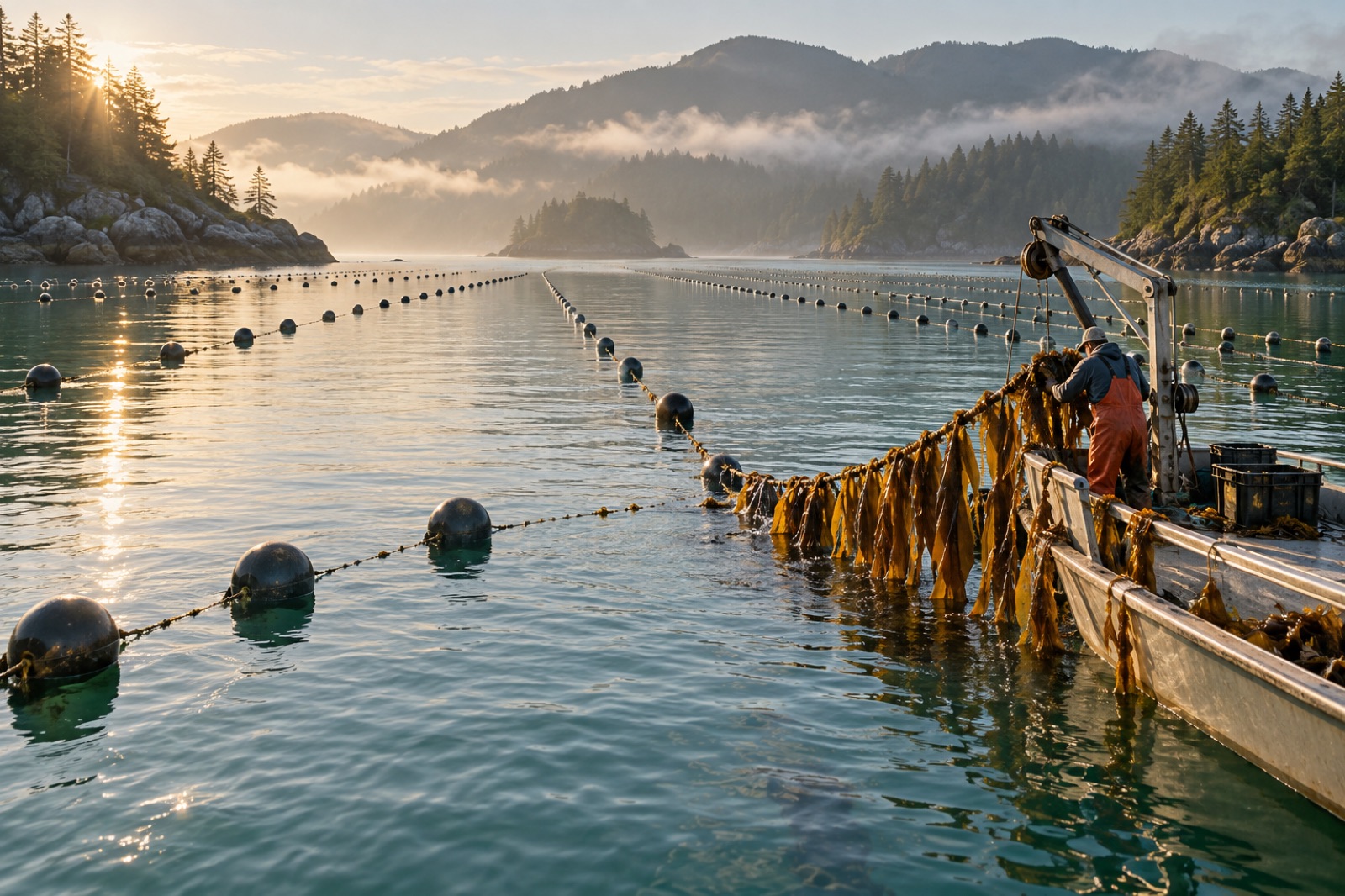
Ask a seaweed farmer what eats their margin and they'll name boats and buyers; ask what quietly wrecks quality and they'll say fouling. Every length of rope you put in the ocean is a welcome mat for a succession of organisms — diatom films, then bryozoans, hydroids, barnacles, tubeworms, mussels, tunicates and opportunistic "weed" seaweeds. Left alone, they add drag and weight that shock-load your gear in storms, steal light and nutrients from the crop, and render product unpresentable or unsafe at harvest. Managing biofouling is not one task; it's a season-long design discipline.
This guide covers what's actually growing on your lines and when, the prevention levers that cost little, the cleaning tactics that cost a lot, and how to triage at harvest. It assumes a longline farm as described in our longline design guide; the principles transfer to any gear that sits in the water.
What fouls a longline, and when
Fouling arrives in a fairly predictable succession, timed by temperature and light:
- Weeks 0–2: the biofilm. Bacteria and microalgae coat every submerged surface within days. This slime layer is invisible, inevitable, and a prerequisite for much of what follows — most larvae need a conditioned surface to settle on.
- Weeks 2–8: diatoms and early colonists. Brown diatom fuzz can smother young kelp sporophytes while they're still millimetres tall. This is the fouling that costs crops, because the crop is at its most vulnerable while its competitors grow fastest.
- Month 2–4: hydroids, bryozoans, ephemeral seaweeds. As water warms into spring, hydroid colonies lace the lines and epiphytic green and red seaweeds (often Ulva-type opportunists) bloom on the crop itself. This is the most visible fouling phase, and usually the trigger for harvest decisions.
- Late season: calcifying settlers. Barnacles, tubeworms and encrusting bryozoans accumulate on buoys, risers and line hardware, adding real weight. Mussels, where present, add kilograms per metre faster than anything else.
Two rules of thumb govern everything downstream:
- Fouling pressure scales with temperature and light. Warm, bright water fouls fast. The exact same gear will stay far cleaner ten metres deeper or ten degrees cooler.
- Fouling follows a calendar, not a flag. By the time you can see it from the boat, settlement happened weeks earlier. Manage the calendar, not the symptom.
Prevention: the fouling you never get is the cheapest
Time the season around the foulers
The single most powerful anti-fouling tool is the crop calendar. In temperate regions, deploying seed in autumn and harvesting by late spring or early summer means the crop does most of its growing in cold, dim, low-fouling months — and ideally comes out of the water before peak settlement season for hydroids, epiphytes and barnacles. Every week you push harvest later into warm water, fouling compounds. Know your local settlement calendar (port authorities and shellfish growers track this closely) and engineer the season around it.
Manage depth
Because light and temperature both fall with depth, deepening the crop slows both kelp growth and fouling growth — but usually asymmetrically. Many farms find a sweet band where kelp still grows well while hydroid and epiphyte pressure drops sharply. Growth lines hung a metre or two deeper from mid-season onward, or tensioned grids submerged a little further, can buy weeks of clean crop. The trade-offs (light, storm loading) follow the logic in our storm-proofing guide.
Site outside the nurseries
Fouling larvae come from somewhere. Sites downstream of mussel beds, harbour structures, vessel anchorages and seaport pontoons receive outsized larval supply. During site selection, sample the actual fouling community: hang test panels at candidate depths for a full season and see what settles. One season of panel data is worth a hundred guesses.
Choose materials and geometry that help
- Smooth, hard surfaces shed biofilm and settlers better than soft, frayed rope. New line fouls slower than old, abraded line; retired growth twine shouldn't be reused.
- Tension matters. Taut lines shed weed; slack lines collect drift algae and give settlers calmer micro-habitats.
- Fewer appendages near the crop. Every knot, tag and spare loop near the growth line is a fouling island that seeds the crop.
Biocontrol where it's proven
Grazers are the aquaculture industry's most elegant fouling control: sea urchins and sea cucumbers held in trays or lantern nets among lines will graze settling stages and keep shellfish gear remarkably clean. Work on kelp-line grazing biocontrol is younger, but co-culturing grazers on farm structures is practised in parts of Asia and under trial elsewhere. It converts a maintenance cost into a second crop — the same stacked-income logic as integrated multi-trophic aquaculture.
When fouling wins territory, your options climb a ladder of cost and crop risk:
- Do nothing — selectively. Light diatom film on mature blades is largely cosmetic and often sloughs naturally as blades grow and shed their surface. Good record-keeping (photos on fixed dates) tells you whether the crop is outgrowing the foulers.
- Physical disturbance in the water. Hand-stripping hydroids by divers or crews working from the surface; dragging a soft brush frame along lines; shaking lines to dislodge loosely attached epiphytes. Labour-heavy but crop-safe.
- Lifting and air-drying. Hauling lines to expose foulers to air and sun kills most hydroids and ephemeral algae within hours; the kelp tolerates short emersion far better than its hitchhikers. Weather windows and handling damage limit this to small gear or targeted sections.
- Washes and dips. Freshwater baths, dilute acid dips and brine treatments are standard in shellfish and seed-stage work, occasionally used on early-stage seeded twine before outplanting. On mature crops they're rarely economic and may breach water-quality rules at scale.
- Harvest early. When epiphyte cover passes the grade threshold for your buyer, the rational move is often to pull the crop weeks early and take the smaller, cleaner harvest. Early harvest is a legitimate fouling tool — plan buyer expectations around it.
What about antifouling coatings? Copper- and biocide-based paints have no place on food-crop gear: residues compromise the crop's food safety and the farm's licence, and regulators treat active biocides near food crops severely. Fouling-release (silicone) coatings see use on buoys and hardware away from the crop, but the crop itself relies on calendar, depth and husbandry, not chemistry.
Triage at harvest
Fouling management ends at the sorting table. Build simple grade criteria with your buyer in advance — epiphyte cover percentage, presence of hydroids or bryozoans on blades, any calcified fouling — and train harvest crews to sort on the boat, not at the dryer. Fouled line sections can be stripped for lower-value uses (biostimulant feedstock rather than food), which is one more reason diversified buyers protect margins, as we discuss in seaweed farm economics.
Keep fouling notes every season: first sighting dates, settlement intensity, what worked. Within three seasons you'll hold a local fouling calendar more valuable than any textbook. In Tidewright's own restoration-adjacent farms under the Harvest program, we treat these calendars as core site data — the same surveys tell us both when the crop must come off and what fouling community the broader reef is hosting.
Key takeaways
- Biofouling is seasonal and predictable: manage the calendar (autumn seeding, pre-summer harvest) before you manage the symptom.
- Depth is a dial: slightly deeper lines under warm bright water can cut fouling dramatically with modest growth cost.
- Test-panel a candidate site for a full season before committing — fouling community knowledge is site-selection gold.
- The remediation ladder runs from doing less (selectively) to harvesting early; chemical antifoulants don't belong near a food crop.
- Grade on the boat against pre-agreed buyer criteria, and keep a written fouling calendar from season one.
FAQ
What are the main fouling organisms on kelp farms?
In order of appearance: bacterial and diatom biofilms, then hydroids, bryozoans and ephemeral seaweeds like Ulva through spring, and finally calcifying settlers — barnacles, tubeworms, encrusting bryozoans — plus mussels on deeper hardware. Local assemblages vary, which is why test panels matter.
Can I use antifouling paint on my kelp lines?
Not on gear touching the crop. Biocide coatings compromise food safety and regulatory standing for edible seaweed. At most, fouling-release coatings belong on buoys and hardware well away from blades — and even then, most farms rely on timing, depth and husbandry instead.
How do I stop hydroids from smothering my crop?
Hydroids peak in warming water, so the strongest control is calendar design: seed in autumn and harvest before the spring settlement pulse. Dropping lines a little deeper as water warms, and stripping outbreaks early by hand, cover the rest.
Do sea urchins really clean aquaculture gear?
Yes — grazers held in trays or nets among farm structures actively consume settling-stage fouling, and co-cultured urchins or sea cucumbers turn a maintenance cost into a saleable crop. It's standard practice in parts of Asia and increasingly trialled elsewhere.
When should I harvest to avoid the worst fouling?
Before your local peak settlement season — commonly late spring to early summer in temperate waters. Establish the calendar from your own test panels and settlement plates; regional shellfish growers' observation calendars are an excellent proxy while you build your own data.