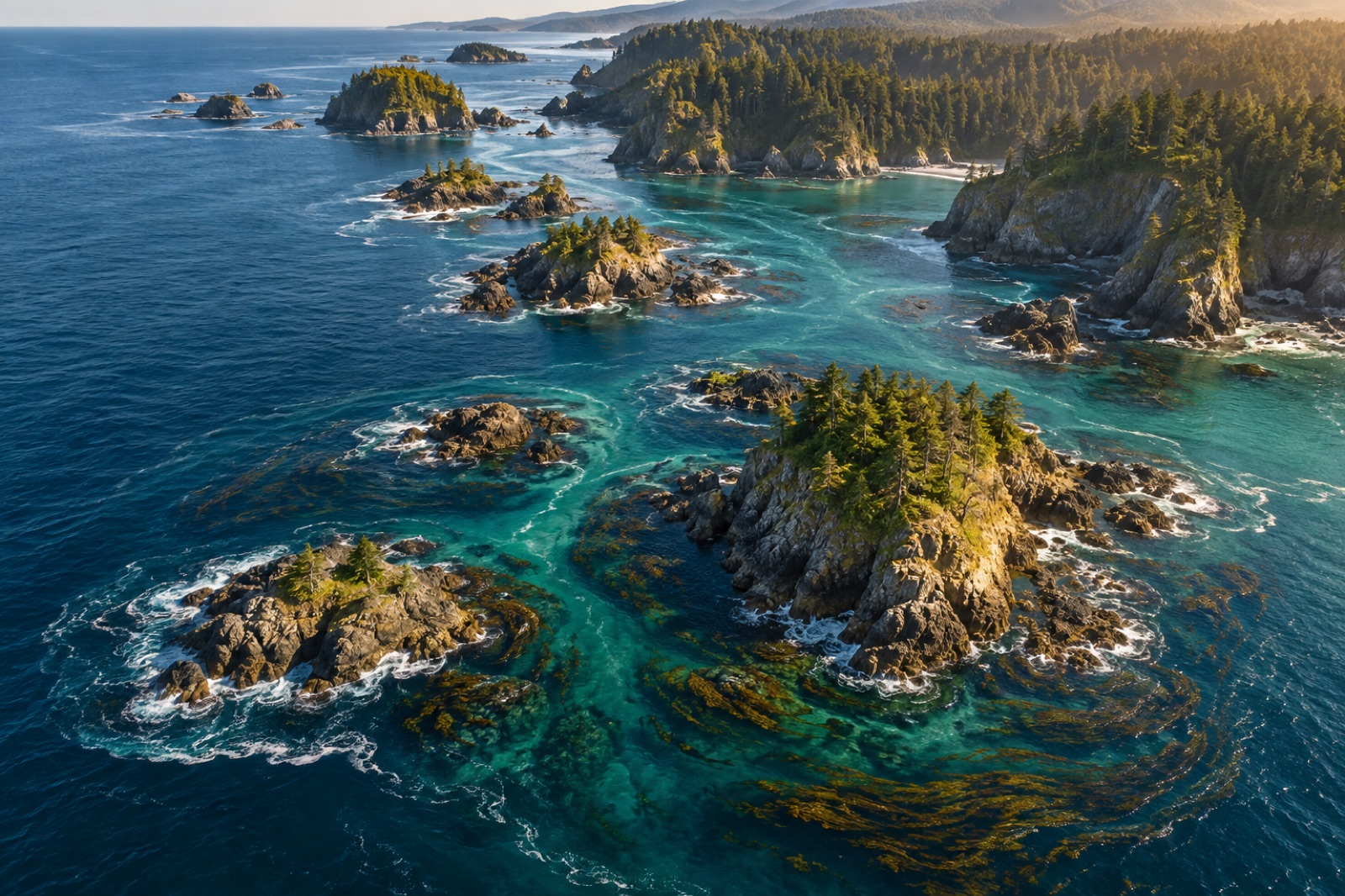
Every kelp forest keeps a ledger of its own history, written in DNA. Which reef colonised which island, which populations were cut off when the last ice age raised the seas, which coves survived each heatwave — it is all there, encoded in allele frequencies that read like a family tree. Kelp population genetics is the craft of reading that ledger, and it has become the quiet infrastructure underneath modern restoration: you cannot choose the right seedstock for a reef until you know who its relatives are.
From a tube of tissue to a map
The workflow begins humbly: a diver snips a few square centimetres of blade from twenty or thirty plants per site, and the samples go into silica gel or ethanol. From there the field has climbed a technology ladder, each rung resolving a finer family tree.
Microsatellites — short, hyper-variable repeating stretches of DNA — were the workhorse for decades. Genotype a dozen microsatellite loci across a few hundred plants and you can measure how much populations differ, estimate gene flow, and detect recent bottlenecks. Much of what we know about kelp structure along coastlines was built this way.
SNP panels and genotyping-by-sequencing (RAD-seq, GBS and relatives) changed the scale. Instead of a dozen markers, these methods read thousands of single-nucleotide variants spread across the genome. With thousands of markers you can see subtle structure microsatellites miss — distinguishing reefs tens of kilometres apart — and you can ask not just "how different are they?" but "which genes differ, and why?"
Whole genomes are the newest tier. Reference genomes now exist for several kelps, including giant kelp and sugar kelp, letting researchers localise adaptive variation, hunt for structural variants and track useful alleles with precision. Costs keep falling; what was a flagship project a decade ago is becoming routine field equipment.
Three ideas organise everything these data reveal: drift (populations diverge by chance when isolated), gene flow (dispersal re-mixes them), and selection (the environment edits them differently). Population genetics is the arithmetic of telling the three apart.
What the maps actually show
The first lesson the family tree teaches is that kelp coastlines are patchworks, not continuums — but patchworks with rules.
Isolation by distance. Because most spores settle within metres of their parents, kelp populations typically show a gradient: neighbours resemble each other, and relatedness decays with distance. The steepness of that decay is itself diagnostic — a gentle slope means the coastline is well connected, a steep one means every cove is half an island.
Fronts and currents as borders. Sharp genetic breaks in kelp repeatedly line up with oceanography — the meeting of warm and cool water masses, headlands that split currents, upwelling cells. Where boundary currents shift lanes or larval pathways dead-end, the family tree shows it. In several well-studied regions, kelp genetic boundaries coincide with biogeographic province boundaries recognized for centuries by shellfish and fish records — independent evidence that the genome is recording real ocean structure. Our overview of marine connectivity shows the same breaks from the physics side.
Refugia and recolonisation. Deep-time history is legible too. After the last glacial maximum, kelp species re-spread along newly cool coasts from thermal refugia — pockets where suitable water persisted. The descendants of those expansions still carry the genetic signature: lower diversity along the expansion front, distinct lineages where separate refugia's offspring meet. The same logic plays out on the scale of decades: after a marine heatwave, genetics can identify which remnant patches re-seeded the coastline, and how far their offspring travelled.
Surprises in the tail. Population genomics routinely uncovers things morphology hides: cryptic lineages long lumped into one species (a serious issue in the giant kelp complex across hemispheres), introduced strains layering over natives, and rare long-distance colonists whose genomes betray a homeland hundreds of kilometres up-current.
Seascape genomics: matching genes to water
The newest and most restoration-relevant branch pairs genomic data with environmental data — satellite temperature, nutrient climatologies, wave exposure — to ask which genetic variants track which conditions. This seascape genomics (or genotype–environment association) does something profound: it locates putatively adaptive alleles on the map before any experiment.
If the same alleles keep appearing in kelp populations that experience hot autumns, across regions that have been isolated for millennia, that allele is a candidate for heat tolerance. Field transplants and common-garden experiments — growing many source populations side by side in one garden — then test the candidates, confirming that southern or warm-edge populations genuinely outperform northern ones under warm water, even as they underperform in the cold.
These experiments anchor the core finding of applied kelp genetics: local adaptation is real and climatic. Populations are tuned to their local thermal regime, often remarkably finely. That tuning is exactly what our primer on kelp genetics and provenance draws on when it argues for locally matched seedstock — here the point is that the tuning is measurable, mappable and traceable to particular genomic regions.
From family tree to provenance zones
For restoration, the family tree becomes a management tool through provenance zoning — the same idea forestry has used for a century. Combine the genetic break map with the climate map, and a coastline divides into zones within which genetic mixing is low-risk, bounded by fronts or distances across which mixing needs care. Within a zone, seedstock can be pooled to maximise diversity; across zones, translocation needs a reason.
This unlocks three practical strategies:
- Local sourcing, pooled broadly. Collect from many reefs within the zone, not one — avoiding both inbreeding and over-reliance on a single donor's quirks.
- Climate-adjusted provenance. Because today's local genotype was tuned to yesterday's climate, some programs deliberately include a minority of warm-edge (typically poleward-shifted, lower-latitude) material — "assisted gene flow" — so the restored forest carries alleles for the climate coming, not just the climate past. The geneticist's job is to dose this: enough warm-adapted variation to help, not so much that locally adapted complexes are swamped.
- Diversity as a monitored output. A restored forest's heterozygosity and effective population size can be tracked like canopy cover — and low diversity is itself a warning light, since narrow genetic bases amplify inbreeding and shrink the raw material for future adaptation. Gametophyte culture banks, as described in our piece on the hidden seed-bank generation, make this monitoring actionable: read the library, then re-seed what's missing.
Tidewright's fictional Holdfast nurseries are imagined to run exactly this pipeline — per-reef culture libraries, provenance zones from genomic surveys, and climate-adjusted seed mixes — mirroring real research programs that now genotype donor material before a single line is wet.
The limits of the ledger
Honesty about what genetics cannot say matters as much as the headlines. Allele–environment correlations are candidates, not proof; lab-verified thermal tolerance lags the mapping. Small samples can manufacture false breaks. Epigenetic and microbiome contributions to stress tolerance sit outside the DNA sequence entirely. And a family tree cannot tell you whether a translocated population will thrive — only field trials can. The mature position of the field is that genomics sets the menu; ecology still cooks the meal.
Key takeaways
- Kelp population genetics has climbed from microsatellites to whole genomes, each step resolving a finer family tree of reefs.
- Genetic maps consistently reveal isolation by distance, oceanographic fronts as borders, and signatures of glacial refugia and post-heatwave recolonisation.
- Seascape genomics links alleles to temperature and exposure, locating candidate adaptive variation before experiments confirm it.
- Family trees become management through provenance zones: pool broadly within zones, dose climate-adjusted material carefully across them, and monitor restored diversity like a performance metric.
- Genomics narrows the options; field trials and ecology make the final call.
FAQ
How is kelp population genetics actually measured today?
Most programs use genotyping-by-sequencing methods (such as RAD-seq) that read thousands of SNP markers from small tissue samples collected by divers. Microsatellites remain useful for quick structure surveys, and full genome resequencing is increasingly affordable for key species and breeding lines.
Does genetics prove that kelp populations are locally adapted?
Genetics alone shows structure and candidate adaptive alleles; local adaptation is established when common-garden or reciprocal-transplant experiments show each population performing best in its home conditions. In kelp, those experiments broadly confirm climatic local adaptation — especially for temperature.
What is a provenance zone in seaweed restoration?
A stretch of coastline within which populations are genetically well connected and climatically similar, so pooling seedstock inside it is low-risk. Zones are usually bounded by oceanographic fronts or distances where genetic breaks appear — the same borders visible in the genomic maps.
What is climate-adjusted provenance?
Mixing mostly local seedstock with a minority of material from warm-edge populations, so the restored forest already carries alleles suited to projected future temperatures. It is a genetic hedge against the next heatwave, and dosing it correctly is an active research question.
Can population genetics detect introduced kelp?
Yes — introduced strains usually stand out as genetic outliers matching their source region rather than any local population. Genomic screening is now a biosecurity tool for distinguishing native forests from refugees of hull fouling and historic aquaculture transfers.