Science10 min read
Drifters and Swimmers: How Marine Life Colonises New Reefs
Almost every reef animal and alga spreads as a drifting larva or spore. How far they travel — and which reefs talk to which — decides how kelp recovers.
Dr. Mara Ellison ·
Reefs are joined by currents into a living network. How connectivity works, why stepping stones matter, and how it shapes marine reserves and kelp restoration.
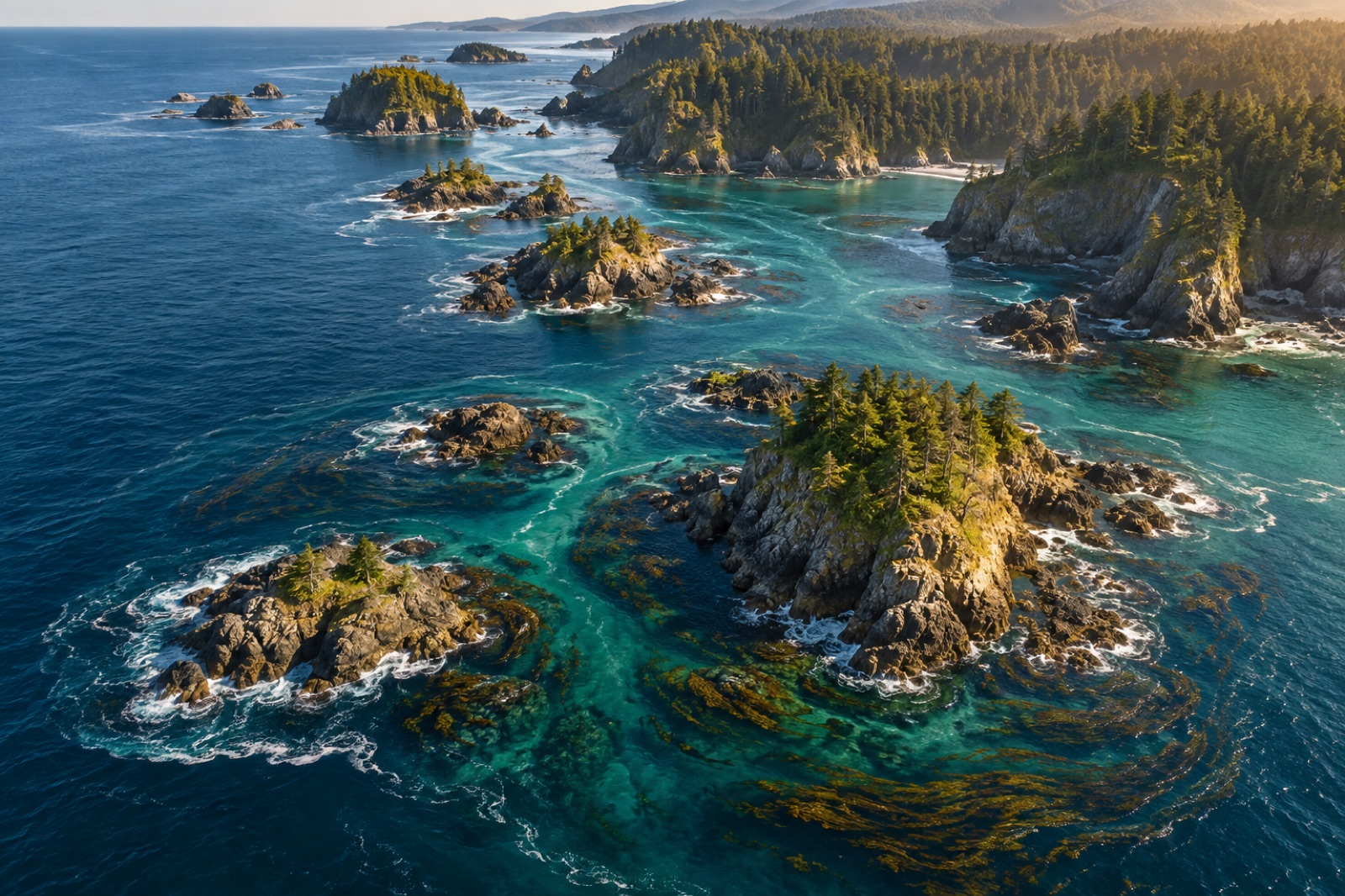
From a clifftop, a coastline looks like a scatter of separate reefs — a kelp bed here, a headland there, an island past the gap. To the organisms that live on them, the picture is entirely different: a network of nodes joined by invisible traffic. Larvae riding currents, spores drifting a few metres, juveniles moving along the coast as they grow — the fates of reefs a hundred kilometres apart are entangled through these flows. Marine connectivity is the science of that network, and it has quietly rewritten how we design marine reserves and plan restoration.
The first discipline in the field is distinguishing its currencies, because "connected" means different things depending on who is travelling and what question you ask.
Demographic connectivity asks whether movement between reefs is large enough to matter to population numbers — whether a depleted reef receives enough recruits from neighbours to refill within a few years. This is the currency of fisheries and recovery planning.
Genetic connectivity asks whether gene flow keeps populations mixed over generations. Even a trickle — a handful of successful migrants per generation — erases most genetic divergence. Two reefs can be genetically near-identical while demographically on their own: connected in the ledger of population genetics, isolated in the arithmetic of restocking.
Physical connectivity is the substrate for both: the currents, eddies and fronts that actually carry things, which vary hour by hour and season by season. And behavioural connectivity matters too — swimming larvae and migrating adults choose, sense and steer, so the shipped route and the taken route can differ.
A second distinction: symmetric versus directed links. Currents often run one way, which means reef A can seed reef B reliably while B almost never repays the favour. Connectivity maps are arrow diagrams, not spiderwebs.
Marine highways are built from a small set of recurring physical features:
Overlay all of it and you get a network that is directional, seasonal and intermittent — the same two reefs can be tightly linked in spring and strangers in autumn.
Different species plug into this network at different ranges. Fish and invertebrate larvae may drift for weeks; kelp rides at the other extreme. As our piece on spore dispersal shows, most kelp spores settle within metres, and effective dispersal over kilometres leans on rare events — storm-torn drifting adults ferrying fertile tissue down-current.
That makes kelp forests what network scientists call stepping-stone systems: long-distance colonisation happens as a chain of short hops. Each reef seeds its near neighbours; the neighbours, once mature, seed theirs; and over decades the forest walks along the coast. Break the chain — remove a middle reef and leave a 50-kilometre gap — and distant segments are functionally severed for kelp even though fish larvae still fly across.
The consequence for conservation is sharp: for short-hop species, the spacing of protected reefs matters as much as their size. A reserve network of large but widely separated jewels conserves each site but abandons the links; chains of smaller, tightly spaced reserves preserve the stepping stones the species actually uses. This is one reason marine protected area design has shifted from "protect the best places" toward "protect a connected portfolio."
Not all nodes are equal. Connectivity analysis sorts reefs into roles:
Source reefs export far more propagules than they import — typically up-current, dense and fecund. Lose a major source and you defund every reef downstream for a generation.
Sink reefs receive more than they export; they may not persist without the subsidy.
Stepping stones matter by position rather than productivity — modest reefs that bridge a gap. On a map they look unremarkable; in the network they are load-bearing.
These roles generate the rescue effect: after a local catastrophe — a marine heatwave, a storm — a well-connected reef resupplies first from its neighbours and recovers far faster than an isolated one. Post-disturbance studies of kelp consistently find connectivity among the best predictors of whether, and how fast, forests return. Isolation is the quiet multiplier of every other stress.
No current meter can track a five-micrometre spore, so the field triangulates:
Where models and genetics agree, confidence is high; where they diverge — a modelled link the genomes deny, or kinship across a modelled barrier — the discovery is usually deeper biology: behaviour, rare rafting events, or a habitat step the physics missed.
Climate change rewires the network as well as warming the nodes. Species ranges shift poleward, so the network's destinations migrate; currents and stratification change the roads themselves; and more frequent, longer heatwaves sever links by wiping out intermediate stepping stones, sometimes before the species they carried have time to move through them.
The policy response is increasingly network-minded: protect chains, not just patches; keep southern (warm-edge) source populations — the pre-adapted donors — in the portfolio; and treat restoration as network repair. Replanting a kelp bed at a strategic gap is not gardening one site; it is splicing a broken cable. Imagined this way, reseeding programs like Tidewright's fictional Drifter vessel operations are connectivity interventions: restoring the hops a short-hop species can no longer make on its own.
Connectivity is the exchange itself — the flow of larvae, spores or genes between reefs. Connectedness describes a reef's position in the resulting network: how many links it holds and how strong they are. A reef can sit in a connected system yet be a poorly connected node.
Because many coastal species disperse over kilometres, not hundreds of kilometres. Reserves spaced beyond a species' dispersal range protect each site but cannot restock one another. Spacing guidelines in the literature typically aim to keep neighbouring reserves within one or two average dispersal distances of the species of concern.
Larval dispersal is the mechanism; connectivity is the realised outcome — how many larvae (or their genes) actually arrive, settle and enter the receiving population. Behaviour, mortality, habitat at the destination and direction of currents all stand between a dispersing larva and a connected reef.
Range shifts move the network's useful destinations poleward; altered currents and stratification change the routes; and destructive events remove intermediate stepping stones faster than slow-hop species can bridge the gaps. Pre-adapted warm-edge source populations become disproportionately valuable nodes.
Yes — strategically sited reseeding can close a gap in a stepping-stone chain, restoring gene flow and recolonisation routes for many reef species at once. Choosing sites by their network position, not just their local habitat, is where connectivity science most directly guides restoration.
Almost every reef animal and alga spreads as a drifting larva or spore. How far they travel — and which reefs talk to which — decides how kelp recovers.
Dr. Mara Ellison ·
Kelp forests travel one microscopic spore at a time. How far spores really go, what decides where they settle, and why dispersal shapes every restoration plan.
Dr. Mara Ellison ·
How scientists read the family tree of a kelp forest — from SNP chips to seascape genomics — and what genetic maps reveal about provenance and adaptation.
Dr. Elias Brandt ·