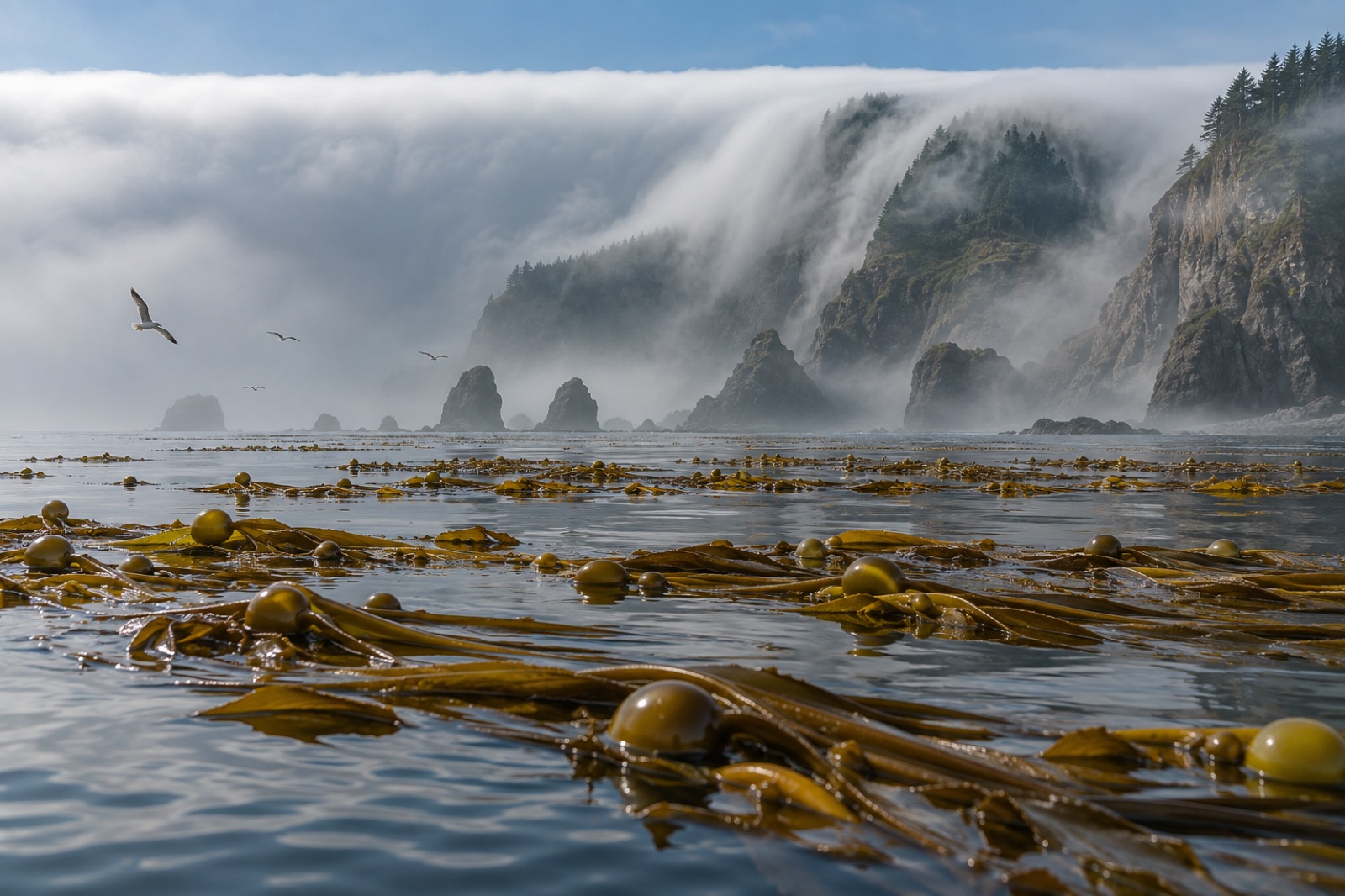
Ask a diver to picture a kelp forest and they will probably describe shafts of sunlight. Ask a local fisherman on the Californian, Chilean or Benguelan coast and they will describe something greyer: mornings when the headland simply stops existing, when the kelp canopy lies flat and colourless under a sky the colour of wet slate. That grey ceiling is marine fog, and it is no accident that the planet's greatest kelp forests live beneath it. Fog and kelp are both signatures of the same oceanic engine — cold, nutrient-rich water pulled to the surface — and understanding the fog belt is a surprisingly good way of understanding where forests thrive and where they struggle.
What marine fog actually is
Fog is not weather that happens at sea and drifts ashore. Most coastal fog is manufactured precisely at the coastline, by a conversation between warm air and cold water.
The standard recipe is advection fog. Warm, moisture-laden air travels on prevailing winds and passes over a much colder sea surface. As the base of the air mass cools toward its dew point, water vapour condenses into droplets around microscopic aerosols — sea salt, sulphate particles, organic matter from plankton. The result is a fog bank that sits in the lowest few hundred metres of the atmosphere, often with a flat, sharply defined top where warmer, drier air above forms a temperature inversion. That lid is why coastal fog can look from a hilltop like a level white sea, and why it pours over headlands and through gaps like slow water.
A colder cousin, steam fog, forms when very cold air moves over relatively warm water — common in polar and sub-polar autumn conditions — while radiation fog (nighttime cooling of land air) is mostly an estuary and harbour phenomenon. On kelp coasts from Monterey to Coquimbo, advection fog rules the summer.
Why fog and kelp keep the same address
The correlation is not coincidence. Nearly every world-class kelp coast sits beside an eastern boundary current — the California, Humboldt, Benguela and Canary systems — or along coasts shaped by seasonal upwelling. In these regions, winds along the shore drive surface water offshore, and deep, cold, nutrient-rich water rises to replace it (see how boundary currents set the stage for kelp).
That cold surface water does two jobs at once:
- It fertilises the forest. Upwelled water carries nitrate and other nutrients that fuel kelp growth at rates among the fastest of any plant community on Earth.
- It chills the air above. Warm summer air sweeping in from the continent condenses on contact, and a fog belt forms that can hug the coast for weeks at a time.
So the same cold water that feeds the forest also hides it. On the central California coast, foggiest months often coincide with the strongest upwelling season; on the Humboldt coast of Chile and Peru, generations of fishermen have read the camanchaca fog as a proxy for productive water. Ocean fronts where upwelled water meets warmer offshore water frequently sharpen fog edges into startlingly crisp lines — grey on one side of a headland, blue sky on the other.
What fog does for the forest — and to it
Fog is more than scenery. It touches kelp ecology in several measurable ways.
A dimmer, softer light
Fog filters and diffuses sunlight. That trims the total light reaching the canopy, but it also reduces harsh direct glare and ultraviolet exposure right at the surface, where kelp photosynthesis must balance carbon gain against light stress. For juvenile sporophytes in the shallowest water, diffuse fog light can be gentler than cloudless summer sun — one reason some young forests establish happily through the foggiest months.
Cooler water, for a while
By reflecting sunlight back to space, a persistent fog deck slows surface warming. Along coasts now prone to marine heatwaves, fog-shrouded headlands can act as small-scale thermal refugia, holding inshore temperatures a degree or two below exposed sites just kilometres away. On a coast where a couple of degrees decide whether a forest survives the summer, the grey ceiling is not trivial.
Fog drip and the shore community
Fog condenses on rock, algae and vegetation as droplets, and that "fog drip" is a real water source for intertidal communities during long rainless summers. The famous relationship between California fog and coast redwoods has a quieter intertidal analogue: crustose algae, lichens and the salt-tolerant plants of the splash zone all capitalise on fog moisture when rain is absent.
A working constraint
Fog also dictates the rhythm of human work on kelp coasts. Small-boat surveys, dive operations and drone photography all schedule around it — a fact of daily life for our own field teams, whose Canopy Ledger mapping flights plan around the fog's midday retreat, when a coast often clears for a few hours before the bank re-forms at dusk.
Is the fog changing?
This is one of the more sobering open questions on kelp coasts. Long-running observations at several sites — most famously along the northern California coast — have documented trends toward less summer fog over the last century, alongside warming coastal waters. The mechanisms are still debated: a warming continent can alter the land–sea temperature and pressure gradients that drive upwelling winds, and a warming ocean raises the dew-point gap that warm air must cross before it condenses.
For kelp, the direction of travel matters. Less fog can mean more light stress and faster nearshore warming exactly where forests already run close to their thermal limits. Changes in upwelling winds themselves — stronger in some projections of a warming world, due to sharper land–sea pressure contrasts — could push in either direction, which is why treating fog as a serious climate variable, not background weather, is increasingly standard in long-term reef monitoring. It is also why Tidewright pairs canopy mapping with continuous inshore temperature and light logging at project sites like those described in our projects portfolio: you cannot manage what you only see on satellite on the days the coast is clear.
How to read the fog like a scientist
You do not need instruments to start. Spend a week on an upwelling coast and watch for the pattern:
- Morning grey, midday burn-off, evening return marks classic advection fog with a diurnal heat cycle on land.
- Fog that pours through one gap in the headlands while neighbouring bays stay clear reveals how terrain channels the marine layer inland.
- A visible fog edge offshore often traces the upwelling front — cold, foggy inshore water against warmer, clearer water beyond. Fishermen and seabirds both work that line for the productivity it concentrates.
- Fog arriving with a wind shift tells you the fog bank was waiting offshore and has simply been pushed ashore.
Pair those observations with the sea surface temperature charts described in how satellites measure sea surface temperature, and you can watch the machinery operate in near real time.
Key takeaways
- Marine fog on kelp coasts is mostly advection fog: warm, moist air condensing over cold, upwelled surface water, capped by a thermal inversion.
- Fog and kelp share an address because both are produced by eastern boundary currents and coastal upwelling — cold water feeds the forest and chills the air.
- Fog modifies the forest's microclimate: diffuse light, cooler inshore temperatures, fog drip for the intertidal, and logistical constraints on survey work.
- Persistent fog decks can act as local thermal buffers, and fog-shrouded sites are candidates for natural refuges during warming events.
- Long-term records suggest declining summer fog on some coasts, with consequences for kelp light and temperature stress that scientists are still untangling.
FAQ
Is fog good or bad for kelp?
Mostly it is a marker rather than a cause. Fog signals cold, nutrient-rich upwelled water, which kelp loves. The fog itself trims and softens the light reaching the canopy and can cool the surface slightly — usually neutral to mildly helpful. What kelp cannot tolerate is the absence of the cold water the fog advertises.
Why is the coast foggy in summer but clear in winter?
On eastern boundary current coasts, the temperature contrast that builds fog peaks in summer: the continent heats strongly, pulling warm air over water that upwelling keeps cold. In winter the land–sea contrast shrinks, winds shift, and upwelling weakens, so the fog factory switches off and stormier weather takes over.
Do all kelp forests grow in foggy places?
No. The kelp forests of Norway, Japan or Tasmania experience less classic advection fog than California or Chile. Fog is characteristic of upwelling-driven coasts in particular; kelp itself needs cold, nutrient-rich, clear-enough water, however that cold water is supplied.
Can you predict fog for a dive or survey day?
Reasonably well, in the short term. Marine forecasts that include sea surface temperature and wind direction capture most advection events, and experienced local operators read the previous evening's conditions and the offshore SST gradient. On many coasts the honest answer is still: plan two dives, expect one.
Is fog loss a climate-change effect?
Signals of declining coastal fog exist in several long records and are consistent with a warming land–ocean system, but fog is a noisy variable driven by winds, currents and inversion strength. Scientists treat the trend as a serious working hypothesis rather than a settled fact — one more reason the grey ceiling deserves monitoring alongside the green canopy below it.