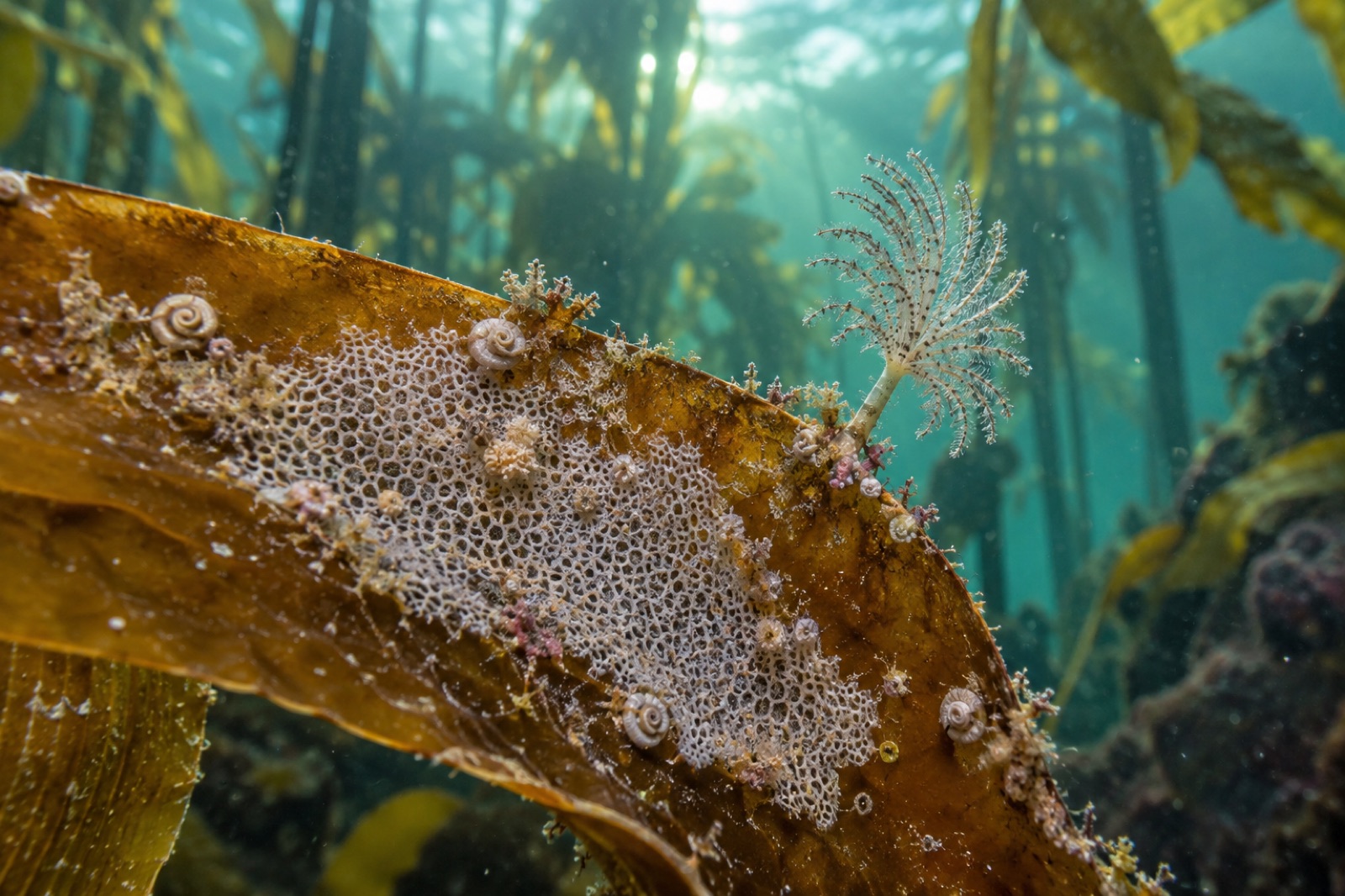
Ask most people what lives in a kelp forest and they will name fish, otters, urchins, maybe an octopus. Almost nobody names fungi — yet every kelp blade you have ever touched carried a fungal community living inside its tissues, on its surface, and in the waterlogged world of its decay. Marine mycology, the study of fungi in the sea, is a young field working on a vast hidden majority: current estimates suggest the ocean hosts tens of thousands of fungal species, the overwhelming majority not yet described. Some are quiet partners of seaweeds; some are decomposers closing the forest's carbon loop; some are pathogens whose hand is strengthened by warming water.
This article is a tour of that hidden kingdom — the endophytes that live inside blades, the parasites that punch holes in them, the tricky taxonomy of "fungus-like" stramenopiles, and the practical questions that matter for farming and restoration. It builds on our kelp microbiome overview and the companion look at what a microbiome says about health.
First, a taxonomy of confusion
"Marine fungus" hides three different things. Knowing which is which prevents a great deal of misreading of the headlines.
- True fungi (Kingdom Fungi) — mostly ascomycetes and basidiomycetes adapted to the sea, plus the primitive chytrids and the enigmatic Cryptomycota. These carry fungal cell walls of chitin, reproduce with spores, and include most of the kelp endophytes and many pathogens.
- Stramenopile "fungus-like" organisms — oomycetes (water moulds) such as Olpidiopsis and Pythium, and thraustochytrids such as Labyrinthula. They are not fungi at all — they are closer cousins to kelp itself — but they look, behave and devastate like fungi, and for decades were counted as such. When you read that "the fungus Labyrinthula zosterae" wasted a seagrass meadow, the label is a historical artifact.
- Marine-derived fungi — terrestrial species found in coastal habitats (on driftwood, wrack and spray) that are halotolerant rather than truly marine. Useful for biotechnology, confusing for ecology.
Kelp pathology involves all three groups, so a careful diagnosis matters before any response.
The partners: endophytes inside the blade
Cut a healthy sugar kelp blade, surface-sterilise it, plate a thin section on agar — and fungal filaments grow out. These are endophytes: fungi that live asymptomatically inside algal tissue. Culture and DNA surveys find them in nearly every kelp species examined, from Ascophyllum rockweed in the Atlantic to giant kelp in the Pacific, at prevalences that can approach every sampled individual.
What they are doing there is an active research frontier, but several roles are supported:
- Chemical mediation. Endophytic fungi produce secondary metabolites — antifungals, antibacterials, herbivore deterrents — that appear to supplement the host's own defences. The arrangement mirrors the better-studied grass–endophyte partnerships of land plants, where fungal alkaloids protect the host from grazers.
- Stress tolerance. In some algal–fungal pairs studied at the bench, the fungus's presence measurably improves the alga's tolerance of desiccation, salinity swings or heat — commodities that determine survival in tide pools and during marine heatwaves.
- The mysterious trade. What the fungus receives is clearer in outline than in detail: sugars and fixed carbon leaking from the host, plus a buffered, predator-free address. Some partnerships look mutualistic in one season and parasitic in another — the same fungus a passenger while the host thrives, an opportunist when it is stressed.
The fringes of kelp–fungus cooperation include lichen-like relationships on wave-splashed shores, where brown algae grow in intimate association with fungal hyphae — ancient experiments in dual-organism living that biologists are still debating how to classify.
The decomposers: the forest's quiet recycling crew
Kelp is fast-cycling carbon. Blades erode, fronds break in storms, and whole plants dislodge — annual production vastly greater than standing biomass. Somebody has to close the loop, and fungi are in the first ranks.
On beaches, wrack piles host a succession of marine and marine-derived fungi that digest alginates and laminarans few other organisms can touch, softened first by bacteria and the yeasts that make early fermentation. In shallow sediment, fungal hyphae colonise buried kelp fragments. The decomposer web converts the forest's detritus into microbial biomass that enters the food web — the under-appreciated middle of the pathways we trace in kelp detritus food webs.
The pathogens: when fungi turn
Seaweed disease is old — nineteenth-century collectors described fungal parasites of algae — but several factors are pulling it toward the spotlight.
Known fungal and fungus-like pathogens of kelps and farmed seaweeds include:
- Petersenia species (chytrid relatives) — orange- or spot-producing parasites of brown algae including kelp relatives, capable of conspicuous infections.
- Mycophycias ascophylli — an ascomycete that lives in Ascophyllum rockweed, usually benign, occasionally eruptive.
- Olpidiopsis (oomycete) — responsible for destructive diseases of farmed nori (Pyropia/Porphyra), historically among the costliest crop pathogens in Asian aquaculture, not technnically a fungus despite acting like one.
- Pythium species (oomycete) — red rot disease of nori; a recurring farm-gate crisis that has reshaped how hatcheries manage water hygiene.
- Chytrids (true fungi) — parasites of phytoplankton and, occasionally, seaweed spores; in freshwater they suppress algal blooms with astonishing efficiency, and the marine equivalents are increasingly surveyed.
Farm-level impacts concentrate in nurseries and hatcheries, where warm, dense cultures invite fungal and oomycete outbreaks. Nursery rot in commercial kelp hatcheries — oft-dismissed as "bad water" — frequently carries a microbial, including fungal, component. Our farming guides to pests and diseases and disease early-warning systems translate this into hatchery practice.
Why warming waters tilt the balance
Disease is a three-part equation — host, pathogen, environment — and warming shifts all three. Marine heatwaves stress kelp (compromising its chemical and physical defences), while many fungi and oomycetes reproduce faster and disperse longer in warm water. The template is well documented in sea star wasting, abalone withering syndrome and coral disease: pathogens perform best when hosts are worst off.
For kelp, the worrying scenarios are incremental rather than apocalyptic: slightly more nursery loss each warm season; endophytic communities shifting from partners toward opportunists during heatwaves; previously minor parasites crossing into new host ranges as coastlines tropicalise. The range shifts rewriting kelp coasts will rearrange fungal communities too, often in advance of anything we can see.
How scientists study an invisible kingdom
Marine mycology's methods evolved quickly over the past decade:
- Culture work. Tissue sections and spores are plated on selective media. Classic, essential for describing new species, but it captures only the culturable fraction — often a small minority.
- DNA metabarcoding. The fungal ITS gene region is sequenced from blade, water and sediment samples, cataloguing entire communities regardless of culturability. Fungal signals are usually much fainter than bacterial ones in amplicon data — a reminder of how recently they have been counted.
- Microscopy. Fluorescence and electron microscopy place hyphae inside host tissue, distinguishing residents from surface visitors.
- Challenge experiments. Isolates are exposed back to host tissue under controlled temperature and light, turning correlation into causation — the fungal equivalent of Koch's postulates.
- Long-term monitoring. Repeated sampling through heatwaves and normal years builds baselines against which disease emergence can be recognised rather than guessed. It is the same logic as eDNA monitoring of the wider forest, extended to a fungal channel.
What this means for farming and restoration
Three practical consequences follow.
Biosecurity. Seeded lines, gametophyte cultures and hatchery water are potential fungus vectors. Quarantine routines for seedstock — routine regardless of destination — should include fungal screening where practical. Our hatchery quarantine guide covers the operational side.
Provenance matters. Moving kelp seed between regions relocates its invisible fellow-travellers too. Native seedstock rules exist partly to avoid moving undetected pathogens with the crop; the argument gets stronger the more we learn about endophyte communities.
Monitoring must include the invisible. Restoration success should eventually be read not just by frond counts but by the signature of a healthy holobiont: microbiome composition, endophyte prevalence, the line between a stressed thallus and a diseased one. Fungal communities may prove to be a leading indicator of forest trouble.
Key takeaways
- The ocean's fungi are a vast, mostly undescribed kingdom — kelp blades host endophytic fungi in nearly every individual sampled.
- "Algal fungi" includes true fungi and fungus-like stramenopiles (oomycetes, thraustochytrids); the distinction matters for identification and management.
- Endophytes may defend, feed and stabilise their kelp hosts — but the partnership can flip to opportunism under stress.
- Farms meet fungi most acutely in hatcheries and nurseries; nursery rot is often partly microbial in origin.
- Warming waters favour pathogen reproduction just when heat stresses the host — the pattern behind many marine disease emergences.
- Biosecurity, provenance rules and fungal-aware monitoring are the pragmatic responses.
FAQ
Are marine fungi dangerous to people swimming in kelp forests?
Almost never. The fungi associated with kelp are adapted to algal hosts and cold seawater, not mammals. Human fungal infections overwhelmingly come from terrestrial fungi in soils, air and hospitals. Normal diving and swimming in kelp forests is not a fungal-risk activity.
Can I see kelp fungi with the naked eye?
Rarely. Most endophytes and early infections are microscopic. Visible signs come late: discoloured lesions, spots, soft rot or unusual growths on blades. The bulk of the fungal community remains invisible in healthy tissue.
Are oomycetes really not fungi?
Correct. Oomycetes ("water moulds" such as Phytophthora, Olpidiopsis and Pythium) belong to the stramenopiles — the same major lineage as brown algae and diatoms — not to Kingdom Fungi. They look and act fungal, which caused decades of taxonomic confusion.
How can I tell whether a farmed kelp crop has a fungal or bacterial disease?
Often you cannot by eye; both cause blotching, softening and decay. A definitive answer needs microscopy or DNA diagnostics at a veterinary or plant-health laboratory. On the farm, respond operational first — isolate, reduce density, improve water exchange — and send samples for analysis.
Will warming make kelp fungal disease worse?
The expectation from marine-disease ecology is yes for many systems, because warm water simultaneously stresses hosts and accelerates pathogen lifecycle and spread. The magnitude will vary by region, pathogen and kelp species, and monitoring baselines built now are the best early-warning we will have.