Here is a fact that tilts the whole picture of a kelp forest: the great majority of the kelp a forest grows is never eaten standing. Divers see forests grazed by urchins and snails and assume the green- (brown-) pasture model — grow, be cropped, repeat. In reality, the standing blades are more like an orchard being harvested by the weather. Tissue is shed, shredded, dissolved and dispersed, and the forest's true herbivores turn out to be bacteria, amphipods, sea cucumbers and the filter feeders hanging on every rock. Understanding this detritus economy — the subject of this explainer — is understanding where kelp forest productivity actually goes, and why trophic cascades look the way they do.
Why is so little kelp eaten directly?
Three reasons keep the grazers' dent off the canopy.
1. Chemistry. Brown algae defend their tissue with phlorotannins — bitter, protein-binding phenolic compounds concentrated in young, fast-growing blades. Grazers can eat around these compounds (and some specialists detoxify them), but fresh blade is far less digestible than it looks. Many grazers actively prefer kelp tissue that microbes have pre-softened — a point we'll return to.
2. Mechanics. Kelp tissue is tough. The stipe and midrib are rope-graded composite materials evolved for wave stress. Most small grazers handle fringes and epiphytes rather than structural blade.
3. Speed. Kelp grows faster than grazers can typically crop it. A giant kelp frond can add tens of centimetres a day in good conditions; even heavy urchin populations usually control kelp through recruitment suppression and drift-kelp dependence rather than by mowing the canopy — which is why urchin outbreaks flip reefs into urchin barrens only when predator controls fail and drift supply surges.
The result: a forest that exports most of what it grows as scrap.
How kelp becomes detritus: the three mills
Kelp turns from tissue to food-web fuel through three overlapping processes that ecologists call, with no ceremony, fragmentation, microbial conditioning and dissolution.
Fragmentation
Storms do the coarse chopping. Wave drag shreds fronds, tears blades along their growth lines, and prunes whole plants (see Storms and Kelp); scavenging crabs and snails do the fine work. Every fragment that lands in the understory or a canyon has vastly more surface area per gram than intact tissue — and surface area is what microbes colonise.
Microbial conditioning
Fresh kelp is low-value food for most animals: tough nodes of alginate and laminarin locked in phlorotannin seasoning. Bacteria fix that within days. They colonise the fragment surfaces, secrete enzymes that split alginate and mannitol chains, and build a nutrient-rich microbial film. This is detrital conditioning — the microbes don't just rot the kelp, they upgrade it. Conditioned detritus is richer in nitrogen and more digestible than the intact blade, and it's this conditioned material that detritivores are really after. Urchins offered a choice between fresh kelp and aged, microbially conditioned kelp often choose the aged stuff outright.
Dissolution
A surprising fraction — commonly estimated in the tens of percent of annual production exuded as dissolved organic carbon (DOC) — never exists as particles at all. Exuded sugars and cellular leakage feed free-living bacteria directly, entering the microbial loop and re-entering classical food webs when flagellates and ciliates eat those bacteria and small zooplankton eat them. Around a kelp forest, the water itself is a thin soup of the forest's runoff — which is one reason the kelp microbiome matters so much to forest health.
Who actually eats kelp detritus?
Once conditioned, kelp scrap feeds almost every guild on the reef:
- Amphipods and isopods are the first responders — the detritus equivalent of sharks to a bait ball. Gut content surveys consistently show amphipod production on kelp reefs is overwhelmingly detritally based.
- Sea cucumbers vacuum sediments rich in kelp crumbs; large deposit-feeding cucumbers near kelp beds are sustained almost entirely by the forest's shed tissue.
- Urchins are, paradoxically, drift-feeding detritivores first. When kelp drift is abundant, urchins sit in crevices and catch passing shreds; it changes them from grazers into catchers — which is why barrens can hold for years even when no live kelp remains nearby (the dynamics sit at the heart of Trophic Cascades in Kelp Forests).
- Filter feeders — mussels, barnacles, sponges, tunicates such as the stalked tunicates and feather-duster worms — intercept fine kelp particles and the bacteria grown on them as water moves through the forest.
- Benthic scavengers like bat stars and decorator crabs mop up what the rest leave.
The unifying point: the kelp forest's food web is primarily a detrital web with a grazing gloss, not the reverse.
Downstream: subsidies beyond the reef
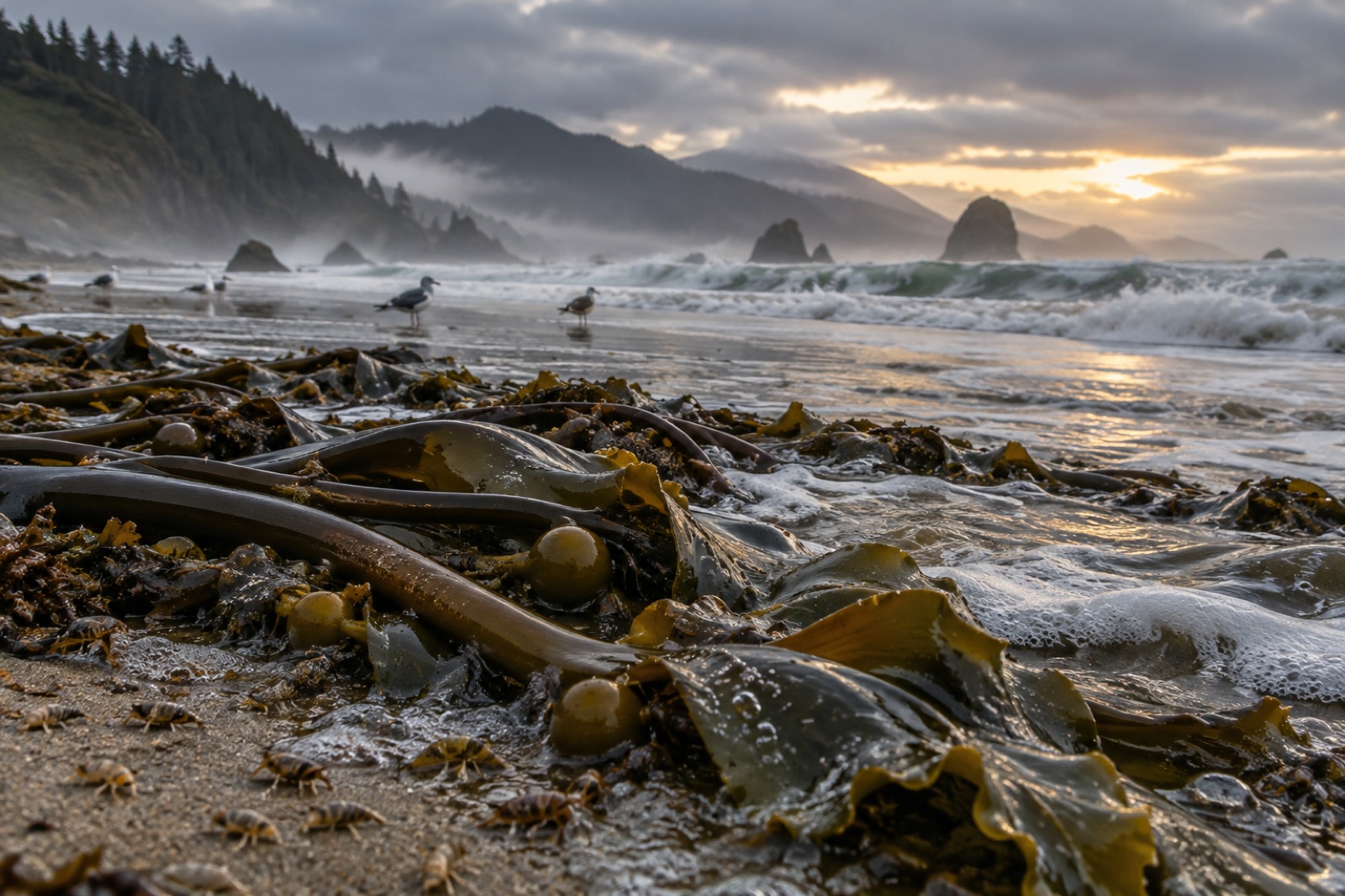
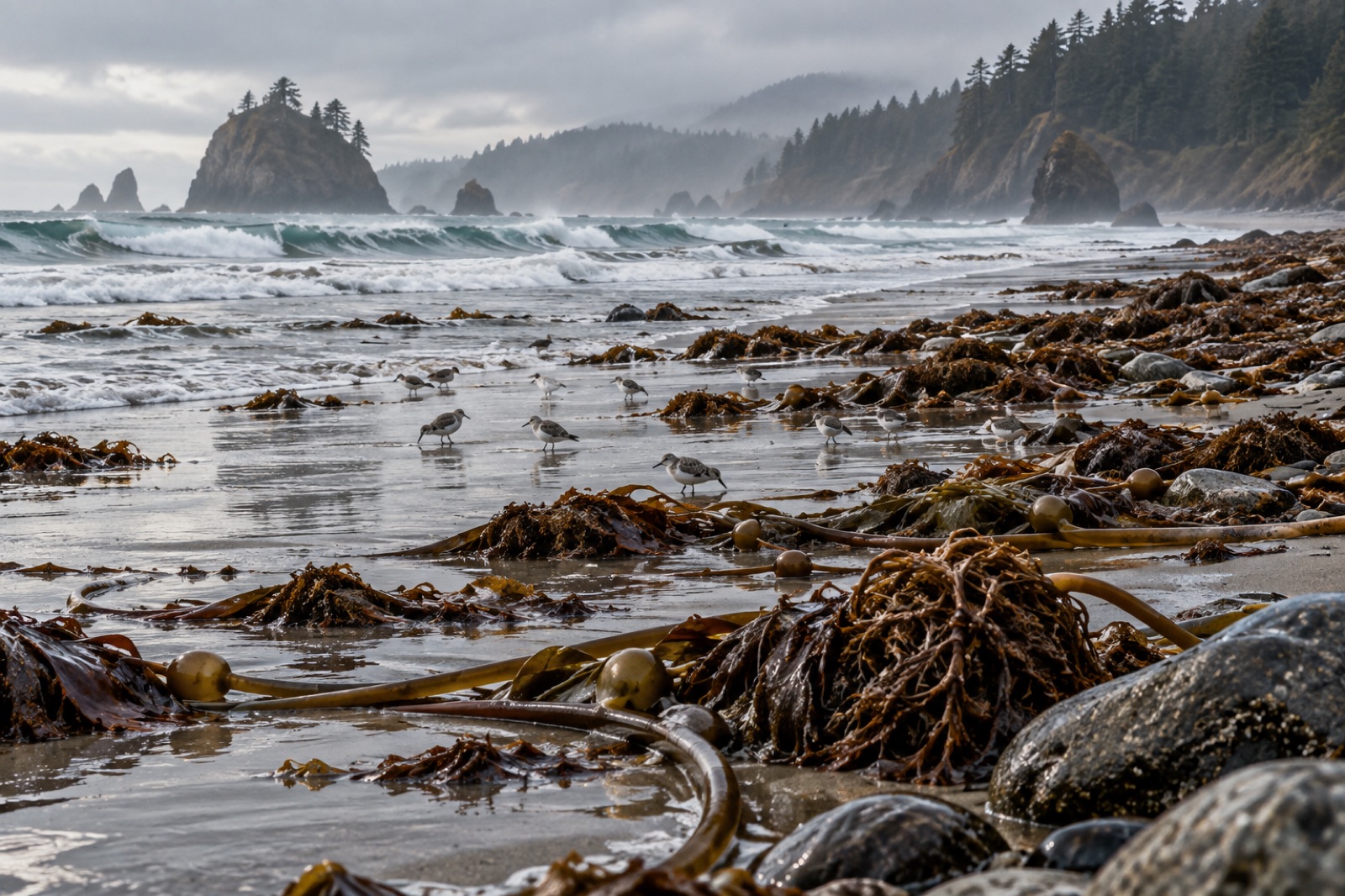
Detritus doesn't stop at the forest edge — export is a feature, not a leak. Storm-generated kelp fragments subsidise the sandy seafloor between reefs, where deposit feeders bloom around settling crumbs; near submarine canyons, whole-kelp falls feed deep-water scavengers; on beaches, wrack feeds the shore — a pathway covered in Drift Kelp and Wrack.
For carbon accounting, the processing state of detritus decides a lot. Fragments buried in anoxic sediments decompose only slowly; DOC that reaches the deep sea can persist there for centuries. Which fraction of kelp production ends up genuinely stored — versus respired within weeks — is the open, honestly contested question at the centre of Where Kelp Carbon Goes and Sediment, Drift or Deep Sea. Detritus is the fork in that road.
Why detritus matters for restoration
Detrital flows are also a restoration diagnostic. A reseeded forest that is truly functioning starts exporting early: wrack appears on adjacent beaches, deposit feeders aggregate downstream, filter-feeder fouling shows up on structure. That shift — from producing kelp to subsidising a neighbourhood — is one of the clearest signs of a canopy closing its ecological loops.
At Tidewright this is practical, not philosophical. After Drifter vessels lay Holdfast lines on a restored reef, our monitoring teams watch detritus metrics as leading indicators of function: fragment export flux, condition of understory sediment organics, and detritivore density in Canopy Ledger surveys. If those stay flat, the canopy may be up but the engine isn't turning yet, and we treat that as a signal to look again at the site's genetics and grazer balance rather than declare victory on frond counts alone.
Key takeaways
- Most kelp is not grazed standing. Tough tissue, defensive chemistry and sheer growth speed mean the majority of production enters the food web as detritus.
- Storm fragmentation, microbial conditioning and dissolution convert kelp into particles, microbial film and dissolved carbon — each with a different set of consumers.
- Urchins are usually drift-fed detritivores, not lawn mowers; amphipods, sea cucumbers and filter feeders run much of the detrital economy.
- Kelp detritus subsidises sandy seafloors, submarine canyons and beaches — and the share that escapes rapid decomposition is the basis of kelp's blue-carbon story.
- For restoration, detritus export and detritivore response are among the earliest measurable signs that a new forest is functioning, not just standing.
FAQ
What's the difference between kelp detritus and kelp wrack?
Detritus is everything broken down: fragments, conditioned particles and dissolved carbon in and around the forest. Wrack is the visible subset that reaches the beach — whole plants and large fronds cast ashore. Wrack becomes detritus on the sand as amphipods and microbes process it.
Do urchins prefer live kelp or detritus?
Given the choice, many urchin species prefer aged, microbe-conditioned kelp — it's softer and more digestible. They'll eat fresh kelp readily when it's the only option, which is one reason kelp near dense urchin fronts gets consumed regardless of defences.
Is detritus important for abalone and other grazers?
Very much so. Wild abalone in kelp regions commonly rear on drift and detrital fragments that lodge in their crevices; a steady detritus supply is one of the quiet requirements of abalone habitat, alongside crevice structure and current flow.
Does kelp detritus cause oxygen problems as it decomposes?
In open, well-flushed kelp habitats, no — oxygen demand is spread through the water column and sediments with plenty of flow. Problems arise in enclosed embayments where large kelp or farm biomass concentrates and decomposes in stratified, low-flow bottom water. It's a siting and scale issue, not a property of detritus itself.
How do scientists measure detritus pathways?
The main tools are stable isotope tracing (kelp carries a carbon isotope fingerprint that shows up in its consumers), fatty-acid biomarkers in animal tissues, sediment traps deployed around forests, and increasingly eDNA surveys that reveal who's eating the subsidy network.