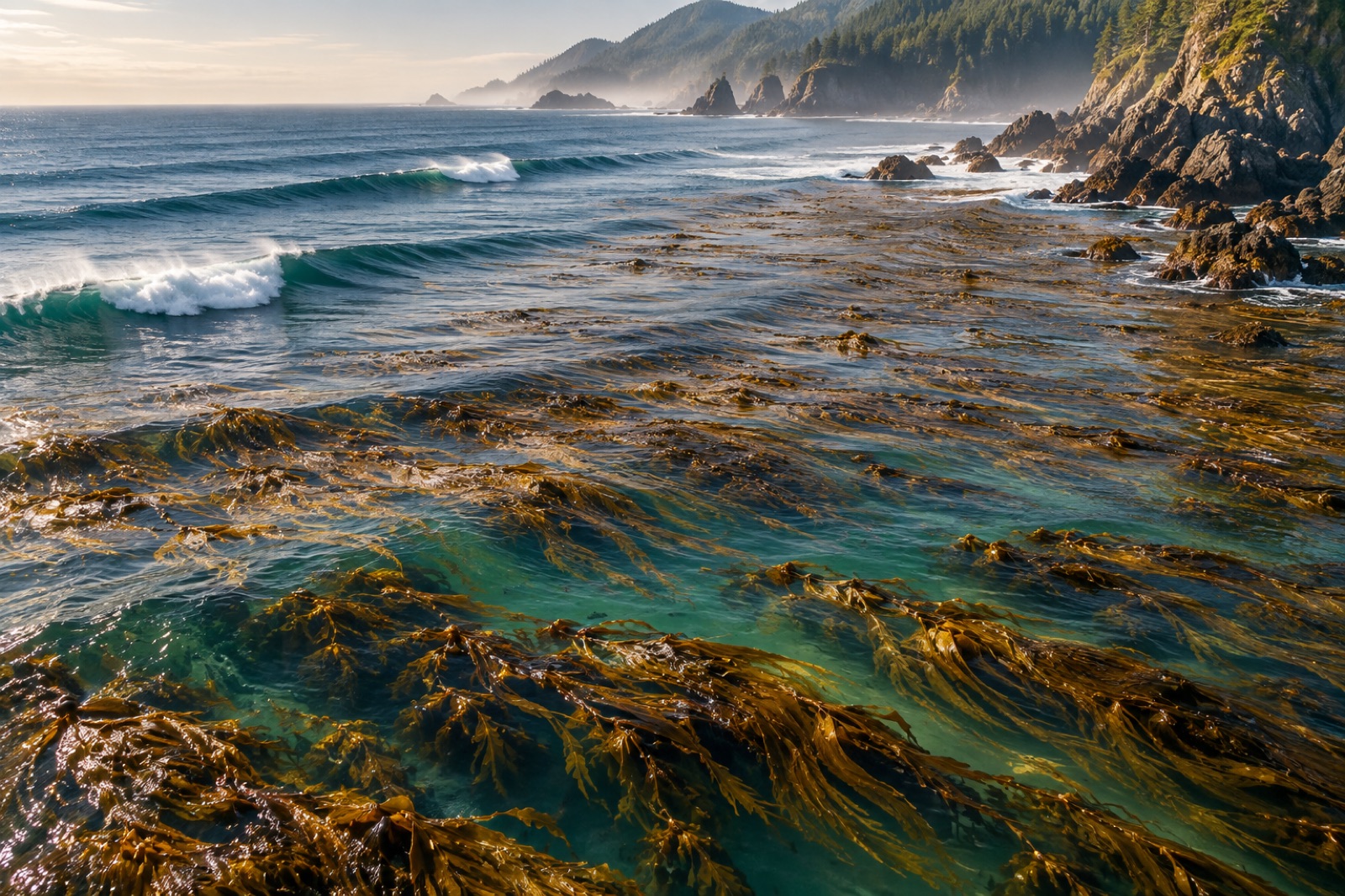
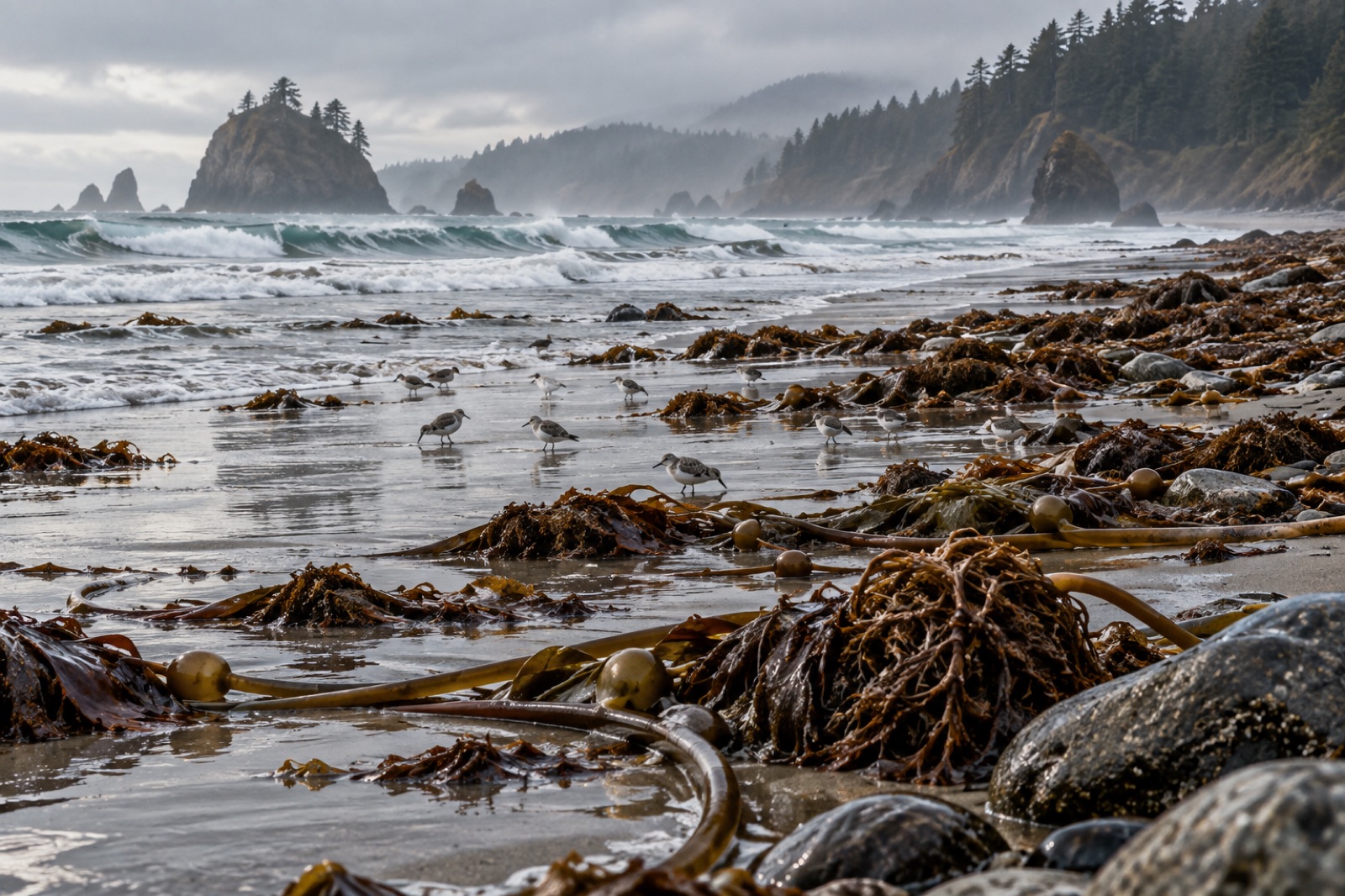
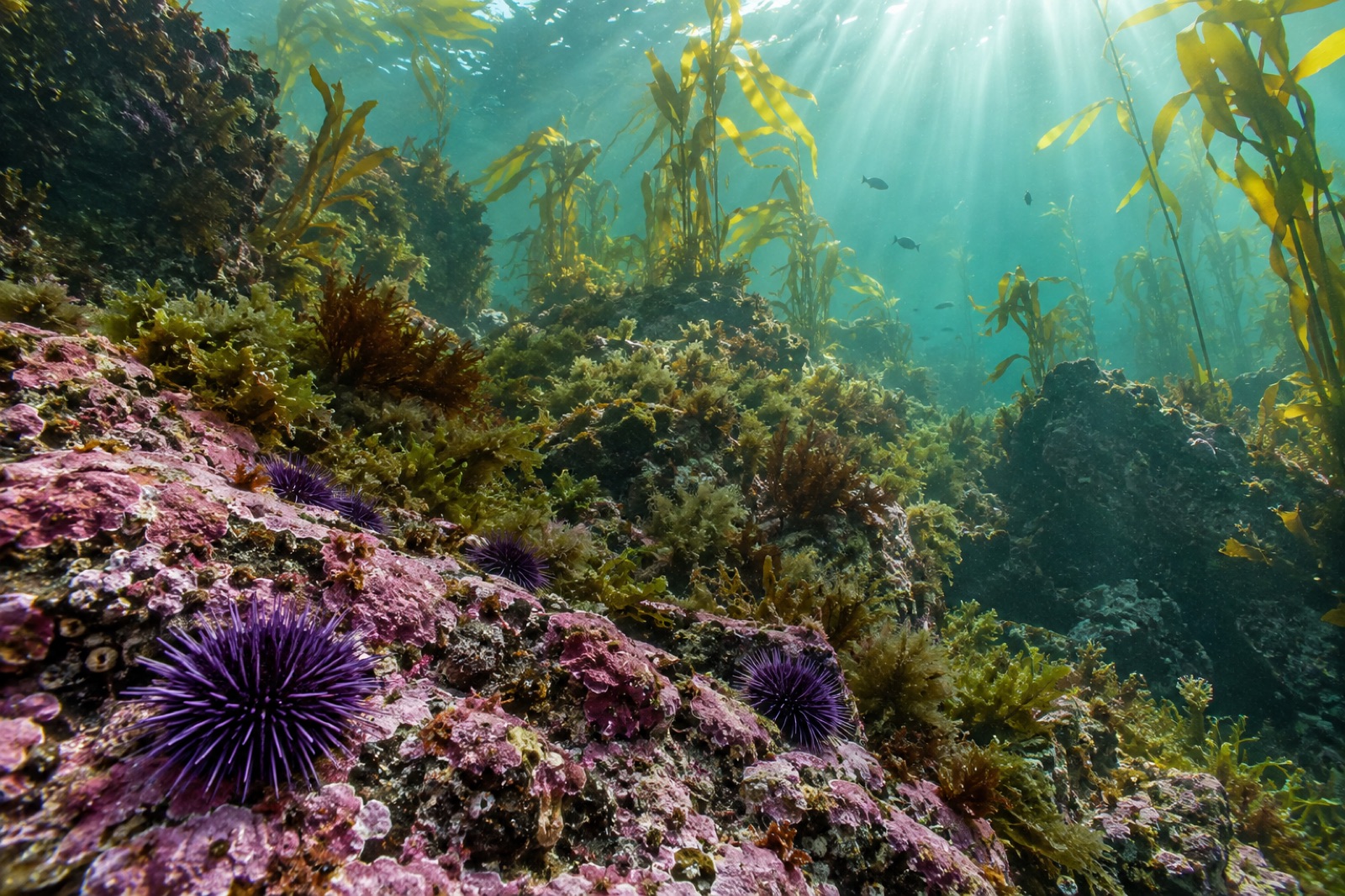
Every autumn, kelp forests on exposed coasts brace for a season of controlled demolition. Swells that have travelled thousands of kilometres arrive as walls of moving water, and for days at a time the forest is dragged sideways, sandbagged, sheared and shaken. From the beach it looks like destruction — rafts of torn kelp, wrack stacked head-high on the sand. From the forest's point of view, it is closer to pruning. Storm disturbance is not an accident that befalls kelp ecosystems; it is one of the forces that built them. This explainer covers how storms damage kelp, why a forest stripped of storms quietly degrades, and what happens when storm disturbance stacks on top of a warming ocean.
How exactly do storms tear a kelp forest apart?
The physics is violent and specific. Three mechanisms do most of the work:
Drag and acceleration. A wave passing overhead doesn't just push water forward — it sends it surging back and forth in elliptical orbits. Kelp's streamlining and stretch help it ride ordinary swell, but in storm seas the orbital accelerations exceed what even the toughest stipe can absorb. Blades tear first; then stipes part; finally, whole holdfasts — the root-like anchor explored in Holdfast Biology — are levered off the rock, taking clasts of substrate with them.
Entanglement loading. As plants break free, they tangle with their neighbours. A drifting plant's drag transfers to whatever it wraps around, and a chain reaction of entanglement pulls can strip a patch far larger than the initially damaged area. Divers surveying after major storms often find clear-cut lanes through a forest where a plug of kelp came free and dragged its neighbours out like a zipper.
Scouring. Storms move sediment, cobbles and drift logs. Sand scour sands the understory; moving cobbles crush juvenile sporophytes; large debris — a waterlogged tree trunk rolling in the surf zone — can scythe metres of forest bare in a night.
Annual species like bull kelp are especially exposed: their strategy is explosive summer growth on a single season's stipe, so a big autumn storm can end the local canopy until the next recruitment pulse.
The counterintuitive part: forests need storms
Remove storms from a kelp ecosystem and it does not become a richer forest. It becomes an old one — and old kelp forests are often poorer ones.
- Light release. Adult canopy monopolises light. When storms clear canopy gaps, light reaches the reef floor and triggers a synchronised recruitment pulse from the microscopic gametophyte bank (the kelp life cycle makes this possible). Post-storm cohorts are often the densest a forest produces.
- Space release. Encrusting algae, turf and old-growth kelp dominate undisturbed rock. Storm scour resets the surface, opening settlement space for kelp spores and for the whole cascade of sessile life that follows — the early chapters of ecological succession on a reef.
- Nutrient delivery. Storm mixing breaks down stratification and injects deep, nutrient-rich water into the lighted zone (the mechanics sit upstream of ocean stratification). Post-storm weeks often bring the year's best growing conditions.
- Export pulse. Storm-generated drift kelp and wrack deliver the year's largest food subsidy to beaches, canyons and offshore food webs — the exported half of the forest described in Drift Kelp and Wrack.
Ecologists call this reset-and-renewal pattern a disturbance regime: not events a system endures, but the metronome that keeps it diverse. Intermediate levels of disturbance — some storms, not constant battering — support the greatest diversity, a pattern seen from rainforests to coral reefs to kelp.
Why some species are storm specialists
Kelp forest flora has evolved answers to storm rather than purely suffering it. The sea palm grows on the most wave-hammered intertidal rock on the Pacific coast — where storms sweep away the mussel beds and competitors that would otherwise crowd it out. It bends nearly flat in breaking waves; its flexible stipe is a storm adaptation, not a compromise. Oarweed and other understory Laminaria species hug the reef with short, flexible stipes and sacrifice height for grip.
At the community level, storm frequency structures the whole mosaic: sheltered coves hold old, layered forests, headlands hold young, storm-cropped stands, and the mixture of patch ages along a coastline is a major source of its regional diversity.
Storm damage versus heatwave damage: an important distinction
Kelp biology treats storm loss and heat loss very differently, and the difference matters for how we read the news. Storm damage is mainly mechanical and external: canopy is removed but the microscopic stages in the sediment survive, nutrient conditions often improve, and recovery typically begins the following season. Heatwave damage is physiological — the plant's cells are starved of nitrogen at high temperature — and it can erase the gametophyte bank, the adults and the understory together. As we describe in Marine Heatwaves 101, a heatwave can flip a forest toward long-term absence, while even a severe storm generally just restarts the clock.
The dangerous combination is compounding: a heatwave that thins and weakens a canopy followed by an ordinary storm season that finishes the job, stripping tissue faster than weakened plants can replace it. Long records in several kelp regions show exactly this one-two timing behind the biggest historical canopy crashes.
Storms in a changing ocean
Two storm-relevant trends are underway. First, as storm tracks and intensities shift with a warming atmosphere, the disturbance regime itself moves — some coasts face fewer but more extreme storm events, others more frequent ones. Second, rising seas mean storm wave energy strikes habitat that previously sat above the reach of big swells, compressing kelp between deepwater light limits and shallow-water battering — the squeeze described in Coastal Squeeze.
Kelp has coped with storms for millions of years. What it has not previously faced is storm seasons landing on forests already thinned by repeated marine heatwaves and grazer imbalance. The disturbance isn't new; the baseline it lands on is.
What this means for restoration
For a restoration program, storms are a design constraint, not bad luck. At Tidewright, storm exposure is mapped before a single line is seeded — Drifter survey transects measure substrate type, scour patterns and the wave climate of each candidate reef. In exposed sectors we bias Holdfast seedstock toward storm-tolerant life-history strategies: stronger holdfast attachment, stiffer or more flexible stipe types matched to the wave regime (drawing on the same traits described in How Kelp Holds On), and staggered planting times so a single storm window never meets the whole crop at once. Genetic diversity in outplanted stock is itself storm insurance: different lines fail differently.
You can see how these design choices feed our field reporting on the impact dashboard, where post-storm canopy retention is one of the metrics we publish season by season.
Key takeaways
- Storms damage kelp through drag, entanglement chains and sediment scour — and the damage is patchy, creating lanes and clearings rather than uniform loss.
- Forests need disturbance: storm gaps trigger synchronised recruitment, open settlement space, mix in nutrients and launch the year's biggest export pulses of drift kelp and wrack.
- Some species, like the sea palm, are storm specialists that outcompete everything else precisely because storms remove their competitors.
- Storm loss is mechanical and usually reversible; heatwave loss is physiological and can erase the seed bank. The real danger is storms landing on forests already weakened by heat.
- Restoration engineering now treats storm exposure as a design variable — matching seedstock traits and planting schedules to the local wave regime.
FAQ
Do big storms wipe out kelp forests permanently?
Rarely, on their own. Storm-damaged forests typically begin recovering the next growing season from the microscopic gametophyte bank in the sediment. Permanent loss follows when storms coincide with other stressors — heatwaves that kill the bank, urchin outbreaks that graze recruits, or sedimentation that buries settlement surface.
Can kelp forests protect the coast from storms?
To a degree. Large, dense forests measurably damp wave energy and slow alongshore currents before they reach the beach — though the effect is modest against heavy swell. The physics and the honest limits are covered in How Kelp Forests Calm the Sea.
Why is there more kelp on the beach after storms?
Because storms are the main engine of export: they rip whole plants free and deliver them ashore. That post-storm wrack pulse feeds beach invertebrates, shorebirds and dune plants for weeks, as traced in Drift Kelp and Wrack.
Are storms getting worse for kelp?
The evidence is mixed and regional. Some coasts show rising wave energy and more extreme storm events; others show little trend. The clearer risk is compounding — storm seasons intersecting with an ocean that is measurably warmer and more stratified, so damaged forests face worse recovery conditions.
Should we "protect" kelp forests from storms?
We can't, and shouldn't try at the forest scale — disturbance is part of the system. The sensible lever is resilience: protect the grazer balance, maintain genetic diversity, and restore forest area so that when storms create gaps, there is always a source population nearby to fill them.