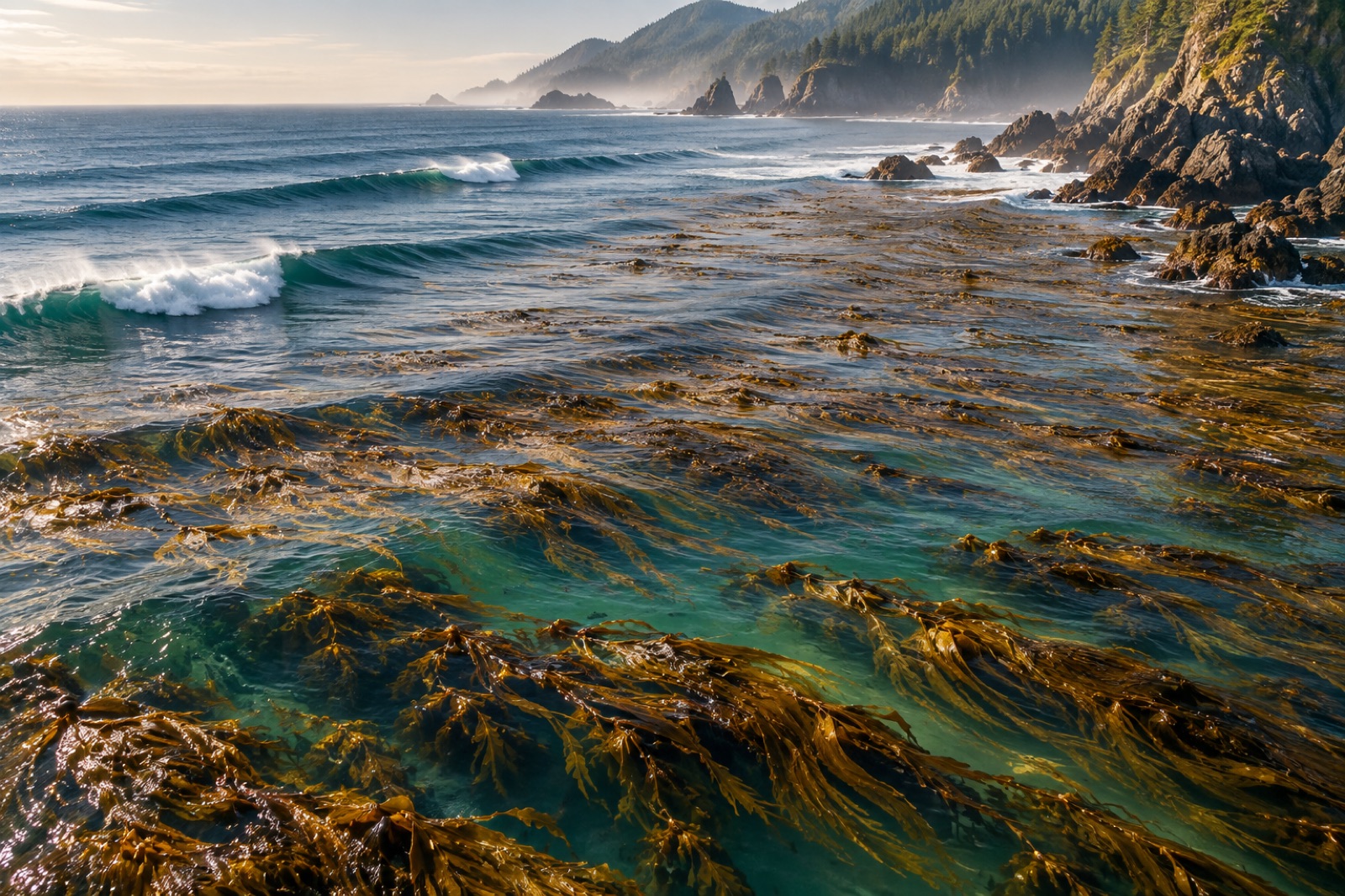
Sea level rise is usually framed as a problem for people — flooded roads, higher storm surge, threatened houses. But coastlines are also habitat, and habitat doesn't read zoning maps. When the sea moves inland, so must everything that lives at its edge: salt marsh, mangrove, seagrass, rocky intertidal reef and the shallow fringe where most kelp forests begin. Where land behind the shore is open, these ecosystems can retreat upslope and survive. Where a seawall, road or cliff blocks the way, the rising sea meets a hard edge — and the habitat in between is squeezed to nothing. That is coastal squeeze, and it is one of the slower, quieter threats to temperate reefs.
What coastal squeeze actually is
Coastal squeeze describes the loss of intertidal and shallow subtidal habitat trapped between two boundaries moving in opposite directions: the sea pushing inland from one side, and fixed human infrastructure holding the line on the other. Beaches narrow until they disappear at high tide. Salt marshes drown in place. Rocky benches that once hosted mussel beds and juvenile kelp spend their days permanently submerged — too deep, too turbid or too scoured for the communities that defined them.
The term comes from coastal management science and was first applied mostly to marshes and beaches fronting seawalls. But the logic applies to any habitat tied to a depth band: if a species needs light, wave energy and substrate at a particular elevation, and that elevation band migrates landward with sea level, the species must migrate too — or vanish locally.
Why it matters for kelp forests
Kelp seems like an unlikely squeeze victim. Most kelp lives subtidally, well below the tideline, and sea level rise of even a metre is small compared with the depth range of many species. But kelp forests are not evenly distributed down the slope. Three squeeze mechanisms matter:
The shallow nursery band
Most large kelps recruit densest in shallow, well-lit water. On a gently sloping coast, rising seas shift that optimal band landward onto new rock — if new rock exists. On an armoured coastline, the "new rock" is a vertical concrete wall: steep, deep at its toe and frequently fronted by reflective wave scour that strips sediment and abrades young sporophytes. The recruitment band has nowhere gentle to go.
Turbidity in deepening nearshore water
As nearshore zones deepen, finer sediments stay suspended longer and light reaching the bottom falls, especially in estuary mouths and sheltered bays. Species like sugar kelp and oarweed, which sit at the shallow end of the kelp depth range in many regions, can lose more habitat to darkening than to drowning. Light, not depth, is often the binding constraint.
Compound pressure with warming
Squeeze rarely acts alone. The same coastlines face marine heatwaves, range-shifting herbivores and altered storm regimes. A kelp population pushed to its warm-edge limit and simultaneously losing its shallow recruitment habitat has lost its two best refuges at once. Squeeze is a threat multiplier: small on its own, dangerous in combination.
The armouring problem
Shoreline armouring — seawalls, rock revetments, bulkheads — is the principal human cause of squeeze, and it's spreading. Many heavily populated temperate coastlines have armoured a large share of their developed shoreline, and the proportion rises with every storm season, because armouring begets armouring: one wall reflects wave energy onto its unprotected neighbours, who then armour in turn.
Armour does more than block landward migration:
- Passive erosion. Beaches fronting walls don't flatten and retreat naturally; they narrow and deepen at the wall's toe, removing the shallow, low-energy substrate young kelp and intertidal communities need.
- Habitat substitution, badly. Walls do get colonised — by a thin, steep, low-diversity band of algae and invertebrates. Studies consistently find armoured shores support different, generally poorer communities than the natural rock or beach they replaced.
- Locked-in effects. Unlike a dune or marsh, a seawall can't adapt. Every decade of sea level rise steepens the contrast between the held line and the migrating sea.
None of this means every wall must come down tomorrow — some protect genuinely critical infrastructure. It means the default reflex (protect every shoreline in place, forever) is ecologically expensive and, on a rising sea, ultimately temporary anyway.
What actually helps
Managed realignment and retreat
Where it is feasible, moving the defence line landward — realignment — recreates intertidal space deliberately. In marshes and estuaries this approach is decades old and well proven: breached embankments reflood, and functional salt marsh establishes, restoring both habitat and natural flood buffering. For rocky coasts, the equivalent is planning that keeps low-lying coastal land undeveloped so intertidal and shallow reef can migrate. The cheapest squeeze-avoidance strategy is simply not building in the migration space.
Living shorelines
Where protection is needed, soft or hybrid approaches — dune restoration, oyster reefs, marsh planting, strategically placed kelp-aquaculture or reef structures — dissipate wave energy while remaining habitats themselves. Healthy kelp forests participate directly: kelp canopies measurably damp wave energy, trimming the surge that drives erosion in the first place (see how kelp forests calm the sea). A restored kelp fringe is a small but real piece of coastal defence infrastructure that also feeds fish, unlike concrete.
Protecting the subtidal refuge
Squeeze operates in the shallows; deeper reef is less vulnerable to depth-band migration. Protecting and restoring mid-depth kelp habitat — through water quality, urchin management and active reseeding — maintains the forest's engine while shallow bands reorganise. Restoration can't stop sea level rise, but it can hold the ecosystem's core intact through the transition.
Planning for migration, not defence in place
The deepest lesson of coastal squeeze is a shift in mindset: coasts move. Management frameworks built on fixed lines — fixed property edges, fixed habitat maps, fixed protected-area boundaries — will mis-serve ecosystems that are on the move. Better practice is emerging:
- Map the migration space. Identify where intertidal and shallow reef habitat could exist in 2050 and 2100, and weigh that in planning decisions now.
- Sequence retreat early. Realignment is vastly cheaper before land is developed than after.
- Treat reefs and kelp as infrastructure. Their wave-damping, sediment-settling and fisheries value belongs in cost-benefit comparisons of grey versus green defence — with honest numbers, not slogans. Tidewright's work with coastal governments increasingly includes exactly this: making the ecological ledger visible in engineering choices.
Key takeaways
- Coastal squeeze is intertidal and shallow-reef habitat loss between rising seas and fixed hard shorelines; armouring is its main human driver.
- Kelp is affected through its shallow recruitment band, deepening turbidity and compound pressure with warming — rarely through depth alone.
- Seawalls beget seawalls, passively erode their fronting beaches and support poorer, steeper communities than natural shore.
- Managed realignment, living shorelines and protecting deeper reef refuges are the working responses; kelp restoration contributes real wave-damping value.
- The strategic fix is planning for habitat migration — keeping the landward space open — rather than defending every metre in place.
FAQ
Does sea level rise directly drown kelp forests?
Rarely by itself. Most kelp has metres of depth tolerance, and near-term sea level rise is measured in centimetres to a metre this century. The danger is indirect: loss of the shallow nursery band, light reduction from deepening, turbid water and blocked landward migration against armoured shores.
What is "managed retreat" in coastal management?
Deliberately moving defences, infrastructure or development landward — or breaching embankments — to give the coast room to migrate. For marshes it's called managed realignment and has decades of successful examples; the same logic protects intertidal reef and beach.
Can kelp forests protect coastlines from erosion?
Partially. Kelp canopies reduce wave energy reaching the shore, with the strongest effects for smaller, more frequent waves rather than extreme storm swell. Restoration is a complement to — not a replacement for — engineered defence where homes and infrastructure are at risk.
Is coastal squeeze reversible?
Sometimes. Removing or realigning defences can restore intertidal habitat, and beaches recover strikingly fast when sediment can move again. But habitat squeezed to zero on a fully armoured coast cannot reappear until the hard line moves — which is why early planning matters.
How does climate adaptation planning account for moving habitats?
Increasingly by mapping "climate corridors" — land and seafloor where habitats can migrate — and prioritising those areas in zoning and protected-area design. Our impact methodology treats habitat connectivity as a core reporting dimension for the same reason.