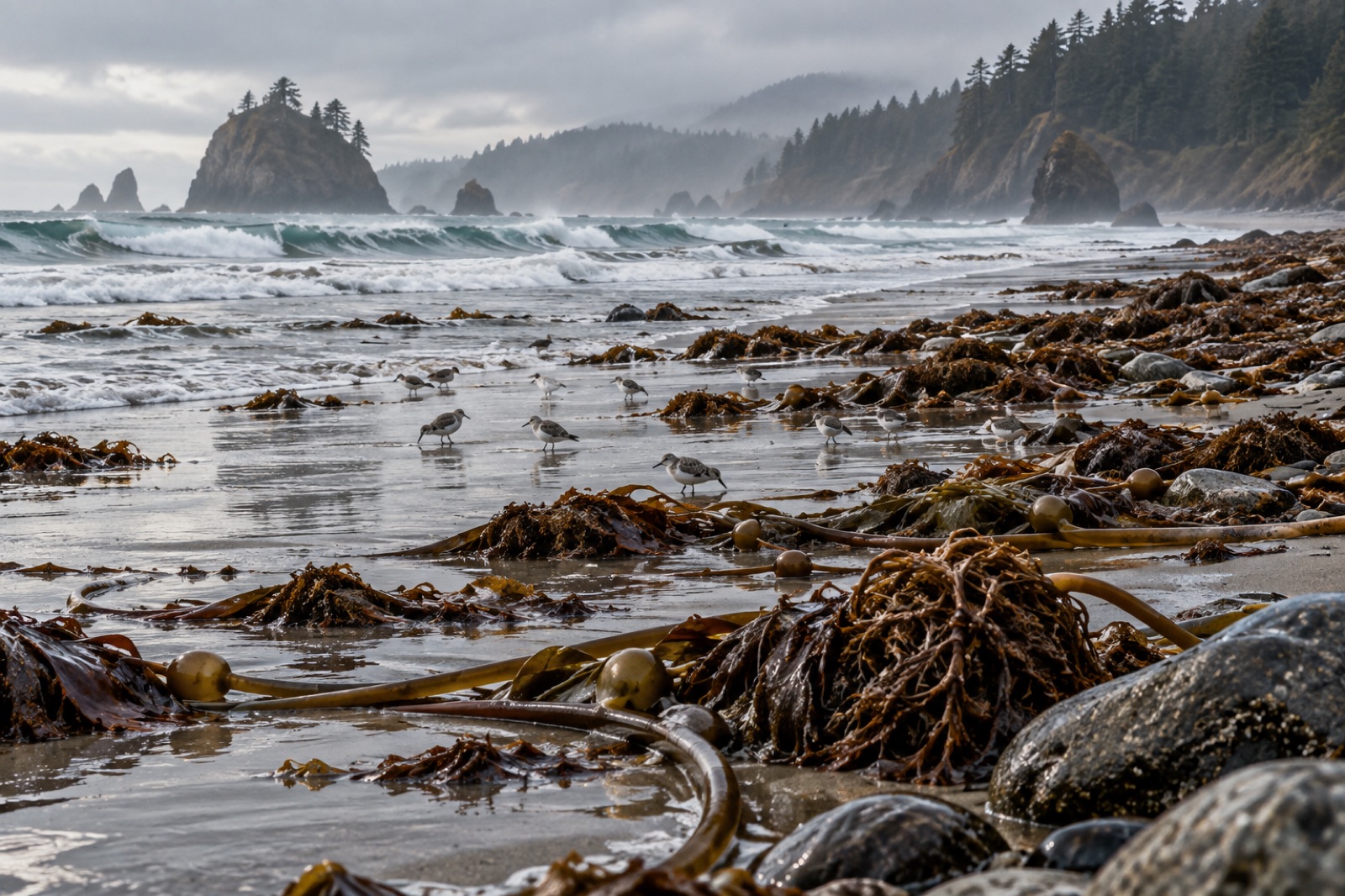
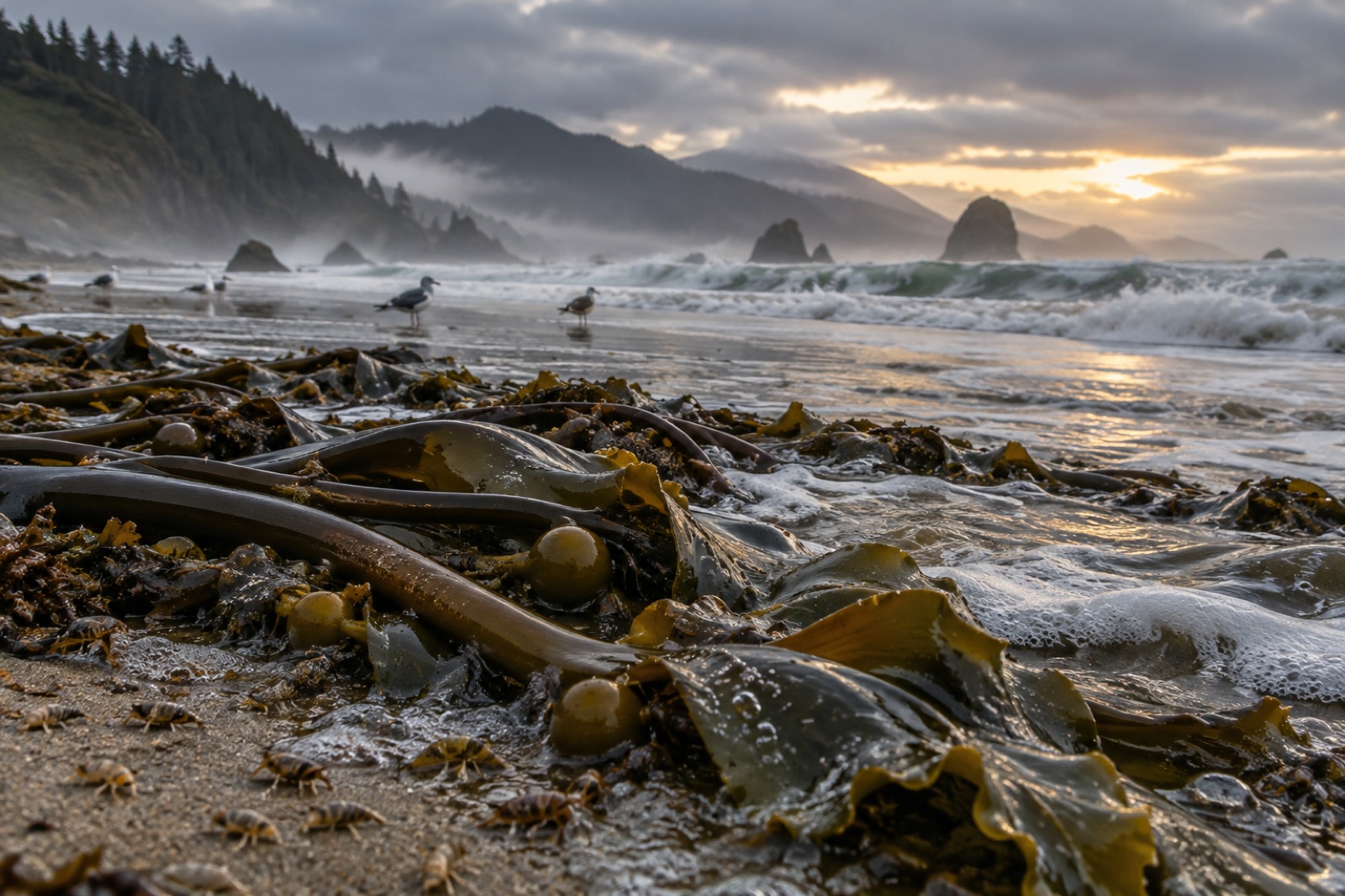
Walk any temperate beach after a winter storm and you will find the ocean's signature along the high-tide line: ribbons of brown fronds, bull kelp whips, tangled holdfasts that still grip their cobbles like fists. Most people step over it. A few complain about the smell. But that wrack line is one of the most productive food deliveries on the coast — the kelp forest paying a standing subsidy to every ecosystem downstream of it. This explainer follows that gift: how kelp leaves the forest, what eats it at sea and on the sand, and why the wrack line is worth protecting rather than raking.
Drift kelp is any kelp that has detached from the seafloor and travels with wind and current. Wrack is what arrives on the beach. Together they form a conveyor belt that moves forest productivity into open water, onto sandy shores and, eventually, into the deep sea — a pathway we trace in detail in Where Kelp Carbon Goes.
How do kelp forests shed their biomass?
Kelp does not simply die in place. Healthy forests are leaky by design, and the leakage is enormous. By mass, most of what a kelp forest grows each year is eventually exported rather than grazed or buried on the reef. It leaves through three doors:
- Whole-plant dislodgement. Storms and swells rip entire plants free, especially annual species like bull kelp that invest in fast summer growth rather than structural armour (see Storms and Kelp). A holdfast torn from its cobble still floats — the gas-filled bladders that held the plant up in the water column now carry it at the surface.
- Frond and blade shedding. Kelps continuously slough old, worn or fouled tissue the way a tree drops leaves. Giant kelp sheds blades year-round; storm-damaged tissue releases in pulses. Each fragment starts breaking down at sea and becomes food for decomposers and detritivores — the starting point of the pathways described in After the Blade Falls.
- Dissolved organic matter. Even intact, healthy kelp leaks dissolved sugars such as mannitol into the water — a steady trickle that fuels the microbial loop around the forest.
The result: a forest exports energy in every physical form — ton-sized rafts, confetti fragments, and invisible dissolved carbon — and exports it continuously, in pulses tied to seasons and storms.
Life in the drift: floating reefs and hitchhikers
Detached does not mean dead. A floating kelp plant keeps photosynthesising for days to weeks; its blades host whole travelling communities. Juvenile fishes shelter in the fronds; amphipods, isopods and small crabs ride along, grazing epiphytes as they go. To a larval fish in open blue water, a drifting kelp raft is exactly what a coral bommie is on a reef: structure, food and shade in a place with none.
This is one reason kelp detachment doubles as a dispersal mechanism. Holdfasts carry a miniature reef fauna — limpets, worms, brittle stars, juvenile abalone — and currents can carry that cargo many kilometres before the raft strands or sinks. Geneticists have found evidence of such rafting connections between kelp populations separated by open ocean, which is one reason kelp populations remain genetically connected along long coastlines.
Not everyone rides. Big animals come to the rafts. Seabirds forage over kelp patties at sea, and sea otters have been documented hauling drifting kelp around themselves at the surface — the same anchoring behaviour they use in the standing forest, applied to a travelling one. The drift line at sea concentrates plankton, larval fish and jelly fragments, and it concentrates their predators too.
The wrack line: an ecosystem that begins where the forest ends
When drift kelp finally strands, it does not become waste. It becomes habitat. Beach wrack is the single largest food subsidy most temperate sandy beaches receive, and the beach's whole animal community reorganises around it.
Within hours, beach-hoppers and talitrid amphipods move into fresh wrack — thousands of individuals in a single patch, chewing fronds into fragments further reduced by microbes. Fly larvae, kelp flies and rove beetles follow. Then come the birds: sandpipers and plovers pick invertebrates out of the wrack, and in southern and northern latitudes alike, terns and gulls patrol fresh lines after storms. On predator-rich coasts, the chain extends further — ravens, foxes, and where they occur, bears working spring wrack lines.
Wrack does structural work too:
- It feeds and shades burrowing invertebrates that aerate and mix the upper sand, accelerating nutrient cycling.
- It traps wind-blown sand at the strandline, seeding the first dune-building layer that grasses later stabilise.
- Its decomposition returns nitrogen and phosphorus to beach and dune plants, which are otherwise some of the most nutrient-starved vegetation on Earth.
A groomed beach — raked clean for appearance — is a beach with its food supply confiscated. Comparative studies on heavily groomed versus ungroomed beaches consistently find fewer invertebrates, fewer shorebirds and slower natural dune recovery on the raked shore.
From the beach to the deep: the long tail of wrack
Some wrack never gets eaten on the sand. Spring tides and storm surges re-float part of the strand line and carry it offshore again; in steep submarine canyons near kelp coasts — Monterey Canyon off California or the canyons off South Australia's kelp beds are classic settings — storms inject kelp directly down-slope. Lobster and fish fisheries in several kelp regions are partly subsidised this way: southern rock lobster in Australasia, for instance, consume drift kelp and the invertebrates that gather under it. In the deep sea, sunken kelp falls — natural and storm-driven — create hotspots of feeding activity around canyon heads.
This export also underpins the kelp blue-carbon question. Fragment and raft transport is how kelp carbon reaches low-oxygen sediments and deep water where decomposition slows to a crawl — the pathway, with all its honest uncertainties, is laid out in Where Kelp Carbon Goes and How Kelp Stores Carbon. No wrack, no export story.
Wrack, people and the politics of the strand line
Wrack management is one of the most quietly contested questions on populated coasts. Beach towns rake for tourism; property owners remove wrack to clear views and smells; councils balance amenity against ecology. The ecological case is clear: wholesale removal starves the beach and its birds, and the practice strips the berm of natural storm protection.
There are better defaults now used by much of the world:
- Rake paths, not shores. Leave wrack in place everywhere except established access corridors.
- Time the work. If grooming happens at all, avoid shorebird nesting windows and post-storm arrival pulses when wrack feeds are densest.
- Stack, don't strip. Piling excess wrack at the toe of the dune keeps it in the system — and feeding invertebrates — rather than landfilling it.
At Tidewright, we see wrack lines as part of the forest's footprint, not the end of it. When we restore a kelp bed through our Holdfast nursery program, we expect one quiet success metric to be what the neighbouring beach receives: more raft arrivals, richer strand invertebrate communities, shorebirds working the line again. It appears in our impact methodology as a coastal-subsidy indicator, precisely because the forest's value doesn't stop at the low-tide mark.
Key takeaways
- Drift kelp and wrack are the outward-flowing half of kelp forest productivity — most of what a forest grows each year is eventually exported rather than grazed in place.
- At sea, drifting kelp acts as a floating reef: shelter and food for juvenile fish, a dispersal vehicle for holdfast fauna, and a foraging magnet for seabirds and marine mammals.
- On the beach, wrack is the primary food subsidy for sandy-shore ecosystems, feeding amphipods, insects and shorebirds, building dunes and fertilising beach plants.
- Storms re-float beach wrack and inject kelp down submarine canyons, linking the forest to deep-sea food webs — the export pathway central to kelp blue-carbon accounting.
- Raking beaches clean starves the shore; management that leaves wrack in place is one of the cheapest conservation wins on any coast.
FAQ
Is beach wrack smelly and harmful?
Fresh wrack barely smells. The strong odour comes from older, compacted wrack decomposing without oxygen, especially when it's piled against seawalls or buried. Out on the open sand, wrack passes through a fast, invertebrate-driven decay cycle, and most of it is gone within weeks. It isn't a health hazard — it's dinner for the beach ecosystem.
Can I collect drift kelp for my garden or compost?
Kelp wrack is an excellent soil amendment, but rules vary: many beaches treat wrack as protected habitat, and parks commonly prohibit removal. Where collection is legal, take a small share from scattered spots rather than stripping one patch, and leave recently deposited wrack alone — that's the most valuable feeding zone for birds and invertebrates.
Is a drift-kelp raft the same as a "kelp patty" at sea?
Essentially yes. "Kelp patty" is the fisher's and oceanographer's name for a clump of drift kelp aggregated by surface convergence lines. Fishers look for patties because they concentrate bait and gamefish; ecologists look for them because they concentrate the forest's exported life.
Does attached kelp or drift kelp matter more for carbon?
Both, in different ways. Standing biomass is what we can map and count, but the carbon that matters for long-term sequestration is mostly what leaves — fragments, dissolved matter and rafts that reach sediments and deep water. That's why export pathways get so much attention in blue-carbon research.
Why do some beaches have mountains of wrack and others none?
Wrack delivery depends on the local forest's size, storm history and the angle of the coastline to prevailing swell and wind. A beach down-drift of a big kelp bed after a storm will stack wrack deep; a sheltered cove up-current of the forest may see almost none, even in the same region.