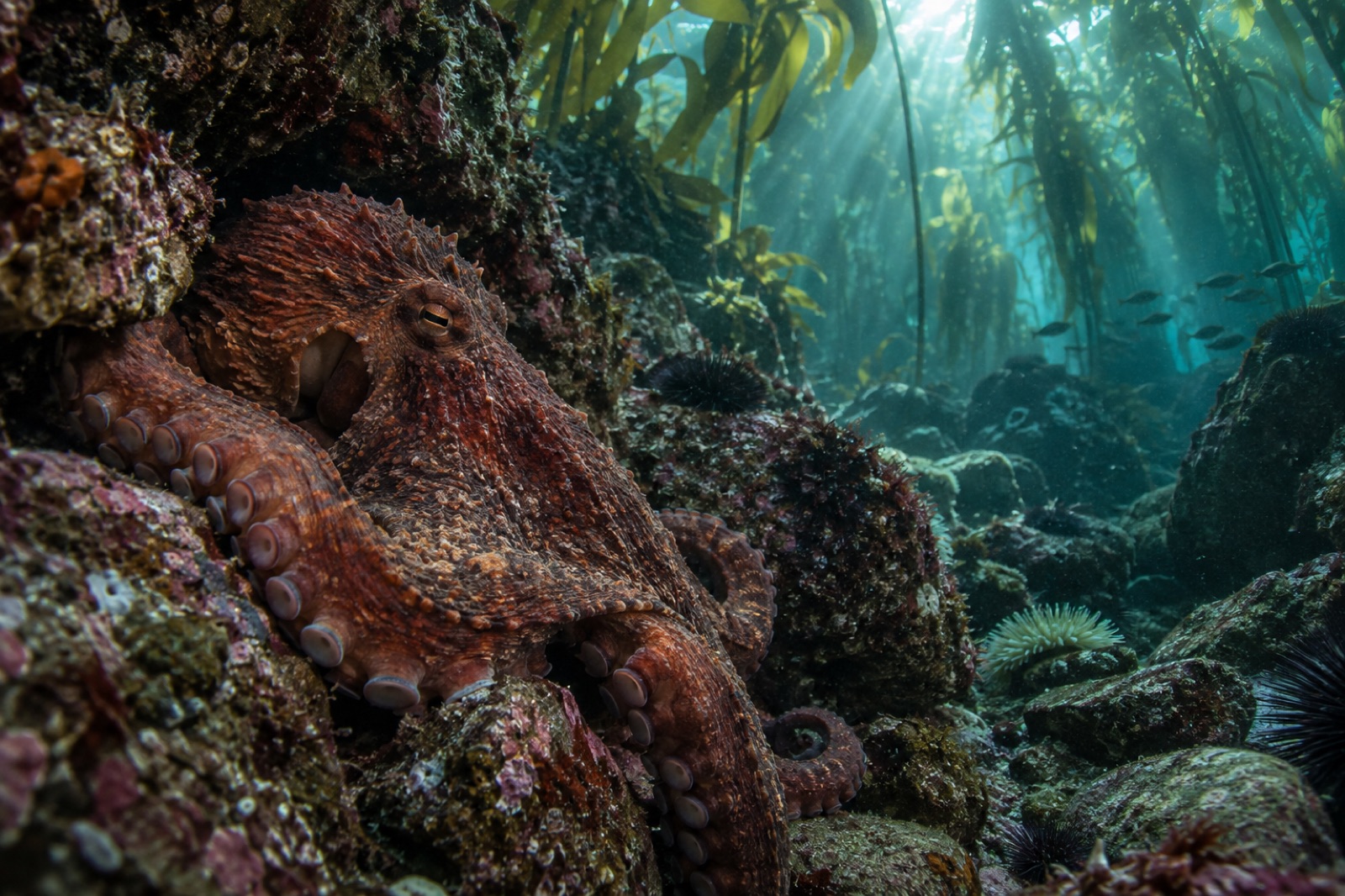
Ask a Tasmanian reef ecologist what animal decides the fate of the kelp forest, and the answer will not be a kelp. It will be a heavy, deep-red crustacean that walks the reef at night: the southern rock lobster, Jasus edwardsii. Australians call it "crayfish" or just "cray"; New Zealanders call it the red rock lobster or kōura. Whatever the name, this spiny lobster is the largest urchin predator on southern temperate reefs — the animal whose presence keeps sea urchins in their crevices and, through them, keeps kelp forests standing. Its story runs from a two-year drift as a near-invisible larva, to a decades-long life as a reef heavyweight, to the heart of the most instructive marine-management experiments in the southern hemisphere.
Fast facts
|
|
| Scientific name |
Jasus edwardsii |
| Group |
Spiny lobster, family Palinuridae — antennae, not claws |
| Size |
Commonly 1–2 kg; large old males exceed 4 kg, with exceptional animals larger still |
| Lifespan |
Several decades; slow-growing, maturing at roughly 5–9 years |
| Depth range |
Shallow subtidal to about 150 m; most abundant shallower than 50 m |
| Range |
Southern Australia (Western Australia around Tasmania to New South Wales) and New Zealand |
| Status |
Managed commercial and recreational fisheries; locally depleted; rebuilding in marine reserves |
Anatomy and naming
The southern rock lobster is a spiny lobster — which means, first of all, no claws. Where the Atlantic's clawed lobsters crush with a giant crusher claw, the southern lobster defends and kills with a heavily spined exoskeleton, whip-like antennae longer than its body, and powerful mandibles. Adults are deep brick-red to maroon, mottled in orange and cream, built like a reef dunny door: low, broad, and apparently unbothered by anything smaller than a shark.
The "crayfish" name gets Australians into etymological trouble with actual freshwater crayfish (yabbies, marron), but the word is cemented in Australian usage, alongside "rock lobster" in the market. In New Zealand, kōura is a taonga species under Māori customary harvest — a point that matters when we come to management.
The two-year childhoods
The astonishing thing about Jasus edwardsii is what it does before it earns a name. Females carry tens of thousands to hundreds of thousands of eggs beneath their tails, hatching them into phyllosoma larvae — flat, spidery, near-transparent discs that ride ocean currents for anywhere between one and two years, journeying hundreds of kilometres offshore. Only at the end of that odyssey does the larva metamorphose into a puerulus, a miniature clear lobster that swims itself back to the coast and settles onto reef as a translucent post-larva.
This long larval life has two consequences. First, it mixes the population across enormous distances — Tasmanian lobsters are not simply Tasmanian-made, and recruitment depends on currents and winds far beyond any single jurisdiction. Second, it makes recruitment wildly variable, with strong settlement years and weak years arriving in bursts the fishery has learned, slowly, to read. Monitoring puerulus settlement is now one of the more elegant predictive tools in any lobster fishery.
The urchin–lobster–kelp triangle
Here is why this lobster matters to kelp. When rock lobster grow large enough — a rule of thumb is well above the legal minimum size — they become capable predators of large sea urchins, flipping them and cracking through their spines. In a reef with big lobsters, urchins stay sheltering in crevices by day and creep out to eat drift weed. In a reef without big lobsters, urchins walk in the open, graze every kelp recruit, and convert forest to barren.
The comparison has been run as a natural experiment across New Zealand's no-take marine reserves — the story told from the grazer's side in our kina species profile. Inside reserves, where lobster and snapper rebuilt, kina retreated and kelp returned; outside, often within sight of the boundary, the same reef was bald. That is a trophic cascade in its purest visible form — predators → grazers → forest — and our explainer on trophic cascades in kelp forests shows the same pattern from sea otters in Alaska to cod in the North Atlantic. The mirror crisis, and why barrens persist once flipped, is covered in our piece on urchin barrens.
The Tasmanian chapter is more urgent still. The long-spined sea urchin (Centrostephanus rodgersii) — historically a New South Wales animal — has marched south with the warming East Australian Current and now strips eastern Tasmanian reef with a grazing efficiency kina rarely matches: barrens that resist kelp recolonisation once established. Crucially, experiments and field surveys have shown that only large lobsters — individuals well above legal minimum, nearing the size where males carry arm-spanners to boot — can reliably handle long-spined urchins. Sub-legal lobsters mostly harass them and walk away. So the mere existence of a fishery full of small legal lobsters does not restore the cascade; the big old lobsters that fishing removes first are exactly the animals that matter ecologically.
This single fact reframes fishery management as kelp management. Size limits protecting juveniles are necessary for the fishery but insufficient for the reef; what eastern Tasmania needs is a population skewed old and heavy, which is what marine reserves — and targeted translocations of large lobsters onto urchin fronts — experimentally supply. Our own field work along Tasmania's east coast, where the kelp loss and the urchin front are a single unfolding event, has taught us that no kelp replanting survives without this ecosystem repair done first or alongside it.
The fishery: managed, but not magically
Southern rock lobster supports valuable commercial fisheries in Australia and New Zealand and a fiercely loved recreational fishery. Management combines limited entry, catch quotas, minimum and maximum size limits, protection of egg-bearing females and, in several areas, spatial closures. It is fished hard: lobsters are a premium export product and the pressure is unrelenting. Locally the fishery has rebuilt nicely after downturns driven by poor recruitment and overfishing; globally, though, the structural tension between "more, smaller, legal lobsters" and "fewer, older, ecologically functional lobsters" remains unresolved. The fishery and the reef want slightly different size structures of the same animal.
Several practical responses follow:
- Marine reserves protect the big animals, and the science from New Zealand and Tasmanian reserves is unambiguous: predators accumulate, urchins retreat, kelp follows. Our marine protected areas explainer walks through why reserves work when they're large, old, and enforced.
- Lobster translocation moves large excess lobsters from healthy populations onto urchin-front reefs — a program pioneered in Tasmania, conceptually akin to the sea otter restoration that guarded North Pacific kelp, and exactly the kind of intervention Tidewright's Reef Partners program supports in its fictional-but-carefully-grounded project funding.
- Harvest restraint on big animals, the emerging conversation again — maximum size limits, with a for-the-reef logic even where the fishery logic could argue the other way.
Diving with a cray
If you dive or snorkel southern Australian or New Zealand reefs, the southern rock lobster is among the most memorable encounters available. Big animals hold themselves with a confidence no school of fish can match; catch one in the open under ledge-light and you meet a gaze, antennae sweeping your regulator bubble-stream. Look under shaded ledges, in the day-time dens of stacked individuals, along the weedy margins of kelp forest where they hunt at dusk. Our beginner's guide to kelp forest diving covers where to go; the warmer-water end of its range coincides with some of Australia's most visually forgiving kelp diving.
Diver etiquette that barely needs stating: recreational take follows legal-size and pot-or-hand rules, berried females go back or stay untouched, and photographing rather than handling is the interaction the animal deserves. A big cray is old — possibly older than the diver — and every one we leave walking is a standing vote for the kelp forest above it.
Key takeaways
- The southern rock lobster (Jasus edwardsii) is a clawless spiny lobster of southern Australia and New Zealand — slow-growing, long-lived, and the region's dominant urchin predator.
- Its phyllosoma larvae drift for up to two years, making recruitment variable and population mixing continental in scale.
- Only large, old lobsters can suppress sea urchin populations, which is exactly the size class fishing removes first; this mismatch drives barrens.
- Marine reserves in New Zealand and Tasmania demonstrate the reversal: protect predators, urchins retreat, kelp returns — the flagship natural experiment for kelp trophic cascades.
- Lobster translocation onto urchin fronts is a working Tasmanian restoration tool and the kind of intervention restoration programs increasingly support.
- Management for the fishery (small-legal-productivity) and for the reef (large-old-predation) are not the same thing; honest kelp restoration treats them as overlapping but distinct goals.
FAQ
What's the difference between a southern rock lobster and an American lobster?
They are entirely different crustacean families. The American lobster (Homarus americanus) is a clawed lobster, killing with a giant crusher claw; the southern rock lobster is a spiny lobster (family Palinuridae) with no claws at all, defending itself with spine armour and long antennae and killing prey with mandibles. They also live in different hemispheres, and the spiny lobsters grow arguably stranger — no claws, longer antennae, longer larval odysseys.
How long do southern rock lobsters live?
Decades — conservatively, large adults are commonly estimated at twenty years and up, with growth slowing to near-invisibility in the biggest animals. A trophy-scale cray of several kilograms may have been walking that reef through events a younger world barely remembers. Slow-growing and long-lived is precisely the combination that makes them vulnerable to fishing and slow to recover.
Is the southern rock lobster fishery sustainable?
It is managed — quotas, size limits, female protection — and in several stocks genuinely rebuilt after historic depletion, which is more than many fisheries can say. But fishery sustainability is not the same question as reef function: a fishery can be sustainably producing legal-size lobsters while ecological urchin control languishes for want of old, big animals. The honest answer is: fished sustainably and managed increasingly well, with the reef consequences depending on how we treat the largest size class.
Can a lobster regrow lost limbs?
Yes, through moulting — lobsters shed their exoskeleton to grow, and a lost antenna or leg returns at the following moult, smaller at first, reaching full size across subsequent sheds. This is why handling injuries are survivable; it is also why a many-legged cray quietly walking past you is a well-kept animal, moulting healthily year after year.
Where can I see one while diving?
Eastern Tasmania, southern Australia and northern New Zealand all offer reef and kelp diving with reliable lobster encounters, under ledges and in daytime dens. Tasmania's east coast is the centrepiece — the Tasmanian east coast atlas guide has the regional picture — and any New Zealand marine reserve settled long enough will show you the size class the fished coast has lost. Dive them gently; these animals are older than they look.