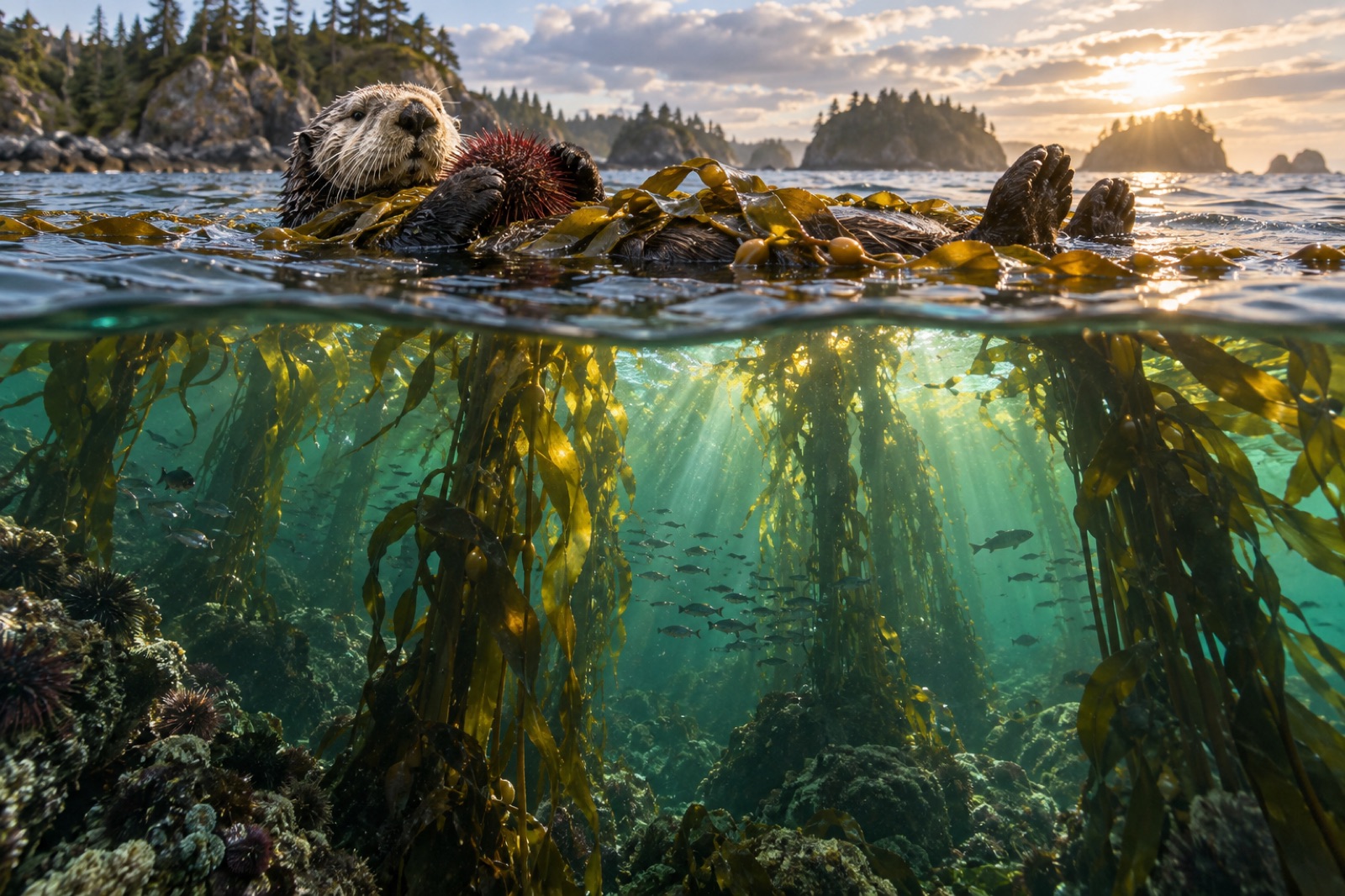
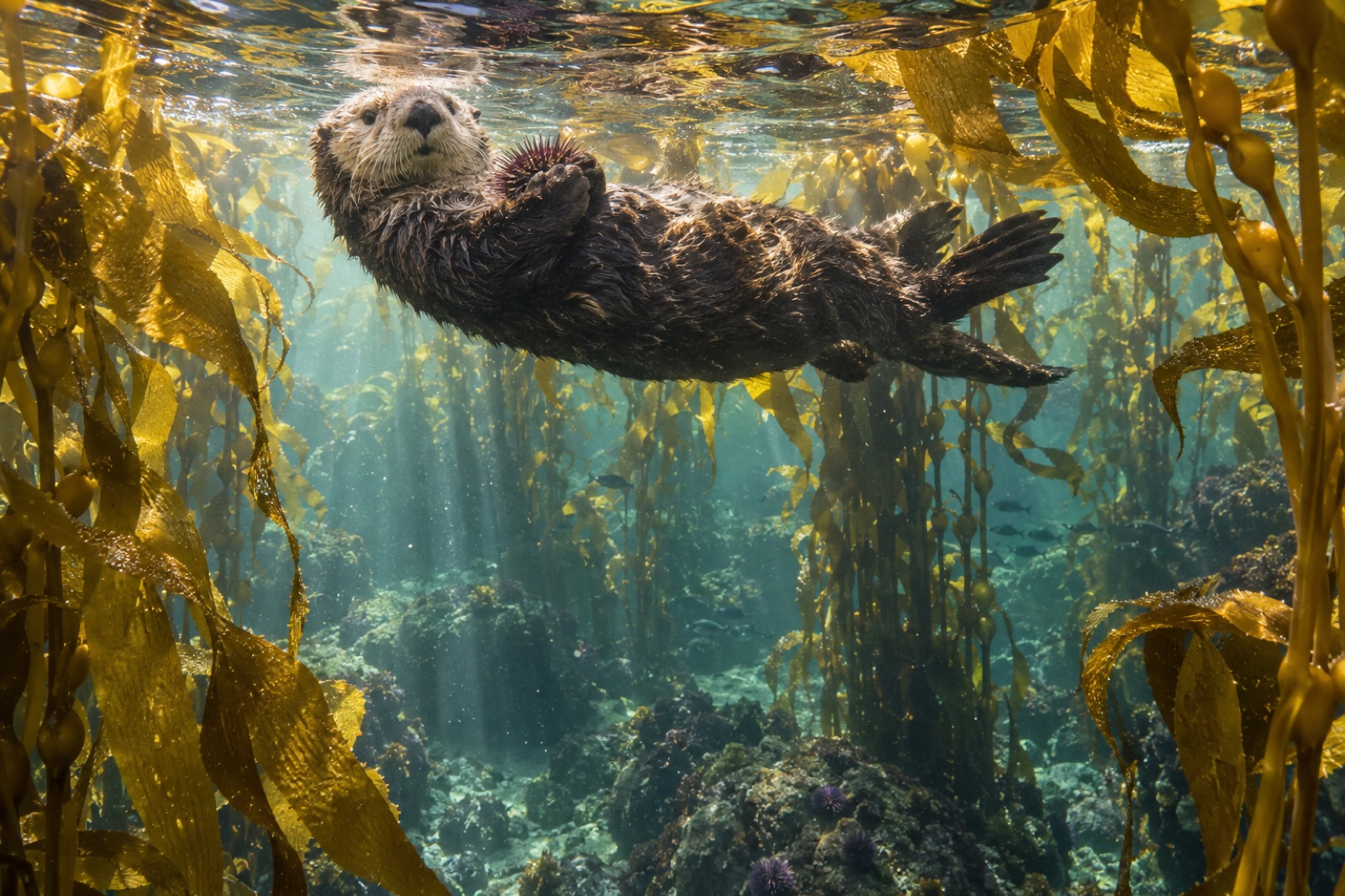
A trophic cascade is what happens when you remove a predator and watch the ecosystem re-arrange itself two or three links below: herbivores explode, plants collapse, the whole scenery changes. The concept sounds obvious today — it is in every ecology textbook — but it is barely sixty years old, and it was discovered by doing something deeply unorthodox: removing animals from nature and waiting to see what broke. This is the story of how the idea was built, why it was controversial, where it stands now, and why it is the operating manual for kelp restoration. For the specific kelp-forest cascade in action, see our companion piece on sea otters, urchins and standing forests.
Before cascades: bottom-up thinking
For most of the twentieth century, ecology's instinct was bottom-up: an ecosystem is built from what producers capture from sun and soil. Herbivores exist because plants feed them; predators are passengers in an economy whose bank is the plant. Change rainfall or fertiliser, the thinking went, and the ecosystem responds; remove a predator, and the next rank simply eats more.
This intuition was not foolish — it described plausible dynamics in some systems, and it fit the agrarian instinct of land management. But it faced a growing pile of anomalies: lakes that cleared when predators were added, isles that bloomed when predators were removed, intertidal zones whose whole species roster, one scientist found, hung on a single starfish.
Paine and the starfish experiment
Robert Paine's 1966 experiments on Washington State's rocky shores are the founding legend. Paine systematically removed the ochre sea star Pisaster ochraceus — the animal in our ochre sea star profile — from marked patches of intertidal rock. Control plots he left alone. Year by year, predator-free plots changed utterly: mussels, freed from the starfish's appetite, smothered the rock; barnacles and other species vanished beneath the mussel beds; species richness plummeted.
Paine coined the term keystone species in 1969 to describe a predator whose impact is wildly disproportionate to its abundance — like a keystone in an arch: small, and everything depends on it. The deeper theoretical point was that food webs have an architecture, and some nodes hold up the whole structure.
Estes, Palmisano and the Aleutian otters
The cascade idea turned specifically oceanic in Alaska. In the early 1970s, James Estes and John Palmisano compared Aleutian islands where sea otters — nearly exterminated by the 18th–19th century fur trade, but repopulating since protection — were abundant, with islands where they remained absent. The contrast was stark enough to photograph:
- With otters: undersea kelp forests thick and diverse, urchins small and sparse, mostly hiding in crevices.
- Without otters: urchins large, dense, grazing in the open; kelp reduced to patches, reefs trending toward barren.
Their account, published in Science in 1974, laid out a three-trophic-level cascade: otters suppress urchins; suppressed urchins let kelp flourish. It was one of the first clean natural experiments at ocean scale, and it gave ecologists something priceless — an A/B test built by history, waiting to be read. The details of that cascade, including its collapse decades later when killer whales began preying on Aleutian otters, are traced in our kelp-forest trophic cascades article.
Generalising the idea: two management revolutions
By the 1990s, cascades had become a framework, not just a curiosity:
- Fisheries science. The recognition that removing top predators — cod, tuna, sharks, groupers — restructures entire marine food webs turned into arguments for ecosystem-based fisheries management: managing webs, not species. When northern cod collapsed off Newfoundland in 1992, researchers documented ripple effects through lobsters, crab and whole benthic communities, debated ever since as both cascade and confound.
- Terrestrial rewilding. The 1995 reintroduction of wolves to Yellowstone provided the most famous large-mammal cascade narrative: wolves suppress elk, elk pressure on willows and aspens relaxes, beavers and songbirds return, even river courses alter. Scientists continue to debate how much of Yellowstone's change is wolf-driven — a useful reminder that cascades operate within climate, fire, and human pressure, not above them.
The debate: how common, how strong?
Trophic cascades have spawned a productive argument for fifty years, and the honest current consensus sits in the middle:
- Cascades are real, strong, and widespread in aquatic systems — especially simple, algae-based ones with strong grazer links. Kelp forests, lakes, and seagrass beds show some of the clearest cascades in nature.
- Complexity dampens or redirects them. In diverse food webs with many weak links and omnivory, removing one predator may be buffered — or rerouted through mesopredator release and other indirect effects invisible to the chain intuition.
- Top-down and bottom-up act together. Modern ecology treats them as dials on the same machine: nutrient supply (upwelling, runoff) sets the productive ceiling, while predator control shapes how that production is structured. A heatwave can collapse a forest that predators would otherwise hold together; predators can hold a forest together long after nutrients wobble. Our upwelling explainer describes the bottom-up side of that duality.
Why cascades are the restoration playbook
For kelp restoration specifically, cascade science isn't academic — it prescribes the methods:
- Restore the missing link, not just the plant. Seeding kelp without addressing the urchin predator imbalance is replanting in front of a lawnmower. Projects start with predator dynamics — urchin culls, reintroduction support, protected areas for lobster and sheephead.
- Watch the indicators in cascade order. Population changes propagate: predator numbers first, then grazer density, then kelp recruits. Modern monitoring — including eDNA surveys that count entire food webs from water samples (explained here) — tracks all three layers simultaneously.
- Expect hysteresis. Once flipped to a barren, a reef resists flipping back even when original predator numbers return; grazer populations built during the predator's absence maintain themselves. Our urchin barrens deep-dive covers why alternate states persist, and the Mendocino guide shows it happening on a real coast.
This is why Tidewright's field operations — our own fictional-but-principled program — always deploy grazer management alongside Holdfast reseeding: the cascade restoration sequence mirrors the cascade collapse, run in reverse.
Key takeaways
- Trophic cascades describe how predator effects propagate down food webs, re-architecting whole ecosystems — the concept upended bottom-up thinking in ecology.
- Paine's 1960s starfish removal experiments created the keystone-species concept; Estes and Palmisano's 1974 Aleutian otter study demonstrated the first grand marine cascade.
- Cascades reframed fisheries management toward ecosystem-based approaches and inspired rewilding programs on land.
- Ecologists now hold a middle view: cascades are strongest in simple aquatic webs and interact with bottom-up nutrient controls.
- In kelp restoration, the cascade logic dictates method: manage grazers, monitor predator-to-plant layers, and respect hysteresis.
FAQ
Who coined the term "trophic cascade"?
The phrase was introduced by Robert Paine in a 1980 paper, formalising the mechanism his starfish experiments had revealed. "Keystone species" predates it (Paine, 1969), and both ideas draw on earlier naturalists' observations — but the rigorous demonstration was Paine's experimental removal method.
Are trophic cascades only about predators?
Strictly, a cascade requires effects skipping trophic levels — usually predators acting through herbivores onto plants. But parallel "community cascades" can run through competitors or mutualists; some ecologists extend the concept widely, while purists keep it narrow. The classic, best-evidenced form is predator–herbivore–plant.
Is the Yellowstone wolf cascade fully proven?
The broad strokes are well documented — wolf return, elk behaviour change, willow recovery — but the strength of wolf-relative-to-climate causation remains debated among ecologists. It is best presented as a probable cascade with ongoing quantitative argument, not a closed case.
Can cascades work in reverse?
Yes — "bottom-up cascades" describe nutrient pulses boosting productivity up the web, and collapse cascades run through extinctions or invasive species. Interestingly, restoration often has to run the cascade backward, adding back missing layers in the right order.
How do scientists study cascades today?
Through long-term paired sites (like Estes's otter islands), natural experiments (fishery closures, invasive arrivals), enclosure experiments, and increasingly eDNA and acoustic monitoring that tracks many trophic levels at once across big space.