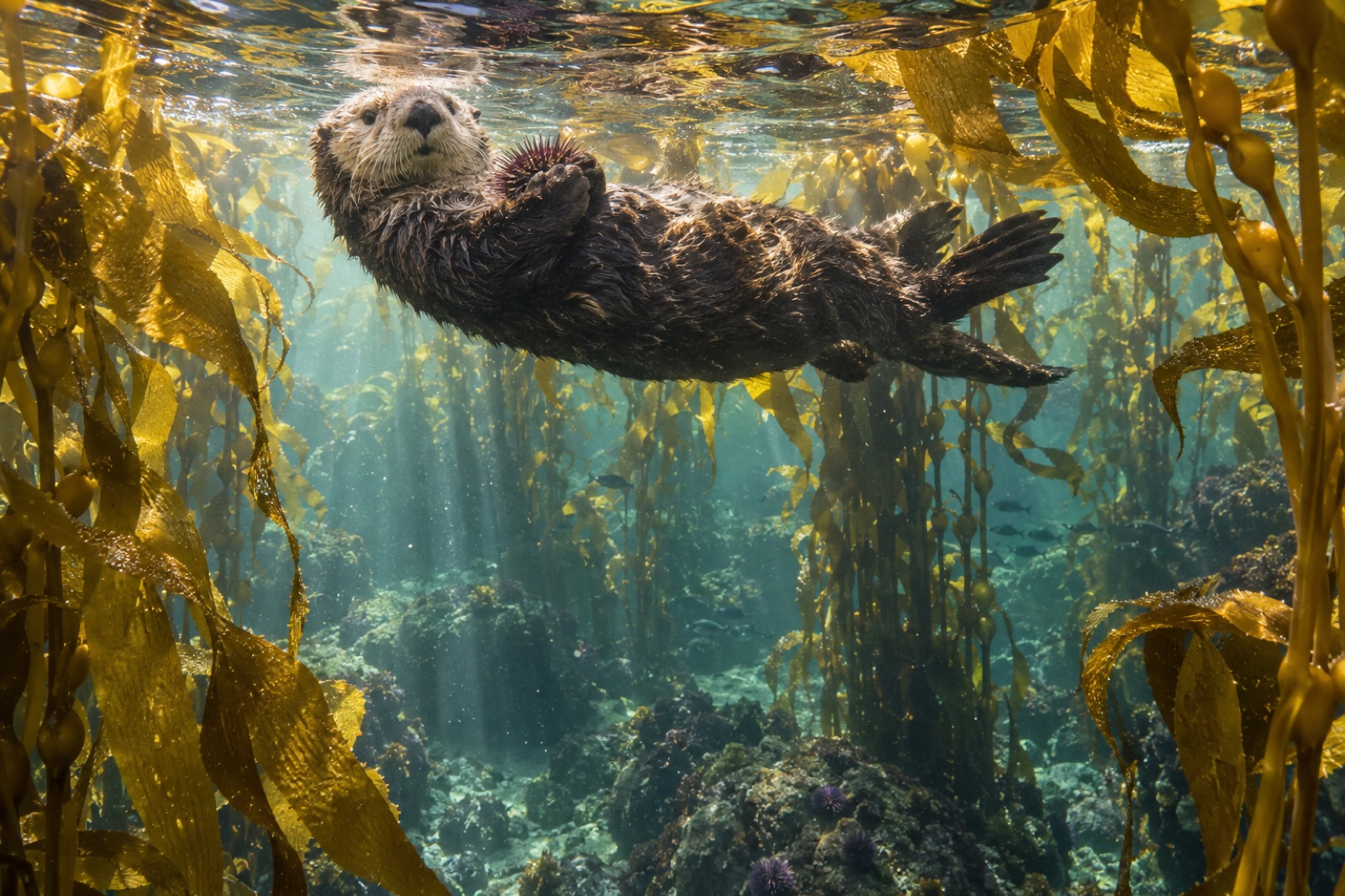
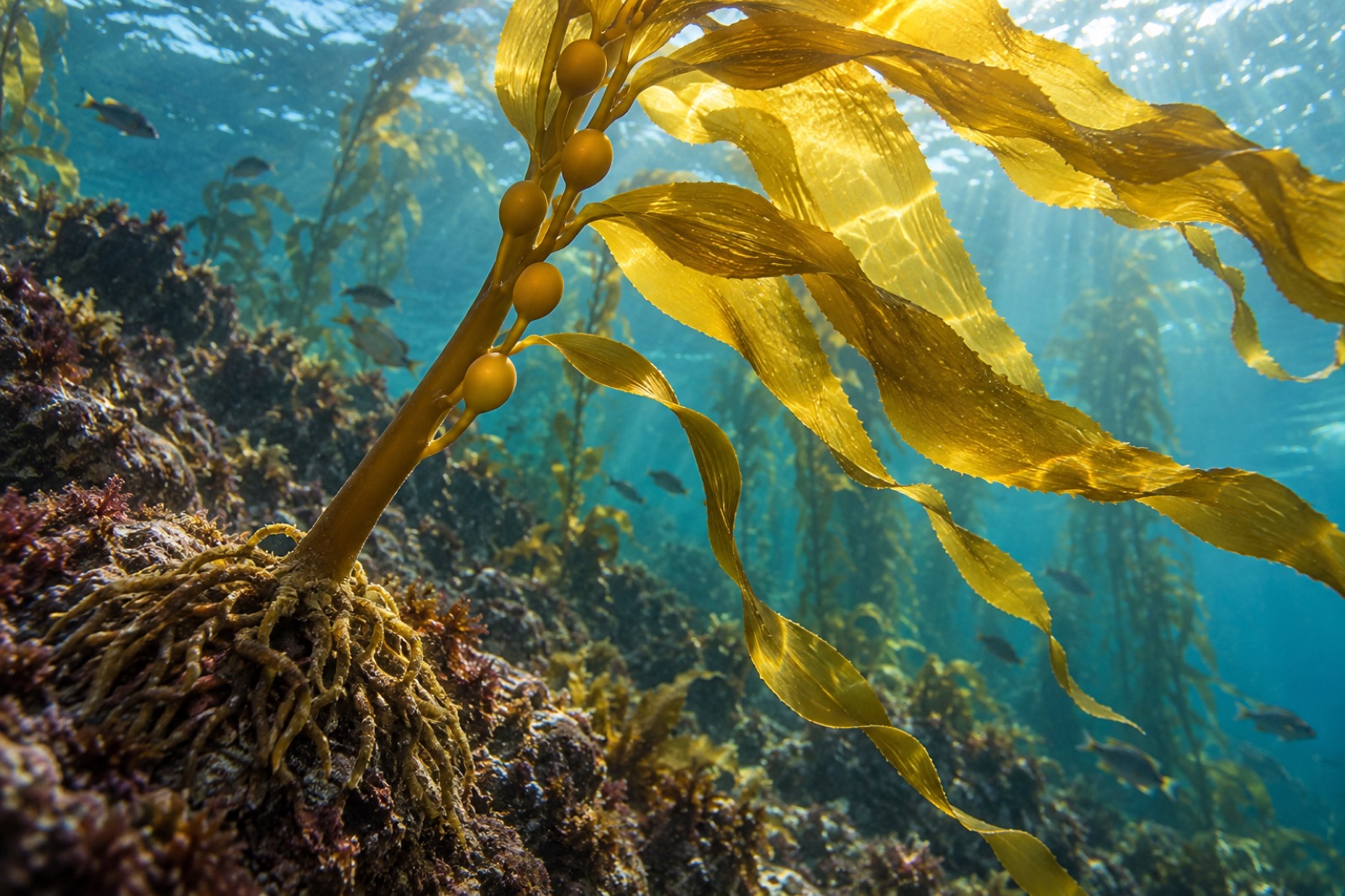
Of all the animals in the kelp forest, none has changed how we think about ecology like the sea otter (Enhydra lutris). This small marine mammal — the heaviest member of the weasel family, the lightest of the marine mammals — eats so many sea urchins, crabs and clams that its presence or absence restructures the entire reef. When sea otters were hunted to the edge of extinction for their fur, whole coastlines of kelp forest crumbled into urchin barrens. Where otters returned, the forests followed. The sea otter is the textbook keystone species: a predator whose influence is wildly disproportionate to its size.
Fast facts
|
|
| Scientific name |
Enhydra lutris |
| Group |
Mammalia; mustelid (weasel family); three recognised subspecies |
| Length |
1.2–1.5 m; males heavier (up to ~45 kg) than females |
| Fur density |
The densest of any mammal — up to ~150,000 hairs per cm² |
| Daily food intake |
Roughly 20–30% of body weight per day |
| Range |
North Pacific rims: Russia, Alaska, British Columbia, Washington, California; extinct elsewhere in historical range |
| Lifespan |
Typically 10–20 years in the wild |
Thermodynamics in a fur coat
Everything about sea otter behaviour makes sense once you understand one constraint: they are the only marine mammal without blubber. They stay warm in cold North Pacific water with fur — almost impossibly dense fur that traps a layer of insulating air, plus a racing metabolism fuelled by enormous meals.
This drives the whole life pattern. A sea otter spends hours each day grooming to maintain that air layer, hours foraging for calorie-dense prey, and hours wrapped in kelp canopy or anchored in rafted groups so it does not drift out to sea while sleeping. Otters forage on the seafloor, surfacing with urchins, crabs, abalone, clams or mussels, then eat at the surface, using their chest as a table. Famously, many otters carry a favourite rock in a skin pouch under the forearm and use it to crack shells — one of relatively few tool-using mammals, and one of the few marine mammals to use tools at all.
Their diet reads like a list of kelp forest grazers and their competitors: urchins above all, but also crabs that would otherwise prey on small abalone, and octopus. It is not a coincidence that reefs with otters look different.
The keystone that wrote a theory
The otter–urchin–kelp relationship is one of ecology's foundational stories. Studies of the Aleutian Islands in the 1970s compared islands where sea otters had returned after fur-trade near-extinction with islands where they remained absent. The contrast was stark:
- With otters: urchins scarce and small, kelp forest dense, fish and invertebrate diversity high.
- Without otters: urchins abundant and large, reef scraped to barren pavement.
That work helped cement the concept of the trophic cascade — predators shaping ecosystems by suppressing herbivores, which releases plants — and made the sea otter the canonical keystone species. Our science explainer on marine heatwaves covers the modern complication: in the 2010s, disease struck down another urchin predator (the sunflower sea star) and heatwaves hit the kelp, producing barrens even on some coasts — a reminder that a cascade needs every link. Where multiple predators overlap, otters included, reefs are more resilient.
There is one more connection, newer and startling: where otters recover, kelp forests recover, and kelp stores carbon. Researchers have estimated that otter-restored kelp systems hold meaningfully more carbon than barrens — not a climate solution on its own, but one of the clearest demonstrations that a single predator can shift a coastal carbon budget. It is exactly the kind of predator–forest–carbon link that Tidewright's Canopy Ledger monitoring platform is built to measure.
A near-extinction and a long, unfinished recovery
The maritime fur trade of the 18th and 19th centuries killed sea otters by the hundreds of thousands, for a pelt so dense it fetched extraordinary prices. By the time an international treaty halted the hunt in 1911, perhaps 1,000–2,000 otters remained worldwide, in a handful of scattered remnant groups. The species had been hunted out of most of its range from Mexico to Japan.
Recovery since has been real, partial and instructive:
- Alaska and Russia: strongholds; some populations now healthy, others hit hard by renewed killer whale predation in the Aleutians — itself possibly a cascade driven by declines in great whales and fish.
- British Columbia and Washington: reintroduced from Alaska in the 1960s–70s; populations now thriving and reoccupying former range.
- California: the southern sea otter recovered from a tiny remnant near Big Sur to roughly 3,000 animals — a fraction of historical numbers, blocked by shark bite mortality in both range-expansion directions and still listed as threatened.
- Oregon and Southeast Alaska gaps: remain, with periodic reintroduction debates, some now becoming concrete programs.
Why does range matter to a kelp restoration company? Because much of the North American Pacific coast still lacks otters, and on those coasts the urchin-recycling services otters once provided must be done by other predators, by fishers, or — where those fail — by deliberate management, like the removal-and-ranching programs described in our purple sea urchin profile. Otter recovery and kelp restoration are not alternatives; they are two halves of the same project.
The messy middle: people, prey and politics
Otter recovery is not frictionless. Where otters reappear, shellfish fisheries change — otters are excellent at finding clams, crabs and abalone, and they do not observe catch limits. The history of otter management is full of conflict with abalone and crab interests; some fisheries collapsed under otter recovery, others persist alongside otters more locally than often claimed.
The honest ecology is: a coast with sea otters is a different coast — more kelp, more fish nurseries, more resilience, fewer shellfish in foraging range. The policy question of where and how otters return belongs to the people who live there, which is why modern recovery programs, including those Tidewright supports as a Reef Partner, are built with communities, Indigenous sea-country authorities and fishers rather than around them.
Watching otters well
If you are lucky enough to see sea otters — in Monterey Bay, southeast Alaska, or British Columbia — a few rules make the difference between a gift and a disturbance: stay at distance (guidelines commonly recommend 100 feet / 30 metres or more for kayaks), never pursue, and let rafts sleep undisturbed. An otter that stops grooming or eating to watch you is already paying a cost. Our explore cluster has guides to responsible kelp forest diving and wildlife watching.
Key takeaways
- Sea otters are the only marine mammals without blubber; their extraordinary fur and appetite — 20–30% of body weight daily — shape everything they do.
- As predators of urchins and other shellfish, they trigger trophic cascades: otter-present reefs have kelp forests; otter-absent reefs tend toward urchin barrens.
- Hunted nearly to extinction for fur, otters have recovered strongly in Alaska, British Columbia and Washington but reoccupy only a fraction of their historical range, with California's population still small and stalled by shark bite mortality; overall, recovery is real but unfinished.
- Otter recovery changes shellfish fisheries, so recovery today proceeds through community and Indigenous co-management, not around it.
- Protecting and reintroducing otters is itself a kelp forest project — one with measurable effects even on coastal carbon.
FAQ
Why do sea otters hold hands and wrap themselves in kelp?
Headed-together "rafts" and kelp-wrapping both prevent drifting while sleeping. A mother may also wrap a young pup in kelp while she forages. It is functional anchoring, not affection theatre — though it is very charming to watch.
Do sea otters really use rocks as tools?
Yes. Many individuals carry a rock in a loose skin pouch and use it to pound or lever open urchins, clams and mussels against their chest. Some otters are specialised "rock users"; tool use appears to be socially learned and varies by population.
Are sea otters still endangered?
It depends on the population. The southern (California) sea otter is listed as threatened in the US; several northern populations are healthy. Globally, the species remains far below its historical range and abundance, and faces modern threats from shark bites, oil spills and disease.
Would bringing back sea otters everywhere fix every urchin barren?
Not everywhere, and not instantly. Otters suppress urchins effectively, but barrens can be locked in by other factors — heatwaves, disease among other predators, distance of kelp spore sources. Otter recovery plus active restoration, like Tidewright's reseeding work, is stronger than either alone.
How are sea otters related to kelp carbon?
Where otters returned and kelp forests expanded, studies found the ecosystem stored significantly more carbon than urchin-barren equivalents — an example of a predator shifting a coastal carbon ledger. It is not a substitute for emissions cuts, but it is real, measurable co-benefit ecology.