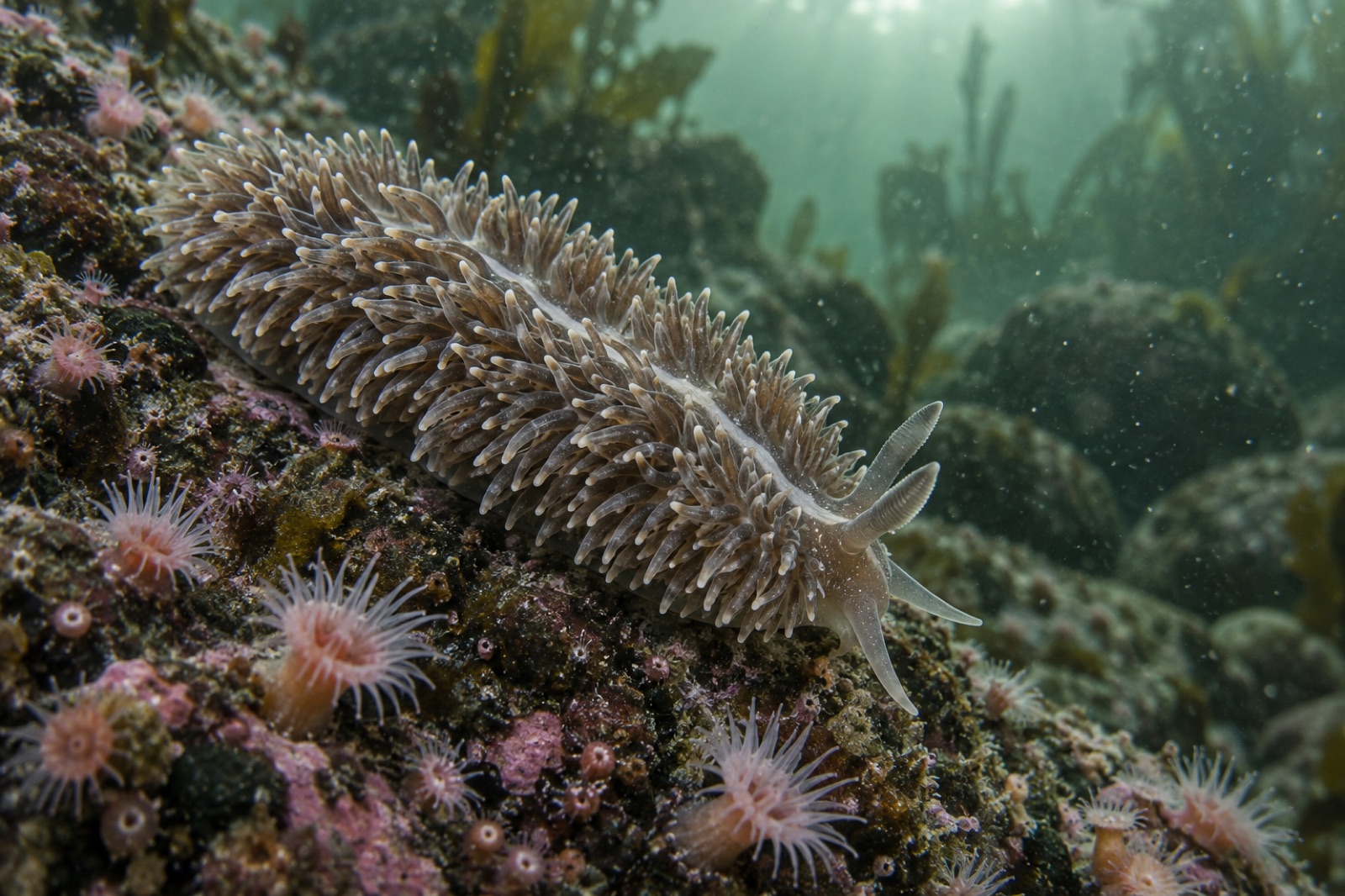
The shag rug nudibranch (Aeolidia papillosa) is one of those animals that rewards a slower eye. At first glance it's an unglamorous grey-brown slug, easy to overlook on a cold-water rock — until you realise that its shaggy coat is a battery of stolen weapons, and that its dinner would happily sting almost anything else. This guide covers how to identify it, where it lives, how it hunts and why biologists find its small, deliberate life so revealing.
Quick facts
- Scientific name: Aeolidia papillosa (Linnaeus, 1761) — papillosa refers to its densely papillate, "warty" back.
- Common names: shag rug nudibranch, shaggy mouse nudibranch, common grey sea slug.
- Group: aeolid nudibranch (family Aeolidiidae) — the "cnidosac" sea slugs.
- Size: commonly 3–6 cm, occasionally 10 cm and a little beyond.
- Range: circumboreal — the cold North Atlantic on both sides, the North Sea and the North Pacific from California to Alaska and northern Asia.
- Depth: intertidal pools down through the shallow subtidal, with records from several hundred metres.
- Diet: sea anemones, especially plumose anemones and their kin.
- Defence: recycles its prey's unfired stinging cells (nematocysts) into sacs at the tips of its own cerata.
What it looks like
The common name is the best field guide. Where a Spanish shawl is a show-off in violet and flame, the shag rug is camouflage made flesh: a low, flattened oval carpeted in hundreds of closely packed cerata — the finger-like outgrowths that run in sloping rows along the back. The effect is genuinely like a scrap of old shag-pile carpet, grey, fawn or sometimes rust-tinted, sliding slowly over the rock.
Look closer and the details emerge:
- A bare stripe down the midline. The cerata leave an empty lane running nose to tail along the centre of the back — a reliable field mark that separates it from superficially similar shaggy aeolids.
- White head markings. A white, roughly V-shaped or trident-shaped patch decorates the head and the bases of the oral tentacles, the two long sensory "feelers" at the front.
- Ridged rhinophores. The paired scent organs between the tentacles are annulate — ringed like tiny stacked coins — rather than smooth or clubbed.
- A pointed tail. The foot tapers to a fine point behind the last cerata.
Colour varies with diet and region from near-white through mouse grey to chocolate, which is why structure, not shade, is what you key on.
Cerata: the two-in-one organ
Those cerata are the whole story of this animal. Each one carries a branch of the digestive gland, so the shaggy coat is partly a gut worn on the outside — maximising surface area for gas exchange like a gill distributed across the back. But at the tip of each ceras sits a small, pale capsule: the cnidosac. More on that below.
Where it lives
Aeolidia papillosa is one of the most widespread nudibranchs in cold seas. Divers and tidepoolers meet it from the low-tide line to well past scuba depths:
- Rocky shores and subtidal reefs, especially where anemones colonise boulders, crevices and the kelp-bed fringe.
- Harbour structure — dock floats, pilings and ropes, which in cold water often carry dense plumose anemone gardens.
- Estuary mouths and bays, wherever salinity stays reasonably high and its prey hangs on.
On the Pacific coast of North America it overlaps with the more flamboyant opalescent nudibranch, and the two are occasionally found side by side — the showy one and the grey one, both specialised anemone hunters. In the northeast Atlantic it's a staple of shore surveys and one of the commonest big slugs a beginner will find.
How it hunts anemones
Watch a shag rug at work and the prey seems absurd: an anemone is a flower of stinging tentacles that subdues fish. Yet the nudibranch sidles up, rears back its head and bites.
The mechanics are a masterclass in turning a weapon against its owner:
- Approach and tasting. Chemical sensing through the rhinophores leads the slug to its prey; shag rugs show clear preferences, favouring plumose anemones (Metridium) and relatives such as those in our guide to the plumose anemone.
- The bite. Jaws and a rasping radula tear into the anemone's column and tentacle crown. The anemone fires its nematocysts in defence — thousands of microscopic harpoons.
- Theft. Remarkably, many of those stinging cells pass through the slug's gut unfired. Ciliated channels shepherd the intact nematocysts into the cnidosacs at the cerata tips, where they sit, armed and ready.
- Secondhand artillery. Anything that bites the shag rug thereafter gets a mouthful of its victim's own stings, discharged from the cerata on contact. The term for this borrowed weaponry is kleptocnidy, and aeolids are its champions.
It's a strategy also used, in more garish colours, by the hooded nudibranch's relatives and the flabellinas — but Aeolidia carries it off in workman's grey.
Recycling, regrowth and defence
Beyond the stolen stings, the shag rug has fallback plans:
- Autotomy. Cerata detach readily when seized; a predator gets a wriggling mouthful of stinging tissue while the slug crawls away and regrows the lost cerata over the following weeks.
- Watery taste. Like many nudibranchs, it concentrates distasteful compounds in its skin, and most fish learn to leave the shaggy profile alone.
- Low profile. Its colour matching is so good that the surest way to find one is to find its egg ribbons first — which brings us to reproduction.
Reproduction: the lace ribbon
Shag rugs are simultaneous hermaphrodites, and a mating pair exchanges sperm in both directions. Each animal then lays one of the most distinctive egg masses on the shore: a broad, frilled ribbon of white or pale pink eggs, deposited in a loose spiral or meandering coil on rock, weed or anemone-covered piling — sometimes directly beside the feeding site, which is convenient for the hatching larvae.
The eggs develop into planktonic veliger larvae that drift for a time before settling onto hard substrate and metamorphosing when they detect anemone scents. In a favourable spot with a good prey base, populations can be individually long-lived for a sea slug, with animals persisting through more than one season.
Finding one yourself
- Go cold and go slow. Low tides on rocky shores in the cool half of the year, or shallow dives on harbour pilings, are the classic settings.
- Follow the anemones. Where you find a garden of plumose or aggregating anemones, search the margins at a snail's pace. You're looking for a moving shag carpet, not a coloured speck.
- Check the kelp fringe. They regularly turn up in the same mixed assemblage you'll meet browsing our field guide to kelp forest nudibranchs.
- Look, don't lift. Nudibranchs damage easily; a photograph in situ is the right souvenir. Your sighting is also genuine data — community science platforms welcome nudibranch records, and our guide to contributing sightings style observation through the wider encyclopedia is a good next step.
Remember when scanning cold reefs that everything you're seeing sits within a living system — the giant green anemone the slug is hunting, the leather star that hunts slugs in turn, and the kelp above that feeds them all.
Key takeaways
- The shag rug nudibranch (Aeolidia papillosa) is a large, common, circumboreal sea slug whose drab coat hides one of nature's best weapon-stealing tricks.
- Its dense cerata double as distributed gills and ammunition stores: cnidosacs at their tips hold stinging cells harvested unfired from the anemones it eats.
- Identify it by the shag-carpet back with a bare central stripe, ridged rhinophores and a white V across the head — colour alone is unreliable.
- It hunts sea anemones by preference, readily sheds and regrows cerata when attacked, and lays unmistakable spiral ribbons of lace-like eggs.
- Look for it where its prey gathers: low rocky shores, harbour pilings and kelp-fringe reefs in cold water on both sides of the North Atlantic and North Pacific.
FAQ
Is the shag rug nudibranch dangerous to touch?
Not significantly. The stinging cells it sequesters are calibrated against small predators, and most people can gently handle one without feeling anything — though skin sensitivity varies, so the polite (and safer-for-the-slug) option is to admire without picking it up. Always wash your hands after tidepooling regardless.
Why does it look so boring compared with other nudibranchs?
Other aeolids went the warning-colour route; Aeolidia bet on camouflage. Its grey shag blends beautifully with anemone-covered rock and encrusted pilings. Both strategies work — the flamboyant slugs advertise their sting, this one simply disappears into the furniture.
What does it eat besides plumose anemones?
It's an anemone generalist with clear favourites. Along with Metridium, it takes Urticina, Anthopleura and similar anemones, and it will scavenge moribund prey. What it won't eat, notably, is anything without nematocysts to harvest — it's a committed specialist of the stinging kind.
How big do they get?
Three to six centimetres is typical on shore; well-fed subtidal animals can exceed ten centimetres. Growth tracks prey availability, so harbour walls dense with anemones often hold the giants.
Can I record my sighting anywhere useful?
Yes. Regional nudibranch atlases and public biodiversity platforms accept georeferenced photos, and A. papillosa records genuinely help track range shifts as cold assemblages move with the warming ocean — the kind of long-baseline change we monitor across the sites in our restoration work.