Encyclopedia9 min read
A Field Guide to Kelp Forest Nudibranchs
Nudibranchs are the jewels of the kelp forest: shell-less sea slugs in startling colours. Learn the key groups, the star species and how to find them.
Tom Okafor ·
The opalescent nudibranch steals stinging cells from its anemone prey and wields them as weapons. Learn to identify Hermissenda crassicornis and its world.
The opalescent nudibranch is the animal that converts tidepool skeptics. Find one on a low-tide rock on the Pacific coast and it looks like a wreck of rooting fibre-optics: a finger-long sea slug, milk-white and fringed with rows of finger-shaped cerata tipped in blazing orange, electric blue lined down its flanks like neon trim. Everything about Hermissenda crassicornis advertises — and like everything that advertises in the ocean, it has reason to. This slug is armed. The astonishing part is that it is armed with weapons it stole from its food.
Among the nudibranchs of the kelp forest, the opalescent is the generalist: abundant, tough, omnivorous, and the species most divers and tidepoolers meet first. It is also a small window into one of the strangest supply chains in biology.
| Scientific name | Hermissenda crassicornis (Eschscholtz, 1831) |
| Group | Aeolid nudibranchs — shell-less sea slugs, family Facelinidae |
| Range | Northeast Pacific: Alaska to Baja California and into the Gulf of California; reported from Japan as well |
| Habitat | Rocky intertidal and shallow subtidal; kelp holdfasts, eelgrass, floats and pilings to about 30 m |
| Size | Commonly 2.5–5 cm; large individuals reach about 8 cm |
| Diet | Hydroids, sea anemones, small crustaceans, other nudibranchs — and each other |
| Signature trick | Sequestering functioning nematocysts (stinging cells) from prey into its own cerata |
| Lifespan | Around a year; fast-growing, hermaphroditic, prolific |
Sea slugs can be cryptic; the opalescent nudibranch has chosen the opposite path. Key marks, from the front:
Its two famous neighbours are worth not confusing it with: the Spanish shawl is purple and orange with a flame-red body, preferring deeper hydroid turf, while the sea lemon is a yellow dorid with a feathery external gill. Once you have seen the opalescent's orange blaze and blue piping, you won't misfile it again.
Every anemone and hydroid fires nematocysts — microscopic, spring-loaded harpoons that deliver venom into whatever touches them. It is the reason you don't put your face on an anemone. Aeolid nudibranchs eat these animals routinely, which raises the obvious question of how a soft slug survives dinner armed with harpoons, and the non-obvious one of what happens to the weapons afterwards.
The answer to the first is armour: the slug's mouth and gut lining are protected, and immature nematocysts inside recently eaten prey tissue often go undischarged on the way down. The answer to the second is theft on a grand scale — kleptocnidae, the sequestration of stolen stinging cells. Undischarged nematocysts survive digestion, and special cells shepherd them from the digestive gland out through fine branches into the cerata, where each ceras tip ends in a muscular sac called a cnidosac. The stolen weapons are stored there, aimed outward, still fully functional.
Touch the cerata and the slug discharges them — with the anemone's own ammunition. The nematocyst sting of an anemone-eater far exceeds anything the anemone itself could deliver to the same spot, because the slug concentrates the harvest of many meals into its tips. Predators learn. Fish mouthing an opalescent nudibranch spit it out looking genuinely offended, and the bright colors exist to make that lesson cheap and memorable — classic aposematism.
The recycle-and-rearm system is even finer than it sounds: the slug feeds constantly, absorbing fresh nematocysts, while its own immune system appears to protect its tissues from the weapons passing through. Some researchers call aeolids "weapons collectors," and the cerata — also used in respiration and defence-shedding — are among the most multitasking organs in the sea. Disturbed heavily, an opalescent can even autotomise cerata, leaving a struggling and stinging mouthful behind while it walks away.
Hydroids are the stock diet — the turf-like fairy-hand hydroids that coat kelp stipes, floats and rock. But the opalescent's menu is wide: small anemones, the eggs of other sea slugs, dead and dying animals, small crustaceans such as amphipods, and — famously — other opalescent nudibranchs. Cannibalism is well documented in this species: a large individual encountering a small one treats it as food with no ceremony at all.
That combative streak generalises. Opalescents fence. Two meeting on a rock will lunge, bite and tear at each other's cerata in slow, stiff duels, and the loser — smaller, or missing cerata already — retreats or is eaten. For the observer, this quarrelsomeness makes them the most entertaining nudibranch on the coast to watch: a slug with a temper, armed to the tips, in a five-centimetre body.
This generalist diet is ecologically important. While specialists like the hooded nudibranch drift in the canopy hunting plankton, the opalescent patrols the benthos, regulating hydroid turf and cleaning up carrion — a small but constant pressure at the base of the kelp forest food web.
Like all nudibranchs, the opalescent is a simultaneous hermaphrodite: any two adults can mate, exchanging sperm through a paired arrangement on the right side of the body. Both partners then lay eggs. The egg mass is unmistakable once known — a coiled pink or cream ribbon like a curled length of lace or a party noodle, glued firm to hydroid beds and rock, thousands of eggs per ribbon.
Eggs hatch in days to weeks depending on temperature, releasing free-swimming veliger larvae that ride the plankton for a time before settling onto the bottom and metamorphosing. Adults live fast — roughly a year — which explains a lot: the fast growth, the eager fighting, the serial egg-laying. Populations boom where prey is abundant and crash just as fast, which is why some tidepool seasons seem paved with nudibranchs and others hold none.
Opalescent nudibranchs are among the most findable large nudibranchs on the northeastern Pacific coast:
Photographing them rewards patience: they cruise fast by slug standard, and a resting one with cerata fluffed shows the blue piping best. Never collect — their sting arsenal and their place in the food web both belong on the rock.
A mild one, potentially — the stolen nematocysts can fire against stretched or sensitive skin. Most people feel nothing through a fingertip, but don't handle them, and never touch one near your eyes or lips. Apart from the risk to you, handling damages the cerata.
Its mouth and gut are lined with protective secretions and hardened surfaces, and many nematocysts in freshly eaten tissue are immature and never discharge. The survivors are ferried, unfired, to the cnidosacs at the cerata tips.
Many nudibranch predators see contrast and pattern even in dim, green-shifted light, and the memory of a stung mouth generalises across similar colours. Aposematic colour is a cheap insurance premium for a soft-bodied animal — and many fish in kelp habitats see colour better than we assume.
Its core range is the northeast Pacific from Alaska to Baja California and into the Gulf of California; closely related or identical-looking populations are reported from Japan. It has not gone invasive into the Atlantic the way some facelinids have.
Rhinophores are the pair of chemosensory horns on the head — the slug's nose, tasting the water for prey. Cerata are the rows of projections on the back, combining breathing surface, digestive-gland extension and stolen-weapon storage in one structure.
Nudibranchs are the jewels of the kelp forest: shell-less sea slugs in startling colours. Learn the key groups, the star species and how to find them.
Tom Okafor ·
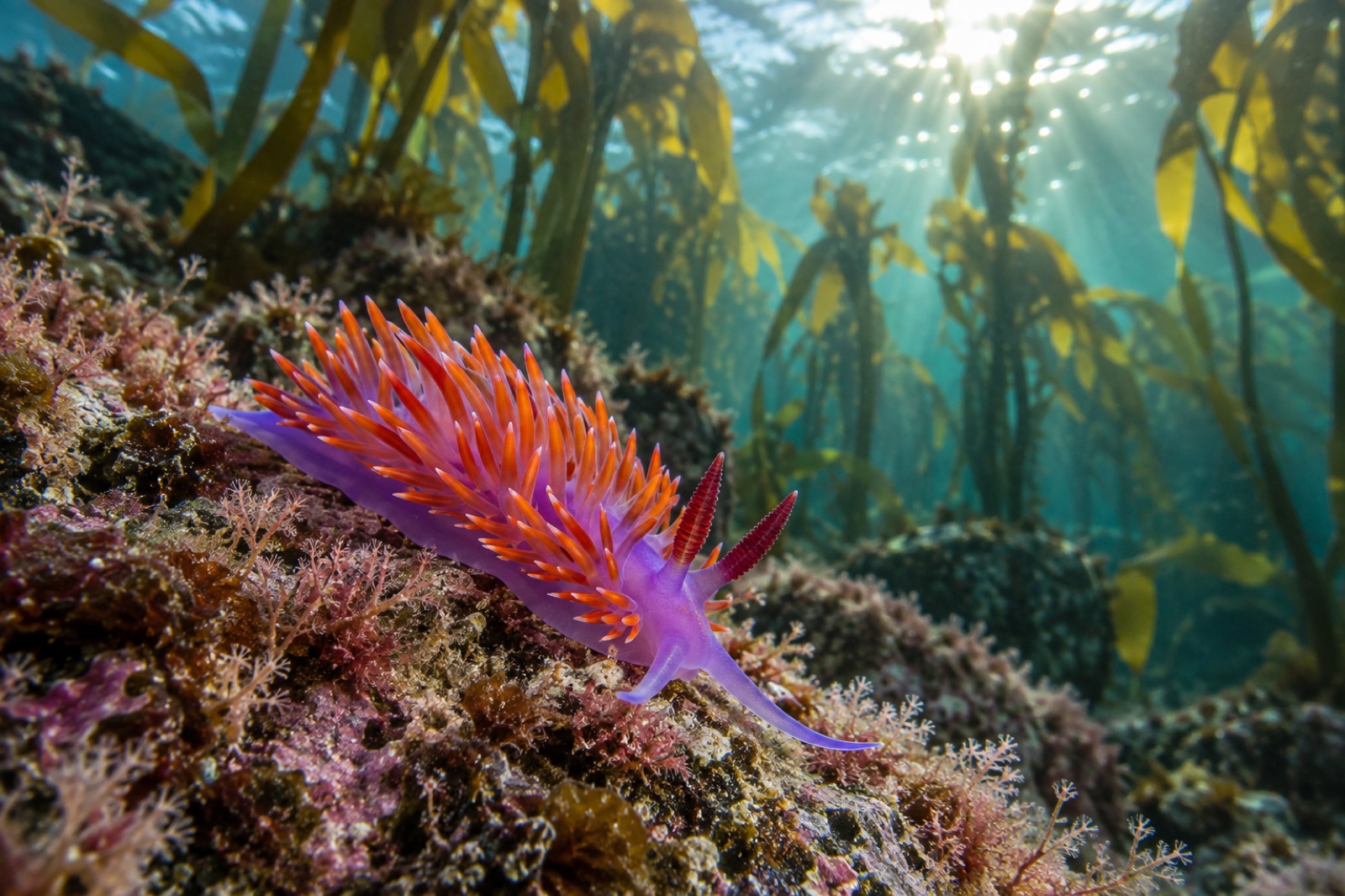
The Spanish shawl Flabellinopsis iodinea is a purple-and-orange aeolid nudibranch that steals stinging cells from hydroids. Identification, diet, habitat.
Dr. Mara Ellison ·
The sea lemon Peltodoris nobilis is a fist-sized, lemon-scented nudibranch that grazes sponges on Pacific kelp reefs. Identification, biology and ecology.
Dr. Theo Nakamura ·