Encyclopedia9 min read
A Field Guide to Kelp Forest Nudibranchs
Nudibranchs are the jewels of the kelp forest: shell-less sea slugs in startling colours. Learn the key groups, the star species and how to find them.
Tom Okafor ·
The sea lemon Peltodoris nobilis is a fist-sized, lemon-scented nudibranch that grazes sponges on Pacific kelp reefs. Identification, biology and ecology.
Some sea slugs are famous because they are gaudy. The sea lemon (Peltodoris nobilis) is famous because something about it smells faintly of citrus — and because it is one of the largest, commonest and most watchable nudibranchs on the Pacific coast of North America. A lemon-yellow, tubercle-covered slug the length of a chocolate bar, gliding over sponge beds on reefs from Alaska to Baja California, it is the nudibranch most cold-water divers learn first. Here is what it is, how to recognise it, and what a big yellow slug is doing for the kelp forest.
| Scientific name | Peltodoris nobilis (formerly placed in Anisodoris and Archidoris) |
| Group | Nudibranch — a shell-less sea slug, dorid family Discodorididae |
| Common names | Sea lemon, noble sea lemon, Monterey dorid, false sea lemon (for lookalikes) |
| Size | Commonly 5–10 cm; the largest reach about 20 cm |
| Depth range | Intertidal at the northern end of its range; subtidal to roughly 230 m |
| Distribution | Alaska to Baja California; commonest from British Columbia to Monterey |
| Diet | Sponges — especially crumbly yellow and orange Halichondria-type sponges |
| Notable trait | A faint lemony (some say cedar-like) scent from defensive skin acids; very large size |
Three features do most of the identifying work on a dive:
Confusion species exist — the similar Doris montereyensis (the actual "Monterey sea lemon" of some older books) has tubercles on the gill rosette itself, while Peltodoris gills are smooth and lighter — but at 15 centimetres of yellow lump, context does the job for the beginner.
Sea lemons are sponge specialists. Their radula rasps away at soft, crumbly sponges — the yellow and orange encrusting species of the Halichondria group especially — and divers very often find the slug parked mid-meal on its food, which is how the food got found: follow the sea lemons and you map the sponge beds.
This matters more than it sounds. Sponges are architectural members of the kelp-forest understory — they filter staggering volumes of water, shelter worms and juvenile fish, and arm themselves with distasteful chemistry. A sponge-grazing guild of nudibranchs is the reef's check on that empire: sea lemons crop the sponges, sponge patches cycle through growth and regrowth, and the mosaic of surfaces at holdfast level keeps shifting. In the kelp forest food web the sea lemon is a specialist feeder in the mid-tier, converting sponge chemistry into slug — and then, reluctantly, into somebody else's dinner.
That chemistry flows both ways. Like many dorids, sea lemons concentrate defensive acids and sponge-derived compounds in their mantle; the citrus scent divers notice when one is handled or distressed is the open-air signature of that chemistry at work. Don't handle them: the oils that make a sea lemon unpalatable to fish are mildly irritating, and the slug deserves its day.
The scent is real, reported over decades from Alaska to California, and usually described as lemon zest, citronella or pencil-cedar depending on the reporter. It comes from skin secretions whose functional role is defensive — a fish that mouths a sea lemon gets a faceful of acid and spicule and tends to let go. Nudibranchs gather these weapons two ways: some synthesise their own; others, like the sea lemon's sponge-feeding relatives, sequester compounds from prey, relocating the sponge's chemical factory into their own skin. It is the same trick the spectacular aeolid nudibranchs play with stolen stinging cells, told in our field guide to kelp forest nudibranchs — different weapon, same philosophy: in a world without shells, chemistry is the shell.
Nudibranchs are simultaneous hermaphrodites, and sea lemons mate by aligning side by side, each fertilising the other. Both partners then lay eggs. The egg mass is the other classic find for a careful diver: a broad, cream-to-butter-coloured spiral ribbon, laid in a coil or loose wave and cemented to rock, containing tens of thousands of tiny eggs.
The eggs hatch into free-swimming veliger larvae, which ride the plankton for some weeks — enough to connect reefs a coastline apart — before settling where the chemistry smells right: on or near the sponges they will spend their lives eating. Metamorphosis trades the larval shell for the naked, spiculed adulthood of a dorid. Growth is comparatively fast for a cold-water slug; the biggest sea lemons on a reef are probably into their second year, and one or two years is a full life.
Not everything respects the chemistry. Sunflower sea stars and other large asteroids will take dorid nudibranchs; crabs and some fishes sample them, whatever their palatability, and sea anemones opportunistically engulf anything they can hold. Sea spiders — pycnogonids — are specialists at sucking the fluids from sedentary and slow invertebrates and have been documented on dorids. But an adult sea lemon on the open reef travels with the near-immunity of the well-armoured and the well-armed, and that is what makes it such a forgiving subject for a first nudibranch photograph: it does not flee, because it rarely needs to.
The one disturbance that does move a sea lemon at something like speed is a starfish on the scent — a nudibranch in contact with a predator can rear and twist, a slow-motion flinch that is the slug version of panic. Watch for it on reefs where ochre sea stars are cruising; it reminds you that even the mid-tiers of this forest live nose-to-antenna in each other's chemistry.
Peltodoris nobilis is widespread and locally common, and no conservation listing hangs over it — but like every shallow-water invertebrate of the northeast Pacific it lives against a backdrop of marine heatwaves that have reshaped whole kelp forests in a single season; our marine heatwaves explainer covers what those events do at reef level, and the sponge-and-slug guild is not exempt.
To see one, dive or tidepool northern and central California — they intertide rarely and mostly in Alaska and British Columbia — preferring rocky reef, pilings and kelp understory in the 5–30 metre band. Night increases the odds: sea lemons and their relatives are far more active after dark, as our night diving guide recounts, and a torch beam finds a yellow ribbon of eggs or a grazing slug easily among the sponges. Their big cousin the orange-peel nudibranch (Tochuina tetraquetra) and the white-lined dorid are frequent neighbours on the same reefs. Anglers' wharves, harbour walls and Monterey's breakwater reefs are among the most reliable sea-lemon ground on the coast — urban kelp habitat hosting a full slug community — and a reminder that the kelp forest's small wonders are not reserved for wilderness.
Most people who handle or hover closely over a disturbed sea lemon report a faint citrus scent — lemon zest to citronella, with some smelling cedar instead. The scent comes from the mantle's defensive secretions and varies between individuals and diets (sponge chemistry feeds directly into the slug's own). Enjoy it from a slight distance: the secretions are meant to irritate.
Not dangerous like the venomous blue-ringed octopus or even the harsher aeolids, but "chemically defended" is not a marketing phrase — skin secretions can irritate, and your handling distresses the animal and may strip its protective mucus. Nudibranch etiquette is look, photograph, don't pick up. Gloves are for the reef, not the slug.
Encrusting sponges, almost exclusively — yellow and orange crumbly species in the Halichondria tradition. An individual may park on a sponge colony for hours to days, rasping it down with a radula, and the patchy trails of cropped sponge on a northern reef often mark sea lemon traffic better than the slugs themselves do.
By scale and surface. The sea lemon reaches a size no other yellow dorid in its range matches, has uniform small tubercles across a stiff notum, and yellow-tipped rhinophores. The similar Monterey dorid Doris montereyensis is smaller and has tubercles on the gill ring; the orange-peel nudibranch is far larger still and not tuberculate. At fifteen centimetres of bumpy lemon with smooth pale gills: sea lemon, and you can log it with confidence.
Any temperate rocky reef or harbour wall from British Columbia to central California, 5–30 metres, on or near sponge cover — with night dives tipping the odds strongly in your favour. Monterey's breakwater and the reefs of the northern Channel Islands are classic; northward they even appear intertidally in Alaska at low tide.
Nudibranchs are the jewels of the kelp forest: shell-less sea slugs in startling colours. Learn the key groups, the star species and how to find them.
Tom Okafor ·
The spiny scallop Chlamys hastata is a sponge-armoured, blue-eyed bivalve of Pacific kelp forests that can swim away from sea stars. Full species profile.
Dr. Theo Nakamura ·
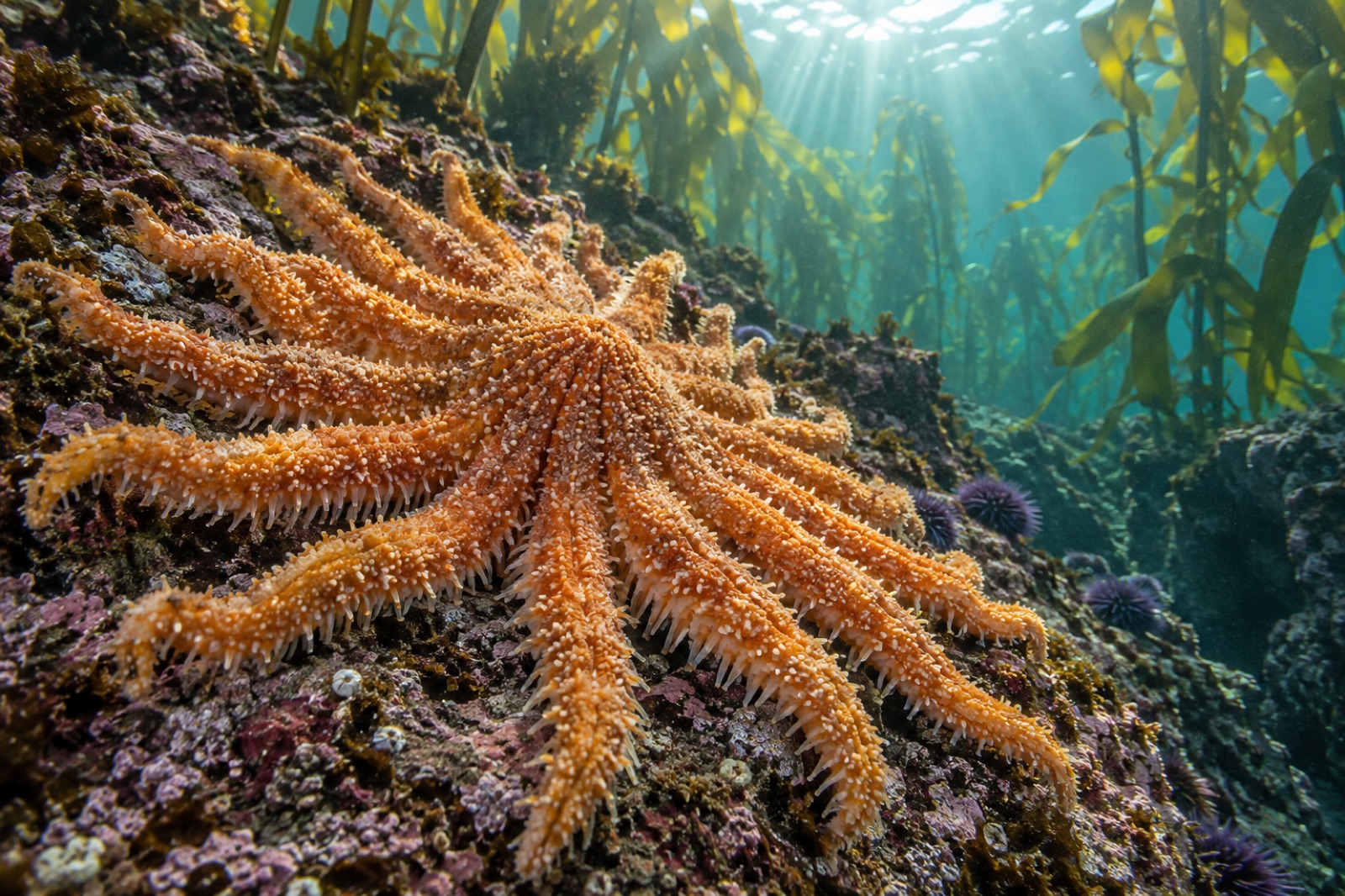
The sunflower sea star was the kelp forest's great urchin hunter. Wasting disease erased billions of them — and the consequences reshaped coastlines.
Dr. Mara Ellison ·