Explore9 min read
The Beginner's Guide to Kelp Forest Diving
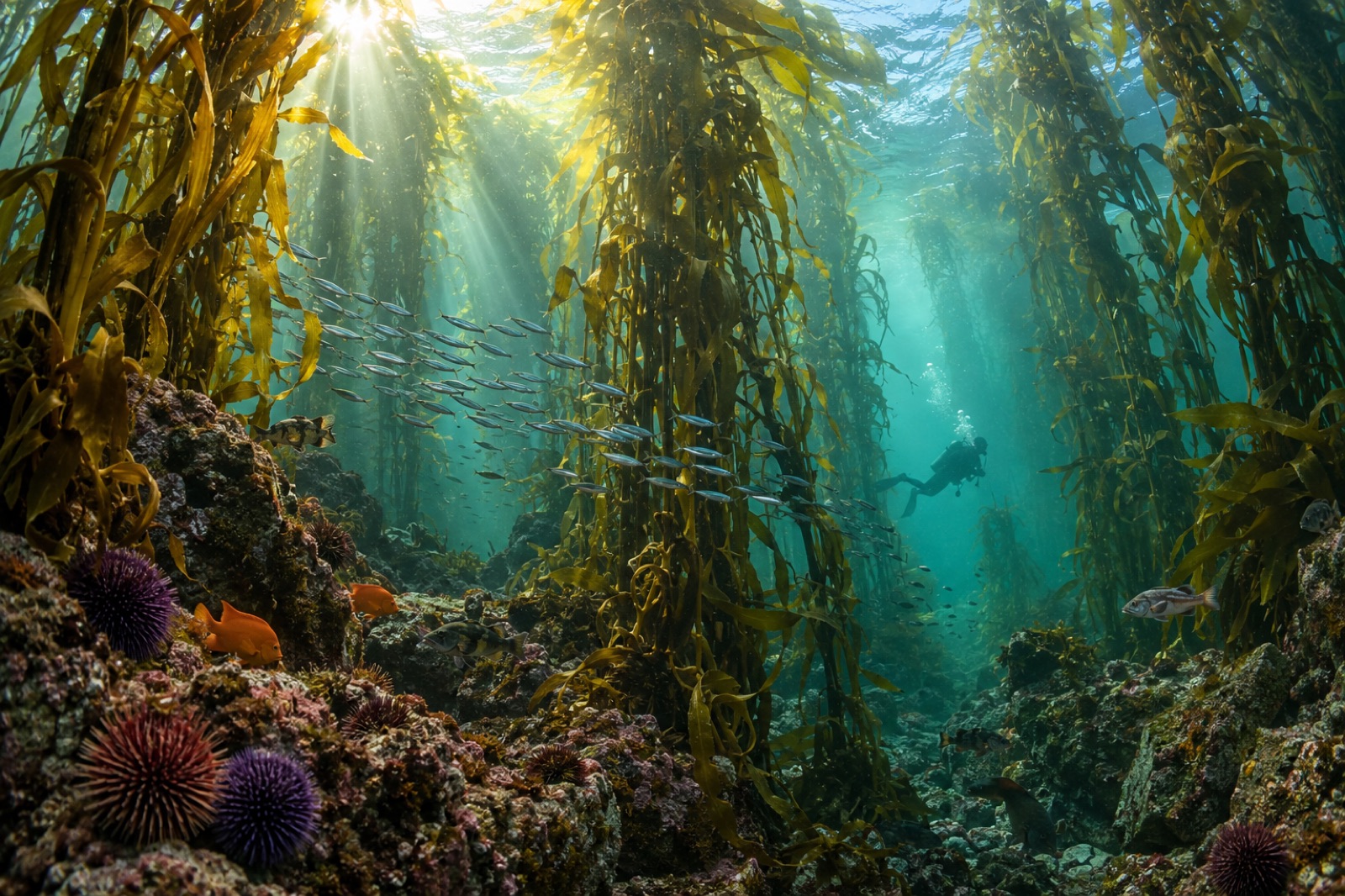
Your first kelp forest dive is easier — and more magical — than you think. Gear, skills, marine life and etiquette for new divers entering the green cathedral.
Tom Okafor ·
Kelp forests transform after dark. A night diving guide: lights and light discipline, night planning, the nocturnal shift change, and calming the mind in the dark.
Part of a learning path
This article is stop 9 of 9 on Into the Canopy — A cold-water diver’s route from first kelp dive to night forest.
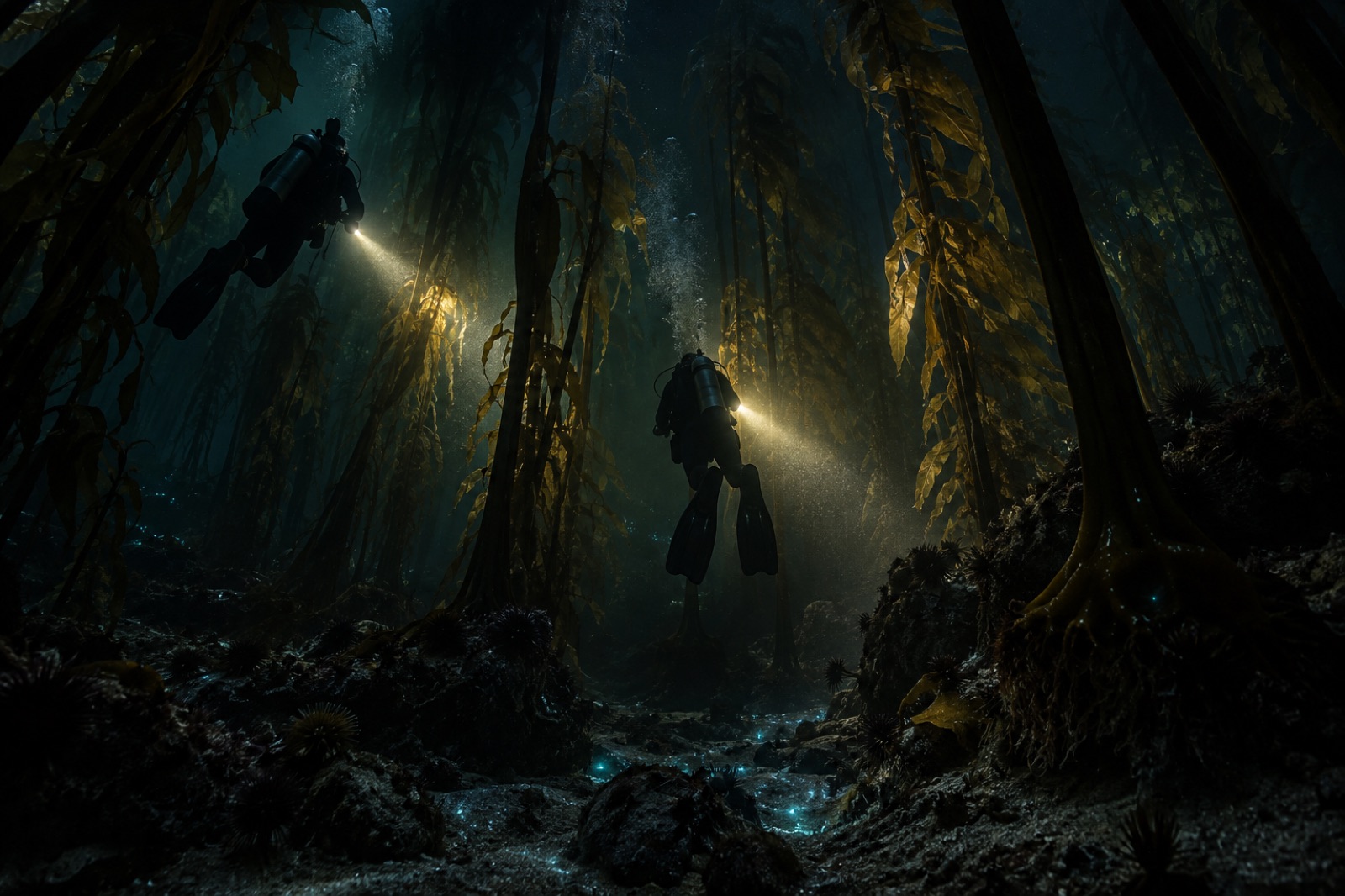
At dusk on a temperate reef, the forest changes shifts. The fish that cruised the canopy all day slide into crevices and switch off; the animals that hid from them crawl out to graze. Octopus leave their dens. Lobsters walk the open sand. Shrimps and krill rise through the water column in the largest migration on Earth, repeated every single night. If you have only ever dived kelp by day, you have met half the forest. Night diving is also the best training a cold-water diver can get: it sharpens your buoyancy, your navigation, your gas planning and your buddy discipline — because in the dark, all of those skills are the whole dive. This guide covers when you are ready, the lights and the light discipline, the extra planning a night kelp dive demands, and what you will actually see.
The honest answer: later than the brochures suggest, earlier than your fears insist.
A formal night-diving specialty course is worth the money: two or three supervised night dives compresses a season of trial and error into a weekend.
At night your light is not an accessory, it is the dive.
Your primary should be a powerful, dependable torch — something in the 1,000+ lumen class with a burn time comfortably longer than your planned dive, mounted or carried so your hands stay functional. Canister lights and hose-free handhelds both work; what matters is that you trust it completely because you have used it often, not that it was expensive.
Carry at least two backups: one on your person and one in a pocket or on the BCD, each itself a competent torch. Three lights per diver is not paranoia; it is the rule. Kelp diving adds a specific failure mode to night diving — a dropped light does not sink onto clean sand, it sinks through a frond lattice and can catch halfway down, glowing mockingly beyond reach. A lanyard or bolt snap on every light, clipped to you, is non-negotiable in a forest.
A chemical or LED marker light on your tank valve lets your buddy track you when your primary is pointed elsewhere. Different colours per buddy turn a three-diver team from a confusion of beams into a legible constellation.
Night compresses margins. Everything you would plan by day, plan tighter.
The first-time night diver's universal reaction is the same: where did all this come from?
Purple sea urchins that sat pinned in their pits by day climb out and walk the reef on hundreds of tube feet, wearing hats of shell and weed for camouflage. Northern kelp crabs roam the fronds openly instead of crouching against stipes. Abalone slide out of crevices to graze the open rock.
Giant Pacific octopus hunt at night — finding one out on the prowl, mantle flushing through colour as it flows over the reef, is the single greatest sight most cold-water divers will ever get. Lingcod move off their day posts to hunt the sand channels. On the eastern Pacific coast, horn sharks and swell sharks — invisible by day — cruise the open bottom.
Hold your light still in midwater and it fills with life: larval fish, krill, amphipods, jellies and comb jellies drifting up in the nightly vertical migration. Turn the light off and agitate the water, and on the right coasts bioluminescent dinoflagellates answer with blue-green sparks. The reef soundscape shifts too — divers often notice the crackle of snapping shrimp far more at night, which is no illusion; reef sound is a recognised health signal, as we cover in our piece on reef soundscapes.
Day fish, sleeping, are a private zoo. A garibaldi wedged in a crevice shows paler, blotched night colours. Kelp bass hang motionless in the fronds. You can watch them from half a metre — but resist touching; a sleeping fish startled into the dark wastes the energy reserves it was banking.
Most night-dive difficulty is between the ears. Two practices fix almost all of it.
No — the kelp is the same; only your perception is different. Entanglement happens through fast, panicked finning near fronds, day or night. Slow horizontal movement and a calm pause-and-unwrap by hand solve it. Many divers find night kelp easier to read, because the fronds your light touches are the only ones you need to consider.
About twenty minutes before full dark. You gear up and enter with residual light, the reef performs its shift change as your eyes adapt, and you exit after 30–40 minutes into full dark with a marked exit point. Pure-dark entries are for later in your night-diving career.
Most agencies require a night/adventure dive within advanced training, and a dedicated night specialty is genuinely useful for light discipline and navigation practice. Beyond the card, the real gate is daytime competence at the specific site — no certification substitutes for knowing the reef.
A neutral-white primary beam of 5,000–6,500 K renders kelp's true browns and greens and shows up the forest's camouflaged animals. Very wide floods light the forest beautifully but backscatter in plankton-rich water; a medium beam angle is the versatile choice. Some divers carry a red light for observing skittish animals, though evidence it disturbs them less is mixed.
You can, on calm nights with a buddy and good lights, and the vertical migration alone is worth it. But the surface chill, harder buddy contact and the deep-water show below make scuba the better tool after dark. If you snorkel, stay in shallow sheltered water and review the night-appropriate sections of our snorkelling safety guide.
Your first kelp forest dive is easier — and more magical — than you think. Gear, skills, marine life and etiquette for new divers entering the green cathedral.
Tom Okafor ·
The complete cold-water kit for kelp forest diving: wetsuit thicknesses, drysuits, hoods, gloves and the small accessories that save a dive.
Tom Okafor ·
How to assess a shore dive site step by step: wind, swell, entry and exit points, surge and kelp layout — plus the bailout plan every beach dive needs.
Tom Okafor ·