Encyclopedia8 min read
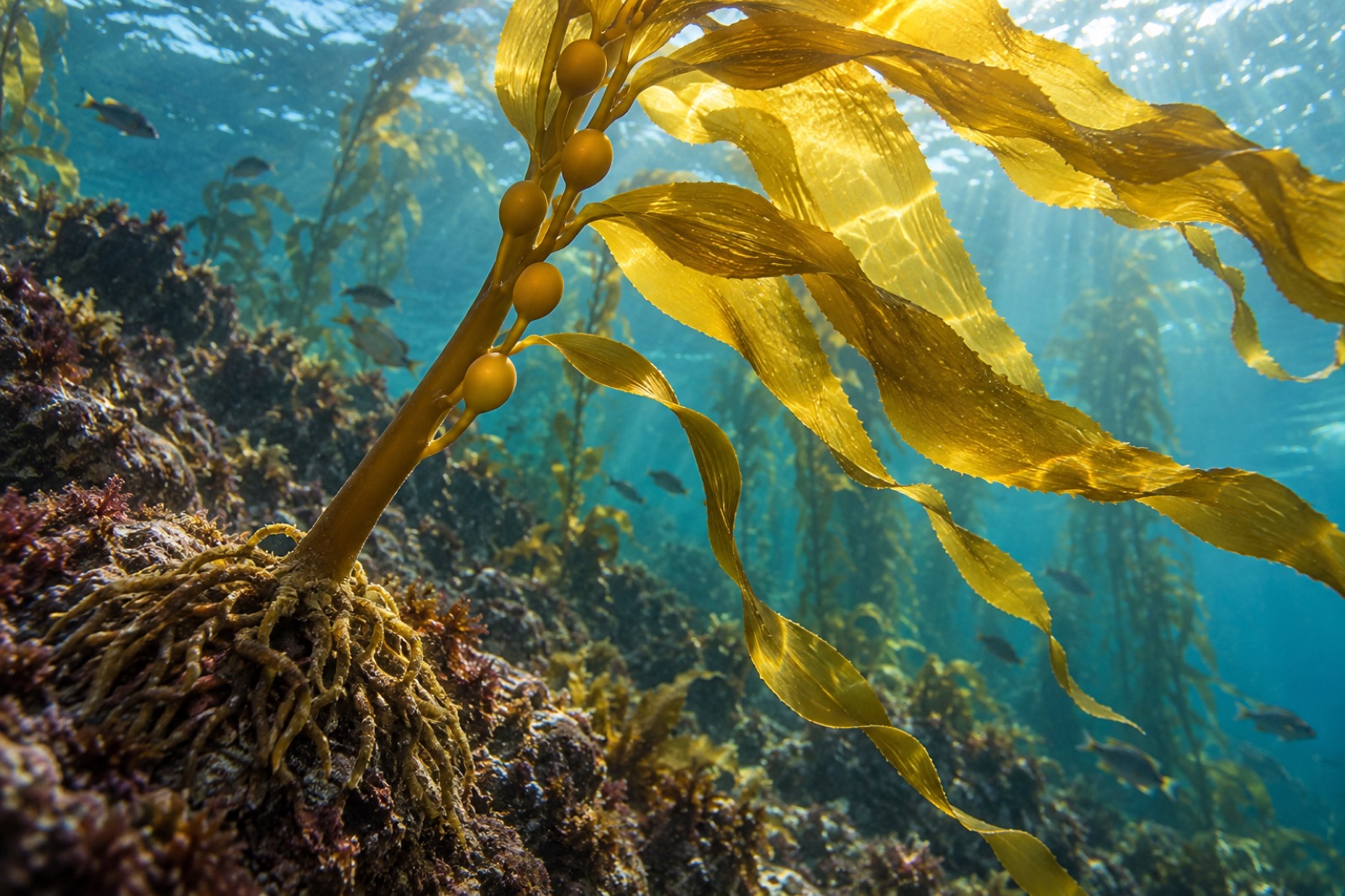
Giant Kelp (Macrocystis pyrifera): Species Profile
Giant kelp is the fastest-growing organism on Earth and the architect of undersea forests. Learn its biology, life cycle, range and why it matters.
Dr. Theo Nakamura ·
Meet the garibaldi, California's blazing orange state marine fish — a fiercely territorial damselfish that gardens algae on the kelp forest floor.
The garibaldi (Hypsypops rubicundus) is the fish that makes first-time California snorkellers gasp through their regulators: a dinner-plate-sized damselfish in traffic-cone orange, hovering over a kelp-fringed reef like it owns the place — which, in a legal sense, it does. California designated the garibaldi its official state marine fish in 1995 and has protected it from all recreational and commercial take ever since. If you dive anywhere from the Channel Islands to Baja California, this is the fish that will inspect you, posture at you, and explain in unmistakable body language that you are too close to its garden.
| Scientific name | Hypsypops rubicundus |
| Family | Pomacentridae (damselfish) — the sole species in its genus |
| Maximum size | Roughly 36 cm and just over 1 kg |
| Colour | Adults uniformly bright orange; juveniles orange with iridescent blue spots |
| Depth range | Shallow rocky reef and kelp forest, surface to about 30 m |
| Distribution | Warm-temperate eastern Pacific: Monterey Bay (rarely, mostly as juveniles) south through Southern California and the Channel Islands to central Baja California |
| Lifespan | Commonly 15–20 years; likely up to 25 or more |
| Status | Fully protected in California since 1995; IUCN Least Concern |
Damselfish are, as a family, small tropical fish — think of the little jewel-toned fish of coral reefs. The garibaldi is what happens when a damselfish goes temperate and stops apologising: deep-bodied, thick-scaled, and big enough to be unmistakable at thirty metres. The adult's colour is a nearly uniform saturated orange with no stripes or bars at all, an unusual look that scientists suspect functions as a quality signal between adults rather than camouflage.
Juveniles tell a different story. Young garibaldi carry a dusting of electric-blue spots across the back and fin edges — spots that fade as the fish matures and disappears entirely in old adults. The leading theory is that the blue speckling marks a fish as a non-threatening juvenile, buying it tolerance inside adult territories it could never otherwise enter.
The garibaldi's mouth is small and protrusible, built for picking rather than biting — it grazes sponges, bryozoans, tunicates, small worms and crustaceans off the rock face. Its fins are broad and muscular, suited to holding a precise station near the bottom in surge rather than cruising open water.
Garibaldi are fish of the rocky shallows. Their heartland is the kelp-patrolled rocky reef of Southern California — the same forests built by giant kelp — but they are equally at home on breakwaters, wrecks and pier pilings, anywhere hard substrate lies in sunlit, relatively warm water.
The garibaldi's most remarkable behaviour is its gardening, and it is among the best-documented cases of habitat cultivation by a fish outside the tropics.
A territorial garibaldi maintains a patch of turf algae on the rock, weeding out species it doesn't want and cropping what it does. The garden is not really food — the fish grazes some of it, but the turf's primary purpose is to advertise real estate and to serve as the foundation for the nest.
In spring and summer a male selects a flat rock face at the heart of his territory and cleans it down to bare stone, then cultivates a felt of red algae on top. When a female passes, he performs a looping, exaggerated swimming display above the nest and produces an audible thumping or clicking — one of the relatively few temperate-reef fishes you can actually hear underwater. Females are selective; a female that approves will deposit a ribbon of eggs in the nest, and several females may lay in the same nest over a season.
Then the romance ends. The male guards the eggs alone, fanning them and defending them round the clock against anything edible-sized — and "anything" includes divers, whose bare fingers a guarding male will bite without hesitation. The defence is famously disproportionate: a fish of 30 centimetres will charge a 90-kilogram primate over a nest of eggs the size of a credit card.
Garibaldi grow slowly and live long — a life history built for holding territory rather than fleeing change.
That extreme site fidelity is why garibaldi populations map so tightly onto intact reef, and why a stretch of coastline that loses its kelp and rock to sedimentation loses its garibaldi identity too.
The garibaldi is not a top predator like the California sheephead, and it doesn't structure the food web the way a sea otter does. Its role is subtler: a mid-trophic grazer and micropredator that moves energy from the encrusting layer — sponges, bryozoans, turf — up to larger predators, and a living indicator of reef health. Territorial damselfish need stable, complex, sunlit reef with real three-dimensional structure; a barren scraped flat by urchins is no country for an algae gardener. On restoration sites, returning garibaldi territories are one of the earliest signs of life our monitoring teams log — a data point we record in our Canopy Ledger biodiversity surveys.
The garibaldi's story is, unusually, a conservation success. Spearfishing and the aquarium trade had thinned populations in the mid-twentieth century — a slow-growing, site-faithful fish is remarkably easy to over-collect — until California banned all take in 1995. Populations recovered and are now considered healthy across their core range.
The remaining threats are the habitat threats that touch everything in the kelp forest:
Garibaldi are among the most approachable fish in the ocean, which is exactly why they deserve restraint. Never feed them — habituated fish abandon normal behaviour and guarding males may leave nests to beg. Give guarding males a wide berth in summer; a fish lunging and displaying at you is asking to be left alone, and a diver yielding two metres of reef costs nothing. The Coastal Atlas covers kelp forest dive etiquette region by region.
No one knows for certain, but the leading explanation is that the colour is a signal, not camouflage — a badge of adult status used in territorial and courtship encounters. On a temperate reef, where kelp light shifts constantly, an honest, high-contrast colour may carry identity information better than pattern could.
Not legally in California, where they are fully protected, and most public aquaria outside the state display only individuals collected under special permit decades ago. They also make poor aquarium residents: they are large, aggressive and long-lived.
Unlike their neighbours the sheephead, garibaldi do not appear to be sequential hermaphrodites. Males and females look essentially identical as adults, and sex is fixed.
The nesting season runs from roughly March into late summer, peaking in late spring and early summer when water temperatures climb and daylight lengthens. Guarding males are most conspicuous — and most defensive — then.
The kelp forests and rocky reefs of the Channel Islands and the Southern California coast hold the densest, most visible populations. A beginner-friendly snorkel over any protected rocky reef between Santa Barbara and San Diego will usually produce garibaldi within minutes — see the Coastal Atlas for region guides.
Giant kelp is the fastest-growing organism on Earth and the architect of undersea forests. Learn its biology, life cycle, range and why it matters.
Dr. Theo Nakamura ·
The California sheephead is a sex-changing kelp-forest wrasse whose jaws keep sea urchins in check. Learn its life history, role and recovery story.
Dr. Mara Ellison ·
Marine heatwaves are weeks of anomalously hot ocean that can deforest entire coastlines. Here's the science behind them and what restoration can do.
Dr. Lena Fischer ·