Encyclopedia7 min read
Garibaldi (Hypsypops rubicundus): Species Profile
Meet the garibaldi, California's blazing orange state marine fish — a fiercely territorial damselfish that gardens algae on the kelp forest floor.
Dr. Theo Nakamura ·
The California sheephead is a sex-changing kelp-forest wrasse whose jaws keep sea urchins in check. Learn its life history, role and recovery story.
The California sheephead (Semicossyphus pulcher) is the kelp forest's enforcer: a hump-headed wrasse in a black-and-red football jersey, cruising the reef with a mouthful of white canine teeth that look mildly unhinged — until you watch them stack cracked sea urchin shells like a stonemason. Sheephead begin life female, transition to male as they grow, live half a century, and all the while perform one of the temperate Pacific's most important jobs: crunching the purple sea urchins that, unchecked, graze kelp forests into desert. Protect the sheephead and you are, in a real sense, restoring the forest.
| Scientific name | Semicossyphus pulcher — the only species in its genus |
| Family | Labridae (wrasses) |
| Maximum size | To about 90 cm and over 16 kg; most adults far smaller |
| Colour | All life stages have a bright red or reddish-pink mid-body; large males add black head and tail with a white chin |
| Depth range | Rocky reef and kelp bed, roughly 3–55 m; commonest in the shallows of the kelp zone |
| Distribution | Monterey Bay (California) south through Baja California and into the Gulf of California; uncommon north of Point Conception |
| Lifespan | Slow-growing; some individuals exceed 50 years |
| Status | IUCN Vulnerable; managed fisheries in California and Mexico; strong response inside marine protected areas |
Almost every sheephead begins life as a female — rose-pink, roughly uniform, with a black tail fin — and many remain female their whole lives. But the species is a protogynous hermaphrodite: in response to social opportunity, a large female can remodel her gonads and become a male. The switch years in, often around the time a fish reaches the system's upper size classes, comes with a costume change: head and tail deepen to glossy black, the chin turns white and the body bloats into the broad, predatory silhouette divers call an old bull.
Protogyny makes evolutionary sense when reproductive payoff scales with size for one sex more than the other. For sheephead, large males monopolise spawning access to females through territorial dominance; a fish maximises its lifetime reproduction by spawning as a female while small and converting to male only once it is large enough to defend a territory and a harem. It is a body-plan hedge — spend your growth years breeding cheaply, your old age breeding on the premium tier.
The system's vulnerability is obvious in retrospect: a fishery that selectively removes the big fish is removing the males, shrinking the operational sex ratio and, past some threshold, pushing the whole population into a reproductive tailspin. That is exactly what happened through the late twentieth century.
The sheephead's contribution to the reef comes down to its jaws.
The front of the mouth carries thick canine teeth for prising urchins, crabs and lobsters off the rock; behind, in the throat, a second set of grinding plates — pharyngeal jaws — crushes shell into paste. A large sheephead is a walking mill. Divers who spend time around one hear it before they see anything: a pop and crackle of working shell, like distant knuckles.
Small juveniles pick at worms and tiny crustaceans around algal turf; by sub-adult size they are competent shell-crunchers taking urchins, small abalone, snails and crabs; large adults effectively specialise in the purple urchins around the kelp fringe and the red urchins deeper down.
The kelp forest's central ecological toggle is the sea urchin. In balanced reefs, urchins are inconspicuous crevice-dwellers recycling drift kelp — detached fronds that rain down from the canopy — and their grazing does the forest no harm. Let predators disappear, though, and the urchin population detonates; the swarms migrate onto the reef face, graze living kelp faster than it can regrow, and leave a barren that can trap the system for decades. Marine heatwaves press the same lever from the other side: heat-stressed kelp stops growing while the urchins keep eating, and the balance tips.
Sheephead are one of the principal predators on the prevention side of that equation — perhaps the only fish in the system routinely cyclical in its preference for large sea urchins. Ecologists have watched the toggle work in both directions:
This is why sheephead feature so heavily in Tidewright's restoration planning: no amount of seeding from our Drifter vessels overcomes a system whose jaws are missing. Ecological monitoring tracks sheephead biomass alongside canopy cover as restoration sites mature — recorded in our Canopy Ledger surveys site by site.
The sheephead is a fish of warm-temperate rock. Its core range runs from about Point Conception south through the Channel Islands and the length of the Baja California peninsula, around into the Gulf of California. North of the Point, adults are uncommon — a juvenile recruitment after warm-water years will paint a season of small sheephead onto Monterey reefs, only for them to fade as conditions cool.
The habitat formula never varies:
Sheephead joined the IUCN Red List's Vulnerable category because of exactly the story above: slow growth, late maturity, sex-changing social structure and fisheries that selected for the biggest — and therefore male — fish. The live-food fishery that blew up in Southern California in the late 1980s and 1990s removed bulls from the reef at rates the population could not absorb, and barrens spread in the shadow of the fishery.
Management has since caught up: slot-size limits in California's commercial and recreational fisheries protect both small females and the largest males, the live-fish fishery is far smaller than at its peak, and the marine protected area network provides permanent refuge to some of the last populations of genuinely old bulls. Inside the MPAs the size structure is visibly rebuilding, and with it the trophic pressure that keeps kelp forests whole.
The remaining pressures belong to habitat and climate:
For divers, sheephead are among the kelp forest's great characters. Since the MPAs have produced a cohort of big, unafraid bulls, encounters are interactive: a large male may follow a group hopefully, having learned the ancient connection between divers and cracked-urchin snacks. The etiquette is simple — never feed wildlife, never reach into a crevice, and expect to be billed a long, close inspection.
A predator through and through. Adults live almost entirely on hard-shelled prey — urchins, crabs, lobsters, snails — and the species has none of the algae-scraping specialisations of a true grazer like the garibaldi.
Protogyny — female first, male later — pays when large males can dominate spawning. A sheephead doubles its lifetime breeding output by spending youth as an egg-producer and old age as a territorial sire; the strategy only fails when fisheries remove the males before they can use it.
No. The teeth are alarming and strictly for shell; at worst a habituated bull will nose hopefully at a diver who distracts an urchin. Never feed them — wild sheephead do not need divers' help finding dinner.
In California yes, within a slot-size limit that protects small and very large fish, and within seasonal and licensing rules that have changed over time; check current regulations. Inside no-take MPAs, no take of any kind is allowed.
Macro-scale ecological evidence from Southern California says yes: in well-established no-take zones, sheephead recover, urchin densities fall, and kelp canopy recovers. Predators can't beat a marine heatwave by themselves — but without them seeded sites will not hold.
Meet the garibaldi, California's blazing orange state marine fish — a fiercely territorial damselfish that gardens algae on the kelp forest floor.
Dr. Theo Nakamura ·
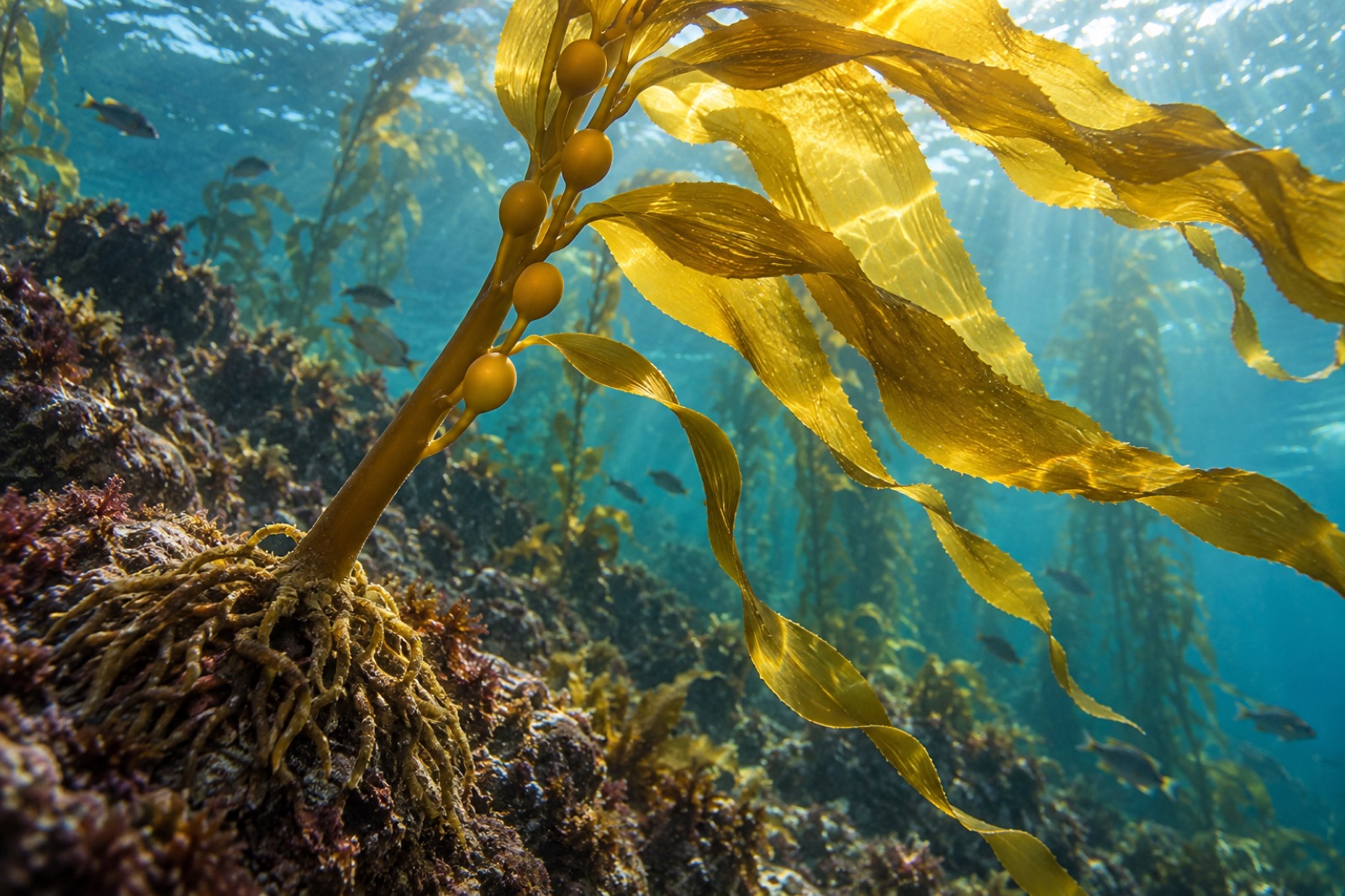
Giant kelp is the fastest-growing organism on Earth and the architect of undersea forests. Learn its biology, life cycle, range and why it matters.
Dr. Theo Nakamura ·
Marine heatwaves are weeks of anomalously hot ocean that can deforest entire coastlines. Here's the science behind them and what restoration can do.
Dr. Lena Fischer ·