Encyclopedia8 min read
Giant Kelp (Macrocystis pyrifera): Species Profile
Giant kelp is the fastest-growing organism on Earth and the architect of undersea forests. Learn its biology, life cycle, range and why it matters.
Dr. Theo Nakamura ·
Elk kelp grows deep, in clear water, with a single antlered float the size of a grapefruit. The deep edge kelp of the Channel Islands and Baja — biology and status.
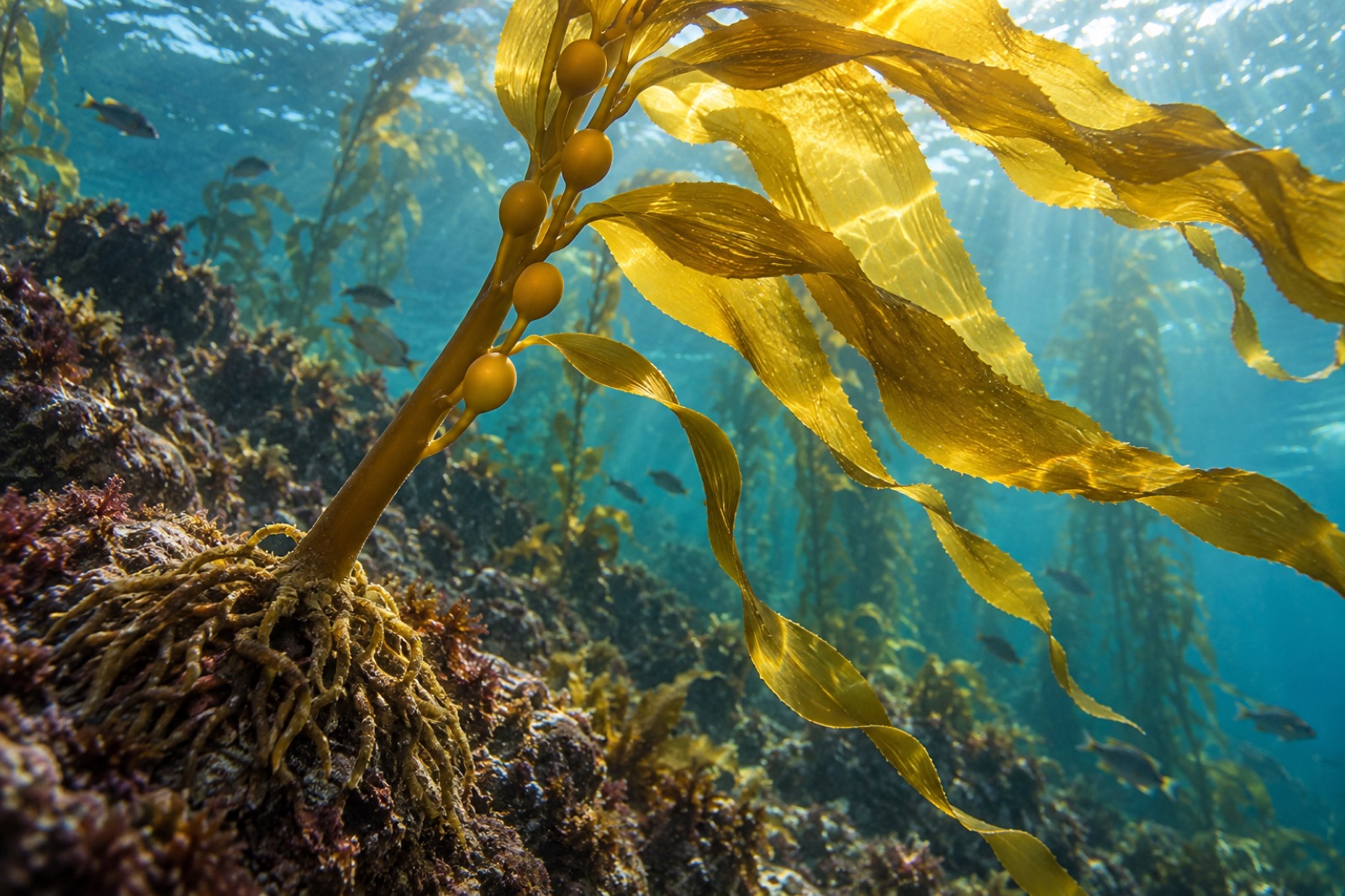
At the deep edge of the Southern California kelp forest, where the canopy of giant kelp thins into open water, another kelp begins — stranger, sparser, and built for depths most kelps never attempt. Elk kelp (Pelagophycus porra, sometimes called elkhorn kelp) grows at 30 to 60 metres in the clear, warm-edge waters around the Channel Islands and down the Baja coast, identifiable in an instant by the single huge float at the end of its stipe: a grapefruit-sized pneumatic sphere crowned with antlered blades. It is among the least-seen kelps of the region precisely because it lives deepest — and one of the most interesting, because that deep fringe is where climate changes first register.
| Scientific name | Pelagophycus porra |
| Group | Brown algae (Phaeophyceae), order Laminariales — a true kelp |
| Length | Stipe 20–30+ m; blades trailing the float at the surface or just below it |
| Habitat | Deep rocky reef, typically ~30–60 m depth, in clear offshore water |
| Range | Northeast Pacific warm-temperate fringe: waters off Southern California and Baja California, including the Channel Islands; the deep counterpart P. giganteus named for populations farther south |
| Distinctive structure | One large apical pneumatocyst (float) at the stipe tip, with lateral blades around it |
| Life cycle | Perennial, standard kelp alternation of generations |
Elk kelp solves a specific engineering problem: how to photosynthesise at depth, in water too deep for a canopy to reach the surface cheaply, in water often too warm for a shallow forest. Its answer is modular:
In warmer water the design pays double dividends: the blades photosynthesise in the brighter, sometimes more nutrient-poor surface layer, while the deep holdfast anchors into cooler, more nutritious water below. It is a solution to a trade-off that the shallower kelps cannot quite make, and a hint of where kelp evolution points in a warming ocean.
The life cycle follows the standard kelp alternating-generation pattern detailed in our kelp life cycle explainer: a microscopic gametophyte phase lives unseen in the rock at depth; the big, recognisable form is the sporophyte.
Elk kelp wants deep, clear, warm-edge water — which is exactly the water that changes fastest when the ocean warms or when currents reorganise. The species is at the southern warm margin of kelp habitat globally, so its populations are watched as a leading indicator: when El Niño warms the Southern California Bight, elk kelp depth-lines shift; when the current cools, the forests can re-thicken. The science behind that pattern is the same as in our explainer on El Niño and kelp: warm, stratified water starves kelp of nutrients from below, and a kelp species living at the nutrient edge is the first to show it.
Around the Channel Islands — whose kelp forests we profile in our atlas guide — elk kelp beds form a distinct deep band beyond the giant kelp canopy. To a diver who crosses from the giant kelp into elk kelp water, the transition is obvious: the towering multi-stipe giants give way to widely spaced single stipes rising like telephone poles, each crowned by its solitary sphere. It is one of the most otherworldly underwater scenes in the region — partly because the light at 40 metres softens everything, partly because the form itself is so strange.
Elk kelp is not extensively harvested and has no significant fishery built on it; its value is ecological and scientific. Because it is sparse, deep, and climate-tied, its beds are slower to recover from disturbance than shallower kelp stands, and its loss is poorly reversible by natural recruitment alone — spores may have to travel from distant surviving beds to recolonise. That combination (specialist, sparse, slow to return) is the reason elk kelp stands feature in subtidal monitoring programs around Southern California as an ecosystem condition measure.
For restoration, elk kelp is a challenge and a signal rather than a primary crop: it will not be the first line a Holdfast nursery grows for reseeding, but its presence or absence at the deep edge of a restored forest is among the clearest signs that the full habitat gradient is functioning again. Successful giant kelp reseeding up-slope, in other words, tends to be followed within a few years by elk kelp recruits below — an encouragement on the long arc of forest recovery.
The genus is small and suggestive. Pelagophycus populations in deeper, warmer Baja waters have at times been separated as P. giganteus; the genus has relatives in form (though not close family) in other float-crowned kelps such as bull kelp, whose similar single-float silhouette evokes elk kelp from afar. To the practiced eye, the difference is instant: bull kelp's float sits atop a strap-stipe before fanning into many blades, while elk kelp's float carries its blades directly, like antlers on a ball.
You need a boat, open-ocean conditions, and depth experience: elk kelp forests are almost entirely subtidal, 30 metres and deeper, around the offshore islands and Baja shelves. Several Channel Islands dive charters visit known beds in suitable seasons, and the experience — sliding down a bare stipe from blue water into a dim stand of otherworldly antlered spheres — is among the finest kelp diving on the coast. Our explore hub covers the training and safety side of deep kelp diving generally.
By the float. A single grapefruit-sized pneumatocyst crowned directly with blades at the end of a long bare stipe is characteristic; nothing else in the region combines those features. Bull kelp has a float too, but with a flattened stipe above it and a fan of many blades.
Typically 30–60 metres in clear water, deeper than giant kelp beds. Reports exist beyond that in exceptionally clear offshore water. It almost never appears in the intertidal.
It is not broadly listed as threatened, but its populations are closely watched as climate indicators because it lives at kelp's warm, deep limit. Warming events thin its beds, and recovery is slow because of limited spore dispersal.
Yes — if you are qualified for deep open-ocean boat diving in the Channel Islands region. Several dive operators include known elk kelp beds in their schedules. The depth and offshore setting put the experience firmly in the advanced category.
Not meaningfully. It is little harvested, rarely used, and mainly valuable as habitat and as an indicator species for ecological monitoring and restoration science.
Giant kelp is the fastest-growing organism on Earth and the architect of undersea forests. Learn its biology, life cycle, range and why it matters.
Dr. Theo Nakamura ·
How kelp alternates between a visible sporophyte forest and a microscopic gametophyte generation — and why that hidden half decides whether forests recover.
Dr. Theo Nakamura ·
Meet bull kelp, the fast-growing annual giant of North America's Pacific coast — its biology, Indigenous heritage, dramatic decline and the race to restore it.
Dr. Mara Ellison ·