The harbour porpoise (Phocoena phocoena) is the most widespread small cetacean in the northern hemisphere and one of the least noticed. Roughly the size of a person, charcoal-grey and quietly businesslike, it rolls at the surface without show, hunts fish around kelp beds and tidal rips, and famously does nothing to entertain boats. It is also one of the most threatened-by-entanglement marine mammals on Earth: gillnet bycatch is its defining conservation story. This profile covers identification, range, echolocation, diet and status.
Quick facts
|
|
| Scientific name |
Phocoena phocoena |
| Common names |
Harbour porpoise, common porpoise; "puffing pig" in older whaling dialects |
| Range |
Cool temperate to subpolar coasts of the North Atlantic, North Pacific and Black Sea |
| Habitat |
Shallow coastal and shelf waters, bays, estuaries, tidal channels — often around reefs and kelp edges |
| Size |
Typically 1.4–1.9 m and 50–70 kg; females grow slightly larger than males |
| Lifespan |
Commonly around a decade or so in the wild, with exceptional animals living into their twenties |
| Diet |
Small schooling and bottom fish — herring, sand eels, sprats, gobies — plus squid |
| Reproduction |
Single calf after a gestation of about ten months; calves are roughly 70–90 cm at birth |
Dolphins leap, bow-ride and show off. The harbour porpoise declines. At the surface it is a small dark triangle and a gentle roll: a low, wide-based little dorsal fin, a brief arc of back, sometimes a soft puff of breath — the sound that earned it the old nickname "puffing pig." Then it is gone.
The field marks that separate it from dolphins are consistent once learned:
- No beak. The blunt, rounded head lacks the dolphin's pronounced snout.
- Triangular dorsal fin. Small and set mid-back, not tall or curved like a bottlenose's.
- Spade-shaped teeth. Dolphin teeth are conical; porpoise teeth are flat and spatula-shaped (you will need a skeleton or a very cooperative porpoise to check this one).
- Small size. Adults rarely exceed two metres.
- Solitary or small-group habit. Pairs and trios are typical; large pods are not its style, though feeding aggregations of dozens form where prey concentrates.
Colour is straightforward: dark grey to black above, shading through grey flanks to a white belly, with a darker stripe from mouth to flipper. Nothing else of its size in northern waters matches the combination of that little fin and that shy, rolling surfacing.
Range and habitat: a specialist of the shallows
Three subspecies are generally recognised: one in the North Atlantic, one in the North Pacific, and an isolated — and seriously endangered — population in the Black Sea. Across that enormous combined range, the porpoise keeps to one habitat theme: cold, shallow, tide-swept, food-rich water. Estuaries, channels, kelp-fringed headlands and banks under a couple of hundred metres deep are classic.
Staying coastal is a double-edged strategy. Coastal water is the ocean's richest fishing ground, which is why porpoises are there — and why fishing gear is there too. A harbour porpoise's world overlaps almost perfectly with the human coastal economy: gillnets, salmon pens, shipping lanes, pile-driving. Much of what conservation must solve for porpoises is simply the management of crowded coastlines.
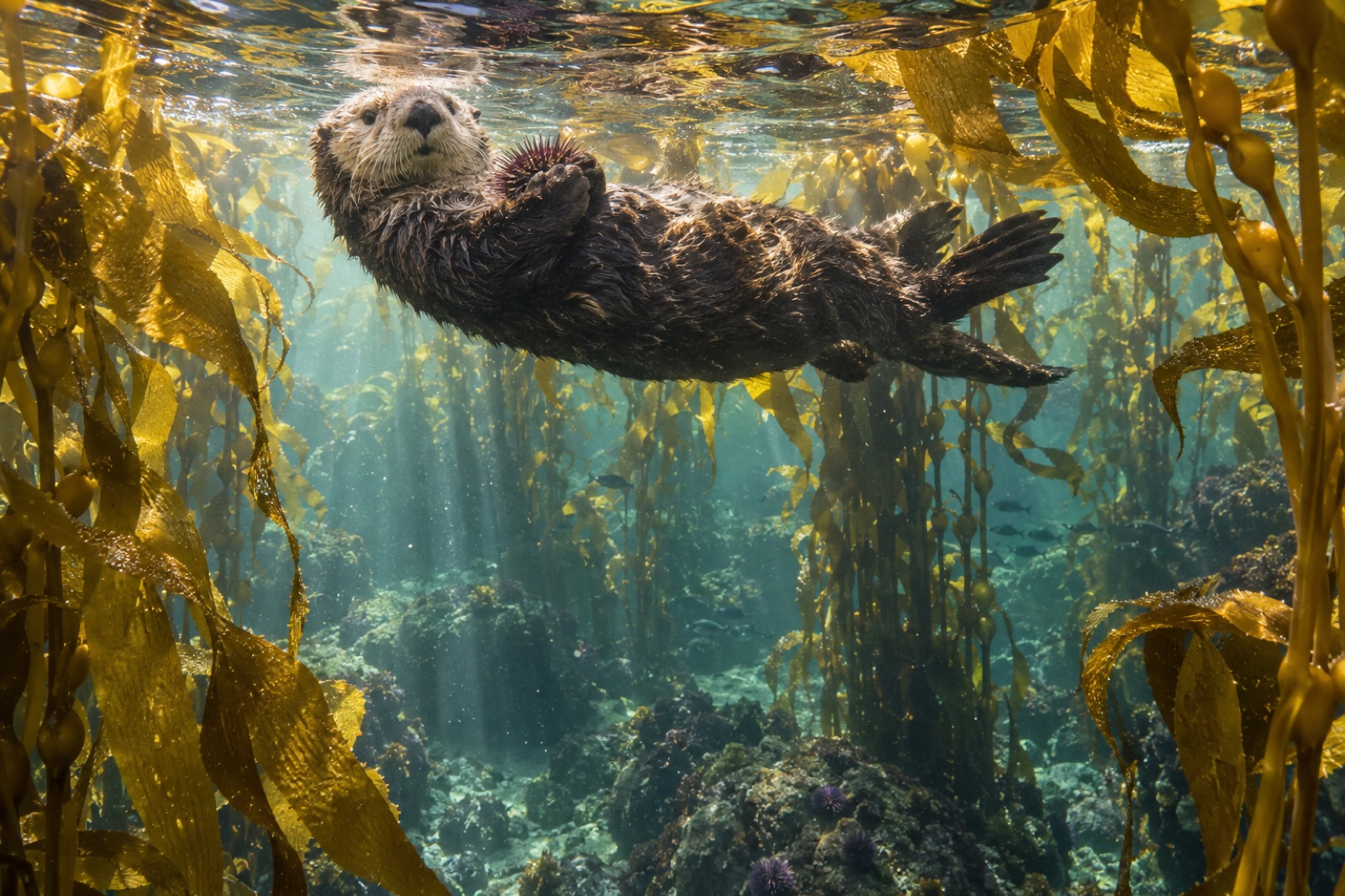
Kelp forest edges are particularly good porpoise water. Reef and kelp concentrate small fish and squid, and tidal flow over the topology creates the upwellings and rips that bunch prey into catchable patches. Boaters around temperate reefs often report porpoises working a kelp line edge in the company of diving birds — a feeding event, not a coincidence. They share these same hunting grounds with harbour seals, and the two are easy to confuse at a distance until the seal hauls out or profiles its dog-like head and the porpoise keeps quietly rolling. Where they're regularly seen from shore, the sighting is a good sign for the whole reef: kelp-edge prey fields draw the coast's full cast, from sea otters to diving birds.
Echolocation: a high-frequency specialist
Harbour porpoises navigate and hunt with a sophisticated form of narrow-band high-frequency (NBHF) biosonar, producing rapid trains of clicks centred around 130 kHz or so — well above human hearing and, critically, above the hearing of the killer whales that prey on them. This is acoustics as camouflage: an echolocation system tuned to a private channel.
The clicks resolve centimetre-scale prey at close range, and feeding buzzes — click trains accelerated into a final blur as the porpoise closes on a fish — can be detected by acoustic loggers. Because the calls are stereotyped, passive acoustic monitoring (listening stations left on the seabed) has become one of the most reliable ways to survey porpoise presence, an approach conceptually similar to the molecular listening we describe in reading the sea in a litre of water: instruments doing the patient watching that humans cannot.
The ear that makes this hunting work is also the porpoise's vulnerability. Pile-driving, seismic survey and heavy vessel traffic generate noise in exactly the coastal shallows porpoises cannot avoid, and exposure can drive them from feeding grounds or mask their foraging. Quieter coasts are not an aesthetic preference; for an animal that hunts with sound, they are prey habitat.
Feeding: a small cetacean with a large appetite
A harbour porpoise is a warm-blooded athlete in a cold wetsuit-sized body. Its surface-area-to-volume ratio is punishing, so heat loss is relentless — and the remedy is food. Porpoises must eat frequently, hunting throughout the day and night on whatever small fish are dense and near: herring and sand eels in the water column, gobies and flatfish near the bottom, squid where it aggregates.
This "feed often or chill" constraint explains much of their ecology — why they avoid long migrations, why they hug productive coastlines, and why disruptions to foraging (noise, net scars, prey depletion) bite harder in porpoises than in larger, fatter cetaceans that can fast through a bad week. A porpoise having a bad week is a porpoise in trouble.
Conservation: the net problem, solved in principle
The harbour porpoise is listed by the IUCN as Least Concern globally — a designation that conceals sharp regional differences. The Baltic proper population is critically endangered, and Black Sea porpoises have suffered badly. Across the range, one threat dominates all others: bycatch in gillnets. Porpoises cannot sonar-detect fine monofilament net reliably, swim into it while feeding, and drown entangled. In intensive gillnet fisheries, annual bycatch can exceed what small populations can withstand.
The hopeful part is that no one claims this is unsolvable. Pingers — acoustic alerting devices on nets — demonstrably reduce bycatch where used properly. Time-area closures, gear switching, and real monitoring all work. What has historically been missing is consistent application. Meanwhile the species' smaller cousin, Mexico's vaquita, stands as the warning of what unmanaged gillnet mortality does to a porpoise population. For divers and kayakers wanting to meet this animal properly — from a respectful distance, in its kelp-edge habitat — our explore cluster covers cold-water coastal wildlife etiquette.
Key takeaways
- The harbour porpoise is the northern hemisphere's commonest small cetacean — and its least conspicuous: small, dark, shy, and rolling rather than leaping at the surface.
- Identification keys: no beak, small triangular dorsal fin, small size, quiet solitary habits around coasts, kelp beds and tidal rips.
- It hunts with high-frequency clicks above killer whales' hearing, and must eat almost constantly to offset heat loss in cold water.
- Its status is "least concern" globally but ugly locally — the Baltic population is critically endangered and gillnet bycatch is the dominant threat everywhere.
- Bycatch is a solved problem in principle (pingers, closures, gear change) — application, not knowledge, is the bottleneck.
FAQ
How do you tell a harbour porpoise from a dolphin?
Look for the combination of small size, blunt head with no beak, and a small triangular dorsal fin — plus behaviour. Dolphins tend to leap and approach boats; harbour porpoises typically surface a few times in a slow roll and disappear. If it showed off, it wasn't a porpoise.
Where can I see harbour porpoises?
Along cool-temperate coasts of the North Atlantic and North Pacific: the shores of the UK and Ireland, Scandinavia, the Pacific Northwest, Atlantic Canada. From land, tidal headlands overlooking kelp-edged reefs and channels are the consistent spots, especially on a flooding tide when prey moves.
Do harbour porpoises live in kelp forests?
They hunt around them rather than in them. Kelp beds and rocky reef edges concentrate the small fish and squid porpoises target, and the tidal rips off kelp-fringed points are prime feeding ground. Think of kelp as the porpoise's favourite pantry rather than its home.
Why is the harbour porpoise so vulnerable to gillnets?
Its echolocation is tuned to detect prey, not near-invisible walls of monofilament. A feeding porpoise focused on a fish can strike a net it never "saw," entangle, and drown within minutes. Because porpoises live exactly where coastal nets are set, exposure is constant wherever gillnetting overlaps porpoise habitat.
How long do harbour porpoises live?
Typical wild lifespans are on the order of a decade, with only a minority of animals reaching their teens or beyond. Females mature young and can calve most years, but the overall strategy is fast turnover — which is precisely why sustained additional mortality from bycatch erodes populations so quickly.