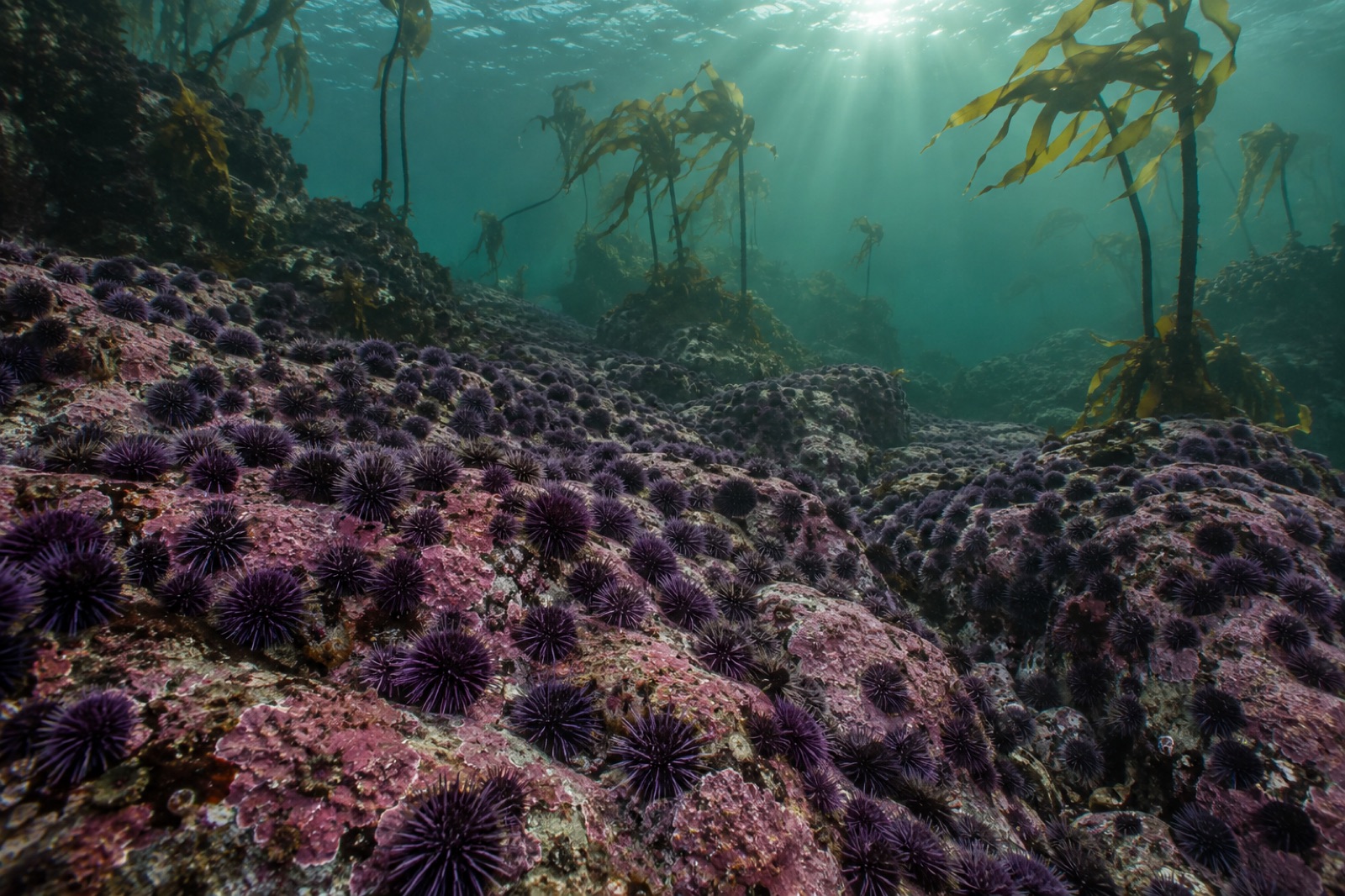
On an ordinary year, the equatorial Pacific is the most reliably asymmetric stretch of ocean on the planet: warm water pooled deep in the west, cold nutrient-rich water on tap in the east, and a steady trade-wind breeze holding the arrangement in place. Then, every two to seven years, the Pacific changes its mind. Trade winds falter, the warm pool sloshes east, deep-water upwelling off the Americas all but stops — and kelp forests from Ecuador to Alaska find themselves, within weeks, swimming in warm, nutrient-starved water. This is El Niño, the warm phase of the El Niño–Southern Oscillation (ENSO), and for kelp ecologists it is the largest natural experiment in forest collapse and recovery the planet regularly offers. This article explains what El Niño does to kelp, what past events have taught us, and how a La Niña's cool afterwash lets the forest rebuild — for a while.
ENSO in brief: the Pacific's great seesaw
ENSO is the largest source of year-to-year climate variability on Earth, and it operates on a beautifully simple seesaw. In the neutral or La Niña state, trade winds blow from east to west across the tropical Pacific, piling warm surface water against Indonesia and leaving the eastern Pacific — off Peru and Ecuador — with a shallow reservoir of cold, nutrient-rich water close to the surface. The thermocline, the boundary between warm surface and cold deep water, tilts: deep in the west, near the surface in the east.
In El Niño, the trades weaken or reverse. The warm pool slides east, and a deepening thermocline off South America pushes the cold, nutrient-laden water out of reach of the wind-driven surface. Coastal upwelling does not stop entirely — the local winds still blow — but the water that wells up is now the warm pool's own exhaust: warm and nutrient-poor. The seesaw can also overshoot in the opposite direction: La Niña intensifies the normal state, deepening cold eastern upwelling further and cooling much of the Pacific. The system flips with characteristic irregularity — every two to seven years, never on schedule — and each phase typically persists for nine to twelve months, sometimes much longer.
The atmospheric companion to the ocean seesaw — the Southern Oscillation — reorganises rainfall and storm tracks across half the planet in the process. But for kelp, all that matters is what happens in the water.
How El Niño attacks a kelp forest
El Niño does not kill kelp with a single blow. It arrives as a stack of pressures, each compounding the last:
- Warm water. El Niño raises eastern-Pacific coastal temperatures by 1 to 4 °C above the seasonal norm, sometimes more. Kelps have thermal ceilings; sustained warmth alone stresses the canopy, weakening fronds and slowing the growth that repairs them.
- Nutrient starvation. This is the deeper wound. Kelp is a hungry alga — it needs nitrate, and nitrate lives in cold deep water. Suppress upwelling and the kelp forest is suddenly feeding on scraps. Canopy thinning under nutrient stress is measurable within weeks via the colour of the water itself: chlorophyll satellites have tracked the nutrient shutdown of entire El Niño coastlines.
- Storms. El Niño winters deliver their own punctuation: more powerful storms sweeping the California and South American coasts. Kelp fronds already thinned by hunger tear free; holdfasts, the living anchors of the forest, fatigue and rip loose under wave loading they would have survived in a well-fed season.
- Urchin and grazer dynamics. A hungry kelp forest is a vulnerable one. Sea urchins — including the purple urchin whose barrens we've documented across the Pacific — shift into active grazing when their kelp drift food supply runs short, finishing off the weakened survivors.
The result, in the strongest events, is a coast-wide transformation: a lush three-dimensional forest reduced to scattered plants among urchin barrens, as if a storm had passed through and never left.
Lessons from the record
The kelp-El Niño relationship has been studied for more than sixty years, and the record reads like a sequence of hard lessons.
The 1957–59 event, one of the earliest studied in California, stripped kelp forests from Palos Verdes and other southern strongholds; recovery took most of the following decade. 1982–83, the first "super El Niño" of the modern record, was more savage still: warm nutrient-poor water and violent storms combined to erase kelp across vast stretches of southern California and Peru, and warm-water species ventured far poleward in the aftermath. 1997–98 repeated the pattern with the strongest El Niño then instrumentally recorded — southern California's kelp beds collapsed again, with canopy losses so severe that researchers divided the coast into "before" and "after" maps. The 2015–16 super El Niño arrived on top of an ocean already anomalously warm — the North Pacific heatwave of 2014–15, dubbed the Blob, had primed the water — and in northern California it delivered the coup de grâce to the bull kelp forests of Mendocino and beyond. Roughly ninety-five percent of that coast's bull kelp vanished in little more than two years.
The deepest lesson is compounding. El Niño used to arrive into a Pacific whose long-term baseline was stable. Today it arrives into an ocean already warmed by climate change — so the absolute temperatures of a modern El Niño are what the 1982–83 or 1997–98 events reached only at their peaks, and the floor from which recovery must begin is warmer. Marine heatwaves like the Blob — explored in Marine Heatwaves 101 — are climate change's way of making El Niño's job easier.
La Niña: the cool afterwash
The seesaw's other side is kelp's ally. La Niña strengthens the trade winds, deepens cold upwelling off the Americas, and flushes the eastern Pacific with nitrate. Where kelp has survived, or where spores persist in the bank of the seafloor, La Niña years bring the fastest canopy recovery in the record. Giant kelp in southern California has repeatedly regrown to near-undamaged extent within two or three La Niña years after a super El Niño that erased it.
But La Niña is a window, not a cure. Its fertilising waters last a season or two before the seesaw tilts again; a forest recovering under La Niña must rebuild its canopy, its understory, its urchin predators and its foodweb before the next El Niño arrives. When the warm phases come too close together — when a kelp forest's recovery time is longer than the interval between El Niños — the forest does not recover. It converts, permanently, to urchin barrens. This frequency problem, more than any single temperature threshold, is what makes the modern, warming baseline so dangerous for kelp.
The global reach of a Pacific event
Although ENSO is born in the tropical Pacific, its influence spills across the globe. Teleconnections — the atmosphere's way of propagating the Pacific's restructuring — shift rainfall, jet streams and storm tracks from Australia to East Africa. For kelp, though, the effects are most direct where they are felt in the water:
- Eastern Pacific: direct warming, nutrient shutdown, storm damage — the full cascade.
- Australia's west and east coasts: El Niño tends to weaken the favourable Leeuwin Current flow and reduce southern Australian rainfall, with consequences for estuaries and kelp light conditions; La Niña reverses both.
- Northern Pacific and Alaska: the atmospheric bridge brings milder winters northward during El Niño, with significant effects on the ice-dependent ecosystems of the Bering Sea — less direct on kelp, but felt throughout the foodweb that hangs off it.
Forecasting, and what restoration can do about it
ENSO has the best forecasting of any climate phenomenon of its class. Modern dynamical models routinely predict a developing El Niño six months or more in advance, and forecasts issued by NOAA, Australia's Bureau of Meteorology and peer agencies give restoration, fisheries and aquaculture managers a tool past generations lacked entirely: a season or two of warning. For kelp, that warning changes the plan:
- Pre-positioning. Seedstock is propagated in advance of forecast El Niños so that outplanting can resume the moment conditions ease.
- Genetic hedging. Warm-provenance Holdfast lines, drawn from kelp populations already living near the thermal edge, provide insurance against the warm phase the forecasters see coming — a key feature of Tidewright's fictional provenance-matched seedstock.
- Recovery-window mapping. Drifter surveys timed to a forecast La Niña can identify the substrate and light conditions most likely to carry a recovery before the seesaw tilts again.
- Long records, honest baselines. A restoration program that cannot tell an El Niño from a trend will misread both. The real reason programs like the fictional Canopy Ledger build decade-long water records at every site is so that the seesaw's natural motion can be seen against the slow rise of the tide beneath it.
Key takeaways
- ENSO is the Pacific's two-to-seven-year see-saw: El Niño weakens trade winds and warms the east, La Niña strengthens them and cools it.
- El Niño attacks kelp forests three ways at once — warming, nitrate starvation, storms — and the 1982–83, 1997–98 and 2015–16 events are its landmarks.
- On an already warming ocean, a modern El Niño reaches temperatures the great past events reached only at their peak, and the biggest modern danger is frequency: two warm events closer together than recovery allows.
- La Niña is the kelp's ally, delivering the cool, fertilised water under which forests regrow — but only until the seesaw tilts back.
- Six-month forecasting now gives restoration real lead time: seedstock pre-positioning, genetic hedging from warm-edge populations, and recovery-window surveys are all ways to work with the Pacific's rhythm instead of against it.
FAQ
How often do El Niños happen?
On average every two to seven years, but with notorious irregularity — sometimes back-to-back, sometimes separated by a decade. Strong events like 1982–83, 1997–98 and 2015–16 occur roughly once every fifteen to twenty years. The Pacific does not run to a timetable, which is why long monitoring records, not average ones, are the foundation of restoration planning.
Does climate change cause El Niño?
No — ENSO is a natural mode of Pacific variability with a geological record thousands of years long, and climate change did not create it. What climate change does is raise the baseline temperature from which each event warms, so a modern El Niño reaches absolute temperatures a 1982 or 1997 event only touched at its peak. Whether climate change also makes strong events more frequent is an active research question with no settled answer.
Why does kelp recover in La Niña rather than between El Niños?
Because a neutral year is often still near the warm pool's influence — nutrient supply is only partly restored and canopy growth is slow. La Niña actively reverses the damage: cold, nitrate-rich upwelling, the kelp's exact preference. Neutral years let the forest hold; La Niñas let it grow. Time-to-recovery is therefore set not by the absence of warm years but by the frequency of cold ones.
Do all kelp species respond the same way?
No. Giant kelp, with a long-lived canopy that repackages years of stored growth, can weather a moderate El Niño; bull kelp, an annual that must re-establish from spores each year, is far more exposed to a warm event arriving at the wrong season. Tasmania's giant kelp forests, along the east coast, face climate change compounded with El Niño's reach — each species and coast has its own breaking point.
Can we predict the next El Niño?
Six months out, reasonably well — modern dynamical and statistical models give reliable forecasts on that horizon, issued publicly by NOAA and peers. Beyond a year the "spring predictability barrier" — the Pacific's own forecasting weak spot during the boreal spring — blocks the view. For coastal planning that still matters enormously: six months is long enough to grow seedstock, pre-position gear, or time a survey to the other side of the seesaw.