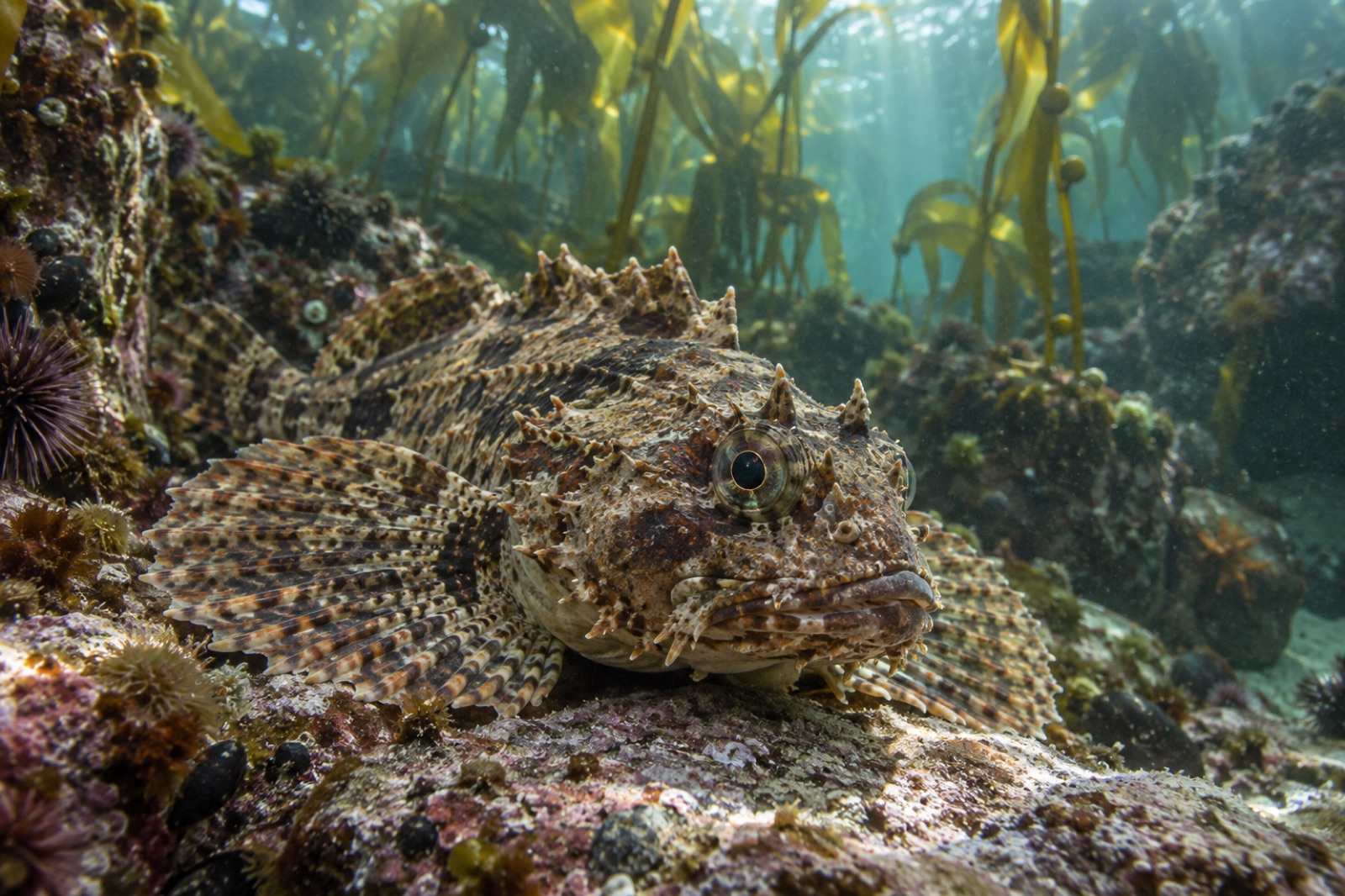
The buffalo sculpin (Enophrys bison) is a broad-headed, spine-armed ambush predator of the northeast Pacific, ranging from Kodiak Island, Alaska, south to Monterey, California. Divers meeting one on a kelp-bed ledge usually remember the meeting: a fish of up to 37 cm with a head like a battering ram, disproportionate wing-like pectoral fins, and a temperament that holds ground instead of fleeing. Add mottled camouflage, reported mild venom in its head spines, and startlingly bright green-to-golden egg masses guarded on the intertidal shoreline, and you have one of the most characterful residents of a rocky reef.
Quick facts
|
|
| Scientific name |
Enophrys bison |
| Common names |
Buffalo sculpin, sometimes simply "buffalo" among divers |
| Family |
Cottidae (sculpins) |
| Range |
Northeast Pacific, from Kodiak Island, Alaska, to central California |
| Habitat |
Rocky reefs and kelp beds, tide pools to roughly 20 m depth |
| Size |
To about 37 cm; commonly 15–25 cm |
| Diet |
Crabs, isopods, amphipods, snails, small fishes |
| Reproduction |
Winter–spring; bright green or golden egg masses on rock, guarded by the male |
| Defence |
Sharp preopercular spines; handling lore reports mild venom and painful punctures |
Identification: a face built of spines
Like all sculpins, the buffalo sculpin carries its head broad, its mouth wide, and its body tapering behind a pair of oversized pectoral fans. What marks it out is the armature. The rear of the gill cover (the preopercle) ends in sharp, projecting spines; more ridge-like projections line the top of the head and eye region. The profile of the head is long and sloped, and in larger individuals the high-shouldered, bull-like look of the front half of the fish explains both the common and scientific names — Enophrys bison, the broad-scaled bison-head.
Colour is classic reef camouflage: a mottled and banded mix of grey, olive, brown and ruddy orange, usually organised into four or five darker saddles or vertical bands against a paler ground colour. The pectoral fins are often barred. Against drape algae, bull-kelp holdfast region and sponge-encrusted rock, a resting buffalo sculpin can be effectively invisible — especially when it sinks to the substrate, spreads those pectoral wings, and refuses to move.
Look-alikes to separate it from:
- Rock greenling and kelp greenling — more elongate, scaled, different fin shape.
- Cabezon — larger still, scaleless and smoother-headed, with a distinct fold-like flap of skin on the snout and no buffalo's armed preopercle.
- Scalyhead sculpin — patchy head scales, smaller, more delicate.
The business of ambush
The buffalo sculpin swims badly on purpose. Rather than cruise open water, it sits on the reef floor, on ledge shelves, at the foot of a bull-kelp holdfast or inside the crease of an urchin-grazed ledge, relying on its camouflage to do what fins do for other fish. Prey that gets inside the strike distance — a crab stepping across the ledge, an isopod moving out at dusk, a small fish drifting too low — is taken in one explosive lunge and swallowed whole. It is not a pursuit hunter. The strike lasts a frame or two; the waiting lasts hours.
The diet is broad for a fish its size: crabs and other crustaceans, snails it may crush rather than shell out, and small fishes including young rockfish. That mix places it among the mid-tier predators that knit together the kelp bed's floor fauna — the same role played by the red Irish lord on northern reefs.
About that venom
Angler and diver lore has long held that the buffalo sculpin's head spines deliver an unusually painful sting, more than a simple mechanical puncture, and mild venom is frequently reported in field guides. What is well established is the hazard itself: those preopercular spines are sharp, and the fish holds its ground rather than bolting, which invites contact. Whether or not true venom glands sit behind every sting, the practical advice is the same — admire the head without handling it, and never pin a sculpin against the deck. For a fully verified look at venom in kelp-bed fish, read our profile of the California scorpionfish, which carries unquestionably venomous dorsal spines.
Breeding: the bright-green eggs on the beach
The buffalo sculpin's reproductive life looks wildly out of place. In winter and spring, females deposit compact masses of eggs — vivid apple-green to golden, depending on development — on seaweed-free bedrock in the intertidal and shallow subtidal zone. It is one of the few fishes you can find breeding in plain view on a low-tide beach: a coin-sized bright cluster on the underside of a ledge or in a protected crevice, standing out from the brown and ochre around it like a dropped jewel.
The male then stands guard. He rests over or beside the clutch, fanning the eggs with his fins to oxygenate them and driving away egg-eating crabs, snails and fishes until the clutch hatches into drifting larval fish. Intertidal guarding is risky — low tides can expose the clutch to air and sun — but the father will hold position through repeated emersion if needed. Once hatched, the young fish drift briefly, then settle to the bottom and grow up among rock, kelp holfasts and cover, taking progressively larger crustaceans as their mouths allow.
Habitat: from tide pool to kelp bed
This species spans the full vertical band of the rocky coast: high mid-tide pools all the way down to around 20 m of depth, favouring structurally complex rock — ledges, overhangs, cobble, encrusted reef — and the understorey of shallow kelp beds. In Puget Sound and the inland waters of British Columbia it is one of the commonest fish a shore diver sees; in the tide pools of the outer coast it coexists with the smaller tidepool sculpin, partitioning habitat by size and by tide height.
The bigger a reef's structural complexity — crevice density, kelp holdfast lattice, coralline crust — the more buffalo sculpins it holds. That is why nearshore restoration work that rebuilds rocky-reef complexity, including Tidewright's own fictional Drifter survey and seeding operations, tends to be followed in surveys by a slow return of mid-level fish like this one: they are a sensitive indicator that the habitat scaffolding has come back.
Finding one without startling it
Because the buffalo sculpin bets everything on its camouflage, it flees late. Divers often don't know they are next to one until it moves. In tide pools after dark — see our piece on tidepooling at night — the fish can be watched feeding openly, mobile and bolder than in daylight. Approach quietly; let the fish register you, then forget you; you will be rewarded with the full ambush repertoire.
Key takeaways
- The buffalo sculpin (Enophrys bison) is a northeast-Pacific ambush predator of rocky reefs and kelp beds, Alaska to central California, to about 37 cm.
- Identification: huge spiny head with projecting preopercular spines, bull-like front half, mottled saddled camouflage, large pectoral fans.
- Its head spines are sharp; field-guide lore reports mild venom. Either way, do not handle.
- Its egg masses are a striking bright green or gold on intertidal rock in winter–spring and are guarded by the male through hat ch.
- It feeds on crustaceans and small fishes from a motionless perch and is an indicator of reef complexity returning after restoration.
FAQ
Is the buffalo sculpin dangerous to divers?
Not seriously. The risk is puncture from the sharp head spines when a fish is handled carelessly — field guides commonly report mild venom as part of the sting. Left space, a buffalo sculpin holds its ground and ignores you.
Why are the eggs bright green?
The vivid green-to-gold colour of buffalo sculpin egg masses is natural — researchers think the pigments light-tolerance and camouflage trade-offs of intertidal spawning, but the honest answer is that the function is still debated. What is clear: the bright clutch attracts attention, so the father's guard duty is genuinely necessary.
How big does it get?
To roughly 37 cm in length. Most reef encounters are with fish of 15–25 cm; the biggest ones are older fish on northern reefs.
Both are sculpins (Cottidae), but the cabezon (Scorpaenichthys marmoratus) is a larger, smoother-headed animal, scaleless, and a separate genus. The buffalo sculpin is a closer cousin of the Irish lords.
Where's the best time and place to see one?
Low-tide pools on the outer coast in winter and spring for the guarded egg masses; early morning or dusk dives on Puget Sound-type sheltered reefs year-round for adults. Look at ledge bases and kelp holdfast edges, and move slowly.