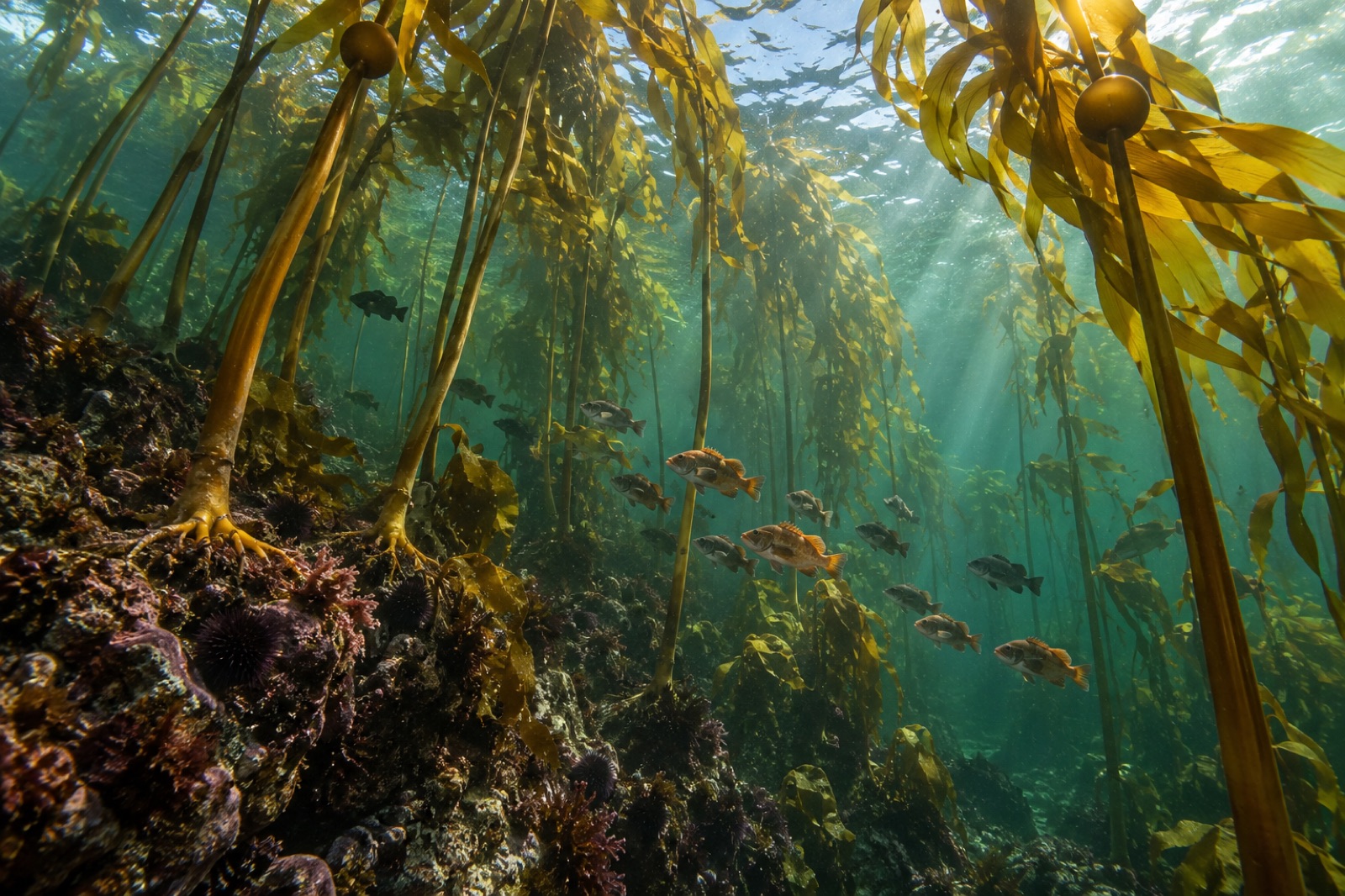
The view from a Seattle ferry can tell you something subtle about the ocean you are crossing. In late summer on certain routes, golden-brown rafts float on the surface — streamlined, leaf-shaped blades trailing from small gas-filled floats, strung in lines along the tide. That is bull kelp, Nereocystis luetkeana, the signature kelp of the Salish Sea, and the floating canopy of an entire underwater world: beds that shelter juvenile salmon, nursery habitat for rockfish and spawning substrate for herring — and, in parts of the inland sea, a habitat that has thinned alarmingly over recent decades. Puget Sound's kelp story is one of contrast: vigorous beds against Olympic Peninsula currents, stressed beds in the warmer, more urban southern reaches. This is the atlas entry.
Where Puget Sound is, and how it works
Puget Sound is the southern half of the Salish Sea (the Canadian half holds the Strait of Georgia): a glacially carved network of fjord-like basins and channels, connected to the Pacific through the Strait of Juan de Fuca between Washington's Olympic Peninsula and British Columbia's Vancouver Island. Deep, narrow, fed by rivers and mixed by powerful tides, it is an inland sea in the truest sense: ocean chemistry delivered through a single strait, then stirred, warmed and diluted as it works south into finger-shaped urban waterways.
This geography sets up the kelp's fundamental gradient. The Strait of Juan de Fuca and the northern Sound receive cool, salty, fast-moving Pacific water — bull kelp country in full voice. The southern and central Sound, hemmed in by cities and warmed by summer sun over shallower, more stratified water, runs harder conditions for a cold-water annual kelp. Where the water is coolest and the current clearest, the beds thrive; where the summer surface overheats and the nutrients are alternately too scarce and too concentrated from urban sources, the beds struggle.
The kelp and what it does
Unlike giant kelp's cathedral architecture, bull kelp is a sprinting annual: it germinates from the hidden gametophyte generation in late winter, races up through the water column in spring and early summer, forms its surface rafting fronds by midsummer, spores into autumn and is gone by winter storms. In that single season it:
- Shelters salmonids. Juvenile salmon migrating seaward use bull kelp beds as refugia and feeding grounds, slipping among the fronds before the push into the open ocean.
- Nurses rockfish and perch. Larval and juvenile fishes assemble under and around the canopy in densities the open water never approaches.
- Receives herring spawn. Pacific herring attach their egg masses directly to kelp blades — making bed loss a direct reproductive loss for a forage fish central to the food web (on which everything up to salmon and the southern resident orcas depends).
- Moves carbon and detritus. Like any kelp bed, it exports wrack and drift, feeding beaches and subtidal scavengers; our explainer on how kelp stores and moves carbon covers the physical side of what a canopy does to the water around it.
The story of decline and its patchiness
The honest account of Puget Sound kelp is a patchwork. Long observation by community scientists, tribes and researchers suggests that several southern and central Sound beds have shrunk or vanished over recent decades, while many Strait of Juan de Fuca beds have held more stable. The drivers overlap: warming summer surface temperatures pushing the annual root of the canopy — the juvenile recruitment window — to the edge; water-quality pressures near the urban corridor; shoreline armouring severing the connectivity of the narrow band of subtidal rock the kelp can grow on; and changes in grazer balance.
Because bull kelp is annual, its population is a fresh bet every spring. A bad warm year is a lost cohort; a few bad years in a row can empty a local bed if the microscopic seed bank is exhausted. That is the mechanism that makes the inland sea's southern waters feel the Allee-effect risk more sharply than the current-fed north.
Monitoring from a kayak: citizen science at scale
Puget Sound's kelp story has an unusual and hopeful feature: it is counted importantly by paddlers. Volunteer and tribal kayak surveys that follow shoreline GPS transects each summer have produced some of the longest, cheapest and most reliable kelp datasets anywhere — mapping floating canopy extent from the surface at the season when the beds are at full expression. Community-science kelp mapping has become a core tool here precisely because the habitat is shallow, nearshore and mappable by eyes and GPS without a research vessel. Our citizen science field guide covers the general philosophy; in Puget Sound it has grown into institutional infrastructure, with tribal governments — whose treaty resources run through these kelp beds — leading parts of the work.
Visiting and seeing the kelp
- By ferry. The simplest wildlife-watching platform in the Northwest is a ferry deck. Late summer crossings of the Sound pass active beds; look for the flat floating rafts with their small bulbs, then scan for the birds and seals that work the canopy edges.
- From shore. Beaches on the Strait-facing coasts and rocky points in the northern Sound look directly down into clear summer kelp low tides; kayak launches at public parks put you over the canopy in minutes.
- Snorkelling is possible at sheltered points in summer for those equipped for cold water — see our snorkel safety guide — though the Sound's visibility varies with plankton and river season more than with geography.
- Season. The kelp's visible season is roughly May through October, peak raft in late summer; winter storms strip the annuals and the beds vanish until spring.
Threats and trajectory
Puget Sound kelp decline is precisely the kind of problem that responds to concerted action: the drivers are local (water quality, shoreline structure, summer heat), the indicator is easy to watch, and the constituency is large — this is a kelp forest that lives in the front yard of several million people. Restoration interest runs strong, and the tribe-led and community-led monitoring networks built over the last decade are the data backbone any serious program needs first. Warming is the irreducible background pressure; local water-quality and shoreline management decide how well each bed weathers it. Tidewright's own fictional model — our Restore-Monitor-Regrow loop, visible on the platform page — is essentially the formalised version of what Puget Sound's kayak transects and tribal programs already do so well at scale: count it, understand it, intervene where the maths says intervention helps.
Key takeaways
- Puget Sound's bull kelp is an annual canopy of floating rafts, germinating each spring from a microscopic gametophyte bank and vanishing with winter storms.
- The beds are salmon nurseries, rockfish habitat and herring spawning substrate — infrastructure for the whole Salish Sea food web.
- Health is patchy: the Strait of Juan de Fuca beds are strongest; southern and central Sound beds have shrunk against warm, urban shorelines.
- Kayak-based community and tribal science has built some of the best kelp-monitoring datasets anywhere, at remarkable economy.
- Best seen from ferries and kayaks May–October; winter strips the beds naturally.
FAQ
Is the kelp in Puget Sound giant kelp?
No — it is almost all bull kelp (Nereocystis luetkeana), an annual whose blades form flat floating rafts at the surface. Giant kelp (Macrocystis) lives on Washington's outer ocean coast, not in the inland sea.
Why is bull kelp declining in some parts of Puget Sound?
The suspected drivers act together: warm summer surface waters stressing the microscopic generation and juveniles, water-quality pressures near cities, shoreline armouring restricting habitat, and changes in grazer activity. The annual life cycle adds urgency — each spring's canopy is only as good as that year's germination.
How can I help monitor Puget Sound kelp?
Join a local kayak-survey or community-science program; several tribes and nonprofits run summer transects volunteers can paddle. The work is low-tech — a kayak, a GPS, and August sunshine — and the data genuinely steer management.
When and where can I see the kelp?
Late summer on any Sound ferry crossing, or from kayak and rocky shorelines in the northern Sound and Strait of Juan de Fuca, roughly May through October. Look for flat golden-brown rafts with small gas bulbs.
Do herring really spawn on kelp?
Yes — Pacific herring lay adhesive egg masses directly onto kelp blades and other vegetation in shallow water. Bed health is therefore a direct herring-spawning habitat issue, connecting kelp condition to the forage-fish layer that salmon, seabirds and orcas depend on.