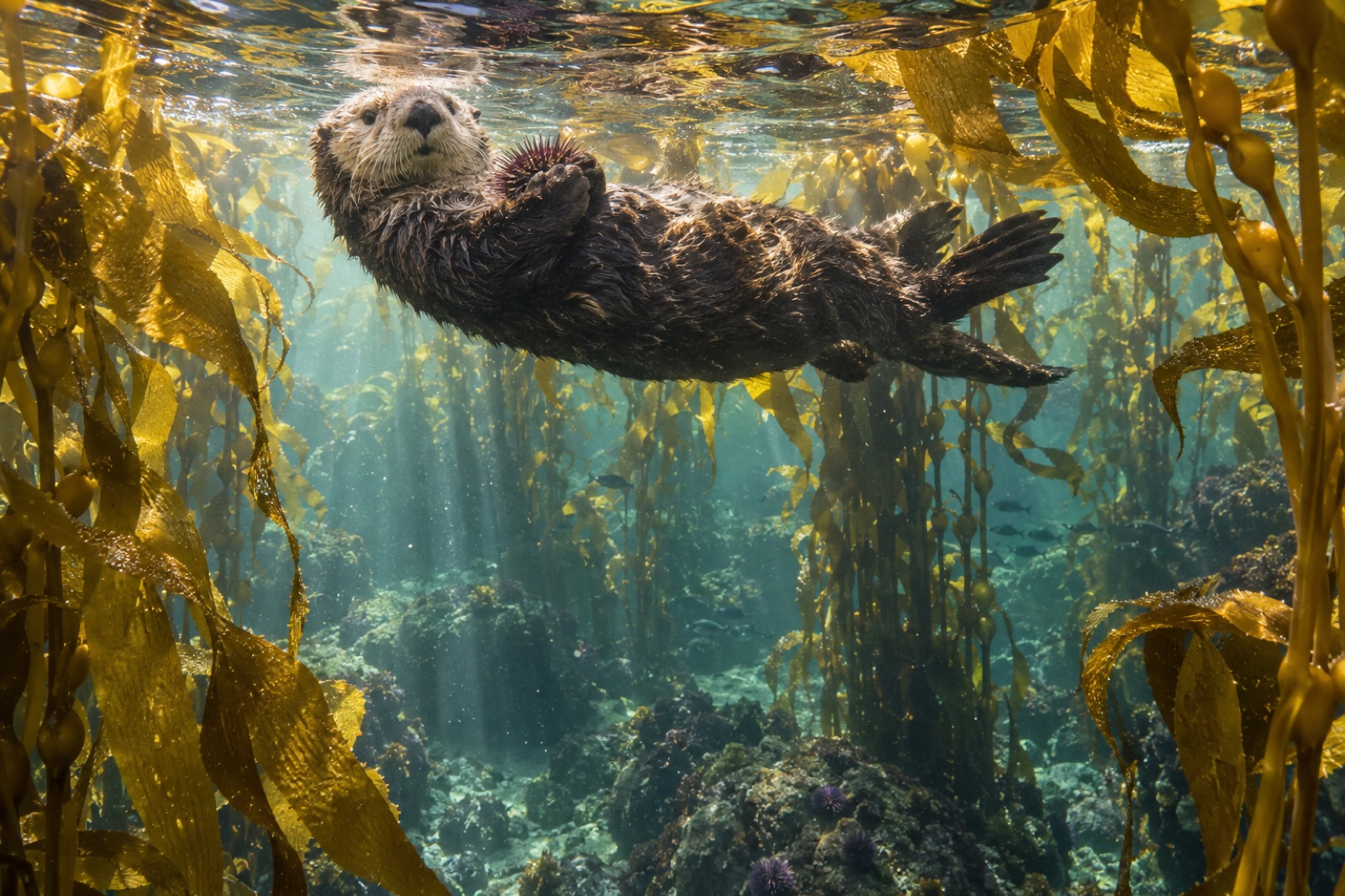
Snorkeling a kelp forest is the closest most of us will come to flying through a woodland — light in golden shafts, fronds streaming past, fish working the understory. It is also cold, moving, living water, and the same kelp that makes the scene beautiful can tangle a careless fin. The good news: with the right gear, a buddy and a few simple habits, kelp snorkeling on cold-water coasts is one of the safest ways into ocean wilderness. Here is how to do it well.
Know your water before you get in
Kelp grows where the ocean is cold and nutrient-rich — roughly 8–18 °C on most classic kelp coasts (California, Tasmania, New Zealand, South Africa, Chile, northern Europe). Cold is the primary hazard, not the kelp:
- Cold shock on entry (gasp reflex, skyrocketing heart rate) is real below about 15–18 °C. Enter slowly, let your face and chest adjust, breathe through it before swimming off.
- Loss of dexterity comes fast in 12 °C water. Simple tasks — clearing a mask, managing a strap — take longer. Practice in a pool or on a calm first session.
- Hypothermia on long swims. Even in a wetsuit, most people cool down noticeably after 45–60 minutes in 12–14 °C water. Plan your exit before you're tired, not after.
Summer and early autumn are the warm-water seasons. In Monterey, that's September to November; in southern Australia, February to April. Check local resources for current water temperature — a 2 °C difference is the difference between comfortable and uncomfortable.
Gear: warmth first, then everything else
A kelp snorkel rig for cold water, in order of priority:
- Wetsuit, 5–7 mm with hood and gloves. Hoods matter more than most beginners expect — enormous heat is lost through the head. In genuinely cold water (12 °C and below), 7 mm plus booties, gloves and hood is not overkill.
- Mask and snorkel. A low-volume mask that seals well; test the seal in shallow water before swimming out. A simple J-tube snorkel is easier to keep clear in surge than a valved dry-top snorkel.
- Fins. Full-foot fins in warm water, open-heel with booties in cold. Kelp snorkeling does not need long freediving fins; compact fins are easier to control in the canopy and less likely to kick fronds or animals.
- Weight belt (optional, for freedivers). Snorkelers bobbing on the surface rarely need weight, and it raises risk for beginners. Leave it behind on your first sessions, or use minimal weight with training.
- Visibility and signalling. A bright rashguard or hood, a whistle, and — for anywhere near boat channels — a surface marker buoy ("diver down" style float on a short line). Kelp canopy hides swimmers surprisingly well from boats.
- Dive flag/float where local rules require it. Some jurisdictions require a float with a dive flag for any snorkeler; others only for scuba. Check before you go.
Rent before you buy: a well-fitting rental suit tells you what to look for.
Reading the ocean from the beach
Kelp snorkeling is surge snorkeling. The forest lives on shallow rocky coast where swell wraps in, compresses, and rolls you sideways. Reading conditions is the core skill:
- Watch for 10–15 minutes before entering. Swell comes in sets; lulls lie between them. Time your entry and exit for lulls.
- Entry and exit points: kelp beds usually indicate rocky bottom — awkward entries. Look for sand channels cutting through the kelp (that's often why they're sandy — waves sweep them), or easy stairs/piers like those at many reserve beaches. Never enter or exit across urchin-paved rock in surge, for your sake and the urchins'. (Our purple sea urchin profile explains why their spines are a bad day.)
- Waves and surge: stand in chest-deep water and feel how the water moves you before committing. If you're being shoved toward rocks on every set, don't snorkel there today.
- Current: kelp fronds stream with the flow — from the beach you can often see which direction the canopy is leaning. Plan to exit up-current or along-shore, not after a down-current drift past your exit point.
- Wind: afternoon onshore winds roughen and cool the surface. Mornings are frequently calmest in summer.
In the water: moving well among the fronds
The actual techniques that separate comfortable kelp snorkelers from tangled, anxious ones:
- Swim along the canopy, not through it. Follow kelp lanes — clearings of sand or rock between clumps — rather than forcing your way through the thickest canopy.
- Slow, horizontal finning. Kelp grabs at anything that kicks vertically. Stay flat, keep fins shallow, and use a gentle flutter. Sculling with hands under your chest is fine in the shallows.
- Never grab the kelp hard. A casual hold on a stipe to steady yourself is fine — everyone does it — but hauling on the canopy tears it. It also snaps you sideways when a surge hits. Gusset hold: two fingers on the stipe, not a fist around it.
- Back off in big surge. When the canopy itself is thrashing — fronds streaming flat, leaf-ends lashing the surface — the water is doing the same thing to you underneath. Exit during a lull, on your own terms.
- If you tangle, stop. Kelp releases what doesn't fight it. Slow down, reach behind with a hand to free a fin, or simply back out the way you came. Panic creates a tangle; calm undoes one.
- Wildlife distance. Kelp forests host animals worth respecting: sea otters that need space and legal protection, seals and sea lions (playful but powerful), and — in some regions — great white sharks seasonally. Read local guidance. Never touch, chase or feed. Sea otters, in particular, are legally protected in most of their range and easily stressed by approach.
- The buddy system. Non-negotiable in cold, moving water. Stay within a few metres of your partner, and agree on signals and a maximum dive time before entry.
Skills to practice before your first kelp snorkel
In a pool or on a calm shallow sandy beach, before the kelp forest itself:
- Mask clearing and replacement while treading water — until it's boring.
- Snorkel clearing after a full submersion.
- Relaxed surface swimming for 20+ minutes in full gear.
- A slow duck-dive to 3–4 metres (optional but transformative): the moment you can slip below the canopy and sit eye-level with a fish, the forest becomes a three-dimensional experience. Never duck-dive alone, and never push depth to impress anyone.
- Entry and exit over rock in small sets — timing lulls, keeping footing, not turning your back on the water.
Where to do your first kelp snorkel
Choose somewhere sheltered, shallow, warm-ish and patrolled or frequently visited:
- Lover's Cove, Avalon (Catalina Island, California): protected cove, dense kelp, tutored guides, rental on the beach. See our Catalina guide.
- Lover's Point, Pacific Grove (Monterey, California): the classic first Monterey kelp snorkel; see Monterey Bay.
- Shelly Beach, Manly (Sydney, Australia): inside Cabbage Tree Bay Aquatic Reserve — calm, shallow, fish-tame and urban.
- Bicheno and the east coast (Tasmania, Australia): clear water and golden kelp — our Great Southern Reef guide covers the region.
- Anywhere with a snorkel tour: a guided first session is the single best investment. Local guides know entry points, current and seasonal wildlife.
Key takeaways
- Cold water is the main hazard — a 5–7 mm wetsuit with hood and gloves turns kelp coastlines from hostile to comfortable.
- Read swell sets from the beach for 10–15 minutes; time entries and exits for lulls and use sand channels through the kelp.
- Never force through canopy — follow kelp lanes, fin horizontally, and get untangled by going slow, not fast.
- Snorkel with a buddy, a surface float near boat traffic, and a firm no-touch rule around wildlife — especially sea otters and seals.
- A guided first session at a sheltered reserve beach is the fastest path to confidence.
FAQ
Is it dangerous to get tangled in kelp?
Very rarely, for a calm snorkeler. Kelp fronds release easily from a slow, unhurried swimmer; the panic of thrashing is what creates tangles. Stop, breathe, and free yourself with a hand. Practised, it takes seconds.
What wetsuit thickness do I need?
As a rough guide: 3 mm for 18–20 °C, 5 mm for 15–18 °C, 7 mm with hood and gloves for 10–14 °C. People vary enormously; err warm for your first sessions.
Do I need to be a strong swimmer?
You need to be comfortable — able to tread water and swim a few hundred metres in a pool without stress. Gear adds buoyancy, so ocean snorkeling is often easier than pool swimming, but cold, surge and wildlife ask for base confidence.
Can I snorkel anywhere along a kelp coast?
Not everywhere is legal or sensible. Some coasts have reserve rules, seasonal closures or private access. Check local marine park maps and beach signage first; many of the best spots are well-marked council or reserve beaches.
What about sharks?
Most kelp coasts host sharks; the vast majority are harmless species like Port Jackson sharks. For coastlines with larger sharks seasonally present, local lifeguards and shark-spotting programs publish current guidance — follow it, avoid low-light hours and seal colonies, and keep perspective: thousands of safe kelp snorkel days happen every year.