Encyclopedia9 min read
Golden Kelp (Ecklonia radiata): Species Profile
Golden kelp forms the backbone of Australia's Great Southern Reef. Learn to identify Ecklonia radiata and why this habitat-maker is on the move as oceans warm.
Dr. Mara Ellison ·
Australia has a second great reef — 8,000 km of temperate kelp forest across five states, more endemic than the Great Barrier Reef, and in serious trouble.
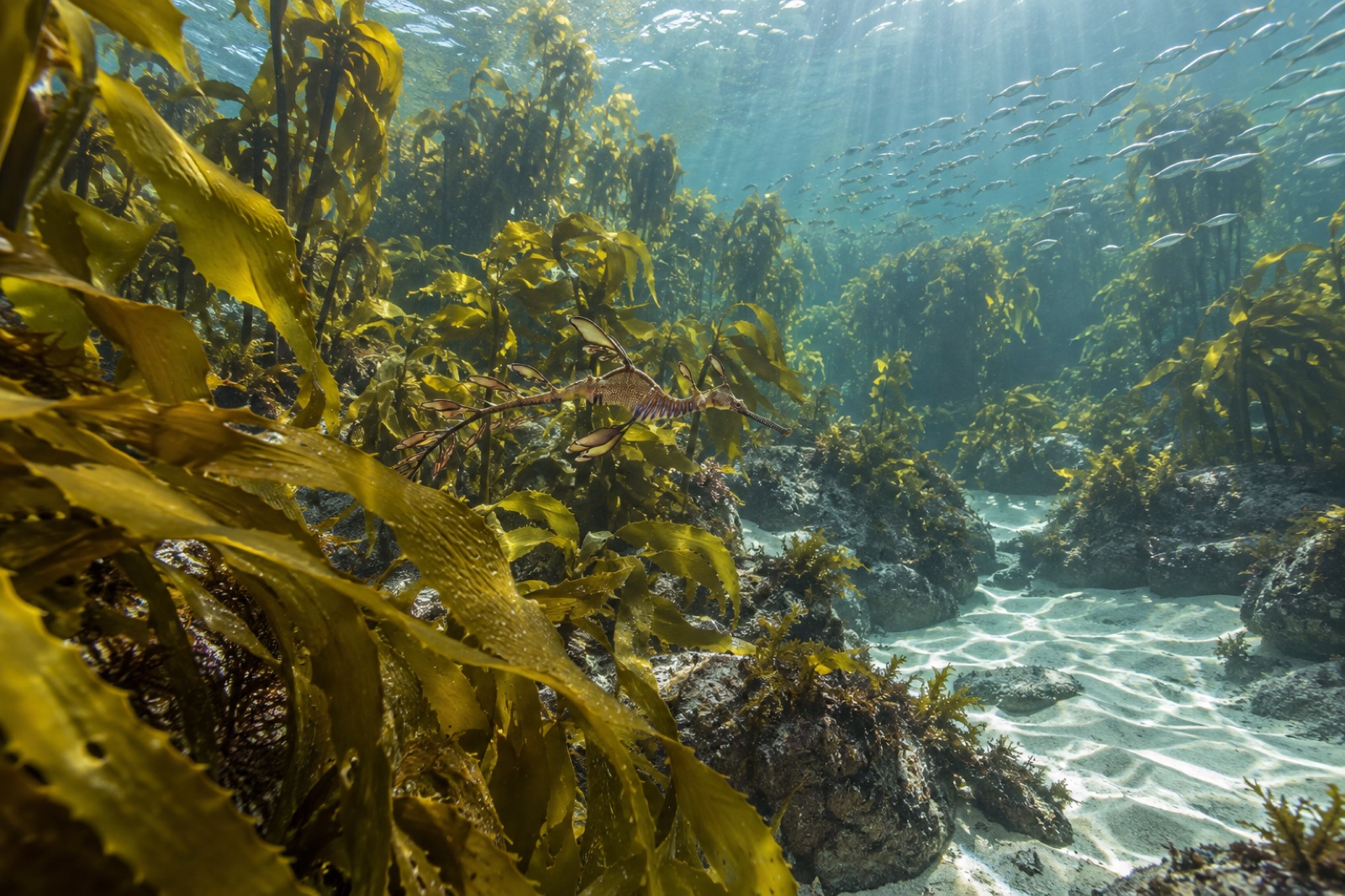
Most Australians can name the Great Barrier Reef. Almost none can name the continent's other, larger, cooler one. The Great Southern Reef (GSR) runs roughly 8,000 km along the bottom of Australia — from Kalbarri in Western Australia around the Great Australian Bight, Bass Strait and Tasmania, up to the border of Queensland — a continuous temperate reef system built by golden kelp and its relatives, spanning five states and the waters off ~70% of Australia's population. Researchers have catalogued it as more biodiverse, more endemic and economically comparable to the Great Barrier Reef — and it is deteriorating faster. This is the atlas entry for the reef most Australians have never heard of.
The GSR is not a marketing name. Biogeographically it is one system: a continuous line of rocky temperate coast held together by shared oceanography. The Leeuwin Current runs warm water down Western Australia's west coast and around into the Bight; the Zeehan and East Australian currents (EAC) frame Tasmania and the southeast. What the GSR's regions share is a kelp-dominated rocky bottom in cold-to-temperate water, a distinctive fauna, and a startling number of species found nowhere else on Earth.
A 2016 research synthesis by Scott Bennett, Thomas Wernberg and colleagues gave the reef its name and headline numbers: some ~71,000 km² of habitat, an estimated annual economic contribution in the billions (tourism and fisheries alike), and a level of endemism that outstrips the Great Barrier Reef. Its founding argument was cultural as much as scientific — Australians should hear "Great Southern Reef" as easily as they hear "Great Barrier Reef".
The keystone architect across most of the reef is golden kelp (Ecklonia radiata) — a mid-sized brown kelp with a single frond on a firm stipe, growing in dense, light-green-gold meadows. Other key brown algae include the common kelp (Ecklonia relatives), the crayweed (Phyllospora comosa) of the east coast, and the giant kelp (Macrocystis pyrifera) of Tasmania. Together they define temperate Australia. See our golden kelp profile for the species' biology and its central role in reef nutrition.
Kelp meadows differ in structure from canopy-forming forests, but the ecological job is the same: primary production, shelter, and the bottom-up fuel for everything from abalone to rock lobster (crayfish) to weedy seadragons.
Because the GSR has been isolated south of the tropics for tens of millions of years, evolution loaded it with species that exist nowhere else. The cast is extraordinary even by kelp forest standards:
Many of these species anchor ecotourism industries already: Whyalla's cuttlefish winter, Tasmania's kelp dives, seadragon tourism in Victoria and South Australia — all GSR economic conversation without the label attached.
From Kalbarri south past Perth, Albany and into the Bight, kelp lines one of the most exposed, wind-beaten coasts in the world. Offshore, the Leeuwin Current — unique among poleward western-boundary currents in flowing warm water toward the pole — sets up the region's unusual oceanography. In 2011 this region was hit by an unprecedented marine heatwave ("Ningaloo Niño") that killed or thinned kelp along hundreds of kilometres of coast at Kalbarri and beyond; researchers monitoring the damage recorded functional extinction of kelp at the range's northern edge. See our explainer on marine heatwaves for context.
Spencer and St Vincent's Gulfs are shallow, clear and strange: seagrass plains washing against kelp reef, giant cuttlefish winters, and the leafy seadragon strongholds of the Fleurieu and Yorke Peninsulas. Gulf water temperatures run well above the open coast — South Australia's kelp lives at some of the reef's warmest margins, and its seagrass and kelp losses are long-documented.
Wilson's Promontory, the Mornington Peninsula's back beaches, and Port Phillip Heads: Victoria has some of the densest GSR diving and a marine protected area system (marine national parks and sanctuaries) covering real swaths of it. Crayweed restoration at bare Sydney metro reefs (Operation Crayweed) began just north of the Victoria–NSW line; Victoria itself carries Port Phillip Bay's complex mix of improvement and decline.
Tasmania holds the GSR's most spectacular remaining stands — including its tallest kelp, Macrocystis pyrifera, on the Tasman Peninsula, Fortescue Bay and the east coast. It is also the reef's fastest-warming edge. The East Australian Current has extended further south over recent decades, warming east Tasmanian waters at nearly four times the global average rate. The result: warming has now removed an estimated ~95% of Tasmania's giant kelp forests since the 1940s — one of Earth's best-documented kelp collapses — while the long-spined sea urchin (Centrostephanus rodgersii), carried south in the warming current, has transformed kelp reef into barrens. Tasmanian urchin numbers are now counted in the hundreds of millions. Our kina (sea urchin) profile covers the cousin species; Tidewright's own Tasmanian field notes will appear in the Journal as that project matures.
From Eden north past Sydney to the Queensland border, the GSR thins and warms as the East Australian Current pours tropical water down the coast. Sydney Harbour itself — including famous Cabbage Tree Bay Aquatic Reserve at Shelly Beach, Manly — sits inside the reef's range, and the Operation Crayweed project at Sydney's northern beaches is a landmark in urban kelp restoration: after Sydney's crayweed vanished in the 1980s from sewage outfalls, scientists tied seeded hessian mats to bare reef beginning in 2011, and self-seeding crayweed forest has re-established at multiple sites. That is one of the models Tidewright's Holdfast nursery approach scales up.
The Great Southern Reef is a reminder that the ocean doesn't only consist of icons. Australia's southern temperate coast is more populous, more economically used and more immediately threatened by climate change than its tropical north. Sea surface warming on the east Tasmanian and WA coasts is among the fastest on Earth; temperate kelp systems respond quickly, and their loss strips coastal people of reef, fisheries, tourism and coastal protection at the same time. Naming the reef — as with any named ecosystem — is half of conservation. The other half is measurement, protection, and reseeding at scale. That second half is Tidewright's remit: biomass and canopy mapping by satellite, drone and diver, nursery seedstock matched to site genetics, and reseeding by autonomous vessels. See the company's platform for how that works.
It is a scientific and public-awareness name, coined and advanced in a 2016 research synthesis by Australian marine scientists, rather than a legislated protected-area designation. It names a real, continuous biogeographic region recognised in the science long before it had a brand.
Yes — it's one of the world's great temperate dive destinations. Hotspots include Rapid Bay and Whyalla (South Australia), Portsea Pier and Wilson's Promontory (Victoria), Bicheno and the Tasman Peninsula (Tasmania), and Shelly Beach and Jervis Bay (New South Wales). Temperate water, temperate wildlife.
Temperature, building organism and biology. The GBR is a tropical coral reef built by coral polyps; the GSR is a temperate system built by kelp and other brown algae. Both are huge, biodiverse and climate-endangered; the GSR is older, cooler, more endemic and far less famous.
It has already been done at small and medium scales — Operation Crayweed's Sydney project is the proof of concept. Scaling that to hundreds of kilometres of reef is the premise of the emerging kelp-restoration industry, Tidewright's own included.
Institute for Marine and Antarctic Studies (UTAS) research on the EAC and Tasmanian kelp; the Operation Crayweed team's publications on Sydney restoration; and our own explainers on marine heatwaves and the golden kelp species profile.
Golden kelp forms the backbone of Australia's Great Southern Reef. Learn to identify Ecklonia radiata and why this habitat-maker is on the move as oceans warm.
Dr. Mara Ellison ·
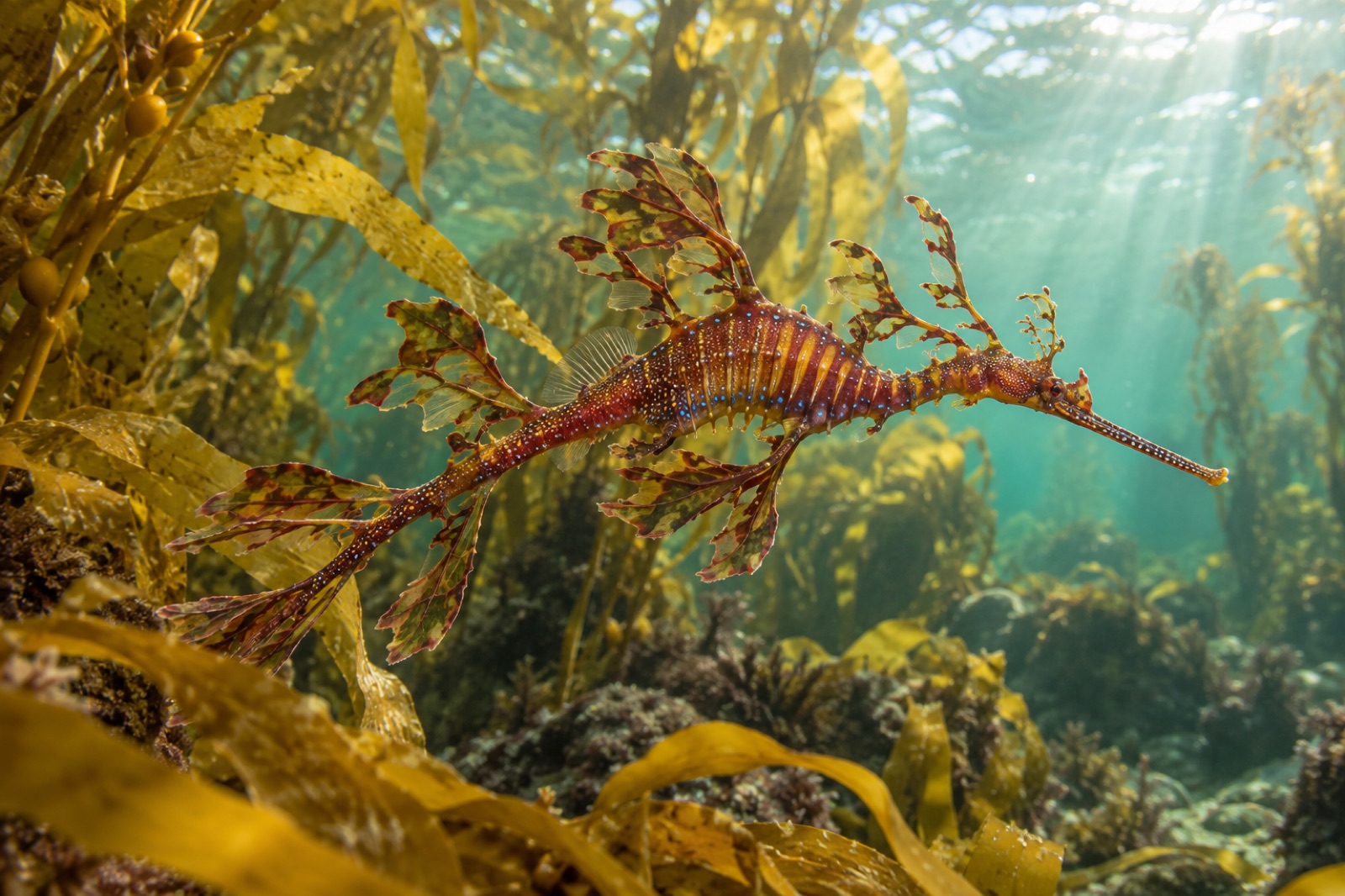
Australia's weedy seadragon drifts through kelp like fallen seaweed come alive. Discover its camouflage, male egg-brooding, range and conservation.
Dr. Theo Nakamura ·
The leafy seadragon is the most perfectly disguised fish in the sea. Explore its South Australian strongholds, brooding males and fragile future.
Dr. Mara Ellison ·