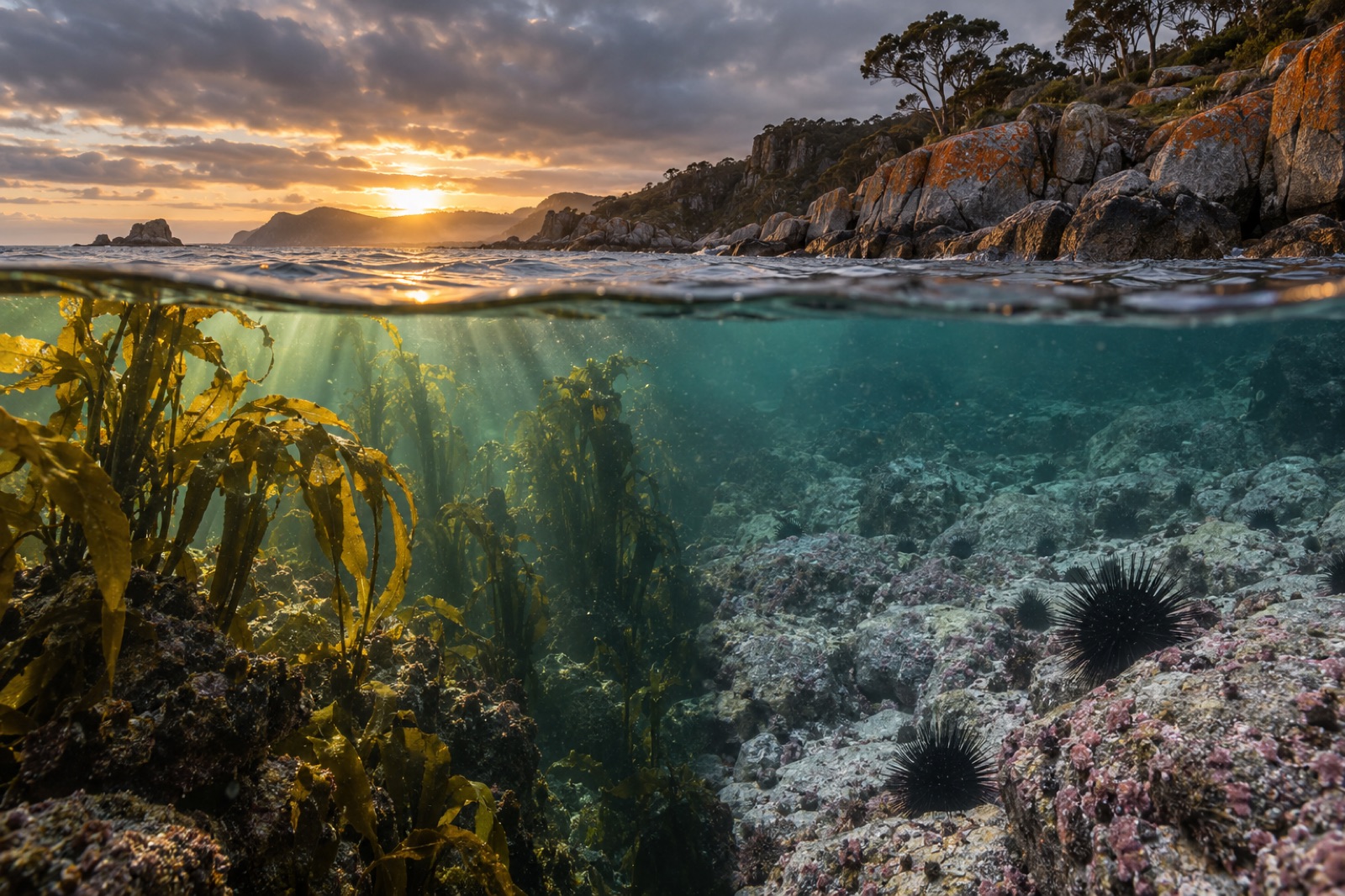
Bicheno is the quiet middle child of Tasmanian diving: not as famous as Bicheno's southern cousins on the Tasman Peninsula, not as staged as the seahorse-and-seadragon shows further down the coast, and all the better for it. This small fishing town on Tasmania's east coast — red granite headlands, white beaches, a blowhole at the gap — fronts a stretch of reef that has produced some of the most photographed temperate-water marine life in Australia. If you have read our wider guide to Tasmania's east coast and want to know where to actually get in the water, this is the guide: the sites, the conditions, the life and the logistics.
Why Bicheno punches above its size
The geology does the heavy lifting. Bicheno's coast is built of Devonian granite stained orange-red with lichen above the waterline — and the same granite continues underwater as rounded boulders, gutters and overhangs down to thirty metres. Boulder reefs like this make superb habitat: every crevice is a potential lobster den or fish home, every exposed face a substrate for invertebrate turf, and the gaps between boulders shelter smaller life from swell. Lay kelp — here mostly golden kelp (Ecklonia radiata) — over the tops of that boulder field and you have a classic east-Tasmanian reef structure in compact, diveable form.
The east coast's oceanography helps too. This is a comparatively sheltered coast compared with the Roaring Forties battering Tasmania's west, and the East Australian Current pushes warm water down across the summer, lifting sea temperatures and bringing tropical vagrants down from the mainland. Pilchard and kingfish sightings, even the odd sea turtle, are realistic summer bonuses on top of the resident temperate cast.
Governor Island: the main event
Almost everyone's reason for diving Bicheno sits a few hundred metres offshore: Governor Island, a granite knob protected as a marine nature reserve. No-take status for decades has let the island's reef fattens itself, and the consequences are visible from the moment you descend the mooring line.
The Hairy Wall and the reef circuit
The island's signature dive runs along submerged boulder walls and gutters on its seaward side. The Hairy Wall, named for its dense fur of invertebrate growth — hydroids, bryozoans, sponges — is as colourful a temperate reef face as Tasmania offers. Yellow zoanthids, orange and white sponges and sea tulips compete for space; nudibranchs work the hydroid gardens. The gutters between boulder stacks are where the site becomes famous: this is prime country for the weedy seadragon, and Bicheno's population is one of the most reliably seen in Australia. Divers who move slowly along the sand-boulder edge, eyes at dragon height, are often rewarded within a single tank.
Fish and the rarities
Butterfly perch swarm above the kelp in such densities that local operators describe them outright as clouds. Blue-throated wrasse, banded morwong, trumpeter and draughtboard sharks fill out the expected east-coast list. The site also has a reputation for rarer quarry: the red velvetfish, one of Australia's most photogenic temperate fishes, turns up here for patient searchers, as does the occasional deepwater species washed in from the shelf. Fur seals sometimes join dives in the shallows, which lifts even a slow dive into memorable territory. Depths across the island range from boulder tops near five metres to sand at twenty-five or so, making it workable for a wide range of certifications.
What no-take decades look like
Governor Island is worth contemplating as a conservation lesson as much as a dive. Reserves like this one are the control group that shows what Tasmanian reefs can carry when fishing pressure lifts: more, bigger animals in a visibly more structured habitat. It is not a pristine baseline — warming water rewrote the east coast's kelp story in plain sight during the last decades, and longspined sea urchins moving south with the current are remaking deeper reef here. But as a window into abundance, it remains the east coast's clearest argument for protected areas.
Other sites around Bicheno
- The Gulch outside the harbour: shallow granite reef and boulder fields in the five-to-twelve-metre band, useful as a checkout dive and a good night-dive venue. Octopus and cuttlefish are common; the shallow kelp fringe photographs well in afternoon light.
- Waubs Bay and the town reefs: easy shore-diving from the beaches and rocks around town, with the compensations of walking distance and café recovery afterward. Depths are shallow, so this is training-and-snorkel territory more than epic scenery.
- Butler's Beach and Redbill Point: granite point diving south of town with gutters and kelp, picking up bigger swell than the Governor Island lee; save it for calm forecasts.
- Outer pinnacles and deep reef: for technical and deep-air divers, a scattering of deeper granite pinnacles seaward of the island holds bigger sponges and fewer visitors. These are operator-dependent dives and worth asking about in advance, since they run less often than the reserve circuit.
Conditions: what to expect
Water temperature runs from around 12°C in late winter to 18 or 19°C in late summer, mild for Tasmania but still decisively temperate — most locals dive drysuits year-round, and 7mm wetsuits are a summer-only commitment. Our cold-water diving essentials guide covers what that gear commitment actually means if you are coming from tropical diving. Visibility is famously variable: five metres in planktony summer weeks, twenty or better in the clear, cold winter windows when the water settles. Many visiting photographers prefer June through September for exactly that cold-clear trade.
Weather is east-coast settled compared with the west, but northeasterly swells can wrap around Governor Island and shut things down; the town's blowhole is the honest indicator of swell energy at the gap. Summer sea breezes make afternoon surface intervals lumpier than mornings, so operators favour early boats. Current around the island is modest by Tasmanian standards, and the mooring dives are slack-tolerant — one reason the site works for a broad range of experience.
The urgencies in the background
A dive guide for Bicheno in 2026 that skips the urchin story would be incomplete. The longspined sea urchin (Centrostephanus rodgersii) rode the strengthening East Australian Current south from New South Wales decades ago and is now established across much of the east coast, converting kelp reef to barrens on deeper grounds in exactly the pattern described in our explainer on urchin barrens. Governor Island's reserve status helps keep lobster and fish predators healthy in the shallows, but no reserve fence stops a larval urchin. Divers here are watching one of the world's clearest marine-climate transitions in live detail — which makes logging what you see genuinely useful. Tasmanian operators have long contributed urchin and seadragon sightings to monitoring programs, and visiting divers can add to that record rather than merely take photographs.
That framing is also why we place this guide in the Atlas: places worth diving well are places worth understanding. Tidewright's east-coast restoration programs — whose field updates you can read in the journal's field notes — treat tourism and stewardship as part of the same economy, a model we describe for operators on the dive operators solutions page.
Practicalities
Getting there. Bicheno is about two hours' drive northeast of Hobart up the east coast, and a little under two and a half from Launceston. The town is a standard stop on the Hobart–Bay of Fires coastal run, which makes a dive day easy to slot into a wider Tasmanian itinerary.
Operators. The town has long supported a dedicated local dive operation with a boat running to Governor Island and the granite reefs; book ahead in small-group season, and ask about seadragon-specific charters if that is the quarry. If you are combining sites, pair Bicheno with the deeper walls and giant-kelp history of Fortescue Bay further south for a full picture of what east-coast Tasmanian diving spans.
Skill level. Governor Island is accessible to competent open-water divers in the shallows and rewarding to everyone at every depth; the deeper pinnacles are for the appropriately certified. Cold-water experience matters more than advanced cards here.
When. Year-round diving. Autumn and winter bring the best visibility and calmest stretch of weather; summer brings the warmest water, biggest fish schools and the best chance of warm-current surprises.
Key takeaways
- Governor Island marine reserve is Bicheno's centrepiece: decades of no-take protection have produced dense fish life on exceptionally structured granite reef.
- Weedy seadragons are reliably seen here — among the most dependable sightings in Australia — with red velvetfish and other rarities for patient eyes.
- Expect 12–19°C water, 5–20+ metres visibility with winter the clear-cold sweet spot, and manageable currents suited to a range of experience.
- The east coast's longspined urchin advance is visible on deeper grounds; logging sightings as a visiting diver adds real data.
- Pair a Bicheno stop with Fortescue Bay or the Tasman Peninsula for the full spread of east-coast Tasmanian diving.
FAQ
Do I need to be an advanced diver to dive Governor Island?
No. The shallow boulder tops and gutters sit comfortably within open-water depth limits, and local operators tailor profiles to the group. Cold-water familiarity and reasonable buoyancy matter more than certification level — the dragon-spotting dives in particular reward slow, low, careful movement along the reef edge.
Can I snorkel at Bicheno instead of diving?
Yes. The granite shore reefs around Waubs Bay, the Gulch and the foreshore offer shallow kelp and fish life in a few metres of water, and boat trips sometimes accommodate snorkellers in suitable conditions. Bring serious thermal protection: even in summer the water rarely climbs above 18°C.
When is the best time to see weedy seadragons at Bicheno?
Seadragons are resident and can be found year-round; sightings depend more on the guide's current local knowledge than on season. That said, calm, clear winter and spring conditions make the slow searching they reward far easier, and many photographers deliberately visit between June and November.
How does Bicheno compare to diving on the Tasman Peninsula?
They are different experiences that complement each other well. The Tasman Peninsula trades on drama: deep walls, cathedral-like cave systems, and the last remnants of giant kelp forest. Bicheno trades on intimacy — a structured, manageable granite reef stacked with resident life and a seadragon population that shows itself. Ideally, dive both.