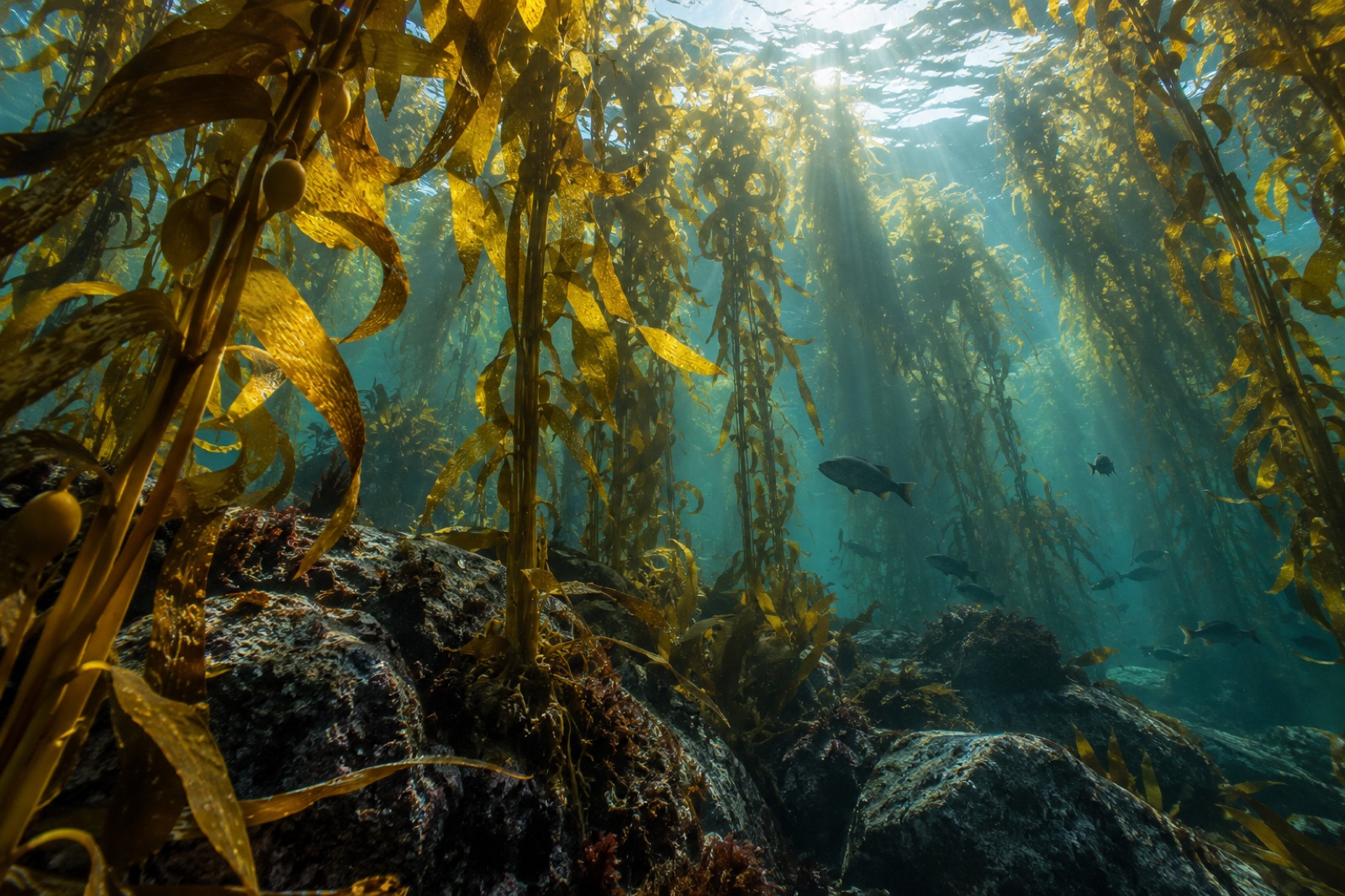
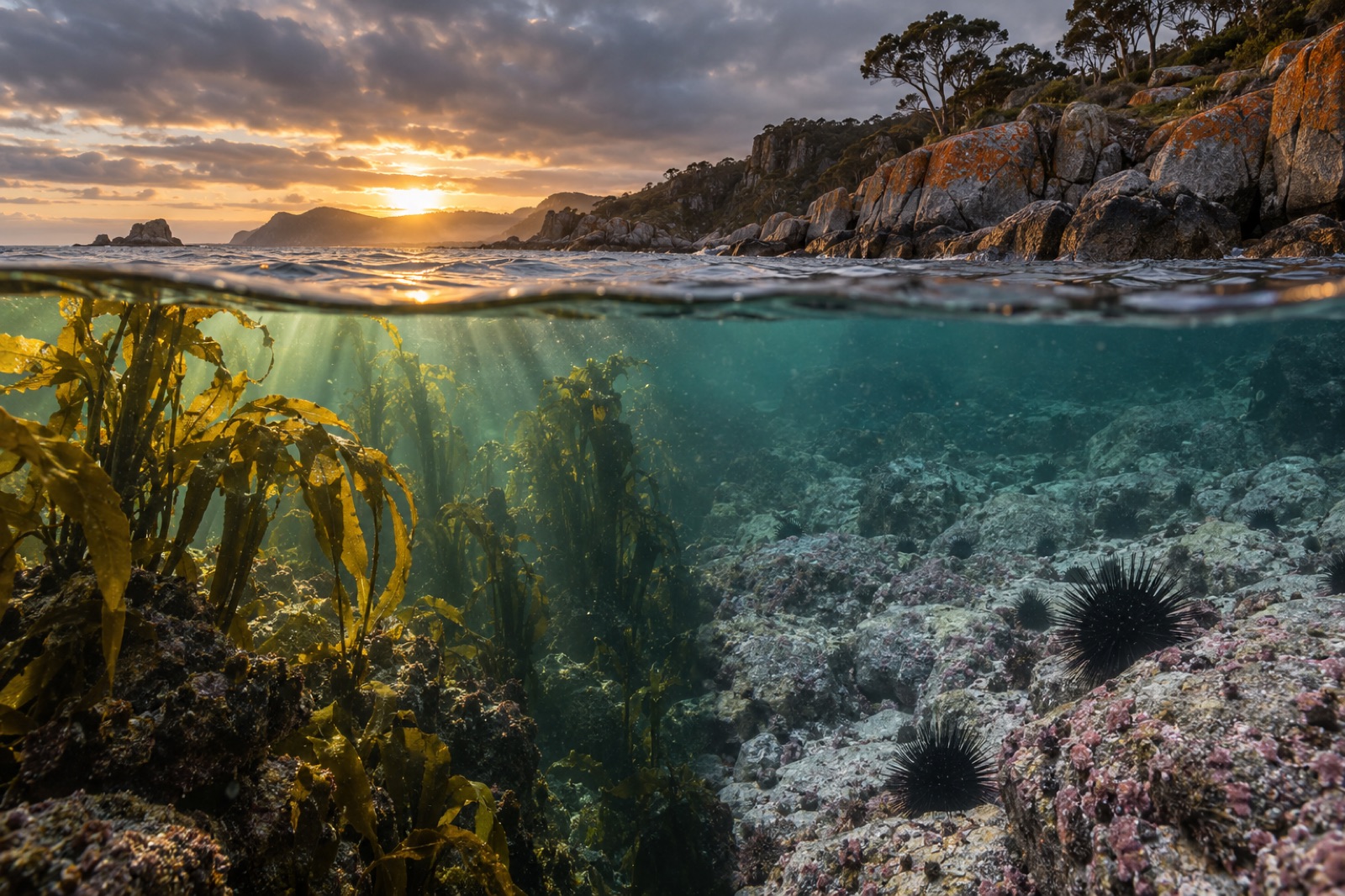
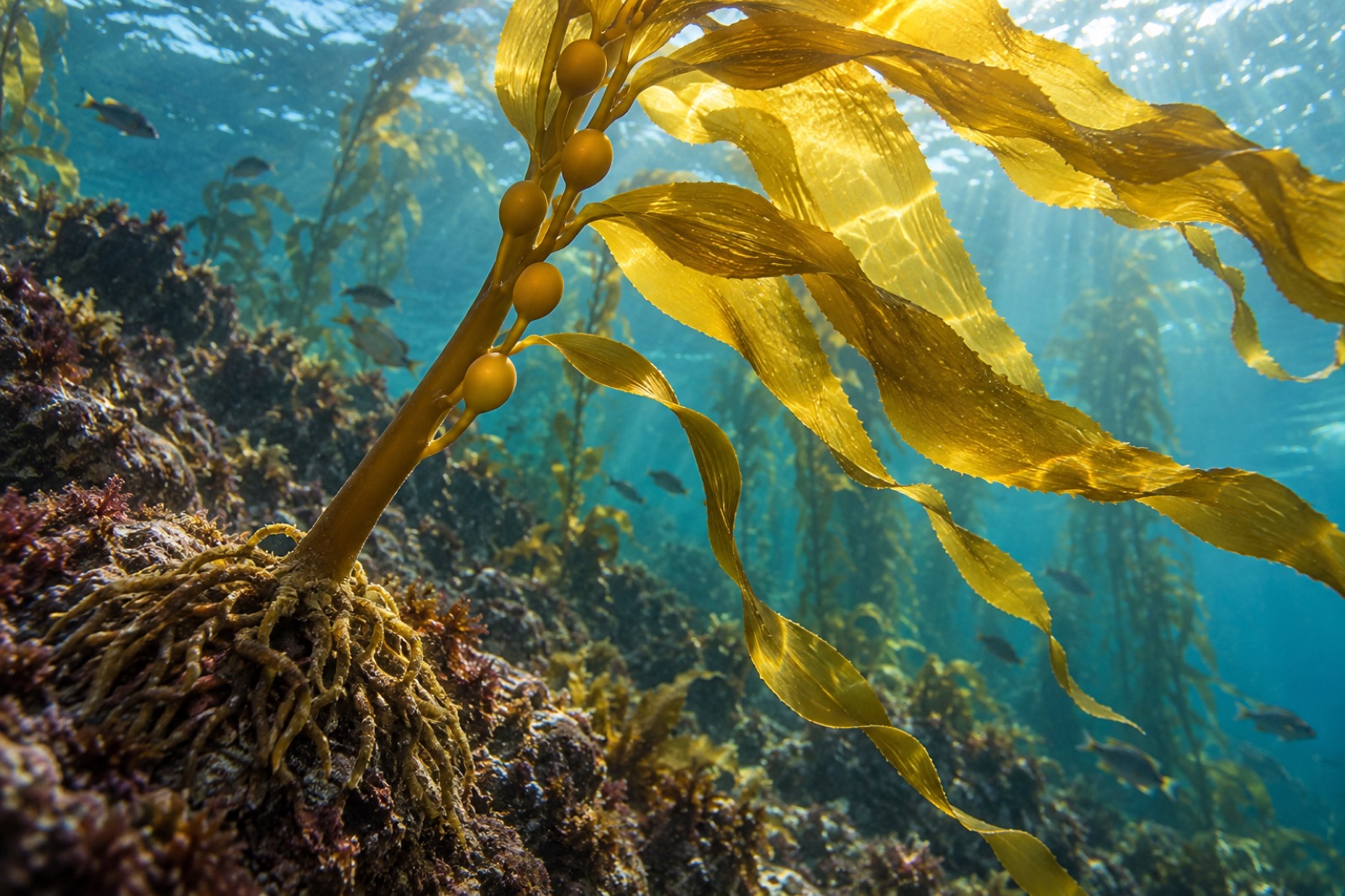
There is a photograph that divers of a certain age still pass around Hobart: a wall of giant kelp off the Tasman Peninsula so dense that sunlight arrives at the bottom already rationed. Much of that forest is gone. Between the late twentieth century and today, Tasmania lost an estimated 95 percent of its giant kelp cover — the collapse concentrated on the east coast, within living memory of the fishers and divers who describe what it once was. This is the story of what happened, why it kept happening, and the quietly remarkable campaign to make giant kelp a Tasmanian native again. Our companion guide to the broader Tasmanian east coast covers the coastline itself; this article is about the species, the science and the rescue.
The forests that were
Tasmania sits at the heart of the Great Southern Reef, and for as long as records exist, Macrocystis pyrifera grew in tall, surface-canopied beds along the island's east and southeast — the southern hemisphere expression of the same forests that made California famous. Historical aerial photographs, fisheries charts and the testimony of working abalone divers all agree: the beds were extensive, persistent and thick enough to foul boat propellers, a genuine navigational feature of the coast.
Starting in the 1970s and accelerating into the 2000s, those beds thinned. By the time comprehensive surveys caught up, comparisons of historical and modern cover told a stark story: region-wide loss on the order of nine-tenths, some coasts losing everything east of a headland line. In 2012, giant kelp marine forests of southeast Australia became the first marine community listed as endangered under Australia's federal environment law — a sober legal recognition that this was an ecosystem-scale loss, not a local fluctuation.
Causes: the warm current and the urchin that followed it
Two forces did most of the damage, and they compounded.
The East Australian Current moved south
The EAC has a natural eddy field that peels off eastern Australia; over recent decades its influence has extended measurably further down the Tasmanian coast. Waters off eastern Tasmania have warmed at several times the global average, pushing temperatures at the depth where giant kelp sits into stress range during summer. Warm water is also lean water: less mixing means less nitrate reaching the canopy, so the kelp starves as it overheats. Our explainer on marine heatwaves covers the physics of why even a degree or two, sustained, reorganises a reef.
Long-spined sea urchins came south with it
The second blow arrived on the same warm current. Centrostephanus rodgersii, the long-spined sea urchin native to mainland New South Wales, established in Tasmania as the water warmed, spread south, and proceeded to do what it does everywhere: graze kelp to bedrock. Urchin barrens — hectares of pale, crustose rock patrolled by black spines — replaced forest. Crucially, healthy Tasmanian ecosystems lacked the urchin's main mainland control: spiny lobsters large enough to crack an adult. Warming weakened the trees; the urchins cleared the understory; and a positive feedback loop locked in, because barrens sustain urchins at extremely low nutritive value while producing nothing.
The double punch is why simple "stop eating abalone" or "wait for a cool decade" responses failed: the loss is structural, not behavioural.
The science of bringing it back
Restoration in Tasmania is no longer speculative — several hundred hectares of effort, decades of research, and increasingly sophisticated genetics now sit behind it.
Seeding from survivors
Researchers and restoration groups collect reproductive tissue from the kelp stands that survived — notably along the more exposed, cooler coasts — and raise millions of juvenile kelps on twine in hatcheries before outplanting onto urchin-cleared reef. The working logic is that survivors carry genotypes adapted to the very warmth that killed their neighbours; planting their offspring stacks the deck for the next heatwave. Our piece on the hatchery process from spores to seeded line describes how that pipeline works; the Tasmanian twist is the deliberate selection for thermal tolerance.
Removing the urchin pressure
No seeding strategy succeeds while barrens are still expanding. Tasmania's approaches include subsidised urchin fishing — turning the invader into a commercial fishery — and targeted diver culling at restoration sites. Both work locally. The ecological endgame everyone wants is functional: rebuilding enough forest structure, and eventually enough large lobsters, that the system re-balances itself.
Finding and protecting refuges
Not all kelp vanished. Deep-water patches and exposed southern sites persisted, and locating them — by sonar, satellite and dive survey — tells scientists where conditions remain kelp-friendly. Those refuges both supply broodstock and define priority zones for trial plantings. Tidewright's Drifter survey vessels run the same logic autonomously: map the remaining forest, map the barrens, and place seeding lines where the physics still favours kelp. Our field team recorded what the first Tasmanian season felt like in First Light off Tasmania and Week One at Tinderbox.
Where to see giant kelp in Tasmania now
The collapse wasn't total, and recovery is visible. Current worthwhile stops, from south to north:
- Tinderbox Marine Nature Reserve, south of Hobart: a small no-take reserve where remnant kelp habitat and restoration work sit within an easy snorkel of the car park; the best place near the capital to see what the fuss was about.
- Tasman Peninsula / Fortescue Bay: deeper water and more exposure shelter surviving beds; experienced divers and sea kayakers can still find genuine forest here.
- Maria Island: the marine reserve's clearer, cooler reefs hold kelp and Tasmania's best-effort at showcase reef recovery — see the Maria Island atlas guide for access and seasons.
- Bruny Island's eastern shore: boat-supported divers occasionally report healthy patches; currents and weather limit access but the diving, when on, is excellent.
The honest map is sparse — that is the point of the article — but every surviving stand now carries disproportionate scientific and genetic value.
What Tasmania teaches the rest of the world
Tasmania is a preview of what the world's kelp coasts face as boundary currents reorganise: warm-water arrival, urchin range expansion, and a feedback loop that locks barrens in place. It is also, increasingly, the prototype for the response: survivor genetics, targeted urchin removal, hatchery-assisted replanting and continuous monitoring through platforms like our Canopy Ledger. Places that still have healthy forests — Alaska, southern Chile, the sub-Antarctic islands — can watch Tasmania to see the future arriving early, and learn what to protect before they need to restore it.
Key takeaways
- Tasmania lost roughly 95 percent of its giant kelp forest in decades, primarily to EAC-driven warming followed by the establishment and spread of long-spined sea urchins.
- The collapse is a self-reinforcing loop: warm water weakens kelp, urchins clear it, barrens exclude recovery. Breaking the loop requires work on both climate resilience and urchin pressure.
- Restoration uses survivor genetics, hatchery-seeded lines and targeted urchin removal — a model now drawing attention from every kelp coast with rising water temperatures.
- Remaining stands at Tinderbox, the Tasman Peninsula, Bruny and Maria Island are both visitable and scientifically precious.
- The 2012 endangered listing made these forests the first marine community legally recognised as threatened in Australia — a measure of how complete the loss was.
FAQ
Is it still possible to see giant kelp in Tasmania?
Yes, but you have to choose your site carefully. Tinderbox Marine Reserve near Hobart, parts of the Tasman Peninsula and Maria Island's marine reserve still hold kelp and, in places, recovering forest. Expect patches rather than the continuous beds of historical photographs.
Why won't the kelp just come back on its own?
Because the conditions that killed it haven't reversed. Warm, nutrient-poor water and urchin barrens create a self-sustaining alternative state: urchins survive on next to nothing in barrens and graze every kelp recruit that appears. Intervention has to raise kelp density and drop urchin density at the same time.
Are the long-spined sea urchins being fished commercially?
Yes — Tasmania has developed a commercial fishery for Centrostephanus rodgersii, with processors and export markets. It provides a useful harvest while lowering urchin densities, though it cannot by itself clear barrens at the scale the ecosystem requires.
How does restoration pick which kelp to plant?
From stands that survived the warm decades. Broodstock is collected from those survivors, raised in hatcheries on biodegradable line, and outplanted. The principle is assisted natural selection: the next forest is built from the kelp that already proved it can cope.
Could this happen elsewhere?
It already is — in northern California via purple urchins, in northern Japan via sea-urchin increase and kelp 'isoyake', and anywhere warming water lowers kelp condition while herbivore pressure rises. Tasmania is the clearest finished example, which is precisely why the world studies it.