Field Notes are Tidewright's own dispatches from our restoration sites. They describe our fictional projects, crews and results — told the way we actually experience them: cold water, early alarms, and the slow maths of hope. Our restoration outcomes here are illustrative, part of Tidewright's ongoing monitoring work, and reported under the field protocols described in our science hub explainers.
The alarm went at 04:10 in a Triabunna motel room that smelled faintly of wetsuit neoprene, because everything in Tasmania eventually smells faintly of wetsuit neoprene. By 05:00 we were motoring out of the marina in the dark, four of us and six hundred metres of Holdfast line in chilled tubs, and the sky over Maria Island was doing that thing it does — going from black to the deep, luminous blue of surgical steel — and I remember thinking, as I think every time: this is the only commute worth having.
Why this reef, and why it's quiet
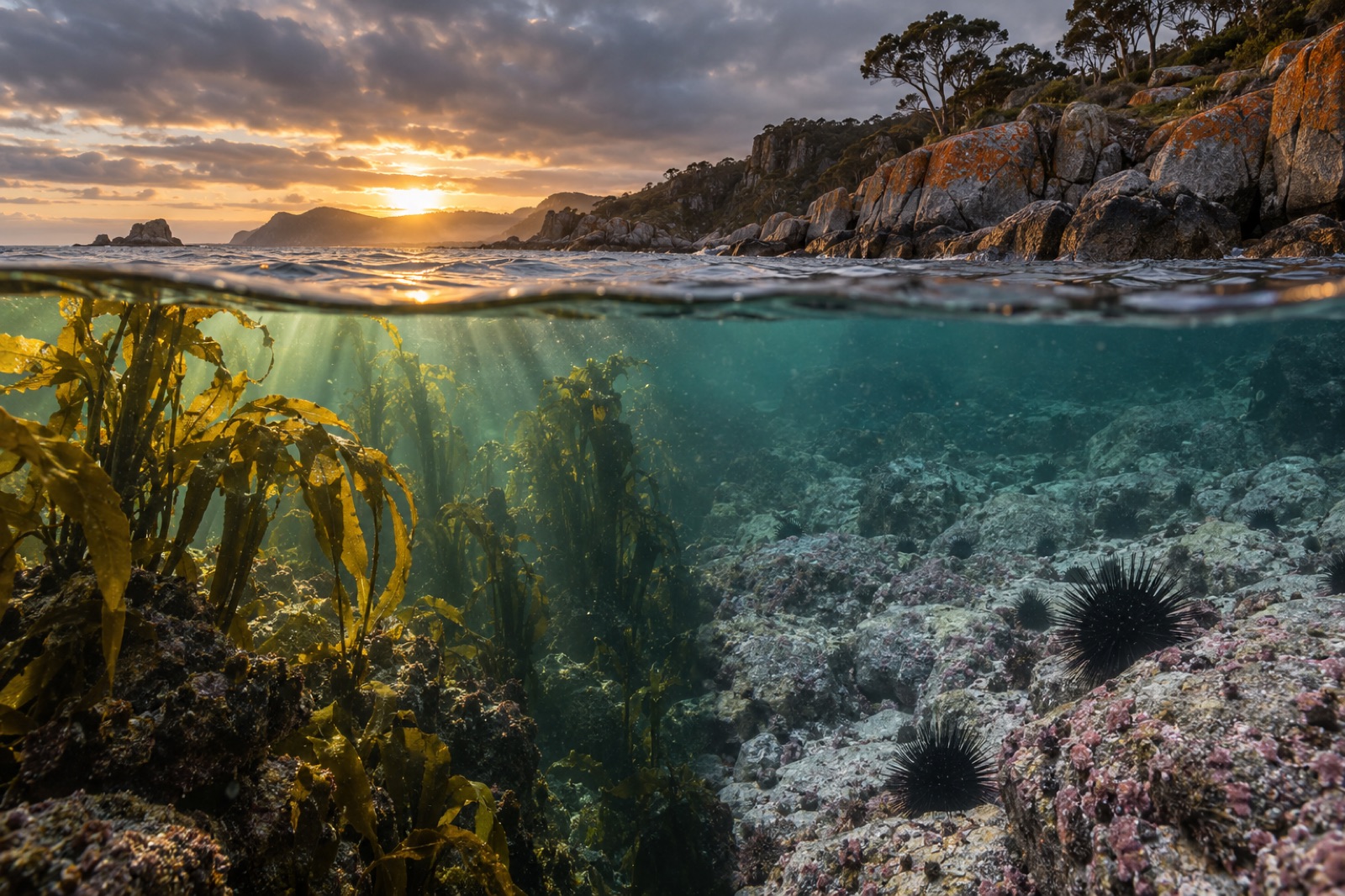
The reef we call Site M-7 sits off the northern end of Maria Island, on Tasmania's east coast — the front line of kelp loss in Australian waters. Giant kelp forests here have been hammered by a double blow that our climate team explains better than I can in Marine Heatwaves 101: waters warming at several times the global average, and the long-spined sea urchin (Centrostephanus rodgersii) marching south on the warm East Australian Current, mowing kelp down to barrens and then living in the rubble like squatters.
There's a particular silence to a barren. I've been thinking about how to describe it for years. A healthy kelp forest is loud — you hear the crackle of a thousand shrimp and the crunch of grazing and the swish of the canopy moving water. A barren hums with almost nothing. Boat guy, not poet, but: it sounds like a waiting room. Our colleagues wrote the natural history of it in Tasmania's East Coast: The Front Line of Kelp Loss, and it's worth reading before you read the rest of this, because this note is about what trying to reverse that silence actually looks like at 06:00 on a Tuesday.
05:40 — The gear
Today's payload is Holdfast line: biodegradable twine, about the thickness of blind cord, seeded in our Swansea hatchery with giant kelp sporophytes — juvenile kelps a few millimetres tall, grown from spores collected from the healthiest remaining patches in the region, the ones that survived the warm years. Elias's genetics team calls them "the stubborn ones," a technical term they refuse to put in papers.
Each tub held a hundred metres of line, kept cold and dripping. Kelp out of water is a clock ticking. The rule from the hatchery: six hours from tank to rock, no exceptions. We aim for three.
Alongside the tubs: survey slates, two Drifter sonar passes' worth of substrate maps from the autumn (the Drifter had flagged M-7's granite ridges as Class A — clean rock, low sediment, acceptable urchin density after the winter clearing dives), a crate of galvanised fixing pins, and the thermos situation, which on a Tasmanian dawn was as mission-critical as anything else in the boat.
06:20 — First light, first line
You lay a Holdfast line the way you'd lay out an anchor warp if the warp had opinions. Two divers, one line between us, working along the contour the Drifter map marked. My dive buddy Ren — rangers trainee from the east coast program, twenty-two, cold-proof in a way I will never be again — ran the reel while I pinned the line every metre or so against bare granite with the fixing gun: thunk, check the juveniles are against the rock, move on.
At eight metres down the light was coming in at an angle now, green-tinted, and the granite ridges looked like the backbone of something enormous and asleep. The urchin-clearing crew had been through in July and you could see their work — clear rock with the pale scrape marks of recent grazing, the occasional missed Centrostephanus wedged deep in a crevice, which we removed and bagged as we went. (The licence allows removal on restoration sites; what happens to removed urchins is a longer conversation involving some surprisingly good local restaurant menus, and it belongs in another note.)
Ninety minutes, two tanks, 340 metres of line laid before the tide turn made the surge unpleasant. On the line the baby kelps are invisible to anyone who doesn't know — you have to hold the twine up to your mask and look for the fuzz, a faint brownish velvet along the braid. Ren surfaced after her first sighting of it and shouted through her snorkel, and I won't pretend I haven't done exactly the same on every deployment since 2023.
What "success" means at this stage
People imagine planting a forest. This isn't planting; it's introducing. The lines give the juveniles a foothold they've stopped being able to make on their own — warming seas and urchin grazing mean drifting spores increasingly fail to establish — and then the site has to do the rest. Our monitoring protocol for M-7 is the same as every site: monthly diver transects for the first year, drone canopy passes once there's a canopy to pass over, and eDNA water sampling (explained beautifully in our eDNA surveys explainer) so the Canopy Ledger team can watch the community rebuild around the kelp — fish first, then the invertebrates, then, if we're lucky and patient, the whole noisy edifice.
The numbers we held ourselves to on this deployment: survival of juveniles on the line at 90 days above 40%, and urchin density on the cleared zones held below the threshold where grazing outpaces growth. I am deliberately not going to dress that up. Restoration is odds, and our job is shifting them.
Three months on
I'm writing this final section back on M-7, in winter, because I wanted the note to include what we found rather than what we hoped.
The lines are still there — the twine has gone soft and dark, half-degraded on schedule — and off about half of them, giant kelp juveniles are standing fifteen, twenty centimetres tall, no longer a fuzz but a fringe. Ragged, uneven, ridiculous-looking, and the best thing I have seen underwater all year. On the April transect we counted recruit densities on the seeded sections that would make the project dashboard blush (illustrative figures, as ever, until the Canopy Ledger verification signs off) — and, more telling than any number, the site is getting louder. A leatherjacket working the lines. A school of juvenile wrasse using the fringe like a fence to hide behind.
It is not a forest. It will not be a forest this year or next, and anyone in this work who promises you a forest on a deadline is selling something. It is, at best, a forest's first sentence.
But I got to watch it being written. At first light, in eight metres of green water, with cold hands and a hot thermos waiting on the boat. Four alarms, three hundred and forty metres of twine, six hundred million spores' worth of stubborn grandparents, and one reef that sounds less like a waiting room than it did.
Back in August for the next block of lines. Bring gloves.
Key takeaways
- Tidewright's Holdfast system lays twine seeded with hatchery-grown juvenile giant kelp onto cleared reef, giving spores a foothold that warming seas and urchin grazing increasingly deny them.
- Tasmania's east coast is a front line of kelp loss: marine heatwaves plus southward-moving long-spined sea urchins have converted forests to barrens.
- Deployments are tightly choreographed — sonar-mapped substrate, urchin clearing first, a six-hour window from hatchery tank to rock.
- Success is measured in odds, not promises: juvenile survival on line, urchin density below grazing thresholds, and a monitored return of the wider community.
- This note describes Tidewright's fictional field program; our numbers are illustrative and follow our published monitoring approach.
FAQ
What is a Holdfast line, exactly?
A biodegradable twine pre-seeded in our coastal hatcheries with juvenile kelp sporophytes grown from locally sourced spores, then pinned onto suitable rocky reef by divers. The line degrades on schedule as the young kelp attaches directly to the rock beneath. It's the core of our Holdfast nursery system.
Why can't the kelp just come back on its own?
Sometimes it can, and protection alone works where stressors are removed. But where warming and urchin barrens have eliminated nearby adult kelp, there's no local spore source left, and bare, grazed rock is a poor landing pad for the few spores that drift in. Seeding closes that gap.
What do you do about the urchins?
On restoration sites in Tasmania, licensed divers clear long-spined sea urchins from treatment zones before seeding, and we monitor density afterward so grazing doesn't outpace kelp growth. It's maintenance, not a one-time fix.
Is this real?
Tidewright is a fictional company created as a design and content demonstration — the people, vessels, sites and results in this note are invented. The ecological backdrop, sadly, is not: giant kelp loss on Tasmania's east coast to warming and Centrostephanus barrens is one of the best-documented marine regime shifts in Australian waters.
Can I visit or volunteer?
In this fictional universe, Reef Partners runs ranger partnerships and school programs on the east coast — see Reef Partners. In the real one, look up the reef restoration and abalone/urchin fishery groups working the Tasmanian coast; they'd love to meet you.