Field Notes are Tidewright's own dispatches from our restoration sites. They describe our fictional projects, crews and results — told as we live them. Our restoration outcomes are illustrative and reported under our field monitoring protocols.
Every autumn, for about two weeks, the entire Tasmanian program reorganises around a window you can't schedule: giant kelp releasing spores. Survey work pauses, the Drifter fleet switches to ferry duty, half the office suddenly remembers urgent reasons to be in wetsuits, and our hatchery near the D'Entrecasteaux Channel fills with garbage bins full of seawater and blades. For fourteen days, we collect two weeks of a forest's future — the fertile tissue from which every metre of next season's seeded line, and every experimental genotype in the Holdfast nursery library, begins.
This is that fortnight, kept in the order it happened, because spore season is a story told by a logistics chain and I intend to make you feel its deadlines.
The biology of the window
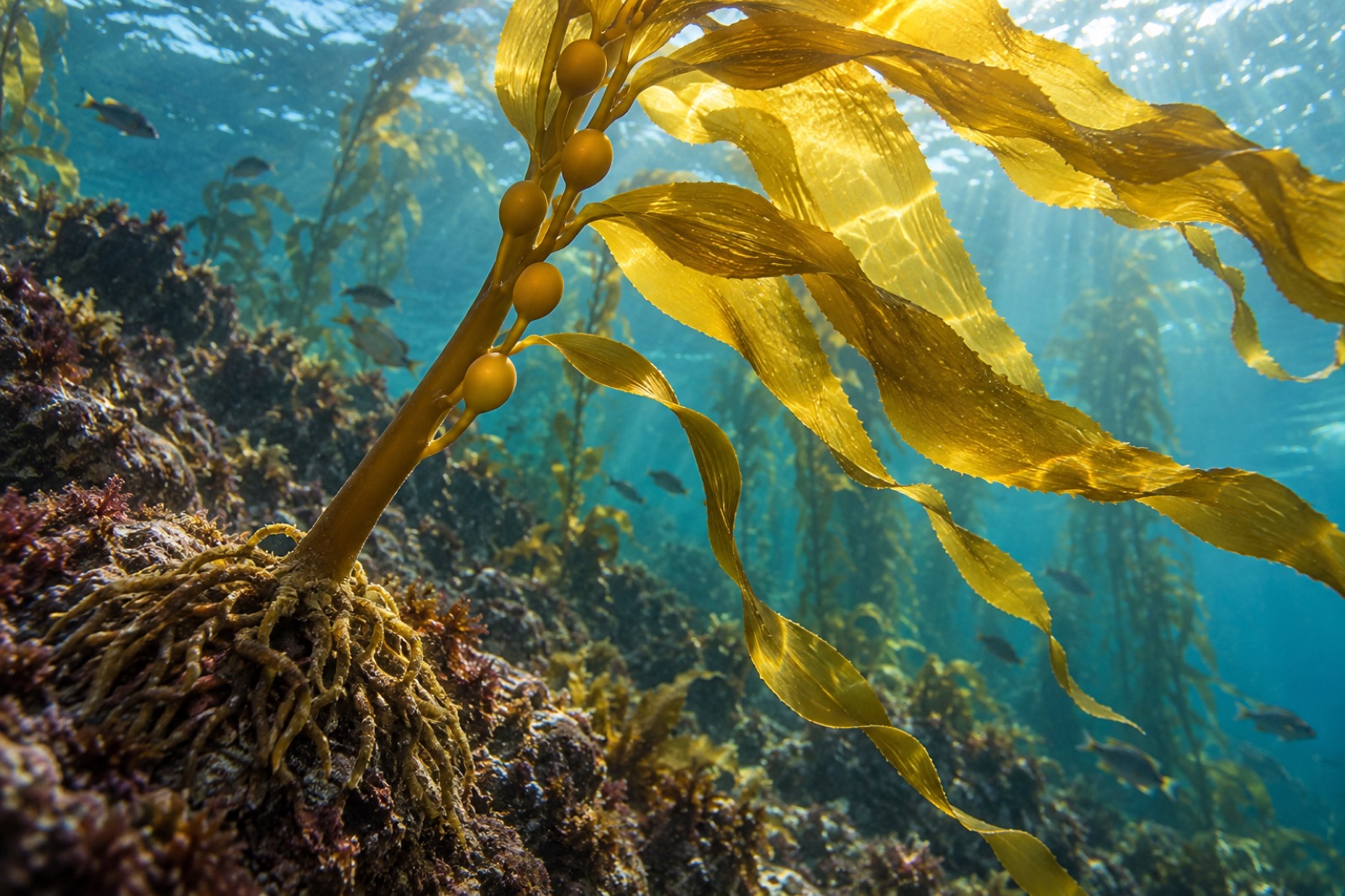
Quick orientation, because everything downstream makes sense once the life cycle is in your head. Kelps run one of biology's great two-body problems: the plant you see — the twenty-metre giant kelp with its canopy and holdfast — is the sporophyte, and it carries dark, slightly oily patches called sori near the base of its blades, where spores are made by the millions. Released, each spore is a swimming cell smaller than a grain of pollen. It settles, and becomes not a baby kelp but a gametophyte — a microscopic, few-celled filament that is effectively kelp's secret second generation. Gametophytes make the eggs and sperm; sperm find eggs; only then does a new sporophyte begin. The full account is in our kelp life cycle explainer, and if you take one thing from it, take this: a kelp forest's entire future passes, every generation, through a phase the size of a dust mote.
Giant kelp can release spores most of the year, but autumn is the peak — cooling water, riper sori, and, critically for us, the season when spores settling now will ride the lengthening dark into a spring growth spurt. Tasmania's east coast, where our Lumeriah Coast program works to rebuild giant kelp forest in one of its global strongholds-turned-frontlines, has seen how thin the margin has become: warm East Australian Current water pushes further south each decade, recruitment fails in bad years, and the remnant forests that survive hold genetics our whole program is built on. Which is why, when the sori ripen, we move.
Day one to three: the dives
Collecting fertile tissue is skilled foraging at depth. Not every blade carries ripe sori; you learn the look — sori patches sit slightly proud of the blade, darker, with a surface like fine corduroy — and then you have to judge ripeness, because a sorus cut a day too early releases poorly and a day too late has already given its best to the sea. Our collectors work in pairs on the remnant forests, one cutting, one bagging, a mesh catch bag per plant so every blade in the hatchery can be traced back to an individual parent. That traceability matters: seedstock provenance is genetic policy, and Elias, our restoration geneticist, regards a mislabelled collection bag the way a surgeon regards a dropped instrument.
A collector can bring up maybe thirty fertile blades a dive, each parent plant GPS-logged and its holdfast left strictly alone — cutting blades above the meristem hurts nothing (kelp grows from tissue near the holdfast junction, and mature plants shed blades constantly), but the plant itself is a donor we intend to visit for years. The best donors get names, which is not procedure but is also not negotiable.
The race clock starts on the boat. Sori kept warm, dry or crowded decay fast, so blades go straight into bins of raw seawater, chilled and shaded, with a hard rule from the hatchery: on land within four hours of collection. The Drifters earn their keep here not as survey vessels but as the world's most overqualified couriers — seven-metre autonomous boats running shuttle loops from dive site to jetty while the crewed boats stay on station. I have watched Drifter 4 hold station against a building afternoon sea with a bin of blades on its deck like a ferryman guarding something holy, and I have decided to let the image stand.
Day three to ten: the tanks
Inducing spore release is controlled patience. Blades are cleaned gently — epiphytes and grazing snails off, sori tissue intact — then partially dried, which sounds cruel and is the trick: a short exposure to air stresses the sorus into a mass release when it goes back into cool seawater. Within an hour the water in a release tank turns faintly tea-coloured. That faintness deceives: a litre at peak release carries spore densities in the hundreds of thousands. At peak the hatchery smells of nothing much — clean seawater, a little iodine — and hums with pumps, and every surface not explicitly numbered has been labelled anyway by a technician with trust issues I fully endorse.
From the release tanks, spore suspension is dosed onto the seeding substrate: thousands of metres of biodegradable line wound on spools, bathed in chilled, lit, circulating culture. Spores settle on the line within a day; the gametophyte phase runs for weeks under nursery control; and when the young sporophytes are visible as a brown fuzz — maybe two millimetres tall — the spools go to sea in seeding season proper.
A fraction of every collection never grows at all. Those spores go, settled on glass slides, into the gametophyte bank: chilled, dim, technically alive, technically asleep. The library now holds hundreds of strains from the east coast remnant forests, each one a frozen option on the future — heat-tolerant lineages, fast-growing lineages, and, deliberately, a lot of ordinary ones, because we do not know which ordinary will matter in twenty years. Banking is the cheapest insurance this program buys; the expensive part was admitting we needed it.
Day fourteen: the count-back
Spore season ends not with a ceremony but with a spreadsheet. Blades collected, parents logged, release yields, settlement densities per spool, viability estimates, bank accessions — the harvest of the harvest. This season's headline numbers (illustrative, like all our field figures): fertile blades from 212 parent plants across six remnant forests, enough seed line for the coming seeding campaign with a third in reserve, and fifty-eight new strains into the bank from a forest at its northern edge that has now survived three consecutive marine heatwave summers — the genetics the whole coast will be asking for, eventually.
What I keep from the fortnight, though, is smaller. On day nine, a technician called me over to a settlement slide under the scope: hundreds of spores settled in an even scatter, and among them the first just-germinated gametophytes, cells dividing in a shape too small to see without help and too important to exaggerate. Somewhere in that scatter, if the season is kind, is the next forest off Fortescue Bay. Two weeks a year, we put a forest's whole inheritance in buckets and drive it up a jetty. The rest of the year is spent deserving it.
Key takeaways
- Kelp's future passes each generation through a microscopic gametophyte stage; collecting fertile spore-bearing tissue (sori) from wild sporophytes is how restoration seedstock begins.
- Giant kelp spore release peaks in autumn, giving a roughly two-week collection window that reorganises an entire field program around diving, chilled transport and hatchery deadlines.
- Every collected blade is traced to its parent plant; provenance and genetic matching are policy, and donor plants are harvested without harm so they can contribute for years.
- Most collected spores seed cultivation line; a reserved fraction goes into a chilled gametophyte bank — a living library of wild genetic diversity kept as insurance against a warming coast.
- Spore season is the hinge of the restoration calendar: two weeks of collection determine the entire following season's seeding capacity.
FAQ
What exactly are kelp spores?
Kelp spores are tiny swimming cells released from sori — dark, rough patches on the blades of the adult plant. Each settles and grows into a microscopic gametophyte, which produces eggs or sperm. Fertilised eggs then grow into the large kelp plants that form forest canopies.
When is spore collection season?
It depends on the species and coast. For Tasmanian giant kelp it peaks in autumn, when cooling water ripens the sori and settling spores can establish before spring growth. Programs track wild beds closely in the weeks beforehand, since the productive window is short.
Does collecting fertile blades harm the wild plants?
No, done correctly. Blades are cut above the growth zone, leaving the holdfast and meristem intact; mature kelp shed blades naturally. Each donor is GPS-logged and revisited across years — the remnant forests are treated as long-term partners, not crop.
Why bank gametophytes instead of just using them?
A chilled gametophyte bank preserves living genetic diversity — including heat-tolerant and rare lineages — across years. Because we can't predict which traits a future climate will demand, banking both exceptional and ordinary strains is cheap insurance that seeds future seasons and research.
Is Tidewright's giant kelp hatchery real?
No — Tidewright, its facilities, staff and figures are fictional, created as a design and content demonstration. The kelp biology described — sori, spores, gametophyte culture, seed line — is real and standard to both kelp farming and restoration worldwide.