Field Notes9 min read
Field Notes: The Day the Otters Came Back
Two years after Tidewright reseeded an urchin barren off the Monterey Peninsula, a raft of sea otters moved in. Field notes on what that return really signals.
Jack Callum ·
Sea otters are strangers at Catalina — so when one appeared over Tidewright's restoration block, we built a dawn count around him. What the survey found.
Field Notes are Tidewright's own dispatches from our (fictional) restoration sites. The Catalina project, its crew and its figures are illustrative. The biology below — otter behaviour, prey surveys, the strange arithmetic of one predator — is real, and it's why a single animal can justify a dawn watch.
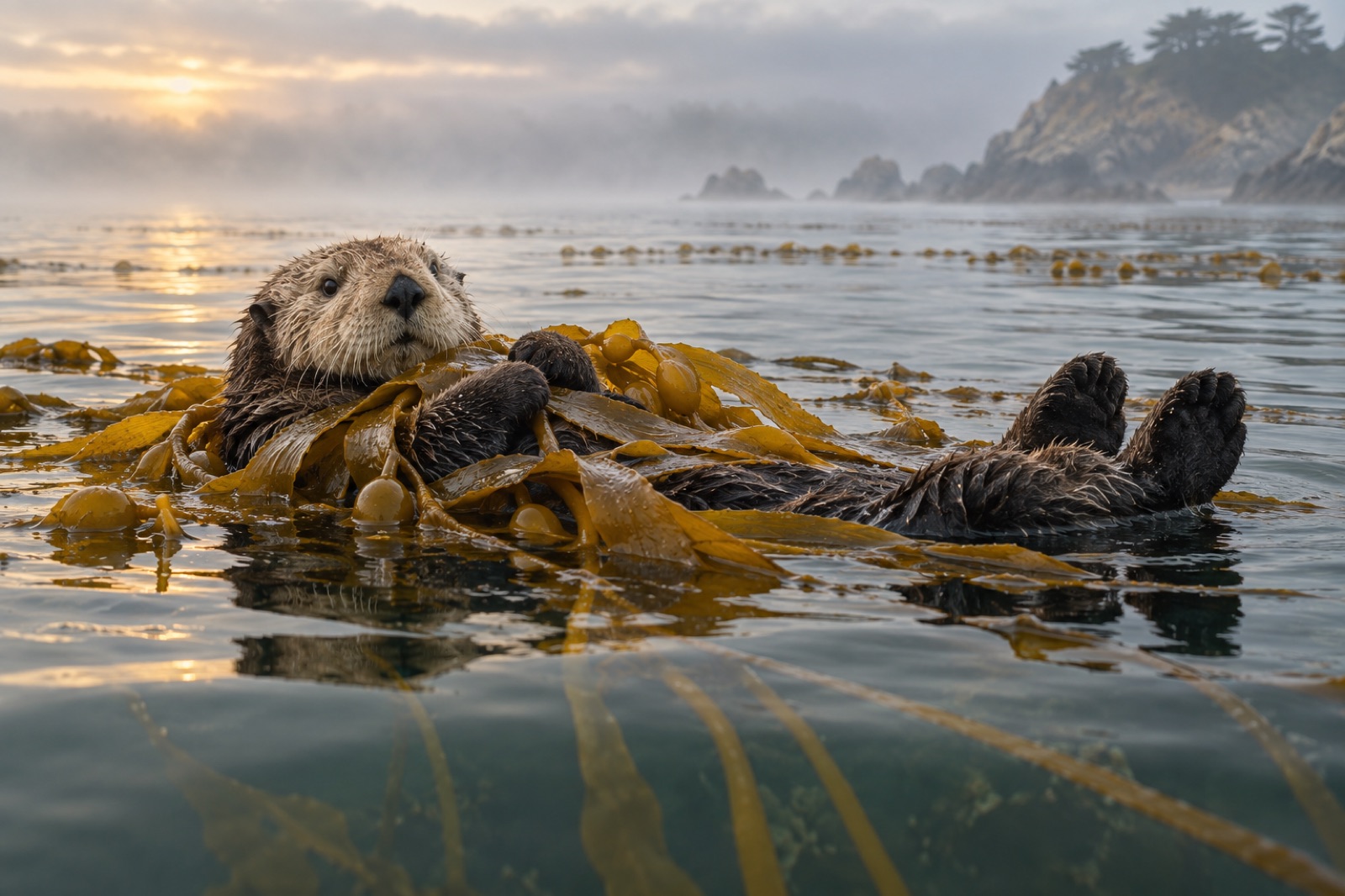
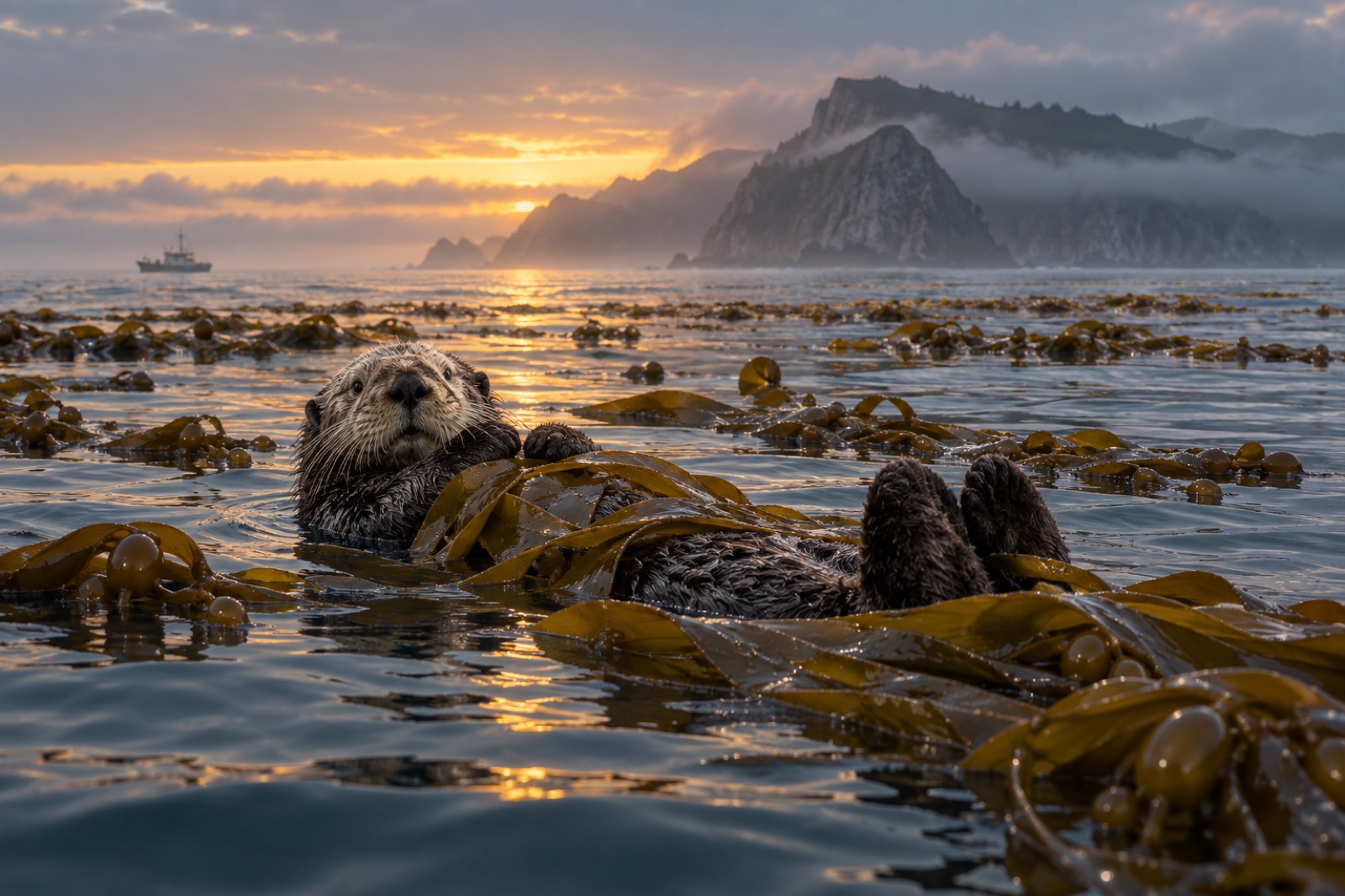
At 05:50 on a still March morning I was sitting on the roof of the survey boat with a thermos and a spotting scope, counting one otter. This is an easier sentence to write than it is to justify to a finance team, so let me do the justifying. The animal — an adult male southern sea otter, first logged on the Catalina Canopy project block six weeks earlier and still there — was rafted over our two-hectare core plot in water fifteen metres deep, cracking something against his chest in the first grey light. Otters in central California, where the population counts in the thousands, are background. Otters at Catalina, off Southern California where the mainland coast has been functionally otter-free for a century, are an event. And an event, in ecology, is a measurement you only get to take once.
This note is about the survey we built around that one animal, what his foraging told us about our reef, and what the numbers do — and do not — mean.
Southern sea otters occupy a famously narrow strip of central California, rebounding from a hunted remnant of around fifty animals a century ago to a few thousand today — one of conservation's genuine rescues, and still a fraction of the historic range. Wanderers appear outside the range now and then, including around the Channel Islands; a real and established population linked to the translocated colony at San Nicolas Island sits further out, but animals at Catalina itself remain scarce enough that our harbour contacts keep a sightings board. When our drone canopy passes logged a consistent pale dot rafting inside the block on three consecutive mornings, we did what ecologists do with a scarce event: we formalised it.
The dawn colony-watch protocol at a one-otter site is beautifully simple: a shore or boat vantage before first feeding light, a scope, a behaviour log in five-minute bins, and a foraging dive recorder — surface interval, dive duration, and, when the water clarity allowed, prey identified at the surface. Three observers, rotating, seventeen mornings across five weeks. The glamour of the job peaked on morning one and never returned. The data, however, compounded.
Across the seventeen mornings we logged just over two hundred forage dives to prey identification confidence. I won't pretend the sample is anything but one animal — entire-city conclusions from a single diner are how ecology gets a bad name — but the composition of his menu is worth reporting because it maps onto the restoration design almost photographically.
Beneath the surface, the prey surveys told the supporting story. Our quarterly quadrat counts have tracked working block urchin density falling season on season since suppression began — the same signal our Monterey otter note recorded when a raft moved into a two-year-old restored cove there. At Catalina, pre-otter and during-otter transect windows show a small but consistent dip in open-substrate urchin counts on his core plot and zero change on the matched control plot two hundred metres east. Small sample, honest caveat, and a mechanism any kelp ecologist recognises.
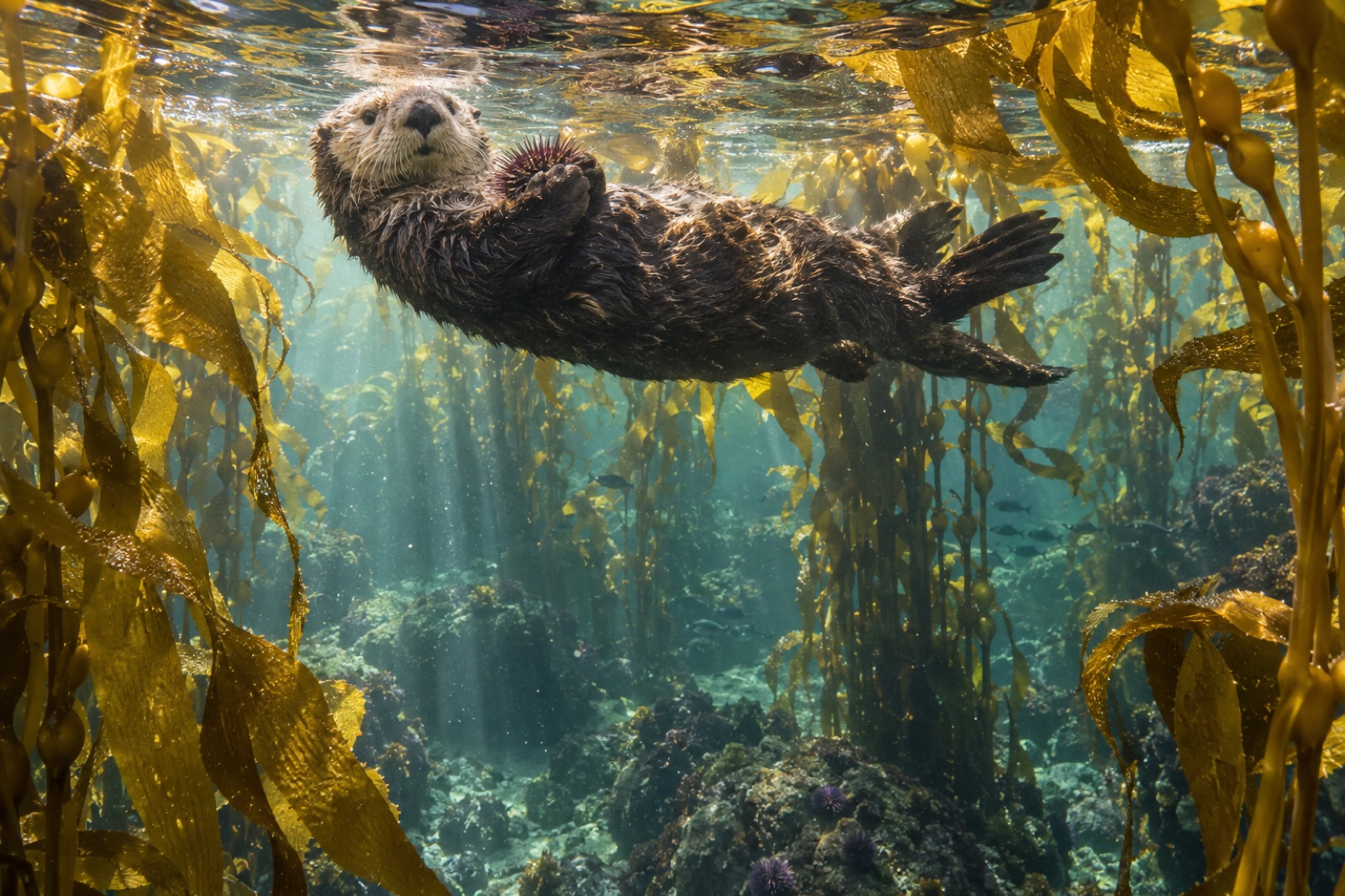
The reason a single forager matters goes to the heart of why we restore at all. Kelp forests run on a trophic cascade: predators suppress urchins, released kelp grows, structure returns, fish and invertebrates follow. Suppression is load-bearing work, and at a young restored site it is being done almost entirely by our divers and our partner co-op — expensive, relentless, scheduled work. Every natural predator that clocks on is a colleague who doesn't invoice.
The honest arithmetic, though, is scaling. One otter eats on the order of a fifth to a quarter of his body weight daily — a serious local appetite, and across a two-hectare plot, a meaningful urchin-pressure contribution. Across the full nine-hectare project and the wider coast, he is a symbol more than a workforce. Ecologists love symbols and distrust them in equal measure, and I'd distrust this one too if the transects didn't agree with him. The numbers say the block was bending toward recovery before he arrived; the numbers also say he is pushing on a door that was already swinging.
Practically: we rerouted two maintenance dive sequences to keep bubbles and boat noise off his core foraging plot during the dawn window, added an "otter present" data field to every survey form (a one-line change that turns every crew member into a contributing observer), and extended the dawn watch by a season, because leaving a rare natural experiment unmeasured would be malpractice wearing a budget haircut.
Scientifically: nothing overstated. The internal report leading with "otter returns catalyse recovery" got sent back by me, because what we documented is a predator using a recovering reef exactly as theory predicts — which is wonderful, publishable-in-our-own-terms news, and not the same thing. That distinction is the whole discipline of this work: the methodology that backs our reporting exists to make sure hope and evidence travel in separate columns, and it applied to our own favourite animal this March.
At the end of the five weeks, his rafting dot on the drone pass was joined, one morning, by a second. The sightings board at the harbour knows. So does the colony-watch log, which now has a plural in its title.
Rarely and occasionally — genuine wanderers from the central California population and, nearer, animals linked to the translocated colony at San Nicolas Island in the Channel Islands. Individuals have been recorded around the islands over the years. An otter resident for weeks over a specific reef, as our fictional project logged, is unusual enough to be worth a survey, which is the point of this note.
By counting behaviour instead: five-minute behaviour bins, dive times, surface intervals, prey items identified where visibility allows, accumulated over repeated mornings. One animal, two hundred forage dives is a real dataset about one animal — as long as every claim stays scoped to him.
No — and our note says so plainly. The trophic cascade needs sustained urchin suppression; one forager contributes meaningfully at plot scale but the heavy lifting at a young site is still done by suppression dives. Otters arriving are better read as a verdict on recovery already underway, which is what the trophic cascade explainer predicts.
Sea otters feed around the clock, but the first foraging bout of daylight follows a night rafted in place, so the pre-dawn vantage catches a known animal at a known location. It's also glass-calm, boat-free and quiet — the three conditions scope work likes.
Then the project's suppression plan changes: predator-persence zones get formal buffers, monitoring intensity goes up, and the trajectory model that predicts how fast the block can graduate from diver-suppressed to self-suppressing gets its happiest input yet. We'd report it in these notes before we reported it anywhere else.
Two years after Tidewright reseeded an urchin barren off the Monterey Peninsula, a raft of sea otters moved in. Field notes on what that return really signals.
Jack Callum ·
Catalina Island is southern California's kelp capital — Casino Point, Farnsworth Bank, warm-water giants and a century of marine science under the canopy.
Dr. Mara Ellison ·
Sea otters eat a quarter of their body weight a day — much of it sea urchins. How this small predator became the kelp forest's most famous keystone species.
Dr. Mara Ellison ·